Showing posts with label containers. Show all posts

Wednesday, 7 September 2016

Winter Hanging Baskets Planted

After getting the plants for them a week ago, we've now planted up the winter hanging baskets. They're hanging about on the arbour, for now, until the summer ones are past their best, when they'll go up on the front of the house.


Winter hanging basket (© Ian 2016)

We also discovered that we had a bowl full of plums on one of the Victorias on the hillside. They are utterly delicious.


Victoria Plum (© Ian 2016)

Thursday, 1 September 2016

Foliage

We planted summer hanging baskets a while ago, and they've done well. Blue Crystal and Blue Fountain lobelia (I think), some becopa, a fuchsia. They're nice, and they've been a really welcome bit of colour on the front of the house. However, apart from (probably) the fuchsia, the plants aren't hardy, and will either die, or look rubbish as soon as it gets frosty.

Clearly, that won't do. Over lunch today, we went to a B&Q, and found a combination of foliage plants that will take the hanging baskets through the winter: a gold-edged ivy, a holly-leaved fern, a black ophiopogon, and an acora.

We've got enough of them to plant up the four hanging baskets that go on the house—we don't intend bothering with the two from the arbour for winter—and got a set of baskets so we can plant them up soon, so they settle and grow together before autumn.


Planting combination for winter foliage basket (© Ian 2016)

Monday, 29 September 2014

Malvern Autumn

We've had a weekend away, visiting Ludlow, and spending Sunday with Liz's grandmother at the Malvern autumn show, which we've not been to before.

It's less of a garden show than, say, Tatton Park, with only a few gardens, and a lot of 'country living' stallholders. However, there was a very good apple pavilion, with an impressive display of apples from RV Roger (who supplied all of the maiden trees for our apple walk earlier this year). We watched a very entertaining, and pertinent, 'conversation' between Joe Swift and Monty Don in the Good Life theatre, and spent a lot of the afternoon browsing the plant nursery stalls, and wondering over the size of the mammoth veg. The prize-winning pumpkin was 472kg, which was, frankly, astonishing, but only slightly more so than the 152kg cabbage, or the 6.3(ish)m beetroot and parsnip, each, apparently, world records. How one digs up a 6m parsnip root, I know not.

(Why, I know not, either.)

Anyway, we managed to fill grandma's not insignificant boot, with thirty-five plants of our own, and a number of hers, and we added a few from her garden to take home, meaning our little Corsa was well loaded for the return journey.
  • Two Crocosmia 'Sunglow', and two 'Buttercup'
  • a 'Twyning's After Eight' dahlia
  • Three white Japanese anemones, 'Honorine Jobert'
  • Two giant scabious
  • Three new heucheras, 'Fire Chief', 'xxx' and 'xxx'
  • A pair of variegated sedums, 'Frosty Morn'
  • A painted fern, 'Burgundy Lace'
  • Three Panicum grasses, 'Squaw'
  • An astrantia, A. major 'Lars'
  • And a tray of obscenely cheap Cyclamen hederifolium; fifteen at a pound apiece.
We finally, definitively, learnt the reason for the riduculously low end-of-show prices. Apparently, the nurseries want to offload the last of their stock at almost any price, because for the quantity involved, the cost of transporting them back to the nursery exceeds the market value—hence selling things at a pound/pot is actually financially better than transporting the stock 'home', and selling it at market value later. I'm happy to help.

We got home about five, and I nipped out to pick up the rest of our pig, having collected the bucket of blood last Wednesday, before planting everything out.

Tuesday, 1 July 2014

Harlow Carr

We spent today at Harlow Carr: the first time, actually, we've been not on a weekend or Bank Holiday. Unsurprisingly, it's much quieter!

We found this in the scented garden, but couldn't see a label, sadly.


The Scented Garden, RHS Harlow Carr (© Ian 2014)


A heavenly almond macaroon (© Ian 2014)


Knautia macedonica, which caught our eye for the wide range of colour (© Ian 2014)


Sweetcorn (Snowbaby and Popcorn Fiesta (this one, with red stems)) in containers in the Bramall Learning Garden (© Ian 2014)


Rhododendron auriculatum in the woodland (© Ian 2014)

When we got home, there was enough time to sow some salad leaves (in pots: direct, they keep getting slugged), and a barrel of carrots.

Monday, 30 June 2014

Odd Jobs

Today—as Wednesday will be, I expect—has mostly been little jobs. Liz has finished 'weeding' the orchard, and I've cut paths through the grass. That leaves things flowering (which looks good), and takes less time (also good), while looking deliberate and allowing easier access to the trees and clearings.

I've topped up the chippings on the steps under the greenhouse, and in front of the wood shelter (where they were getting weedy, and decomposing). That's let us re-stack a load of wood, delivered last week, more neatly on the drive. We'll need to spend a day next weekend sawing, splitting, and stacking, though.

The greenhouse is finally sorted, and we've potted a load of things into proper pots, and laid them out on the new 'patio' outside the dining room. That needed levelling, before pots would be stable, and that's done. We need a new load of chippings to spread on the membrane, so that it looks a little less artificial.

We've also been able to collect enough flowers to start 2 gallons of elderflower wine, as well as (yesterday) bramble tips (the first 4" of brambles) for a gallon of wine (a new one for us, to make up for missing the dandelions). The bramble tips steep in hot water overnight, and then get simmered for fifteen minutes (over lunch), before straining the liquor onto sugar (I'll add yeast before I go to bed). The elderflowers have boiling water poured on them, along with sugar; yeast will be added in the morning.

Thursday, 29 May 2014

Old English Plaster

For today's first trick, we learnt how to plaster, in Old English finish. In a way, we're lucky, because the rest of the house is plastered in this style, so we're justified in plastering the garage and the rest of the house, in the same way, without it seeming odd. Lucky because neither of us has plastered before, and flat, smooth plastering was likely to take a while to master, even if I have practised on the odd Christmas cake before. I have to admit that it's not a perfectly flat, smooth surface.

Old English finish, however, is not meant to be. Instead, the surface is uneven, with prominent trowel marks. If it weren't deliberate, you'd think it was incompetent. To its credit, it covers uneven walls very well: if the plaster surface was perfect, the underlying lack of right angles, plumb verticals, and parallel  walls would shout at you.

The experiment appears to have been a success: we'll be sure when its dry and painted, of course. For now, we've plastered only the one board that covers the stud wall: in time, I'll dry line the entire room, but that's not urgent. It was more economic than I thought, too: a quarter bag of plaster (6.5kg, plus 3l water) was enough to cover the board, and do the joints over about half the ceiling, having fortunately taped them before mixing the plaster.

That finished, we then put down the last section of floor that can be done before the doors are replaced with walls and windows. The builder should be starting that work in the next week, so we also needed to clear access to everything he needed, which entailed moving everything previously standing in the front third of the room onto the new floor, leaving the front area (almost exactly three sheets worth of flooring: two deep on the door side, one deep on the far side) bare for him to work in.

We then worked through a stack of almost a hundred pots, planting up small plants that have grown on from seedlings over the past few months, and which are mostly now out on the weed membrane. We also potted up a dozen big pots of tomatoes, and a number of chillies and sweet peppers, which are on the benches in the greenhouse now.

It got rather late, so the cats had to come and shout for us to come in.

Wednesday, 23 April 2014

Strimming the Orchard

The orchard's been starting to look rather overgrown, after a number of months without cutting the grass, so I was pleased to be able to spend this morning going over it with the brushcutter. Pleasingly, I was able to do this on my own, as it's now almost all grass (and a few short brambles, thistles, and the like), and Liz was able to get on with other work: painting the support tubes for the apple walk. They're now a very striking cream (a second coat will follow in due course), and stand out from much further. Only the Grandpa Buxton apple appears to have broken bud; but many are swelling. By the same token, a number of the grafted fruit trees look as though they will break bud, but not quite.

Liz also managed to get the construction wood (3x3 posts, 3x1 planks, and the like) cleared from the site of the pond, so I can get to the old shed panels. I need to chainsaw these into sections, for making compost bins.

We've had to chilli-oil the trees on the hillside, again, as one of the Scots pines has been attacked by deer.

After several years languishing in pots, we've finally been able to plant out our amelanchier, lilac (both in the corner where a pine was, near the top of the drive), and weeping willow (on the SE boundary). Hopefully they'll be happier in the ground, and the amelanchier, in particular, should be a nice feature on that border of the garden.

Sunday, 9 March 2014

Sprung

Today's been a phenomenally nice day, with temperatures around 17°C, and bright sun. Yesterday was cooler, and a bit cloudier, which made it an ideal day for chopping a load of firewood (sticky tricky pine, but never mind).

The warmth and bright sun today's meant that there are probably a dozen daffodils pretty much out, where yesterday there were three. The crocuses enjoyed it, too, and I'm pretty sure a bee flew past me (too fast to be sure) this afternoon.

The dwarf irises in the long border, and around the pond, are out, and beautiful.

Dwarf iris (© Ian 2014)

When the acer in the front garden was first planted, in a large pot in our last garden, we underplanted it with snowdrops. They never came to much, but after we planted the acer in our new front garden (before starting this blog: I think it was September 2009), they've started to come up, and the last couple of years have given us a decent show.

Snowdrops under the acer (© Ian 2014) 

I've actually got a big consignment of snowdrops on order—1000 common singles (Galanthus nivalis) and 500 doubles (G. n. 'Flora Pleno')—which will hopefully arrive, in the green, soon, and can go out, on hillside and in garden.

Which brings us to today's efforts. First thing was finishing the winter pruning, by working on the fruit bushes. The blackcurrants, gooseberries, and red/whitecurrants all needed pruning, and we also removed some old wood on the blueberries, which are still proving troublesome. The two oldest ('Grover' and something unknown) were several years old when planted in 2010, and the other three are now four years old—and still not very large (to say the least). These three have definitely grown better over the last year (hopefully the good mulching last spring and resultant weed-free year has got them going), at least. However, we decided that we had to take out some old wood on the oldest pair, as ageing stems is possibly the cause of their much-reduced yield.

Once we'd finished in the fruit beds, we went up onto the hillside, to start work on clearing the blackthorn at the back of the orchard. This is partly to increase the size of the orchard, as the two sweet chestnuts are nestled into clearings in the blackthorn, and the space for the second mulberry (which, I'm astonished to realise, I never mentioned) is currently somewhere inside the blackthorn shown below.

Orchard, with back boundary of blackthorn (© Ian 2014) 

The blackthorn (which have never produced loads of sloes, sadly) lies in front of a line of trees (hawthorn, elder, and holly, primarily) which would make a better boundary, probably underplanted with hazel, beech, and bulbs. We're working on it from above, so it looks much the same today as it does in these photos, but we've actually hollowed out the undergrowth quite effectively. It's probably still a couple of days' work, but it's a good start. As Liz cleared, I was burning the blackthorn on a bonfire in the upper clearing (a hot, fast burning bonfire, I must note: no smoky, smouldering eyesore), as blackthorn's a nightmare to chip.

The entrance to the clearing, through, hopefully, arch-trained plums, will be roughly central in the photo below. You can just make out the sweet chestnut's stake on the far right; the other is hidden on the left. The mulberry will probably go behind and left of the established apple tree just in front of the blackthorn (for now). So; the mulberry. For several years, our local garden centre has sent a voucher around early November, which I've managed to use for a cheap fruit tree: a Broadview walnut in 2012, and a Serbian Gold quince in 2011. Last November, they had a 'Chelsea' mulberry (also known as 'King James', as it comes from a plant grown at Chelsea Physic Park as part of King James IV's misguided silk industry initiative), which we thought would make a good partner to the Jerusalem mulberry planted nearer the front of the orchard. And with 50% off, it was rather a good deal. It's had to remain in its pot, unfortunately, as we've not finished clearing its space, but fortunately, as it's container grown, it should be fine for a little longer: there's not the rush to get it in the ground, unlike bare-root, field-grown trees.

The orchard, looking up at the doomed blackthorn bank (© Ian 2014)

Tuesday, 22 October 2013

Bottled Apples

We made a late start to things today, as we had a team round to survey for wall insulation. That done, we donned boots, and got out to plant our spring-flowering bulbs.
  • 100 mixed daffodils
  • 70 mixed dwarf daffodils
  • 300 Puschkinia Libanotica
  • 100 Iris Reticulata 'Pixie'
  • 200 mixed Chionodoxa
  • 50 Narcissi Tête-à-Tête
  • 25 Purple Blend Tulips
  • 40 Ard Schenk crocuses
  • 20 mixed hyacinths
  • 200 mixed species crocuses
  • 20 Camassia quamash
  • 10 Fritillaria meleagris
  • 12 Nectaroscordum siculum (honey garlic)
  • 16 Allium aflatunese
  • 24 Allium sphaerocephalon
  • 50 Allium caeruleum, and
  • 10 Allium 'Purple Sensation'
We haven't done all 1300 today, but made a good start. The daffodils have gone into the beds either side of the septic tank, and we enlarged the bed on the games-lawn side, making it more like the other one, and curving out into the lawn (less mowing!). The puschkinia, chionodoxa, and crocuses are for the sweet-pea/wildflower bed and the heuchera bed; the camassia, snakes-head fritillaries and honey garlic are for the copse bed; while the rest of the alliums are going at the garage end of the long bed. The irises will go at the kitchen end of the same bed, and the hyacinths and tulips are for pots.

We got as far as the light would let us, and then came in to bottle some apples. Each 2l kilner jar takes a kilo of apples, peeled, cored, and sliced. They go in the oven at 140°C for 50 minutes, then you add boiling water and seal. Very straightforward, and they will hopefully keep for a year.


Wednesday, 2 October 2013

Greenhouse

I've wanted one for about 14 years, and finally, we have one. Our little 8x6' greenhouse arrived today, as a stack of toughened glass panes, and several bundles and boxes of parts. We'll put it up at the weekend, hopefully, on the back patio.

In other news, I've started a bucket of greengage wine, with some frozen fruit we weren't getting round to using (Liz wasn't enamoured of the jam we made originally). Needs 250g pearl barley, unusually, as well as 1.5kg of stoned fruit.

Last night, we finished the spiced berry cordial, by adding 2kg of sugar, three teaspoons of each of nutmeg, allspice, and ginger, two big cinnamon sticks, and thirty cloves. That was simmered for five minutes, then bottled.

We've also picked all the apples from the front left established apple tree (which we pruned into quite a pleasing, goblet shape in the winter), which were starting to fall rather readily. There's probably been 5kg of windfalls, and 20kg of picked fruit, which bodes well. I'm hoping to build a scratter over the weekend, to help pulp/crush apples for pressing.

Tuesday, 24 September 2013

Mowing by Moonlight

I've just managed to finish mowing the lawn before it went completely dark. I have no doubt that it won't be a particularly well finished cut, but I needed to seize the opportunity, as I've not managed to mow it for two weeks, and it needed doing before it gets too wet, and too long.

It will probably be the last regular mow that I do this year. If there's a suitable dry spell, I'll try to cut it during the autumn and winter, but the weekly cuts are almost certain to be over now.

Yesterday evening I strained a batch of blackberry wine from the fermenting bucket into a demi-john (and second bottle!), which I started last week. It'd been sitting in the bucket longer than it should have been, but I think it's fine, especially as it's been quite cool, so it wasn't rocketing along.

The vegetable garden is noticeably slowing: the courgettes are further apart, and the beans and peas are slower. The sweet peas have almost had it, but are just about hanging on, giving us a little late burst of colour. Even so, I doubt they've got more than a week or two in them now. That said, they're the best we've had them, and it's probably no coincidence that it's also the first year we've had them in the ground, not in a big container.

Autumn, then, is nearly with us. The trees have started to colour, the apples are almost ripe, and the summer flowers are fading. And, not least, I've got several hundred spring bulbs waiting to go in the ground: probably during a week of leave in October.

Sunday, 8 September 2013

Blackberries

After several sessions, I've now finished painting the window frames for the year: I've done a little over half of them, and will do the rest in the spring.

In other DIY, I've replaced the fill mechanism in the downstairs toilet cistern, which seems trivial, but will be much better: it's taken increasingly long to fill since moving in, starting at about 20 minutes, and reaching a couple of hours, before packing in entirely a week ago.

We've sown a number of seeds, including some aquilegia ('Royal Purple' and 'Magpie', as well as some free-pollinated seeds from grandma's garden), and potted up a number of house plants.

It's blackberry season: we picked a couple of ice-cream tubs full -- all from the hillside. It's been really good to step out of the house and collect so much fruit: far better than having to schlep to the quarry, or a stretch of the lane, and lovely to have it growing in our own land. It's looking like nice fruit, as well, and there'll be more to collect in a few days, I think.

Some of the weekend's been spent putting together a plan of works for the next twelve months, to include, hopefully, wall insulation, a small greenhouse for the back patio (the 'big' greenhouse on the hillside will be another few years), the work on the colour-wheel garden, and a pergola/fence structure to enclose the drive. The greenhouse, if we go ahead, will be imminent; the pergola in the next few months; the wall insulation won't be until the spring/summer.

Sunday, 1 September 2013

Potatoes, Parsnips, and Planting

After discovering quite a lot of wireworm damage to a couple of parsnips, we decided to take up the parsnips (4.5kg), carrots, and maincrop potatoes, to limit damage. The Druid potatoes have yielded 28kg, from 20 plants, which is pleasing.

Although taking them up early was a bit frustrating, we've also managed to get our honeyberries in the ground, finally, and get a number of other pots planted into the front copse bed, as well as the goji berries into their new beds on the back patio. The honeyberries, and two cultivated blackberries, have gone into new small beds demarcating the entrance to the kitchen garden, which also feature willow trellis panels. I'll have to get a photo...

A heather, the forsythias, the old astible and heuchera from the pots in the front, have all gone into the copse bed—the astilbe and heuchera having been split. Some of the heucheras have gone into the hanging baskets for the winter, as the nasturtiums (which have been great) have been badly caterpillared in the last couple of weeks, and are rather the worse for wear.

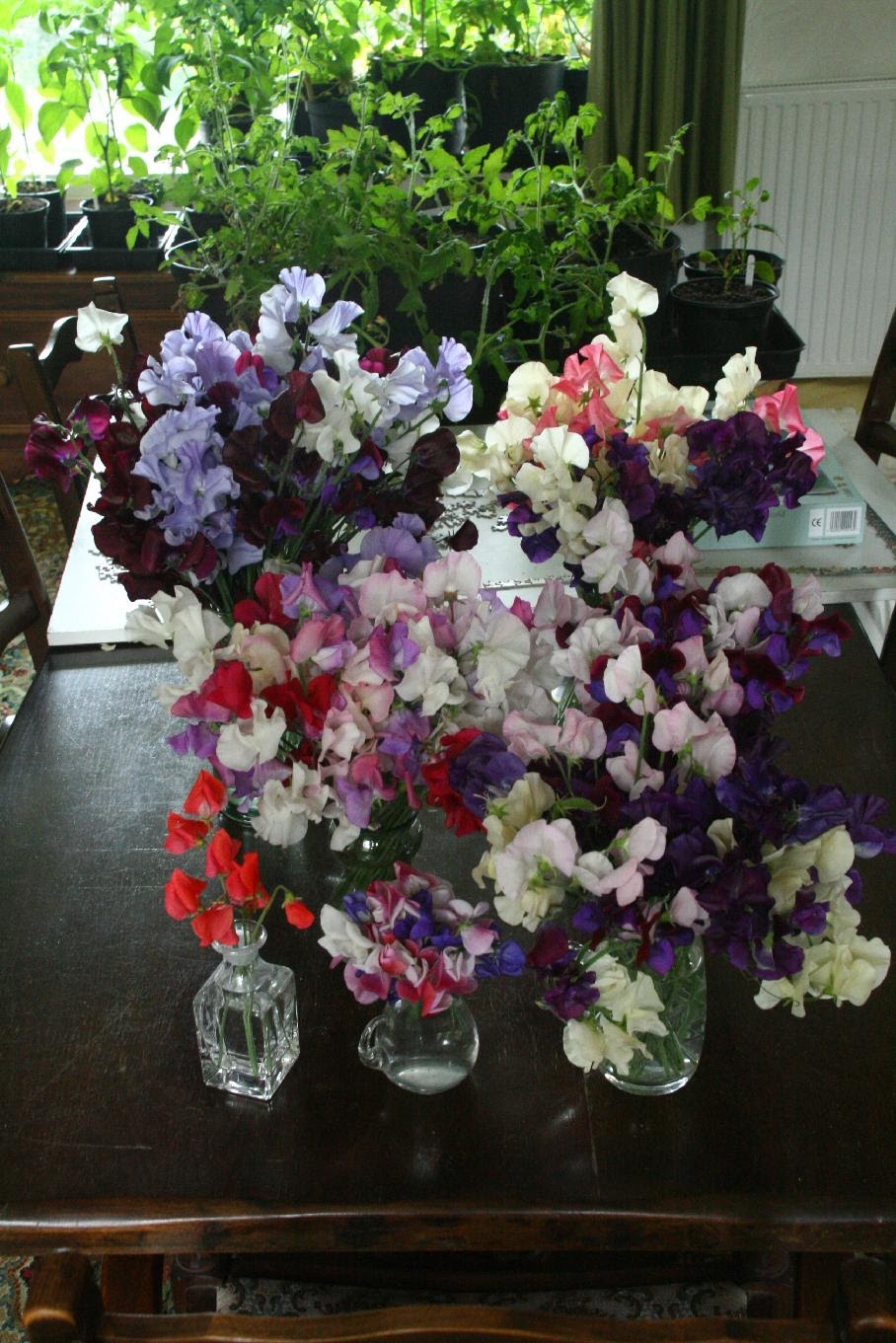
Lastly, a photo of this week's sweet pea harvest: 700 stems. It's probably the peak, but we've been getting about 500 stems each of the last 8-9 weeks, I estimate, which is a staggering number of flowers. Sadly, the plants are showing signs of fatigue, so it won't go on much longer.


The sweet-pea tripods (pre-harvest!) (© Ian 2013)


700 Sweet-Peas (© Ian 2013)

Monday, 29 July 2013

Netting

Our visit to Tatton Park was bracketed by days at home, which we mostly spent outside, of course. Saturday was dominated by going over the hillside with the brushcutter, cutting the grass, and removing or weakening as much of the brambles, gorse, rush-grass, and ragwort as possible. It's hot and hard work, but the hillside is definitely showing improvement. This time last year, it would have been tricky to get to the two 'best' apple trees, and barely possible to get to the other three or so—and impossible to reach the track up into the middle levels or hill-top.

Now, the orchard is easy to walk around, and the main clearing of the middle level is accessible. The bracken there, which I've now cut down three times, is still coming up, but not strongly. By comparison, the bracken on the other side of the wall, and further along the hill, where I've not done anything, is six feet tall, and impenetrable.

I have to confess that we saw a rather fine summer house at Tatton Park, one of the Malvern Collection. It's a few years off, yet, though, but it was very nice, and would be a lovely, secluded hideaway on the hillside.

Enough of that. Otherwise, on Saturday, I checked that the newly installed sprinkler on the woodstore's green roof is working, and established that my beer is ready for barrelling. The chardonnay I started at the same time, incidentally, is in the cellar clearing, and is probably ready for bottling. The dandelion is slowly clearing, having finished its vigorous fermentation; the elderflower is on a warm windowsill, bubbling furiously.

Monday was more varied, although we had to contend with showers. The butterfly netting is now up, covering the two plantings of brassicas (which replaced the alliums in the Q-bed, and the early potatoes up one arm of the C-bed). The sprouts, kale, cauliflowers, purple sprouting, and swedes have all settled in fine, and the rows of 'Golden Ball' turnips we sowed at the same time have germinated well.

We discovered a pot of leeks, which hadn't been planted out, so we filled a few gaps in the rows of leeks where tiny seedlings hadn't transplanted (only about three of thirty, and those three were properly tiny), and put the rest in spaces among the autumn onions. The earliest of these, Early Fen, looks like it's nearly ready. On a similar note, the garlics (Germidour) and summer onions (Radar), which are drying in the wood shelter, are coming along nicely.

We've found that we've been losing a lot of courgettes before they get to a sensible size, rotting from one end. On investigation, I think it's where the flower has started to rot, and this has spread into the fruit. To combat this, I'm going to try to remove the flower as soon as it's gone over, and let the fruit swell. Jenny & Philip are away, so we're also picking their fruit and veg (and sweet peas!), which means we're inundated with courgettes.

The hanging baskets, which we tried with dangling nasturtiums for the first time, are looking splendid: I must get a photo of the front of the house. I'm trying to remember to regularly feed them: strangely, the two on the front of the house proper (rather than on the porch extension) are doing less well, though they get more light (marginally).

Once that, and some weeding, was all done, we spent a little while clearing some spaces for our flower show purchases, before going in for lunch. This afternoon I've spent preparing David and Anne's wedding present: but more on that after their wedding...

Sunday, 21 July 2013

Sweet Peas

The sweet peas are at that glorious stage where, the morning after you pick the whole obelisk-worth of flowers...there's more open.


Sweet peas ( Ian 2013)

In addition to this, we've had an uneventful weekend, tidying up firewood, lifting the Radar over-wintered onions, the Germidour garlic, and the Elephant garlic (all looking good, and racked in the woodstore to dry over the next few days), and doing odds and ends.

We also lifted the Lad Christl potatoes, having taken up the Swift a little while ago. The yield's noticeably higher (16.8kg of Lady Christl, against 6.3kg of Swift), but not as high as I expected (which would have been about 20kg). They're also not looking fabulous: quite a lot of marking.

Sunday, 30 June 2013

Bonfire

Earlier this year, we cleared a lot of gorse from the hillside, and have added—during our subsequent clearing and trench digging efforts—brambles, hawthorn and gorse to the heaps. We decided it'd had long enough drying, and the conditions were about right, to burn. It turned into an all-day job, as it burnt better than expected, meaning that we spent the day feeding the bonfire, but it means that it's all done, rather than taking several efforts.

In the nettle-y corner up from the house, I set a small fire (few sheets of newspaper, four bits of kindling and, pleasingly, a single match & firelighter!), and started feeding dry gorse into it. That burnt well, and so as Liz brought over dry material from the various heaps we'd accumulated, I cut the branches from the other hawthorns we wanted to remove, and we burnt them, too. Even though it was wet, it burnt well once there was a good, hot bed of charcoal.

As I say, that took all day, in the end, and we've spent today mostly on the hillside, too. Breaking it into several sections, I've used Sigrid to brushcut almost the entire orchard, clearing grass, gorse, brambles, thistles and ragwort. Liz cleared up behind me, thus replacing a lot of the heaps we burnt only yesterday. So it goes.

Fortunately, the hillside now looks immeasurably better.

In between brushcutting, we got a few jobs done in the garden-proper. All the brassicas have been moved up a pot size (purple sprouting, romanesco cauliflowers, January King cabbages, kale, sprouts), to grow on before being planted out after alliums or potatoes come out. We sorted out the irrigation system in the fruit beds, which had been disturbed when we mulched them in the spring. Lastly, we've sown some more lettuce/salad leaves, and resown Swiss Chard in the barrel (previous sowing was a no-show).

Sunday, 16 June 2013

Tidying Up

It's been a busy weekend of mostly tidying up, meaning accumulated progress, rather than any particular thing getting very far.

We've sown some more seeds: Dianthus amurensis 'Siberian Blues' (for the rockery wall in the front); Polemonium boreale 'Heavenly Habit' (Jacob's ladder); two aquilegias, 'Magpie' and 'Royal Purple'; and a mixed selection of hostas (hopefully some of which will be pretty!).

We've planted out half a dozen rows (about ninety plants) of carrots, and another block of beetroot (about forty plants) in the bottom bed.

Liz weeded the bed at the front of the copse, and we've done another prune/tidy of the shrubs in the bottom bank, which were hit by the cold east wind.

The pots on the patios, and sitting on the old shed base, needed some attention, so we've sorted through them, removing the dead/empty pots to the back patio, and weeding, tidying and fertilizing the rest. Another heuchera's been hit by root-eating grubs (which seem to focus their predation on primrose and heuchera roots, for whatever reason), so that needed cleaning up and re-potting, in the hopes that it might survive.

We dug up the buddleja that we planted in one of the front beds in 2010 (I think: I don't appear to have a note!), and is the bottom right of this photo (from April last year). Liz has never been sure about it, and we found a pretty acer that will replace it, and go well with the other, older acer that's the centre point of the adjacent bed.

I took the opportunity to add new guide wires to the wall behind for the Virginia creeper to run along. It's almost reached the ivy at the bottom (which I had to cut back earlier this week, as it was encroaching on the windows, again), and is looking pretty with its new growth.


Front garden (© Ian 2012–13)

We re-planted the hanging baskets, with bronze carex, cinereria, trailing nasturtiums, and petunias, and I re-hung the bracket that came off the wall late last year.

Liz potted up another 96 lavenders which arrived this week, into modules. They'll grow on ready to be planted into the herb garden edges later this year, hopefully.

The two clematis (C. florida 'Alba Plena') we bought at Tatton Park last year, and which are growing up the trellis sides of our arbour, are growing well. However, we want, if possible, to move the arbour later this year, in order to dig out and lay the paving that's going under it. That will be well-nigh impossible with clematis entwined up both sides. To solve this, I've used a couple of blocks of wood, and wire, to space two 1'x6' trellis panels, one behind each plant, away from the main trellis. We'll twine the climbers up these, instead of the arbour, so it'll still look good, but when (if) we have to move things, they can be transferred safely and separately.

To finish the weekend, we made use of a prolific spinach crop (very pleased with the spinach: it's 'Lazio', which is effectively new to us, as it didn't grow in last year's horrible conditions), and made a batch of spinach black pudding ('boudin noir du Poitou'). It's made with a kilo of spinach, a pint of light bechemal, half a pound of onion, four ounces of breadcrumbs, a pint and half of cream, and eight pints of blood; the seasoning (salt, pepper and mace) is extended to include nutmeg, too.

As with our batch of 'fry-up' black pudding (with pork fat and oatmeal, instead of spinach, bechemal, and breadcrumbs), we cooked it as cakes, in loaf tins.

It's frankly delicious, and a fine conclusion to a weekend of hard work.

Sunday, 2 June 2013

Tulips

We've enjoyed a lovely weekend in the company of university friends (Katherine, Rachel, Philip, Liz, Robert, and their five-month-old, James), for which the weather cooperated magnificently. While we spent a lot of time outside, little of it was working, until this afternoon, when we managed to get a few things done.

We sowed the last of the RHS-produced ornamental seeds, potted up new lavender plants (48 Hidcote, 48 Munstead) that arrived on Friday, planted gladioli in pots, sowed some more cauliflowers (Mystique) and leeks (Prizetaker), watered everything, and admired the tulips.


Pots of tulips (© Ian 2012)

Sunday, 19 May 2013

Planting Out

A mixed day, of sorting and planting. We've planted sweet peas around the supports in the new flower bed (I'm going to have to think of a better name); about a dozen plants around each of the smaller wigwams, and about eighteen around the large, central obelisk. We've tried to pair the varieties so that they're distinct, but complementary, so we can identify which one the flowers that we like are from.

We also planted the mangetout plants ('Delikata') on a support in the herb garden, and also planted out the snow-in-summer (Cerastium) and centranthus (C. ruber 'Snowcloud') in a different square. Two squares now have asparagus peas sown in them, and we also planted the eighteen decent box plants we have, and about fifty mixed lavenders, on the edges.

That's reinforced our need for a lot more box plants!

In the kitchen garden, we've planted out thirty-odd spinach plants, and a few modules of salad leaves. The potatoes almost all needed their trenches topping up, too. Pleasingly, the onions seems to have almost unanimously found their way through the holes in the weed-suppressant membrane, and their shoots are growing on.

We've potted on forty celeriac, and Brussels sprouts and caulis, to grow on before planting out in the next couple of months.

I think there's some sign, finally, of the wildflowers on the green roof germinating, which is a relief.

Elsewhere in the garden, the second cherry (Stella) has been in flower for a couple of days, which means it's overlapped with Summer Sun -- hopefully that will mean we finally get a cherry crop. The bluebells are in full swing, which makes that bank look lovely, and the pots of tulips are going strong, making a good display from the kitchen window.

We finished the day sowing some more pots of vegetables: swedes (Golden Ball), cauliflowers (Triomphant and Romanesco), dwarf French beans (Speedy and Castendel), some ornamental sunflowers (Bicentennial and Pastiche), and then planted out a few primroses and geums (which have been around for ages: I think they're Lady Strathden, but I could be very wrong).

Wednesday, 31 October 2012

Christmas Trees

We spent most of yesterday getting some plants into the new bed in front of the copse. To start with, we've put the two dogwoods we already had (Cornus alba 'Elegantissima' and 'Spaethii') near the bottom apex of the bed (near the fruit cages); three new witch-hazels (Hamamelis x intermedia 'Jelena'  and 'Magic Fire, and H. mollis) went further up, on the copse side, and we moved the weigela (W. florida 'Variegata') and the caryopteris (C. x clandonensis 'Worcester Gold') in as well. A group of heathers (white darleyensis: 'Silberschmelze', I think), and two groups of hellebores also found homes.

Then we went to town with bulbs. 180 daffodills (a mix, including jonquillas and narcissi, 'Golden Ducat', 'Pacific Coast', 'White Lion' and 'Minnow'), 100 chionodoxa, and 100 crocus ('Ard Schenk', 'Sieberi Firefly', 'Barr's Purple' and 'Romance').

Having done that, we weeded the bed in front of the dining room window, and planted a further fifty mixed daffodils, fifty Dutch irises, three allium 'Hair' and three A. caeruleum, and 32 of each of A. sphaerocephalon and ostrowskanium.

Today, we'd happily weeded the vegetable beds, and had a pleasing hour planting pots of tulips (loads of them, as you'd expect: 30 mixed Rembrandt; 25 mixed Kaufmanniana; 60 mixed Triumph) and lifting the gladioli (not done well this year, and small bulbs), when a delivery man dropped off twenty five Christmas trees.

Not cut, or very large: twenty-five 2 year old, bare-rooted, Scot's pines (Pinus sylvestris). We're planning on finding a spot for these, and cutting one or two down each year as our Christmas tree (this is, evidently, a longish-term plan)—but we hadn't expected them to arrive until, say, December. Or preferably January. And we didn't have anywhere to put them.

Undeterred, we immediately set to clearing the bed around the Victoria plum, to the side of the future pond. This bed we planned to create in the spring, running round three sides of the pond, and encompassing the fruit trees, and the bed alongside the septic tank. A quick debate about shape and size, and I started lifting turves. I got past the plum, as far as the spot we're planning for a bench, figured that was enough space, and started de-stoning the ground. This part of the operation probably took as long as lifting the turf, and we excavated probably two barrows of stone. Beyond the plum, I met my match, in the shape of a huge stone probably two feet long and one wide, with an unknown depth. I gave up there, and we planted the pines on the other side of the plum. They'll over-winter there, and we'll aim to find permanent sites for them while they're still dormant, and get them there by March.