Gravel path laid through herb garden (© Ian 2017)
Showing posts with label herb garden. Show all posts
Wednesday, 25 October 2017
Gravel
Gravel is heavy. Not a surprise, but a bit of a pain when one has a ten ton heap of it to move. Anyway, we've got it down onto most of the herb garden, with Liz clearing the path ahead of me, and me shifting the gravel.
Labels:
herb garden
Tuesday, 29 August 2017
RHS Harlow Carr
Nothing exciting this weekend, but good progress on a few things. We spent most of Saturday painting windows (a bit late in the year, but hey-ho), and have probably done a bit less than half. We had a day out on Sunday and went to Harlow Carr, which is looking lovely (as you might expect).
Most of Monday was spent with the bees, who are winding down for the autumn. And today was spent making a bit of progress on our bathroom renovation plan (ie, progress on making a plan), and measuring the garden paths. Having previously used forestry/hedging chippings for these, we're planning to upgrade to aggregate. It's more expensive in the first place, but shouldn't need replacing every few years, which is both a lot of effort, and ongoing expense. The trouble is getting a suitably large load here, given the access difficulties—and in deciding on a satisfactory type of gravel...
RHS Harlow Carr (© Ian 2017)
Most of Monday was spent with the bees, who are winding down for the autumn. And today was spent making a bit of progress on our bathroom renovation plan (ie, progress on making a plan), and measuring the garden paths. Having previously used forestry/hedging chippings for these, we're planning to upgrade to aggregate. It's more expensive in the first place, but shouldn't need replacing every few years, which is both a lot of effort, and ongoing expense. The trouble is getting a suitably large load here, given the access difficulties—and in deciding on a satisfactory type of gravel...
Labels:
colour wheel,
DIY,
garden visits,
herb garden,
kitchen garden
Monday, 24 July 2017
In the Ground
Shockingly quickly, we've planted out the purchases from yesterday's Tatton Park show. It's also entailed rather radically reducing the amount of white valerian in the herb garden (which has spread somewhat invasively), and moving—for example—the yellow lysimachia erupting in the red bed of the colour wheel to its rightful location (that is, the yellow bed) to make way for the much more appropriate Royal Bumble salvias.
Tatton also reinforced our desire to put alliums in, especially, the colour wheel. There are a few, but not that many. We're compromising the nominal colour scheme in the colour wheel in the first half of the year (when we find it difficult to get the full spectrum of flower), so long as it hits the right rainbow notes by July. Earlier in the year, I'll take flowers of any colour, so a healthy number of daffodils, tulips and alliums are probably going to grace the beds. Alliums were beautifully displayed by W S Warmenhoven at the show, so I expect we'll order a wholesale quantity of mixed bulbs from someone in the coming months.
W S Warmenhoven's allium display, RHS Tatton Park (© Ian 2017)
And daffs, if I can get away with it. You know how I love daffodils.
Labels:
bulbs,
colour wheel,
flowers,
herb garden,
new plants
Sunday, 23 July 2017
RHS Tatton Park 2017
This week's been the RHS Tatton Park show, and so for the fifth year, we went along to the last day. It was a really good show, as normal, and we were luckier with the weather than expected (the forecast a couple of days before was for heavy rain showers: we actually only had a few minutes of light rain at about 1400).
We made the most of getting there early and went straight to the floral marquee. I think that's best early, before it gets (a) hot, and (b) full of people. We found a number of things we wanted, including some selfheal (Rose and Blue Pearl varieties) to brighten the herb garden, some salvias (Royal Bumble) that will go in the colour wheel, and some blue-flowered garlic chives (also for the herb garden). It's a rather smaller haul than previous years (I think 2016 will forever be our high-water mark for purchases), but that reflects the simple fact that the garden, after eight years being here, is increasingly planted-up, and more space now comes either from replacing plants that die (or we grow bored of), or gradual increases in flower beds at the expense of lawn (see: mulberry bed in the games lawn).
Labels:
colour wheel,
garden visits,
herb garden,
new plants,
z_photos
Monday, 31 October 2016
Tulips
One of the last 'urgent/important' jobs for us this autumn has been getting some tulips planted. We ordered 256 mixed 'perennial' tulips, to go into the herb garden. Technically, all tulips are perennials, as bulbs, but in the UK then many of them only flower for one or two years, before fading, flowering less well and then reducing to just foliage before vanishing. These are meant to be longer-lived, and (combined with planting them as deeply as I could) I hope they'll brighten the herb garden for some time.
I planted a hundred of these last autumn, but forgot to make a note of it: however, they're similar to some we've had a few years, and which I wrote about in 2013&emdash; when they're pictured with the nascent herb garden in the background.
They looked good, earlier this year, but a hundred wasn't enough, hence rather increasing numbers. They're now all over the herb garden, in and amongst other things.
Labels:
autumn,
bulbs,
herb garden
Sunday, 3 April 2016
Potatoes
For most of the weekend, Rebekah and her family have been staying with me, mainly so she could go to a friend's 30th. However, yesterday we managed to go to a very nice pub in Blackmoorfoot, which had some good guest ales, and an extremely reasonable three-course fixed menu. We walked round the reservoir afterwards, which the dog and ten-month-old enjoyed (the rest of us squelched, rather). In the evening, Dan and I went to another pub, closer to home, to while away the evening with more guest ales...and gin. It was very pleasant.
Today's been rather more productive. They set off after breakfast, to time travelling with a morning nap; I went out to plant my potatoes (all Lady Christl, this year), and did a couple of hours of weeding. The herb garden and colour wheel are looking much tidier, now. I've sown broad beans in the former; there are flowers to direct-sow soon in the latter, which I'll try to do this week, as the weather is gradually improving.
My onions still haven't arrived, so I can't plant them out yet—hopefully soon.
I came back in, and put the skirting board on the wall behind the desk on the landing, and have filled it. A quick coat of gloss tomorrow evening, and the desk can go back in place,
I realised too late that I should probably have mown the lawn, as I think evenings this week will be damp. Never mind. More positively, though: the frogspawn in the pond is doing really well. There's loads—I'd guess seven clumps.
Frogspawn as laid 14th March (© Ian 2016)
The first little wrigglers have emerged, now, and the rest will probably do so over the next ten days. The survival fraction is atrocious, but hopefully it'll mean I'll have half a dozen new frogs in the pond.
Frogspawn two weeks later (© Ian 2016)
This evening, I've made some seed bread which looks rather good. It's about 40% white flour, 40% wholemeal, and 20% rye, with sunflower, poppy and sesame seeds, and golden linseeds.
Multi-seed bread (© Ian 2016)
Labels:
colour wheel,
cooking,
DIY,
flowers,
herb garden,
potatoes,
remodel,
vegetables
Sunday, 21 February 2016
Chestnut
Over the past few weeks, I've been getting on with some bits and pieces: mostly plastering the first floor. I'm nearly there: a little more in the front guest room that needs to wait; a little on the landing. The master dressing room is a weekend's work, because it needs to be emptied, the wallpaper stripped, and then plastered. The sewing room needs a lot of plastering, some onto stone, which I'm leaving for now. The chimney breast in the master bed needs plastering and painting. Then there's the whole floor to paint, and the window reveals to tidy and finish.
I've a lot to do, so I'm just chipping away at it all.
This weekend, though, was a 518 mile round trip to Surrey. We ordered a load of coppiced chestnut, which will form a fence along the edge of the herb garden (a wind break, and a better definition of where it ends, visually). This was cut over the winter, and was ready for collection, so I hired a Jumbo Transit van, and drove down yesterday. I got to Lodsworth (Prickly Nut Wood) at about 2, loaded up, and got back to Liz's sister in Farnham around 3. This afternoon, I've driven back up, unloaded (loading, with three of us, was much easier than unloading single-handed!), cleaned the van, and collapsed onto the sofa. The van was surprisingly easy to drive (rear visibility aside), and I was pleased to keep the fuel consumption as good as 29mpg. Ten hours of driving later, I've about a ton of chestnut poles on the kitchen patio.
Starting work on the jigsaw puzzle they represent will have to wait, though. I've several weekends away coming up, and really I need to saw, split, and stack some/most/all of the firewood on the driveway to get space to do the work.
Jumbo the Transit van waiting to set off (© Ian 2016)
The House in Prickly Nut Wood (© Ian 2016)
The van full of chestnut (© Ian 2016)
Starting work on the jigsaw puzzle they represent will have to wait, though. I've several weekends away coming up, and really I need to saw, split, and stack some/most/all of the firewood on the driveway to get space to do the work.
Labels:
biomass,
DIY,
friends,
herb garden
Sunday, 21 June 2015
Irrigation
Having got the taps ready, today we installed the irrigation system for the two patios (kitchen and dining room), and the front garden. The colour wheel is simply a hose leading to a bar sprinkler. We didn't have time to do the herb garden, other than to lay the supply hose. The 4mm branches, and associated sprinklers/sprays will have to wait. The other big achievement was to finally repair the leak in the dining room hot water pipe, by doing the bypass I explained yesterday. This seems to have worked, and now means that the leaking pipe is no longer used, and the route hot water takes through the house is much shorter, which should also make it hotter. As a side benefit, the pipe we've taken out of the circuit also appears to be the one that was making the water mucky, as it's now running clear. The repair might have taken six months to solve, but we're finally there, and with a much better set-up.
Labels:
colour wheel,
herb garden,
watering
Monday, 18 May 2015
Plumbing, planting, potatoes
We've had a pleasant couple of days in Scarborough, with the obligatory beach-front ice-cream. Back home, we've been checking that we're happy with the pond construction and layout, because we plan to line it in a week. As we were using the very fast and effective, but relatively imprecise minidigger to excavate, it does need a degree of manual finessing, to get the shape and depths we want. Hopefully that will only take a day or so to get right, and we can then line it, build the retaining dry-stone wall, fill it, and sort out the edges.
Today, we've had a day of smaller jobs. Inside, the dandelion wine is now in its demijohn. We spent the first part of the morning connecting the two outside taps (near the greenhouse) that I started to do last summer, and never quite finished. This means that there are now two watering points which don't require the workshop door to be propped open, which is much better—it means that the kitchen garden irrigation can be left automatically running, which is critical when we're away during the warmer months. The second hose point will let us set up automatic drip irrigation inside the greenhous (much better for the tomatoes during the summer), which is a later project.
Because we only made about half of the climbers' supports 'properly' last year, we've put up a further five that are more rustic, shall we say: lengths of poplar, tied together at the top. Less attractive, but functional. I hope to make more proper frames in the autumn.
We've planted out the tulbaghia, chives, coriander and parsley into the herb garden; as well as the agapanthus into the long border, as frosts should be past, now. I've taken a number of cuttings from the dahlias in the greenhouse, which are starting to grow on well (Bishop of Llandaff and Twyning's After Eight). They go in a propagator in the dining room for a few weeks until they've rooted, and will then grow on in pots this year.
Down in the kitchen garden, the beetroot are now planted out (a rainbow mix, this year: we found the flavour much superior to Boltardy, and really pretty, too). The cauliflowers are also out, and we've planted the second half of the mini salad bed. I think these plants have been in modules for too long, though, so they might not thrive.
The potatoes are doing well, and almost all needed earthing up. The scorzonera has germinated really well; almost every station has a couple of seedlings. The parsnips, inevitably, are much slower, and will probably be less reliable. That's fine, though, we don't need many.
Today, we've had a day of smaller jobs. Inside, the dandelion wine is now in its demijohn. We spent the first part of the morning connecting the two outside taps (near the greenhouse) that I started to do last summer, and never quite finished. This means that there are now two watering points which don't require the workshop door to be propped open, which is much better—it means that the kitchen garden irrigation can be left automatically running, which is critical when we're away during the warmer months. The second hose point will let us set up automatic drip irrigation inside the greenhous (much better for the tomatoes during the summer), which is a later project.
Because we only made about half of the climbers' supports 'properly' last year, we've put up a further five that are more rustic, shall we say: lengths of poplar, tied together at the top. Less attractive, but functional. I hope to make more proper frames in the autumn.
We've planted out the tulbaghia, chives, coriander and parsley into the herb garden; as well as the agapanthus into the long border, as frosts should be past, now. I've taken a number of cuttings from the dahlias in the greenhouse, which are starting to grow on well (Bishop of Llandaff and Twyning's After Eight). They go in a propagator in the dining room for a few weeks until they've rooted, and will then grow on in pots this year.
Down in the kitchen garden, the beetroot are now planted out (a rainbow mix, this year: we found the flavour much superior to Boltardy, and really pretty, too). The cauliflowers are also out, and we've planted the second half of the mini salad bed. I think these plants have been in modules for too long, though, so they might not thrive.
The potatoes are doing well, and almost all needed earthing up. The scorzonera has germinated really well; almost every station has a couple of seedlings. The parsnips, inevitably, are much slower, and will probably be less reliable. That's fine, though, we don't need many.
Labels:
brewing,
herb garden,
pond,
potatoes,
vegetables
Thursday, 30 April 2015
Asparagus
We've managed to pop out most of the evenings after work this week, and have finished the deep-weeding of the herb garden beds that we've been getting ready to plant asparagus into. These arrived yesterday: compost-block grown plants (which are easier to plant that bare-root crowns, and which can be planted any time of year) from Victoriana Nursery. They're a variety bred in New Jersey called Jersey Knight, and we're hoping their origin will mean they're well equipped for our weather. They're meant to be a heavy- and long-cropping variety, producing thick stems; and they're an all-male variety, too.
We've thoroughly weeded the beds, and tonight we planted them out, putting a thick layer of mulch down. We can't crop from them this year, and only very lightly next, but in two year's time, we're hoping that they'll make a big difference during the hungry gap between the last of the over-winter veg coming out, and the new annuals being ready.
Labels:
herb garden,
new plants,
vegetables
Friday, 10 April 2015
Watered In
It's been dry for a week, and having moved a lot of earth around, things are actually pretty dry, so, having planted out a lot of plants yesterday afternoon, I've watered everything again. We're now about to drive down to Kent to see David and Ann for a couple of days, calling in to see the cats' friend in Cambridge on our way.
Labels:
colour wheel,
herb garden
Thursday, 9 April 2015
Bobcat
Last bits today for our week of work, as we're off to visit David and Ann tomorrow. We started by moving the last of the topsoil we needed down to the veg garden. There's still a small heap on the driveway, but not very much. There's a mound of mulch on the hillside for the nursery beds, apple walk, and trees, which we'll need to top up with chipping mulch. The rest of the driveway heap is probably going to be used topping up the two beds to the sides of the beech bench.
That done, we had just enough time to plant up some of the herb garden extension and the colour wheel beds, though it did mean we were finishing off, watering in, by moonlight. The box that remained in the herb garden (having moved several into the long border) have neatly delineated the corners of the colour wheel beds—there are similar plantings in the herbaceous borders at Harlow Carr, which I've long admired, and this mimics that. The Tail Feathers grasses (Pennisetum macrourum) that we sowed in January 2014, and grew on all last year, have gone around the outer edges of the beds, to give some boundary and height. We've then planted out a lot of perennials that, mainly, we've been growing on from plug plants for the last year or so, and which overwintered in the greenhouse in 9cm pots. We also put about nine Deschampsia cespitosa that have outgrown the beds near the beech bench (planted 27 Mar 2014?). As a result, the beds are looking much less empty, but there's space we're planning to grow some annuals in, particularly ones that can be useds as cut flowers.
Mid afternoon, though, we also had to say goodbye to Bobcat the mini-digger, after seven days of hard work. It's let us come on leaps and bounds in the garden construction—in fact, structurally, the garden is now all but complete, as the beds are all where we want them. A little more work in the copse, the laying of the patio, and the construction of the pergola around the access ramp, and the Big Things will be done.
That done, we had just enough time to plant up some of the herb garden extension and the colour wheel beds, though it did mean we were finishing off, watering in, by moonlight. The box that remained in the herb garden (having moved several into the long border) have neatly delineated the corners of the colour wheel beds—there are similar plantings in the herbaceous borders at Harlow Carr, which I've long admired, and this mimics that. The Tail Feathers grasses (Pennisetum macrourum) that we sowed in January 2014, and grew on all last year, have gone around the outer edges of the beds, to give some boundary and height. We've then planted out a lot of perennials that, mainly, we've been growing on from plug plants for the last year or so, and which overwintered in the greenhouse in 9cm pots. We also put about nine Deschampsia cespitosa that have outgrown the beds near the beech bench (planted 27 Mar 2014?). As a result, the beds are looking much less empty, but there's space we're planning to grow some annuals in, particularly ones that can be useds as cut flowers.
Mid afternoon, though, we also had to say goodbye to Bobcat the mini-digger, after seven days of hard work. It's let us come on leaps and bounds in the garden construction—in fact, structurally, the garden is now all but complete, as the beds are all where we want them. A little more work in the copse, the laying of the patio, and the construction of the pergola around the access ramp, and the Big Things will be done.
Labels:
colour wheel,
herb garden,
pond
Saturday, 4 April 2015
Digging Over the Herb Garden
Having got the land-drains in the new garden sorted out yesterday, we were able, this morning, to break ground on the pond. My plan has been to dig it out from the bottom apex, near the apple tree, and work back to the top corner, at the entrance near the sweet pea bed. I've had to change my mind, though, as the reach and depth of the digger, and the risk of overbalancing, are problems. Instead, I'm going to do the bottom corner, then the far corner, and work back to a position roughly half-way up the side (basically, sat next to the plum). I think I'll have to then take the digger along the path next to the long border, to finish off, before driving out.
We only got a bit of this done before Katrina and Dan arrived: they're up for a wedding near us, and we're B&B'ing them. After lunch, Dan was immensely useful in helping us dig over the herb garden. We did the first half of this by hand last summer, and it turns out we did the harder half. The remaining area, we'd covered with weed-suppressant membrane, and it's actually had all the rubble from the house renovations sat on it. This has totally wiped out the grass, which has rotted down into lovely topsoil.
Dan ran the digger, turning this over, and we picked out the stones we found. We've also moved the last of the big stones from last time down to the growing piles around the pond, where I'll build them into the retaining wall we need behind the pond (the path along the long border is about 60cm higher than the apex at the apple).
The herb garden's now completely dug over, and tomorrow we'll return to digging the pond.
We only got a bit of this done before Katrina and Dan arrived: they're up for a wedding near us, and we're B&B'ing them. After lunch, Dan was immensely useful in helping us dig over the herb garden. We did the first half of this by hand last summer, and it turns out we did the harder half. The remaining area, we'd covered with weed-suppressant membrane, and it's actually had all the rubble from the house renovations sat on it. This has totally wiped out the grass, which has rotted down into lovely topsoil.
Dan ran the digger, turning this over, and we picked out the stones we found. We've also moved the last of the big stones from last time down to the growing piles around the pond, where I'll build them into the retaining wall we need behind the pond (the path along the long border is about 60cm higher than the apex at the apple).
The herb garden's now completely dug over, and tomorrow we'll return to digging the pond.
Labels:
herb garden,
pond
Thursday, 25 September 2014
Autumn Cut
We've enjoyed the wildflowers in the orchard this summer, which is one reason why I've left large swathes of it uncut for some time, only clearing paths through it. However, as autumn enters, I've now gone over the entire orchard, cutting it back as close as I can, so that it stays neat, and walkable, over the winter. Heavy work, even in the milder temperature, but it actually only took about three hours, which isn't bad. It looks a lot neater, even with the strewn vegetation.
Before doing that, though, this morning I've painted the arches of the apple walk, coating the steel rebar with cream-coloured metal paint. The arches now really stand out, and will stand the weather much better.
I've planted out the autumn-planting onions (100 Radar) and garlic (30-odd Marco) in the herb garden, through weed-proof membrane.
Last thing, I managed (just, before the light faded and drizzle set in) to mow the lawn. I managed to do the games lawn a while ago, but it's been some time since the rest has been done, and it really needed it. Hopefully, as the weather cools and the days shorten, it'll be a while until I have to do it again. I am hoping to manage to keep trimming it through the winter, weather permitting, this year. I do still need to take the brushcutter to the copse, though, and tidy the verges of the lane, so my grass-cutting isn't over for the year...
Before doing that, though, this morning I've painted the arches of the apple walk, coating the steel rebar with cream-coloured metal paint. The arches now really stand out, and will stand the weather much better.
I've planted out the autumn-planting onions (100 Radar) and garlic (30-odd Marco) in the herb garden, through weed-proof membrane.
Last thing, I managed (just, before the light faded and drizzle set in) to mow the lawn. I managed to do the games lawn a while ago, but it's been some time since the rest has been done, and it really needed it. Hopefully, as the weather cools and the days shorten, it'll be a while until I have to do it again. I am hoping to manage to keep trimming it through the winter, weather permitting, this year. I do still need to take the brushcutter to the copse, though, and tidy the verges of the lane, so my grass-cutting isn't over for the year...
Wednesday, 10 September 2014
Planting Out
It's been a little while since we actually spent much time in the garden, so it's been nice to get out today. We spent the morning at Harlow Carr, enjoying the start of the transition into autumn in the shrubs and trees, and the long borders are glorious in their late-summer show.
Once we were home, we started by doing some weeding in the herb garden, which really needs it, although the addition of the membrane & chippings path has significantly reduced the impact of walking on the ground. It did get very compacted, which made weeding hard work, and although there's a lot of grass to dig out, it's much better. The grass will, I'm sure, continue to be a problem for a year or more, as we weaken the remaining, creeping roots.
We didn't have time to finish the herb garden, though, so once we'd made a dent in it, we went down to the kitchen garden. Having weeded those beds, I planted out a few clumps of spring cabbages (Durham Early), which may not amount to much, but might provide some useful leaves. Spring cabbages aren't, for us, a particularly useful crop, as they seem to come ready a little late, when actually we want to be putting in new plants in their space. Much more effective, to date, have been the winter Savoy cabbages (January King, the last couple of winters), which is harvested at a more useful moment. Anyway, we had some Durham Early plants, so in they've gone.
We've cut down the fruited raspberry canes, leaving only the stems that have grown this year. Getting the pruning right (last autumn) has made a big difference to the plant health and the size of the harvest this year.
The spring cabbages are the last thing that we'll be planting out in the kitchen garden until spring, now, so the remaining empty space was weeded, raked, and sown with green manure. This is a winter mix of crimson and red clover (leguminous nitrogen fixer and weed suppressors), Italian ryegrass (good soil stabilization, and deep roots for mineral up-lift), and mustard (bulky foliage for digging in). We added extra Caliente mustard, which is a particularly good biofumigant, improving soil health when it's chopped into the ground in spring. The current weather is good for sowing green manure: the soil's still warm, and moist, so it should germinate well, and get a few weeks growth before it gets particularly cold. The mustard nor the crimson clover are particularly hardy, so they won't survive a bitter winter, but there's a window for them to do some work, at least.
The kitchen garden sorted, we spent half an hour tidying the long border, before planting out the plants we bought at York Gate and Wisley.
From York Gate: a white salvia (into the copse bed: Salvia paniculata, I think), a white Jacob's Ladder (P. caeruleum subsp. caeruleum f. album), a white phlox (P. paniculata), a helenium, and a golden oats (Stipa gigantea). Wisley yielded three variegated eupatorium ('Pink Elegans'), two variegated phlox (P. paniculata 'Norah Leigh'), three agastache ('Blackadder'), a crimson sedum ('Red Cauli'), and a molinia ('Skyracer'), which have, apart from 'Norah Leigh', gone into the long border.
Labels:
flowers,
herb garden,
kitchen garden,
soil,
summer,
vegetables,
weather
Sunday, 27 July 2014
RHS Tatton Park 2014
This morning, at about 0815, we set off for Tatton Park, as we have the last couple of years, to the RHS flower show. It takes about an hour, and having parked and walked to the showground, we were in the queue at about 0940, giving us a quarter hour to start looking at the show catalogue (and map) before being let in at just before 10. I've been impressed, this year and last, at how quickly they scan the bar-coded tickets and get you in.
There were some really good show gardens, this year. We particularly liked a heritage/allotment fruit and veg stall from a group of local allotmenteers, and were struck by a scarlet mountain spinach (orache) that we've never seen in the flesh before. It's a possible potager plant next year.Grasses were much in evidence, as well as chocolate cosmos, sanguisorba, crocosmia, and brunnera. That suited us nicely, as we've many grasses that could be used in combination. We have one sanguisorba, 'Tanna', and a brunnera, 'Jack Frost', both bought at Tatton last year, and came looking for more brunnera. We have a few crocosmia, but one caught our eye today that is apparently a fairly new introduction; Twilight Fairy 'Gold'. It has lovely bronzed foliage, but sadly wasn't for sale from the show garden (the Young Designer of the Year garden by Sam Ovens).
We saw a couple of water features we liked, which might inform later plans.
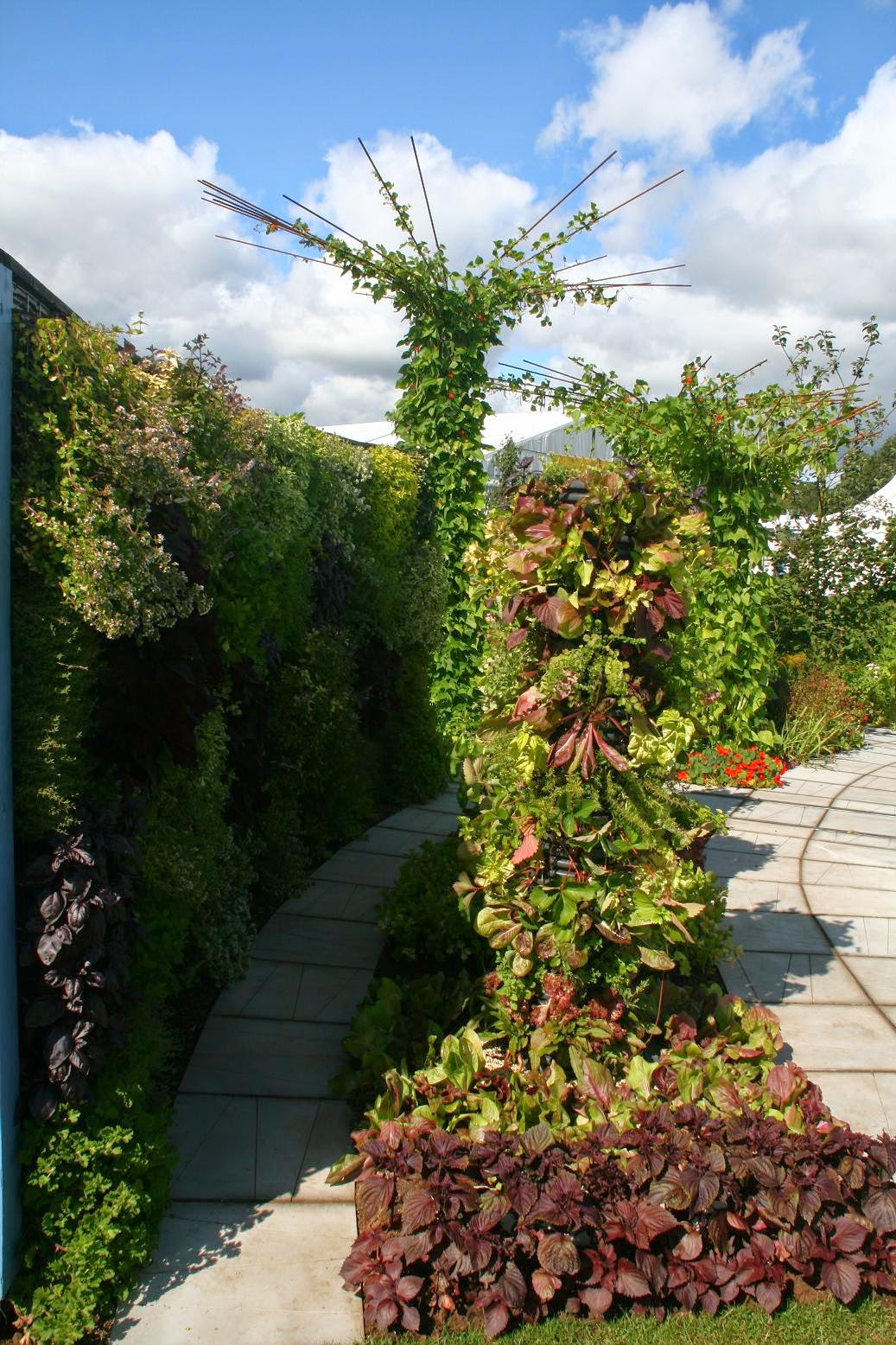
This garden had a rebar construction for its runner beans: apparently I'm not the only one using rebar to construct supports! It also had a rather good green wall, one of which Liz still wants to find a space for.
These garden seats were very good, and next door we saw some very weather resistant swing seats by the well-named Yorkshire Swingseat Company.
One feature that we enjoyed was a collection of eight vignette gardens that encapsulated larger gardens' feel in small plots. They're all from Cheshire, and included Arley Hall, which is actually just down the road from Tatton Park, and we thought looked worth a real visit, based on their 'taster' garden.
The floral marquee was, as ever, phenomenally stocked by nurseries, and although we only bought two plants, the other displays were excellent, and gave us contact details for a number of specialist nurseries. One, near Cambridge, might be a good source of alpines, if we do decide to put a green roof on the mini-sheds. There were a couple of hosta specialists, too, for when we dig the bog garden.
The two plants we bought were both from the Hampshire Carnivorous Plants: one was a Sarracenia hybrid (a North American Pitcher Plant), which suited us because it actively requires a good cold winter spell, probably in the unheated greenhouse. The other is a dangling/hanging sort of plant, a Monkey Cup called 'Linda' (a hybrid, Nepenthes cv 'Linda') despite being a dioecious male. It now hangs, slightly threateningly, in the sitting room.
For us, though, the Young Designer Gardens were the best. We felt that the television coverage (Thursday and Friday evening) actually let these down, and all three, but particularly Alex Schofield's, were much better in the flesh. In fact, everything else we purchased came from these three gardens.
Acquisitions were:
There were some really good show gardens, this year. We particularly liked a heritage/allotment fruit and veg stall from a group of local allotmenteers, and were struck by a scarlet mountain spinach (orache) that we've never seen in the flesh before. It's a possible potager plant next year.Grasses were much in evidence, as well as chocolate cosmos, sanguisorba, crocosmia, and brunnera. That suited us nicely, as we've many grasses that could be used in combination. We have one sanguisorba, 'Tanna', and a brunnera, 'Jack Frost', both bought at Tatton last year, and came looking for more brunnera. We have a few crocosmia, but one caught our eye today that is apparently a fairly new introduction; Twilight Fairy 'Gold'. It has lovely bronzed foliage, but sadly wasn't for sale from the show garden (the Young Designer of the Year garden by Sam Ovens).
We saw a couple of water features we liked, which might inform later plans.
(© Ian 2014)
(© Ian 2014)
These garden seats were very good, and next door we saw some very weather resistant swing seats by the well-named Yorkshire Swingseat Company.
(© Ian 2014)
(© Ian 2014)
(© Ian 2014)
(© Ian 2014)
For us, though, the Young Designer Gardens were the best. We felt that the television coverage (Thursday and Friday evening) actually let these down, and all three, but particularly Alex Schofield's, were much better in the flesh. In fact, everything else we purchased came from these three gardens.
(© Ian 2014)
- From Alex Schofield's garden:
- Brunnera; I need to check the cultivar
- Astrantia 'Gill Richardson'
- Sanguisorba (S. officionalis)'Tanna'
- Sedum (S. spectabile) 'Matrona'
- From Clare Broadbent's garden:
- Echinacea 'Secret Love'
- Eupatorium, I think E. purpureum
- From Sam Ovens' garden:
- Scabious 'Pink Mist'
(© Ian 2014)
Labels:
flowers,
garden visits,
green roof,
greenhouse,
herb garden,
holiday,
kitchen garden,
new plants,
photos,
pond,
summer,
wishlist
Sunday, 20 July 2014
Paths
Today started with a soft-fruit picking session. The raspberries are nearly over: probably one, maybe two more pickings left. However, the gooseberries are really just starting: the fuzziest, first variety at the top of the bed, Invicta (which also seems to have bigger fruit) is mostly ready, and some of the red and golden Hinnonmaki are there, too. While I prickled myself collecting these, and then a bowl full of blackcurrants, Liz collected about 80% of the redcurrants. The whitecurrants are always a bit later, and some of the red weren't ready yet...but it's still a lot of fruit. The bushes have now properly hit their stride, in their fifth year (we planted them in December 2009), although one of the blackcurrants isn't doing nearly as well as the other two. That's a shame, as blackcurrants are my favourite (compared to red/white/pink...I don't know how I'd choose a soft fruit, let alone a fruit, as a favourite), but there you go. I'm hoping that a couple of year's good mulching and pruning might see it straight. Alternatively, it may not be getting as much irrigation, as it's at the top of its bed (which is, literally, the highest point of the kitchen garden, and furthest from the watering system inlet).
Putting this path down meant moving four box that were an edge in the old design, but are no longer, as the edges have moved, and aren't going to be box any more. The four plants have moved into the long border, replacing clumps of alchemilla, and will gradually form balls.
Lastly, I've had to add more strings to the legume supports, as they finally, slowly, start to grow. They went out too late, really, delayed by the work on the back of the house, so it's not going to be a productive pea and bean year, sadly.
A few clumps of ragwort have been growing in the orchard, and while certainly not an infestation (there's a nearby field which is just a mess of ragwort—and, worryingly, is a horse paddock), I wanted to remove it before it sets seed. When we bought the land, there was, comparatively, quite a lot, which a year of strimming and pulling has mostly resolved. Anyway; I pulled up what I found, and checked in on the graftlings, which all seem to be doing ok.
When I'd done so, Liz had weeded beech bench bed, and the bed to either side, and had also put down cardboard mulch sheets around the beech. That was a prerequisite for spreading chippings around the beech, which will now have much less competition for light, water, and soil, and look a lot tidier. I moved the turf stacked in front of them, and the spoil heap of stones (including a couple of large lumps of concrete, and several stones worthy of walling or pond-side). Between us, we've laid out weed-membrane, and covered it with chippings, to form a path down that side of the lawn. During the winter, when we're bringing wood up from the wood shelter, that path quickly gets muddy, so this should be a better route, now.
This was really part of a larger chipping-spreading activity, as we've put a path (membrane and chippings) through the middle of the herb garden. It's not planted, apart from the lavender lines crossing it, and having the lined path will mean a bit less weeding. The un-dug part of the potager, which has had weed membrane down on it for some time, has now also had a layer of chippings, which makes it look much more attractive than black membrane.
Putting this path down meant moving four box that were an edge in the old design, but are no longer, as the edges have moved, and aren't going to be box any more. The four plants have moved into the long border, replacing clumps of alchemilla, and will gradually form balls.
Lastly, I've had to add more strings to the legume supports, as they finally, slowly, start to grow. They went out too late, really, delayed by the work on the back of the house, so it's not going to be a productive pea and bean year, sadly.
Sunday, 6 July 2014
Nettle Cordial
The days started with some weeding, and my finishing off the shed-boxes (needed to add weather strips inside the last two boxes' doors, and paint the floor of the one which has the lawnmower in, as this will often be a bit damp). I also added some extra strings to the willow-less legume frames, as they're starting to get going.
Even though we planted out a great number of things earlier, we still have a lot of small plants growing on, mostly around the greenhouse, or on the weed membrane near the kitchen. Today we managed to plant out a number of these—but there are still lots of pots left! It takes many, many plants to fill half an acre, it turns out.
Into the long border have gone several astrantia (A. major, A. minor, A. maxima, as well as a variegated form from my parents' garden—it might be A. major 'Sunningdale Variegated'); a few trios of coreopsis; some more of our seed-grown Stipa tenuissima; and some geums.
More geums, and some mixed achillea, went into the bed on the games lawn side of the septic tank, to balance it with the other side (the geums there are doing marvellously, and look good set against the new green background of the sheds.
A few spare achilleas, and then some campanulas, aquilegias (Magpie and Royal Purple), and lupins (mixed, hopefully nice colours!) went into the two beds around the sweet peas that aren't looking so good (the back one of the three is pretty good, but the others' wildflowers didn't germinate well.
We also had three little dicentra (with rather darker, single-colour flowers: we're not much taken with the pink & white normal form, but this one, and the all-white we already have, are much more to our taste), which have gone in the copse bed.
A bunch of hardy fuchsias (Hawkshead, Delta's Sarah, and Army Nurse), have been potted up, along with a dozen box cuttings, a number of 'Tail Feathers' grass (Pennisetum macrourum), rose campion, and other achilleas.
Over lunch, we moved the elderflower wine into demi-johns (adding yeast nutrient), and also bottled the nettle cordial which we started a week ago. It looks a brighter colour than last time.
Even though we planted out a great number of things earlier, we still have a lot of small plants growing on, mostly around the greenhouse, or on the weed membrane near the kitchen. Today we managed to plant out a number of these—but there are still lots of pots left! It takes many, many plants to fill half an acre, it turns out.
Into the long border have gone several astrantia (A. major, A. minor, A. maxima, as well as a variegated form from my parents' garden—it might be A. major 'Sunningdale Variegated'); a few trios of coreopsis; some more of our seed-grown Stipa tenuissima; and some geums.
More geums, and some mixed achillea, went into the bed on the games lawn side of the septic tank, to balance it with the other side (the geums there are doing marvellously, and look good set against the new green background of the sheds.
A few spare achilleas, and then some campanulas, aquilegias (Magpie and Royal Purple), and lupins (mixed, hopefully nice colours!) went into the two beds around the sweet peas that aren't looking so good (the back one of the three is pretty good, but the others' wildflowers didn't germinate well.
We also had three little dicentra (with rather darker, single-colour flowers: we're not much taken with the pink & white normal form, but this one, and the all-white we already have, are much more to our taste), which have gone in the copse bed.
A bunch of hardy fuchsias (Hawkshead, Delta's Sarah, and Army Nurse), have been potted up, along with a dozen box cuttings, a number of 'Tail Feathers' grass (Pennisetum macrourum), rose campion, and other achilleas.
Over lunch, we moved the elderflower wine into demi-johns (adding yeast nutrient), and also bottled the nettle cordial which we started a week ago. It looks a brighter colour than last time.
Nettle cordial straining (© Ian 2014)
We had hoped to move a load of chippings onto the weed membranes, but only managed about ten barrow-loads, because first we had raspberries and courgettes to pick. The raspberries are doing much better this year, probably because they've been well mulched last year and this, and we got the pruning right last August. The courgettes are just starting to form: it seems earlier than last year. I think we just about had them in mid/late July, so it's earlier than that. The plants seem to be fruiting at a smaller size, too: I don't know how much of all this is down to the variety (Defender), which is new to us.
It's been a good weekend for cat company: they've been much in evidence.
Hungry cat (© Ian 2014)
A number of seedlings are growing on well, including these dierama, which I'm looking forward to having.
Dierama (RHS seed) two weeks ago... (© Ian 2014)
...and now (© Ian 2014)
Labels:
brewing,
cats,
flowers,
herb garden,
new plants,
plants,
seeds,
summer,
vegetables,
wine
Sunday, 22 June 2014
Redesigning the Knot Garden
The herb garden's been in the planning for some time, and the design's evolved in the making. Originally, we thought we'd have just box edging, and primarily herbs. We added roses to the planting, and lavender to the edging. Then, when we worked on the design, rather than the concept, we came up with something that needed three edging materials to work well, and so we added step-over apples. The last couple of years of growing the kitchen garden suggested that we actually needed a little extra edibles space, and so we added runner beans, peas, and French beans to the planting -- which helped with height -- and then over-wintered onions, garlic, and elephant garlic. Trying the design last year made it clear that the squares of the design weren't really big enough, so we made them 50% larger. In turn, that meant the design changed, and now we need only two edging types once more. The design, now, is really one of a potager, or ornamental kitchen garden, encompassing roses (technically edible), herbs, apples, and ornamental vegetables -- the attractively podded (and flowered) Shiraz mange tout, Blue Cocoa runner beans, and red/purple Brussels sprouts. Out have gone the inedible box (now to form evergreen box balls in the herbaceous border), and a predominance of herbs.
The oil tank has been waiting for removal for a while, and we eventually found someone who wanted it, thus avoiding having to pay (several hundred pounds) for someone to remove something we didn't want. Getting this heavy steel tank off its piers, missing the greenhouse (just the other side of the protective sheet of ply in the photo), across the patio, down two sleeper-built steps, and the length of the games- and pond gardens, and then up the driveway to the truck was, shall we say, tiring.
But now it's gone, and we have a 6x4 space in which a shed might go -- and now no smell of kerosene on warm days.
Now: back to the herb garden. We'd marked out the pattern (basically unchanged) last time, so apart from fine tuning a couple of measurements that had been hindered by rocks (which Liz made excellent progress moving: it really feels thankless work), we were able to immediately see where each square/diamond went.
Into several of these, I sank the climber supports, which Liz started yesterday by painting (I'd only done some of them). We've not had time to add the woven willow sides, so these will have to wait until autumn. For now, there are strings tied round them to get everything growing: they'll be invisible soon, and the willow will be in place for the winter, when it's actually meant to be an attractive feature.
Having sunk the six supports into the ground, we topped up the soil in all of the squares (but not the edges: lavender doesn't want rich soil) with compost, neatly finishing the 'ready' bay of compost, and started planting. The plants are mostly those that we potted up and set outside a few weeks ago, and included enough lavender to complete those edges that we've cleared space for (almost).
From the greenhouse have come the Laguna, Speedy, and Castendel French beans, the White Lady and Blue Cocoa runner beans, and the Shiraz and Delikata peas/mange tout. We've also planted out 32 red sprouts, a load of chicory, a dozen or so bronze fennel, a pot's worth of aniseed, and the Japanese ginger we bought at Tatton. All that obviously needed watering in, and tying to supports where necessary, and it's meant rather a late finish (I came in at 11, and Liz only came in half an hour earlier, to cook)...but it's looking really good.
This weekend, then, we've spent getting as far as possible with the new design. We got started on clearing the ground a week ago, and (after a vet trip that took much of the morning), continued this yesterday. We finished that by about mid-morning today, and then, in an afternoon punctuated by someone coming to finally take away the oil tank, finished preparing the ground by about 5 o'clock.
The oil tank, half-way out ( Ian 2014)
The oil tank has been waiting for removal for a while, and we eventually found someone who wanted it, thus avoiding having to pay (several hundred pounds) for someone to remove something we didn't want. Getting this heavy steel tank off its piers, missing the greenhouse (just the other side of the protective sheet of ply in the photo), across the patio, down two sleeper-built steps, and the length of the games- and pond gardens, and then up the driveway to the truck was, shall we say, tiring.
But now it's gone, and we have a 6x4 space in which a shed might go -- and now no smell of kerosene on warm days.
Now: back to the herb garden. We'd marked out the pattern (basically unchanged) last time, so apart from fine tuning a couple of measurements that had been hindered by rocks (which Liz made excellent progress moving: it really feels thankless work), we were able to immediately see where each square/diamond went.
Into several of these, I sank the climber supports, which Liz started yesterday by painting (I'd only done some of them). We've not had time to add the woven willow sides, so these will have to wait until autumn. For now, there are strings tied round them to get everything growing: they'll be invisible soon, and the willow will be in place for the winter, when it's actually meant to be an attractive feature.
Having sunk the six supports into the ground, we topped up the soil in all of the squares (but not the edges: lavender doesn't want rich soil) with compost, neatly finishing the 'ready' bay of compost, and started planting. The plants are mostly those that we potted up and set outside a few weeks ago, and included enough lavender to complete those edges that we've cleared space for (almost).
From the greenhouse have come the Laguna, Speedy, and Castendel French beans, the White Lady and Blue Cocoa runner beans, and the Shiraz and Delikata peas/mange tout. We've also planted out 32 red sprouts, a load of chicory, a dozen or so bronze fennel, a pot's worth of aniseed, and the Japanese ginger we bought at Tatton. All that obviously needed watering in, and tying to supports where necessary, and it's meant rather a late finish (I came in at 11, and Liz only came in half an hour earlier, to cook)...but it's looking really good.

Labels:
alliums,
biomass,
clearing,
composting,
fruit,
grafting,
greenhouse,
herb garden,
kitchen garden,
layout,
new plants,
planning,
summer,
vegetables
Friday, 20 June 2014
Patio Doors
Over the last week, we've had the picture window in the dining room taken out, the wall lowered, and folding patio doors installed instead. (At the same time, the big windows in the kitchen and sitting room have been replaced, as the timber frames of both were rotting slowly away, and needed annual maintenance.)
With the folding doors, you now have more of a sense of the garden, and with them open, you really feel in the garden from inside the room.
The view before was fine enough. But from most of the room, what you saw was mostly the borrowed landscape, not the garden.
Picture window in dining room, pre-work (frame on left; doors propped on table, right; dustsheets everywhere!) (© Ian 2014)
With the folding doors, you now have more of a sense of the garden, and with them open, you really feel in the garden from inside the room.
New folding doors into knot garden (© Ian 2014)
The doors are really good; smooth action, good locking, and they fold away to one side (right, above) very neatly. The 'access' door, on the left, opens independently, and the drop bolts (silver, between the right pair) hold the others in place while you do so.
It's still a bit of a mess outside, and I need to build steps to them, as there's a nearly two-foot drop at the moment.
The cats seem to like the extra entrance, at least.
Chess examining the new view (© Ian 2014)
Labels:
cats,
DIY,
herb garden,
house,
photos
Subscribe to:
Posts (Atom)