Showing posts with label flowers. Show all posts

Monday, 24 July 2017

In the Ground

Shockingly quickly, we've planted out the purchases from yesterday's Tatton Park show. It's also entailed rather radically reducing the amount of white valerian in the herb garden (which has spread somewhat invasively), and moving—for example—the yellow lysimachia erupting in the red bed of the colour wheel to its rightful location (that is, the yellow bed) to make way for the much more appropriate Royal Bumble salvias.

Tatton also reinforced our desire to put alliums in, especially, the colour wheel. There are a few, but not that many. We're compromising the nominal colour scheme in the colour wheel in the first half of the year (when we find it difficult to get the full spectrum of flower), so long as it hits the right rainbow notes by July. Earlier in the year, I'll take flowers of any colour, so a healthy number of daffodils, tulips and alliums are probably going to grace the beds. Alliums were beautifully displayed by W S Warmenhoven at the show, so I expect we'll order a wholesale quantity of mixed bulbs from someone in the coming months.


W S Warmenhoven's allium display, RHS Tatton Park (© Ian 2017)


And daffs, if I can get away with it. You know how I love daffodils.

Sunday, 12 June 2016

RHS Harlow Carr Flower Show

This weekend was the RHS Harlow Carr flower show, which we've never been to before, but made it to. The parking is off site, with a shuttle bus, which meant we had to carry everything back on a bus...

...which was inevitably a lot/more than intended, given the number of good displays and stands.


For the colour wheel purple bed (© Ian 2016)


The rest of the plants! (© Ian 2016)

The geraniums, Purple Ghost, have nice foliage, and should flower soon. The Mathiasella bupleuroides have—as you'd guess—very similar flowers to the Bupleureum rotundifolium we've grown in the colour wheel. However, unlike the annual, this perennial will stick around, which makes life easier.

The cardoons (Cynara cardunculus) are for the herb garden. Instead of making more trellis pyramids, we're going to alternate them with the cardoons. They're perennial, and reasonably evergreen, so they should form a softer, but still architectural, and living repeating element. They're not huge, but the grower seems to have similar conditions to us, and thought they'd get on well.

Sunday, 3 April 2016

Potatoes

For most of the weekend, Rebekah and her family have been staying with me, mainly so she could go to a friend's 30th. However, yesterday we managed to go to a very nice pub in Blackmoorfoot, which had some good guest ales, and an extremely reasonable three-course fixed menu. We walked round the reservoir afterwards, which the dog and ten-month-old enjoyed (the rest of us squelched, rather). In the evening, Dan and I went to another pub, closer to home, to while away the evening with more guest ales...and gin. It was very pleasant.

Today's been rather more productive. They set off after breakfast, to time travelling with a morning nap; I went out to plant my potatoes (all Lady Christl, this year), and did a couple of hours of weeding. The herb garden and colour wheel are looking much tidier, now. I've sown broad beans in the former; there are flowers to direct-sow soon in the latter, which I'll try to do this week, as the weather is gradually improving.

My onions still haven't arrived, so I can't plant them out yet—hopefully soon.

I came back in, and put the skirting board on the wall behind the desk on the landing, and have filled it. A quick coat of gloss tomorrow evening, and the desk can go back in place,

I realised too late that I should probably have mown the lawn, as I think evenings this week will be damp. Never mind. More positively, though: the frogspawn in the pond is doing really well. There's loads—I'd guess seven clumps.


Frogspawn as laid 14th March (© Ian 2016)

The first little wrigglers have emerged, now, and the rest will probably do so over the next ten days. The survival fraction is atrocious, but hopefully it'll mean I'll have half a dozen new frogs in the pond.


Frogspawn two weeks later (© Ian 2016)

This evening, I've made some seed bread which looks rather good. It's about 40% white flour, 40% wholemeal, and 20% rye, with sunflower, poppy and sesame seeds, and golden linseeds.


Multi-seed bread (© Ian 2016)

Monday, 28 March 2016

Easter

I've had a really relaxing couple of days over at my parents' & sister's, with an Easter egg hunt (yes, I'm 33), an hour of badminton, and the finales to two TV series we've all been watching. It's been restorative, not least after the busy couple of days painting.

When I left my last job, in January, one of my colleagues' many generous presents was a pack of Dutch irises. I didn't want to plant them at home—I'm going to be forced to leave so many plants behind, and they'd be one more to move, and a difficult one; so it would have been almost like wasting them. Instead, I've planted them in my mum's garden. I hope they'll look good this year, and I might 'collect' them later—but if not, at least I can still see them there.

I got home a couple of hours ago, and have put the top-coat of Timeless paint onto the guest en suite walls (which was where we'd left off on Saturday). It needs a bit of brush work, but that would have meant opening a new tin of paint, which I don't want to do at this moment.

I have a slightly daunting, and rather long list of things I need to get done before I can put this house on the market. It's 102 things, in fact, quite aside from the day to day (cleaning, firing up the biomass heating, mowing the lawn...), and doesn't cover any of the other things I'm going to have to do before too long—like instructing estate agents, finding a conveyancer, getting a new mortgage, and packing everything (there's a lot of 'everything'). I don't think I'm going to be bored this year.

However, this weekend I have managed, with help, to get four more things done. Seven out of 102, now.

Sunday, 10 May 2015

Sweetpea Supports

Last year, I made a number of timber-framed wigwams for growing annual climbers up, but only added the woven willow sides to those for the sweetpeas. They worked really well, though, and it was only time (that is, insulating the walls of the house!) that stopped me doing so for the pea and bean supports in the herb garden. They had to suffice with strings, which didn't work nearly as well. The beauty of the diamond-woven willow is that the tendrils seem to latch on very readily, meaning that they only need a little help to get started, and then the climbers just take off by themselves, with very little twisting in.

Yesterday afternoon, we worked together to get the willows put on the sides of the six remaining supports in the herb garden, spurred on by the growth the beans and peas are putting on while on the dining room windowsill. We're hoping to be able to plant them out next weekend, if the weather's looking stable.

We also managed to sow a number of seeds; some more legumes (to account for germination losses), and a tray of brassicas: cauliflowers, swedes, and turnips.

Today we've mown the lawn, and edged it (have adopted shears from my parents, who don't have any lawn, now), for which it's looking immensely neater; weeded (well, Liz did this), and have started putting a timber frame onto the fruit cages to replace the wire net supports. The nets, and wires that carried them, have gradually deteriorated, mainly because of the combined effect of wind and snow. I'm hoping that timber framework, combined with chicken wire mesh roof, will be longer-lasting. We're about half way on the frame: adding the net/mesh is going to be a bit time-consuming, though.

At lunch, we started a batch of dandelion wine, using flowers picked before I mowed the lawn. The combined yield of the lawn and paths, fittingly, is about perfect for a one-gallon batch. The petals stew (with chopped raisins) until later this week, when lemon and yeast are added. Five more days in the bucket, then it goes into a demi-john until autumn. We've also got round to bottling the two gallons of elderflower, and one of bramble-tip, that I made last year. All very good, so we're planning to make more of both in the coming weeks.

Sunday, 22 February 2015

Mulch Preparation

We've got a load of mulch arriving this week, ready to spread on the beds. That means that the first weeding of the year is now urgent, because the mulch does an excellent job of reducing new seedlings, but just gives existing weeds a boost, which isn't quite what we want. As well as weeding, we've also pruned the apples and pears on the hillside, tying in the slow winter growth in the apple walk as we go; pruned the fruit bushes; and admired the emerging snowdrops.

We also potted up ten new hellebores that arrived this week, which are now in the front garden growing on; six Chocolate Cosmos; and the 20-odd tender yellow things I can never remember the name of. Argyranthemum/margeurites, possibly. We take cuttings of them each autumn to over-winter, and they're out-growing their modules, now.

The other thing we managed was to tie together the willow growing down the sides of the septic tank, to start forming the arched tunnel over the mini-sheds. There's some way to go, admittedly, but you finally get an idea of what it will eventually achieve, which is nice.

Tuesday, 4 November 2014

First Frost

This morning saw our first frost of the winter—coincidentally, on the same date as last year.

Fortunately, it wasn't a hard frost, hitting only the windscreen of the car, and not quite reaching the ground, which is as well, because we've not lifted anything. A frost was predicted for Wednesday morning, but not last night, so we were lucky. The house, too, protects the front garden, where the zonal pelagoniums are: we only have a limited number of non-hardy perennials, and these are a high fraction of the total.

As a result, we went out after getting back from work to lift the other vulnerable plants, as well as the geraniums in the front garden. The variegated agapanthus, Tinkerbell, and tulbaghia from Tatton last year, the three chocolate cosmos from this year, and the Queen Victoria lobelia (also Tatton Park 2013, I realise) have all been potted, and are in the greenhouse. That extends the time they can stay outside, before we have to find windowsills for them to go on, although they can't stay out there over winter, as the greenhouse isn't heated.

We've left the dahlias (Bishop of Llandaff, Twying's After Eight) for now, as they can wait until a proper frost kills the top-growth, before we lift the tubers for the winter.

Monday, 29 September 2014

Malvern Autumn

We've had a weekend away, visiting Ludlow, and spending Sunday with Liz's grandmother at the Malvern autumn show, which we've not been to before.

It's less of a garden show than, say, Tatton Park, with only a few gardens, and a lot of 'country living' stallholders. However, there was a very good apple pavilion, with an impressive display of apples from RV Roger (who supplied all of the maiden trees for our apple walk earlier this year). We watched a very entertaining, and pertinent, 'conversation' between Joe Swift and Monty Don in the Good Life theatre, and spent a lot of the afternoon browsing the plant nursery stalls, and wondering over the size of the mammoth veg. The prize-winning pumpkin was 472kg, which was, frankly, astonishing, but only slightly more so than the 152kg cabbage, or the 6.3(ish)m beetroot and parsnip, each, apparently, world records. How one digs up a 6m parsnip root, I know not.

(Why, I know not, either.)

Anyway, we managed to fill grandma's not insignificant boot, with thirty-five plants of our own, and a number of hers, and we added a few from her garden to take home, meaning our little Corsa was well loaded for the return journey.
  • Two Crocosmia 'Sunglow', and two 'Buttercup'
  • a 'Twyning's After Eight' dahlia
  • Three white Japanese anemones, 'Honorine Jobert'
  • Two giant scabious
  • Three new heucheras, 'Fire Chief', 'xxx' and 'xxx'
  • A pair of variegated sedums, 'Frosty Morn'
  • A painted fern, 'Burgundy Lace'
  • Three Panicum grasses, 'Squaw'
  • An astrantia, A. major 'Lars'
  • And a tray of obscenely cheap Cyclamen hederifolium; fifteen at a pound apiece.
We finally, definitively, learnt the reason for the riduculously low end-of-show prices. Apparently, the nurseries want to offload the last of their stock at almost any price, because for the quantity involved, the cost of transporting them back to the nursery exceeds the market value—hence selling things at a pound/pot is actually financially better than transporting the stock 'home', and selling it at market value later. I'm happy to help.

We got home about five, and I nipped out to pick up the rest of our pig, having collected the bucket of blood last Wednesday, before planting everything out.

Wednesday, 10 September 2014

Planting Out

It's been a little while since we actually spent much time in the garden, so it's been nice to get out today. We spent the morning at Harlow Carr, enjoying the start of the transition into autumn in the shrubs and trees, and the long borders are glorious in their late-summer show.

Once we were home, we started by doing some weeding in the herb garden, which really needs it, although the addition of the membrane & chippings path has significantly reduced the impact of walking on the ground. It did get very compacted, which made weeding hard work, and although there's a lot of grass to dig out, it's much better. The grass will, I'm sure, continue to be a problem for a year or more, as we weaken the remaining, creeping roots.

We didn't have time to finish the herb garden, though, so once we'd made a dent in it, we went down to the kitchen garden. Having weeded those beds, I planted out a few clumps of spring cabbages (Durham Early), which may not amount to much, but might provide some useful leaves. Spring cabbages aren't, for us, a particularly useful crop, as they seem to come ready a little late, when actually we want to be putting in new plants in their space. Much more effective, to date, have been the winter Savoy cabbages (January King, the last couple of winters), which is harvested at a more useful moment. Anyway, we had some Durham Early plants, so in they've gone.

We've cut down the fruited raspberry canes, leaving only the stems that have grown this year. Getting the pruning right (last autumn) has made a big difference to the plant health and the size of the harvest this year.

The spring cabbages are the last thing that we'll be planting out in the kitchen garden until spring, now, so the remaining empty space was weeded, raked, and sown with green manure. This is a winter mix of crimson and red clover (leguminous nitrogen fixer and weed suppressors), Italian ryegrass (good soil stabilization, and deep roots for mineral up-lift), and mustard (bulky foliage for digging in). We added extra Caliente mustard, which is a particularly good biofumigant, improving soil health when it's chopped into the ground in spring. The current weather is good for sowing green manure: the soil's still warm, and moist, so it should germinate well, and get a few weeks growth before it gets particularly cold. The mustard nor the crimson clover are particularly hardy, so they won't survive a bitter winter, but there's a window for them to do some work, at least.

The kitchen garden sorted, we spent half an hour tidying the long border, before planting out the plants we bought at York Gate and Wisley.

From York Gate: a white salvia (into the copse bed: Salvia paniculata, I think), a white Jacob's Ladder (P. caeruleum subsp. caeruleum f. album), a white phlox (P. paniculata), a helenium, and a golden oats (Stipa gigantea). Wisley yielded three variegated eupatorium ('Pink Elegans'), two variegated phlox (P. paniculata 'Norah Leigh'), three agastache ('Blackadder'), a crimson sedum ('Red Cauli'), and a molinia ('Skyracer'), which have, apart from 'Norah Leigh', gone into the long border.

Friday, 29 August 2014

RHS Wisley

After a very long day yesterday, we got away from Ludlow as soon as we could (eleven), and made the long journey down to Surrey over lunch. We'd resolved to visit RHS Wisley, as we were in the area without Katie and Dan (staying elsewhere, though we're all using their house for two nights).

It's an impressive garden, though, actually, I think Harlow Carr compares well, and has the advantage of being a more locally representative climate.

The orchard, particularly, we enjoyed: there are hundreds of decades-old apples, which give a beautiful impression of what, eventually, we hope our orchard will come to be like.

Thursday, 28 August 2014

Flower Arranging

[placeholder entry: awaiting photos]

Wednesday, 27 August 2014

Down to Ludlow

Need list of the morning's work. We had a rather longer list of things to do today than ideal, but we managed to get them done, and set off for Ludlow at half-two, with a car full of presents, foliage, luggage, and flowers. We got to Ludlow castle at about half-five, and then had two hours to get the flowers arranged, with Jenny, and Dan's sister and aunt helping. Amazingly, it all got done, and we staggered back to Molly's for a late supper. The big day awaits tomorrow...

Tuesday, 19 August 2014

Late Summer Flowers

After weeks of sweetpea arrangements, they're starting to come to an end, and so this week's centrepiece arrangement is a bit different (apologies for the shaky photo).


Golden rod, achillea, echinacea, grasses, and lysimachia in this week's flower arrangement (© Ian 2014)

We went up on the hillside, too, and it's very pleasing how the apple walk and graftlings are coming on. The apple walk's structure is a lot clearer than I thought it would be, in its first year, and the shoots need tying in again. In the graft bed, I'm delighted that we seem to have three viable Hessle pears, two each of the apples, Crimson Superb and Craggy's Seedling (a third, of each, is in the walk, grafted directly). There's only one of each of quinces Ivan and Vranja, and medlar Dutch, which is, admittedly, all we needed to make the effort a success. Sadly, the medlar Royal didn't take, in any of the three attempts, but there you go. I make that a 12 out of 21 success rate, for my first grafting attempts.

Tonight, we potted on three giant scabious, a load of Lysimachia ephemera, and a tray of Hidcote lavenders; all seed-grown, the first and last from the RHS. That's freed up a couple of module trays for some perennial plugs that will arrive soon.

Sunday, 27 July 2014

RHS Tatton Park 2014

This morning, at about 0815, we set off for Tatton Park, as we have the last couple of years, to the RHS flower show. It takes about an hour, and having parked and walked to the showground, we were in the queue at about 0940, giving us a quarter hour to start looking at the show catalogue (and map) before being let in at just before 10. I've been impressed, this year and last, at how quickly they scan the bar-coded tickets and get you in.

There were some really good show gardens, this year. We particularly liked a heritage/allotment fruit and veg stall from a group of local allotmenteers, and were struck by a scarlet mountain spinach (orache) that we've never seen in the flesh before. It's a possible potager plant next year.Grasses were much in evidence, as well as chocolate cosmos, sanguisorba, crocosmia, and brunnera. That suited us nicely, as we've many grasses that could be used in combination. We have one sanguisorba, 'Tanna', and a brunnera, 'Jack Frost', both bought at Tatton last year, and came looking for more brunnera. We have a few crocosmia, but one caught our eye today that is apparently a fairly new introduction; Twilight Fairy 'Gold'. It has lovely bronzed foliage, but sadly wasn't for sale from the show garden (the Young Designer of the Year garden by Sam Ovens).

We saw a couple of water features we liked, which might inform later plans.


(© Ian 2014)


(© Ian 2014)

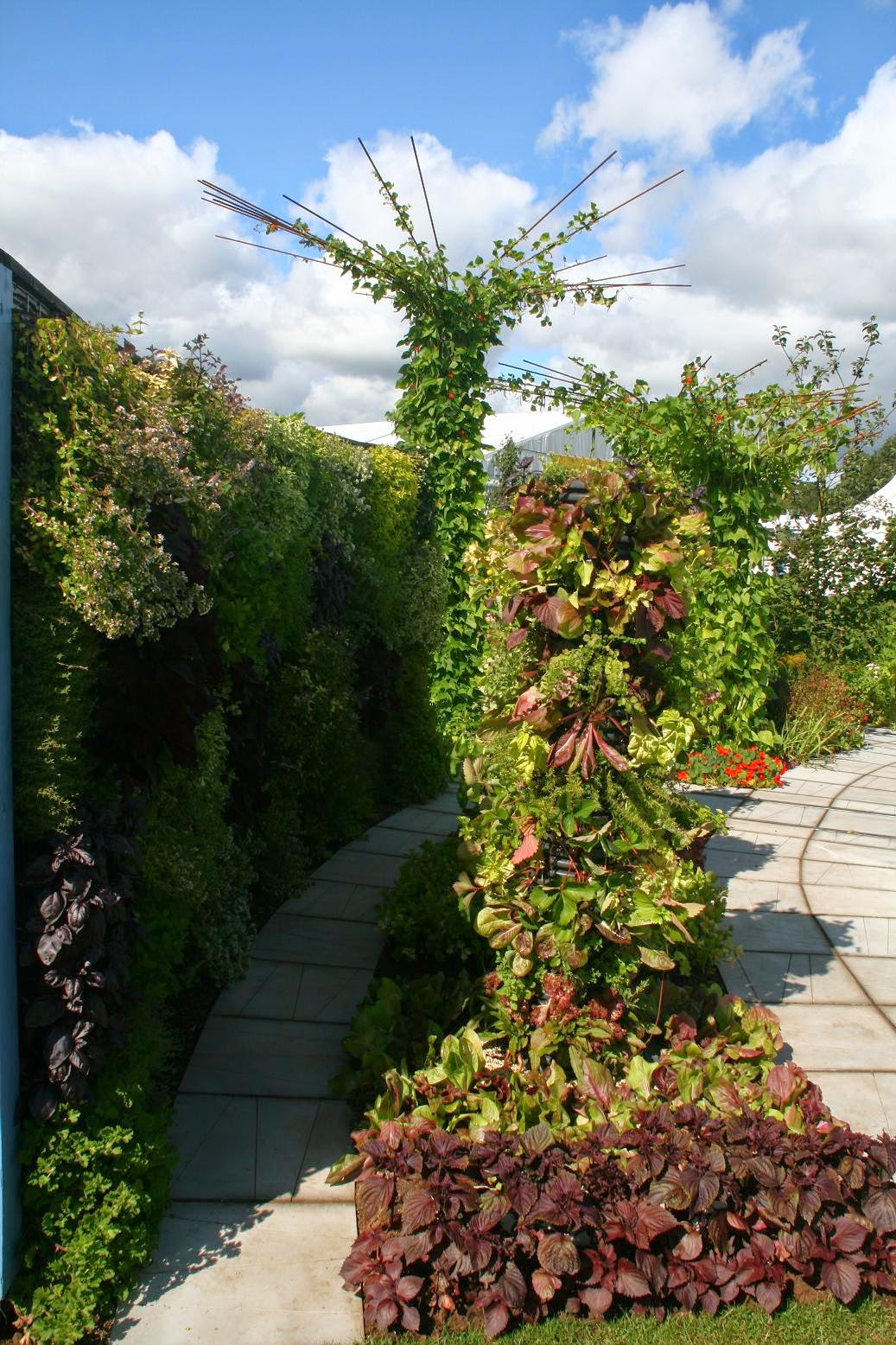
This garden had a rebar construction for its runner beans: apparently I'm not the only one using rebar to construct supports! It also had a rather good green wall, one of which Liz still wants to find a space for.


These garden seats were very good, and next door we saw some very weather resistant swing seats by the well-named Yorkshire Swingseat Company.


(© Ian 2014)


(© Ian 2014)

One feature that we enjoyed was a collection of eight vignette gardens that encapsulated larger gardens' feel in small plots. They're all from Cheshire, and included Arley Hall, which is actually just down the road from Tatton Park, and we thought looked worth a real visit, based on their 'taster' garden.


(© Ian 2014)

The floral marquee was, as ever, phenomenally stocked by nurseries, and although we only bought two plants, the other displays were excellent, and gave us contact details for a number of specialist nurseries. One, near Cambridge, might be a good source of alpines, if we do decide to put a green roof on the mini-sheds. There were a couple of hosta specialists, too, for when we dig the bog garden.


(© Ian 2014)

The two plants we bought were both from the Hampshire Carnivorous Plants: one was a Sarracenia hybrid (a North American Pitcher Plant), which suited us because it actively requires a good cold winter spell, probably in the unheated greenhouse. The other is a dangling/hanging sort of plant, a Monkey Cup called 'Linda' (a hybrid, Nepenthes cv 'Linda') despite being a dioecious male. It now hangs, slightly threateningly, in the sitting room.

For us, though, the Young Designer Gardens were the best. We felt that the television coverage (Thursday and Friday evening) actually let these down, and all three, but particularly Alex Schofield's, were much better in the flesh. In fact, everything else we purchased came from these three gardens.


(© Ian 2014)

Acquisitions were:
  • From Alex Schofield's garden:
    • Brunnera; I need to check the cultivar
    • Astrantia 'Gill Richardson'
    • Sanguisorba (S. officionalis)'Tanna'
    • Sedum (S. spectabile) 'Matrona'
  • From Clare Broadbent's garden:
    • Echinacea 'Secret Love'
    • Eupatorium, I think E. purpureum
  • From Sam Ovens' garden:
    • Scabious 'Pink Mist'

(© Ian 2014)

Wednesday, 23 July 2014

Brassicas

On Friday evening, we lifted the Red Duke of York, the Lady Christl, and some of the International Kidney/Jersey Royal potatoes, as the haulms were clearly going over. They're being washed and bagged up, slowly.

This has created some space, particularly where the earlies were, in the bottom bed, and allowed us to plant out a number of brassicas there yesterday evening: Romanescu cauliflowers, January King savoy cabbages, Mystique cauliflowers, and Rudolph purple sprouting broccoli. We've also sown two rows of Golden Ball turnips, between these and the Defender courgettes. They, incidentally, are just getting into full speed, and producing almost daily courgettes. They seem more upright plants than our previous courgettes, as well as generating better textured (less prone to disintegrating in the pan) courgettes, and I'm rather pleased. I reckon we'll be into a glut in a couple of weeks.
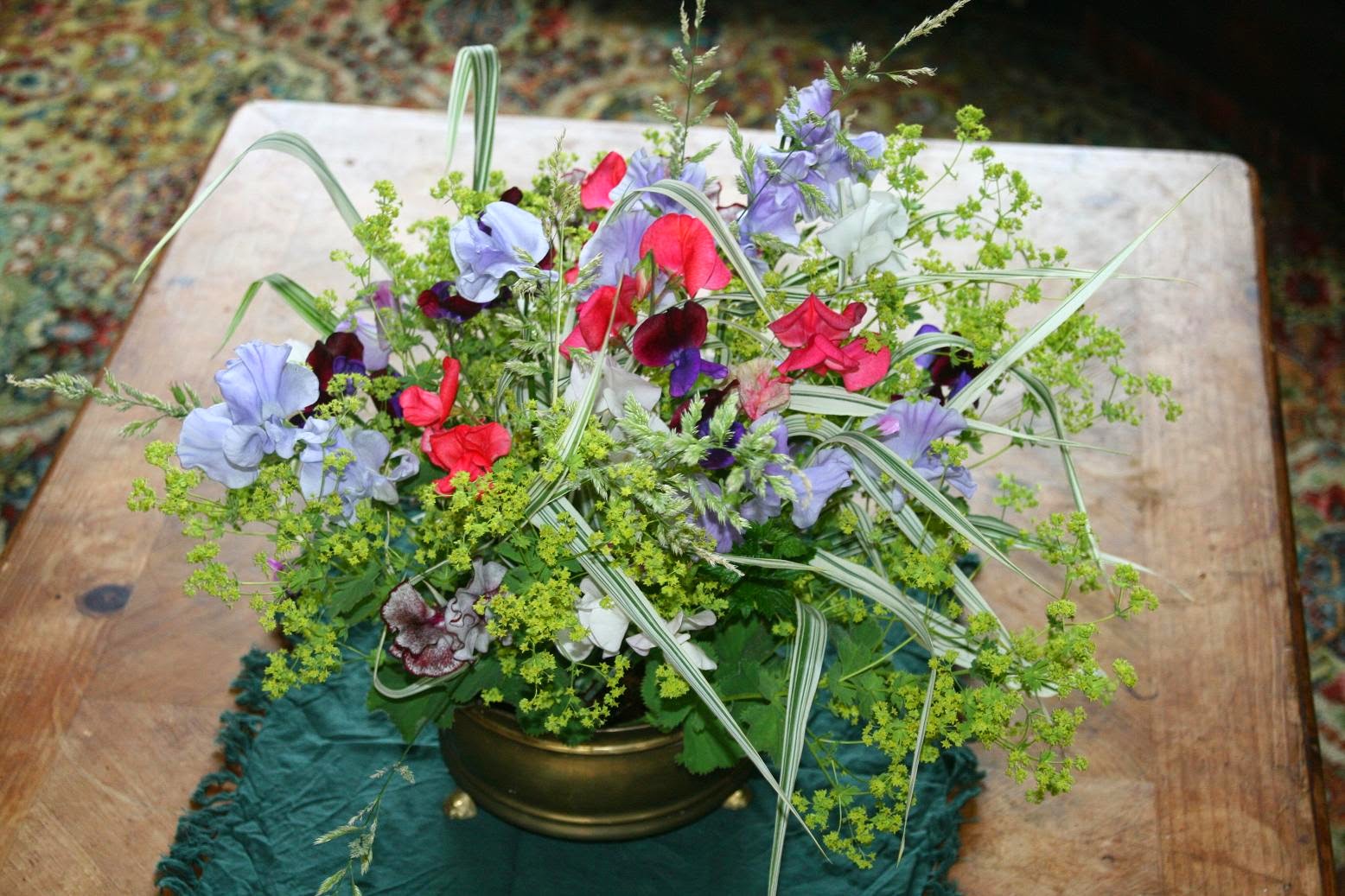
Tonight's been less exciting, as I've mown the lawn—whereas Liz has collected enough sweet peas for eight vases. We're definitely into 'glut' for them.


Sweetpea Centrepiece (© Ian 2014)

Wednesday, 9 July 2014

Flower Arrangements

For which Liz must take the credit.


26th July (photo © Ian 2014)


2nd August (photo © Ian 2014)


9th August (photo © Ian 2014)

And three more window decorations from 9th (all photos © Ian 2014):


Sunday, 6 July 2014

Nettle Cordial


The days started with some weeding, and my finishing off the shed-boxes (needed to add weather strips inside the last two boxes' doors, and paint the floor of the one which has the lawnmower in, as this will often be a bit damp). I also added some extra strings to the willow-less legume frames, as they're starting to get going.

Even though we planted out a great number of things earlier, we still have a lot of small plants growing on, mostly around the greenhouse, or on the weed membrane near the kitchen. Today we managed to plant out a number of these—but there are still lots of pots left! It takes many, many plants to fill half an acre, it turns out.

Into the long border have gone several astrantia (A. major, A. minor, A. maxima, as well as a variegated form from my parents' garden—it might be A. major 'Sunningdale Variegated'); a few trios of coreopsis; some more of our seed-grown Stipa tenuissima; and some geums.

More geums, and some mixed achillea, went into the bed on the games lawn side of the septic tank, to balance it with the other side (the geums there are doing marvellously, and look good set against the new green background of the sheds.

A few spare achilleas, and then some campanulas, aquilegias (Magpie and Royal Purple), and lupins (mixed, hopefully nice colours!) went into the two beds around the sweet peas that aren't looking so good (the back one of the three is pretty good, but the others' wildflowers didn't germinate well.

We also had three little dicentra (with rather darker, single-colour flowers: we're not much taken with the pink & white normal form, but this one, and the all-white we already have, are much more to our taste), which have gone in the copse bed.

A bunch of hardy fuchsias (Hawkshead, Delta's Sarah, and Army Nurse), have been potted up, along with a dozen box cuttings, a number of 'Tail Feathers' grass (Pennisetum macrourum), rose campion, and other achilleas.

Over lunch, we moved the elderflower wine into demi-johns (adding yeast nutrient), and also bottled the nettle cordial which we started a week ago. It looks a brighter colour than last time.


Nettle cordial straining (© Ian 2014)

We had hoped to move a load of chippings onto the weed membranes, but only managed about ten barrow-loads, because first we had raspberries and courgettes to pick. The raspberries are doing much better this year, probably because they've been well mulched last year and this, and we got the pruning right last August. The courgettes are just starting to form: it seems earlier than last year. I think we just about had them in mid/late July, so it's earlier than that. The plants seem to be fruiting at a smaller size, too: I don't know how much of all this is down to the variety (Defender), which is new to us.

It's been a good weekend for cat company: they've been much in evidence.

Hungry cat (© Ian 2014)

A number of seedlings are growing on well, including these dierama, which I'm looking forward to having.

Dierama (RHS seed) two weeks ago... (© Ian 2014)

...and now (© Ian 2014)

Wednesday, 2 July 2014

Last Few Jobs

I'm astonished to say that, of our list of jobs we made on Saturday for the past five days, we've actually done them all. Today, I've turned the compost heaps (decomposing beautifully); replaced the satellite cable and LNB (finally we have two signals to the box, reducing recording conflicts); we've painted the bike shelter (it'll need another coat or two, but there you go); installed the loft hatch in the garage (still so named!); and hung ladder hooks in the same (necessitated by putting a hatch in the hole they poked up through). Liz has done a thorough weed of the long border over the last couple of days, and it's looking loads better. We've also managed to move all the stone (and turf) that we put on the septic tank two years ago when digging the beds on either side. This is because, having transformed the garage, we want to get some of the garden tools out; but, lacking a shed, this is tricky. Our solution (long planned) will be a set of storage cupboards along the septic tank, within the living willow structure we're growing over it. Ideally, these will each have a little green roof, probably planted with alpines (which have their interest mostly in the spring, before the willow gets into full leaf). They arrive on Friday, so in order to assemble them this weekend, the tank top needs to be clear.

Having uncovered it, I've been reminded that two of the five manhole covers don't fit at all well. By which I mean they're alarmingly unstable, and seem too small. The concrete lid sections have also 'drifted' towards the bottom end of the tank. We've pushed them back together, but the covers are irredeemably too small. I shall buy a couple of new ones, and mortar them in, which will make it all rather safer.

While we've been working, the cats have kept us company. Chess found somewhere shady to nap (I don't know how he got through the latticework).


Chess sleeping inside a sweet-pea pyramid (© Ian 2014)

We're almost, but not quite, at the point of enough sweet-peas for every downstairs room.


Liz's sweet-pea (and berberis and alchemilla) flower display for the week (© Ian 2014)

Tuesday, 1 July 2014

Harlow Carr

We spent today at Harlow Carr: the first time, actually, we've been not on a weekend or Bank Holiday. Unsurprisingly, it's much quieter!

We found this in the scented garden, but couldn't see a label, sadly.


The Scented Garden, RHS Harlow Carr (© Ian 2014)


A heavenly almond macaroon (© Ian 2014)


Knautia macedonica, which caught our eye for the wide range of colour (© Ian 2014)


Sweetcorn (Snowbaby and Popcorn Fiesta (this one, with red stems)) in containers in the Bramall Learning Garden (© Ian 2014)


Rhododendron auriculatum in the woodland (© Ian 2014)

When we got home, there was enough time to sow some salad leaves (in pots: direct, they keep getting slugged), and a barrel of carrots.

Tuesday, 24 June 2014

Leeks and Bouquets

One thing we didn't manage to squeeze into an already busy weekend was planting out the leeks, which have really been ready for a couple of weeks. They've had a space planned, of course, in the kitchen garden, although it's meant taking out the over-wintered cabbages, 'Frostie', which were late to heart up. We're going to be eating a lot of cabbage, I predict, over the next couple of weeks. They should stand for a while with their roots in water, hopefully.

Anyway: the leeks. We sowed a couple of pots of Porbello, which we grew last year. With a lot of the seeds this year, I sowed the seeds in seed compost (sterile and fine, but low in nutrients), but with most of the pot pre-filled with normal compost (not sterile, as it's home made, and a bit lumpy, but able to sustain for a lot longer). This has meant that the seeds can germinate in something fine, and with fewer weeds coming up around them, but their roots quickly hit the fertile compost beneath, so they don't get checked in growing. It's also meant that seedlings have been much happier growing on in their pots, and are bigger when we prick them out.

Planting leeks is quite fun, by my reckoning: I have a sturdy plastic dibber, which makes a nice hole about 1½" across, and 5" deep, or so. I push a row of holes (about 6" apart), and drop the separated seedling in. They're tall enough that they poke out a good few inches, and the soil will settle loosely around them when watered in. Some people seem to advocate trimming the roots somewhat (to encourage strong new growth), and correspondingly reducing the leaves (to maintain root:leaf balance), but I haven't ever tried this.

While I did this, and collected what might be the last rhubarb harvest of the year, Liz picked another tub of strawberries (the fifth, I think: they've done well), and flowers. This is the third lot of sweet peas, and the first significant crop: the first two batches were just enough for a small jug. Soon, though, we'll get to the point where up to a hundred new flowers are opening every day; probably in about 4–5 weeks time.


Liz's flower arrangement in brass bowl: sweet peas, Lady's Mantle (alchemilla), and grasses ( Ian 2014)