
We've enjoyed the wildflowers in the orchard this summer, which is one reason why I've left large swathes of it uncut for some time, only clearing paths through it. However, as autumn enters, I've now gone over the entire orchard, cutting it back as close as I can, so that it stays neat, and walkable, over the winter. Heavy work, even in the milder temperature, but it actually only took about three hours, which isn't bad. It looks a lot neater, even with the strewn vegetation.
Before doing that, though, this morning I've painted the arches of the apple walk, coating the steel rebar with cream-coloured metal paint. The arches now really stand out, and will stand the weather much better.
I've planted out the autumn-planting onions (100 Radar) and garlic (30-odd Marco) in the herb garden, through weed-proof membrane.
Last thing, I managed (just, before the light faded and drizzle set in) to mow the lawn. I managed to do the games lawn a while ago, but it's been some time since the rest has been done, and it really needed it. Hopefully, as the weather cools and the days shorten, it'll be a while until I have to do it again. I am hoping to manage to keep trimming it through the winter, weather permitting, this year. I do still need to take the brushcutter to the copse, though, and tidy the verges of the lane, so my grass-cutting isn't over for the year...
Showing posts with label alliums. Show all posts
Showing posts with label alliums. Show all posts
Thursday, 25 September 2014


Friday, 15 August 2014
Onions
We had thought we might get some weeding and lawn-mowing done this evening, but discovered two problems with that plan when we went outside.
Firstly, it was still a bit damp, and the mower doesn't collect wet clippings very well, which means a big raking-up job in addition to the mowing, of which I am not enamoured.
Secondly, there have clearly been deer rampaging through the garden in the last few days, and they've done distressing damage. They've stripped the leaves, flowers, and pods from the runner beans, climbing beans, peas, and French beans (no legumes this year, I suspect, now); nibbled the chicory and Japanese ginger; damaged a forsythia in the copse bed, munched some of a neighbouring heuchera or two; eaten a lot of the strawberry foliage (not necessarily a problem, this one, as that was due for trimming back, anyway); destroyed the last of the spinach; eaten several stems of tay- and loganberries (losing next year's crop); and—as best I can ascertain—done some sort of deer dance on top of the onions. I think it's their route from kitchen garden to games lawn.
Fortunately, the onions were pretty much going over, and ready to be lifted, although they also did a lot of damage to the weed membrane we grow the onions through, which means I'll have to replace, tediously, some of it. Nonetheless, it meant that this evening's job was lifting the onions, trimming their tops, and setting them out on racks in the wood shelter to dry.
We've put some deterrent barriers in what we think the deer's routes in have been: a few gaps in the bottom hedge, some tunnels between kitchen garden and games lawn, and over the wall behind the beech bench. Hopefully that will help. Liz is more sanguine about this than me, and reckons it's a price we pay for enjoying deer roaming on the hillside. I look at the losses and damage to plants, crops, and trees, and think thoughts of venison.
Firstly, it was still a bit damp, and the mower doesn't collect wet clippings very well, which means a big raking-up job in addition to the mowing, of which I am not enamoured.
Secondly, there have clearly been deer rampaging through the garden in the last few days, and they've done distressing damage. They've stripped the leaves, flowers, and pods from the runner beans, climbing beans, peas, and French beans (no legumes this year, I suspect, now); nibbled the chicory and Japanese ginger; damaged a forsythia in the copse bed, munched some of a neighbouring heuchera or two; eaten a lot of the strawberry foliage (not necessarily a problem, this one, as that was due for trimming back, anyway); destroyed the last of the spinach; eaten several stems of tay- and loganberries (losing next year's crop); and—as best I can ascertain—done some sort of deer dance on top of the onions. I think it's their route from kitchen garden to games lawn.
Fortunately, the onions were pretty much going over, and ready to be lifted, although they also did a lot of damage to the weed membrane we grow the onions through, which means I'll have to replace, tediously, some of it. Nonetheless, it meant that this evening's job was lifting the onions, trimming their tops, and setting them out on racks in the wood shelter to dry.
We've put some deterrent barriers in what we think the deer's routes in have been: a few gaps in the bottom hedge, some tunnels between kitchen garden and games lawn, and over the wall behind the beech bench. Hopefully that will help. Liz is more sanguine about this than me, and reckons it's a price we pay for enjoying deer roaming on the hillside. I look at the losses and damage to plants, crops, and trees, and think thoughts of venison.
Tuesday, 24 June 2014
Leeks and Bouquets
One thing we didn't manage to squeeze into an already busy weekend was planting out the leeks, which have really been ready for a couple of weeks. They've had a space planned, of course, in the kitchen garden, although it's meant taking out the over-wintered cabbages, 'Frostie', which were late to heart up. We're going to be eating a lot of cabbage, I predict, over the next couple of weeks. They should stand for a while with their roots in water, hopefully.
Anyway: the leeks. We sowed a couple of pots of Porbello, which we grew last year. With a lot of the seeds this year, I sowed the seeds in seed compost (sterile and fine, but low in nutrients), but with most of the pot pre-filled with normal compost (not sterile, as it's home made, and a bit lumpy, but able to sustain for a lot longer). This has meant that the seeds can germinate in something fine, and with fewer weeds coming up around them, but their roots quickly hit the fertile compost beneath, so they don't get checked in growing. It's also meant that seedlings have been much happier growing on in their pots, and are bigger when we prick them out.
Planting leeks is quite fun, by my reckoning: I have a sturdy plastic dibber, which makes a nice hole about 1½" across, and 5" deep, or so. I push a row of holes (about 6" apart), and drop the separated seedling in. They're tall enough that they poke out a good few inches, and the soil will settle loosely around them when watered in. Some people seem to advocate trimming the roots somewhat (to encourage strong new growth), and correspondingly reducing the leaves (to maintain root:leaf balance), but I haven't ever tried this.
While I did this, and collected what might be the last rhubarb harvest of the year, Liz picked another tub of strawberries (the fifth, I think: they've done well), and flowers. This is the third lot of sweet peas, and the first significant crop: the first two batches were just enough for a small jug. Soon, though, we'll get to the point where up to a hundred new flowers are opening every day; probably in about 4–5 weeks time.
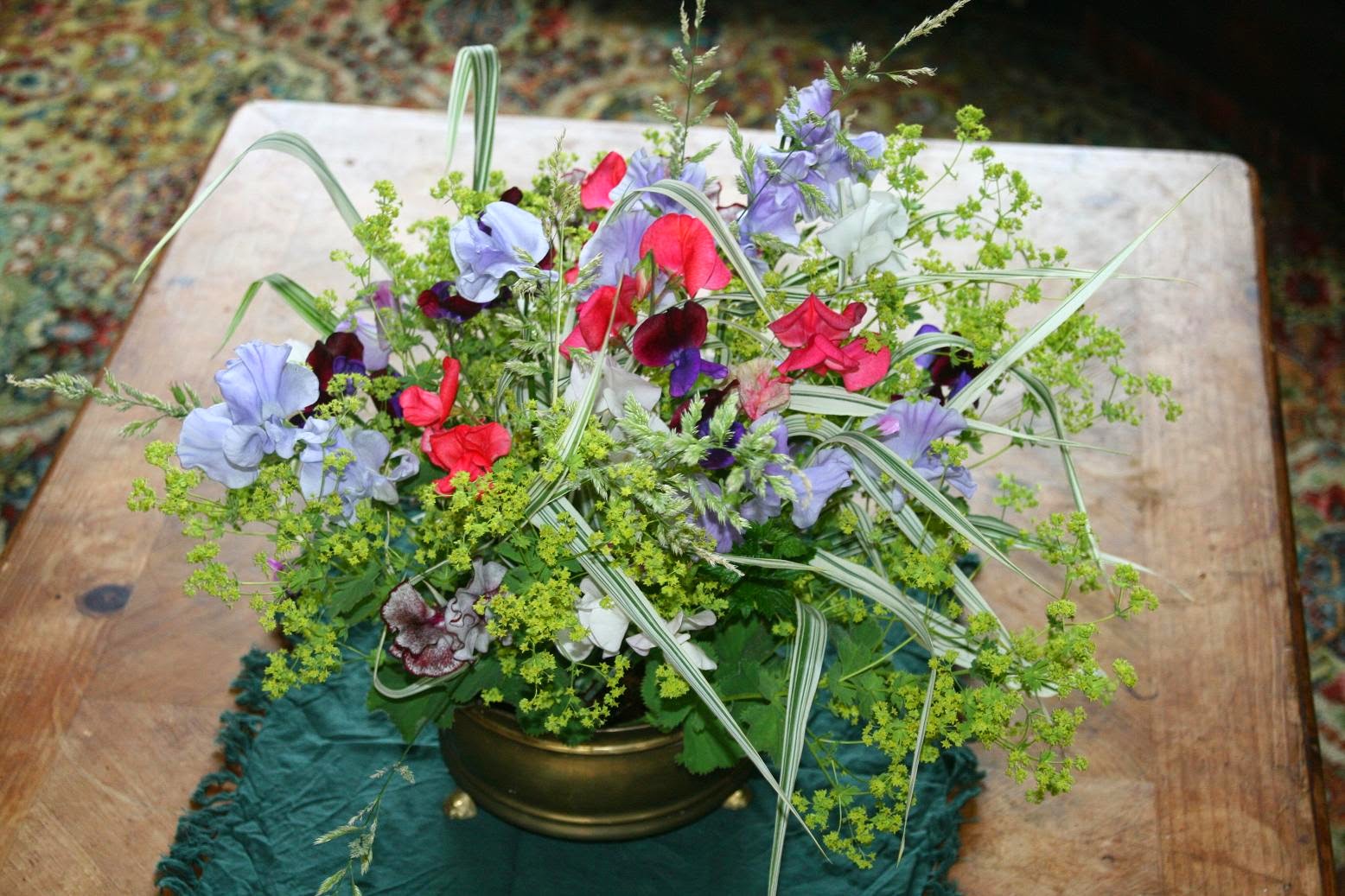
While I did this, and collected what might be the last rhubarb harvest of the year, Liz picked another tub of strawberries (the fifth, I think: they've done well), and flowers. This is the third lot of sweet peas, and the first significant crop: the first two batches were just enough for a small jug. Soon, though, we'll get to the point where up to a hundred new flowers are opening every day; probably in about 4–5 weeks time.
Liz's flower arrangement in brass bowl: sweet peas, Lady's Mantle (alchemilla), and grasses ( Ian 2014)
Sunday, 22 June 2014
Redesigning the Knot Garden
The herb garden's been in the planning for some time, and the design's evolved in the making. Originally, we thought we'd have just box edging, and primarily herbs. We added roses to the planting, and lavender to the edging. Then, when we worked on the design, rather than the concept, we came up with something that needed three edging materials to work well, and so we added step-over apples. The last couple of years of growing the kitchen garden suggested that we actually needed a little extra edibles space, and so we added runner beans, peas, and French beans to the planting -- which helped with height -- and then over-wintered onions, garlic, and elephant garlic. Trying the design last year made it clear that the squares of the design weren't really big enough, so we made them 50% larger. In turn, that meant the design changed, and now we need only two edging types once more. The design, now, is really one of a potager, or ornamental kitchen garden, encompassing roses (technically edible), herbs, apples, and ornamental vegetables -- the attractively podded (and flowered) Shiraz mange tout, Blue Cocoa runner beans, and red/purple Brussels sprouts. Out have gone the inedible box (now to form evergreen box balls in the herbaceous border), and a predominance of herbs.

The oil tank has been waiting for removal for a while, and we eventually found someone who wanted it, thus avoiding having to pay (several hundred pounds) for someone to remove something we didn't want. Getting this heavy steel tank off its piers, missing the greenhouse (just the other side of the protective sheet of ply in the photo), across the patio, down two sleeper-built steps, and the length of the games- and pond gardens, and then up the driveway to the truck was, shall we say, tiring.
But now it's gone, and we have a 6x4 space in which a shed might go -- and now no smell of kerosene on warm days.
Now: back to the herb garden. We'd marked out the pattern (basically unchanged) last time, so apart from fine tuning a couple of measurements that had been hindered by rocks (which Liz made excellent progress moving: it really feels thankless work), we were able to immediately see where each square/diamond went.
Into several of these, I sank the climber supports, which Liz started yesterday by painting (I'd only done some of them). We've not had time to add the woven willow sides, so these will have to wait until autumn. For now, there are strings tied round them to get everything growing: they'll be invisible soon, and the willow will be in place for the winter, when it's actually meant to be an attractive feature.
Having sunk the six supports into the ground, we topped up the soil in all of the squares (but not the edges: lavender doesn't want rich soil) with compost, neatly finishing the 'ready' bay of compost, and started planting. The plants are mostly those that we potted up and set outside a few weeks ago, and included enough lavender to complete those edges that we've cleared space for (almost).
From the greenhouse have come the Laguna, Speedy, and Castendel French beans, the White Lady and Blue Cocoa runner beans, and the Shiraz and Delikata peas/mange tout. We've also planted out 32 red sprouts, a load of chicory, a dozen or so bronze fennel, a pot's worth of aniseed, and the Japanese ginger we bought at Tatton. All that obviously needed watering in, and tying to supports where necessary, and it's meant rather a late finish (I came in at 11, and Liz only came in half an hour earlier, to cook)...but it's looking really good.
This weekend, then, we've spent getting as far as possible with the new design. We got started on clearing the ground a week ago, and (after a vet trip that took much of the morning), continued this yesterday. We finished that by about mid-morning today, and then, in an afternoon punctuated by someone coming to finally take away the oil tank, finished preparing the ground by about 5 o'clock.
The oil tank, half-way out ( Ian 2014)
The oil tank has been waiting for removal for a while, and we eventually found someone who wanted it, thus avoiding having to pay (several hundred pounds) for someone to remove something we didn't want. Getting this heavy steel tank off its piers, missing the greenhouse (just the other side of the protective sheet of ply in the photo), across the patio, down two sleeper-built steps, and the length of the games- and pond gardens, and then up the driveway to the truck was, shall we say, tiring.
But now it's gone, and we have a 6x4 space in which a shed might go -- and now no smell of kerosene on warm days.
Now: back to the herb garden. We'd marked out the pattern (basically unchanged) last time, so apart from fine tuning a couple of measurements that had been hindered by rocks (which Liz made excellent progress moving: it really feels thankless work), we were able to immediately see where each square/diamond went.
Into several of these, I sank the climber supports, which Liz started yesterday by painting (I'd only done some of them). We've not had time to add the woven willow sides, so these will have to wait until autumn. For now, there are strings tied round them to get everything growing: they'll be invisible soon, and the willow will be in place for the winter, when it's actually meant to be an attractive feature.
Having sunk the six supports into the ground, we topped up the soil in all of the squares (but not the edges: lavender doesn't want rich soil) with compost, neatly finishing the 'ready' bay of compost, and started planting. The plants are mostly those that we potted up and set outside a few weeks ago, and included enough lavender to complete those edges that we've cleared space for (almost).
From the greenhouse have come the Laguna, Speedy, and Castendel French beans, the White Lady and Blue Cocoa runner beans, and the Shiraz and Delikata peas/mange tout. We've also planted out 32 red sprouts, a load of chicory, a dozen or so bronze fennel, a pot's worth of aniseed, and the Japanese ginger we bought at Tatton. All that obviously needed watering in, and tying to supports where necessary, and it's meant rather a late finish (I came in at 11, and Liz only came in half an hour earlier, to cook)...but it's looking really good.
Wednesday, 11 June 2014
Task List
I've had today off, though Liz has been working: that made it an ideal day to get a number of little jobs done, and I've had a pleasingly productive day.




It's the time of year when I start trying to get the window frames painted. Last week, two of the last wooden windows on the back of the house were replaced with uPVC, which (in addition to looking rather good, especially for uPVC) means I have two fewer frames to worry about. Of course, the time-consuming Georgian-barred windows on the front are no fewer, and it's those which have always taken the time.
However, before embarking on this year's painting, I decided to install some eye bolts on the front wall, in order to tie down the ladder while using it. I've had enough of bouncing on an unsteady ladder, and don't enjoy working on one at the best of time. The window at the end of the study has always needed a rather extended ladder, as the ground drops off in that direction, and the path has stepped down towards the level of the garage. It's always, therefore, been the worst climb.
To combat this, I've installed two M12 shield anchor bolts (18mm holes, which aren't for the faint of heart, or drill), one on either side of the window, at about 180cm height. Using a ratchet strap passed around each stile and angled down through the bolt, the ladder can now be tightly held in place. The result is revelatory: I felt much more secure, and less conscious of the drop...
That window, and two dining room ones, are now done: I'm only planning to chip away at the painting, with the aim of getting about half done over the next couple of months.
Next, I strimmed the half of the orchard I didn't manage to do eleven days ago. I'm hoping I'll only have to do this regularly for another 12-15 months, and that we can think about a couple of sheep by then.
I've painted some of the remaining legume/sweet pea supports, which means their bituminous feet (the underground bit) are done, and as many of their above-ground elements as I could get to (given that the tarry feet were drying).
I shan't dwell on unblocking the kitchen drain.
The work on the garage has been going on since the end of last week; sorting the foundations took a little while, but the builder started the actual walls yesterday, and has finished them today. The uneven-ness of the walls has complicated things slightly, and none of the windows are going to be quite the same height. The joiner will be along on Monday to measure up, and hopefully the building work will otherwise be done tomorrow. Next up will be the replacement of the dining room window with a set of patio doors.
After lunch, I took the time to do a wander of the garden with camera in hand. It's been a while, but here's where things are up to.
Bees foraging in the wallflower in the front garden (© Ian 2014)
The dining room windows, for now, until the patio doors go in (© Ian 2014)
The sweet pea supports (© Ian 2014)
One of the sweet peas is flowering; several more are on the verge of doing so (© Ian 2014)
The heuchera bed; not sure whether the quince has set fruit (© Ian 2014)
One of the astrantias in the copse bed (© Ian 2014)
The long border in front of the dining room (© Ian 2014)
The mess of the pond aside, the bed next to the septic tank has filled out well, and needs pruning (© Ian 2014)
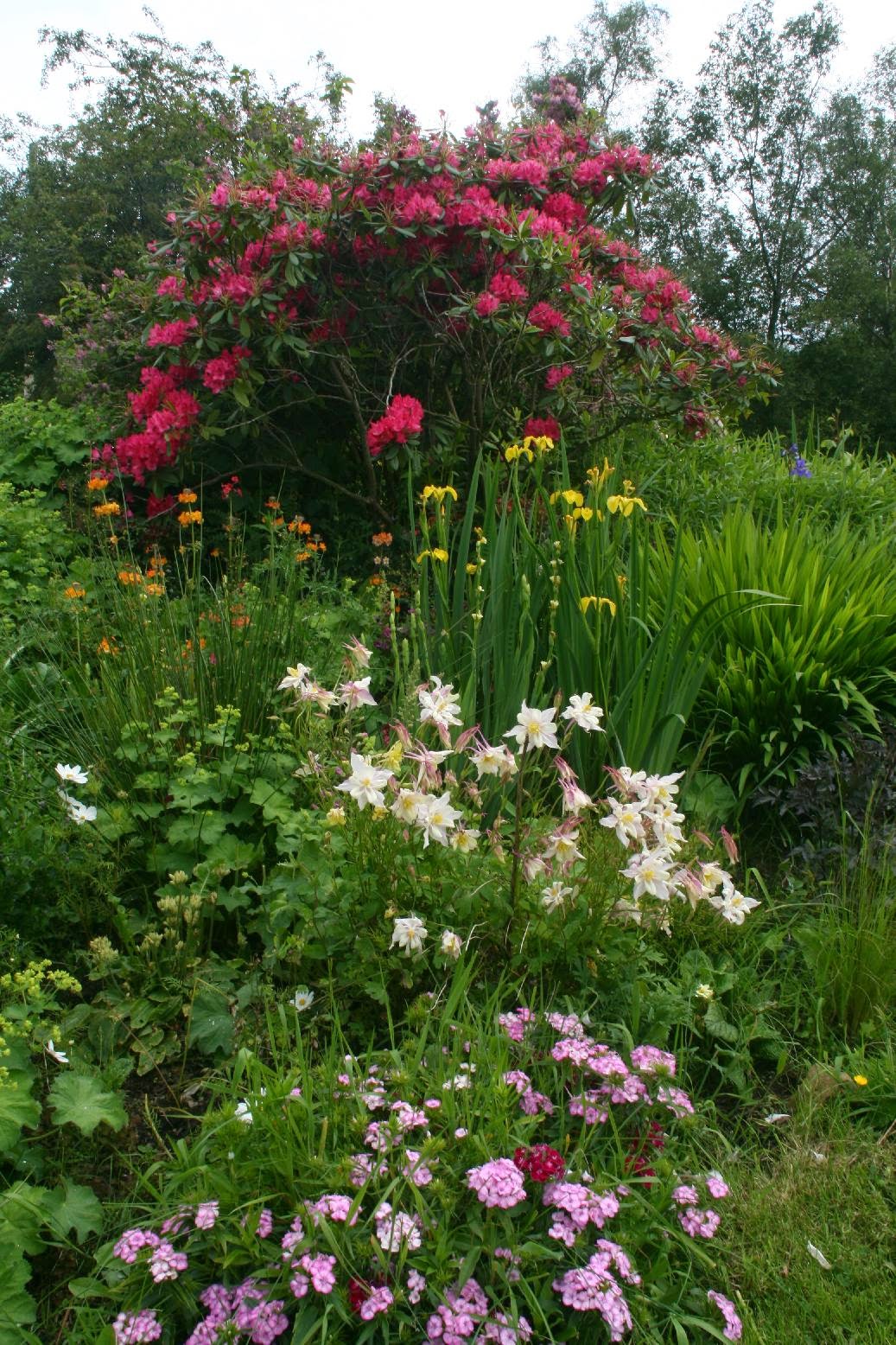
The aquilegia here has gone slightly mad this year (© Ian 2014)
Astrantia flower (© Ian 2014)
Mostly-planted vegetable garden (© Ian 2014)
Red Duke of York potato (© Ian 2014)
Green roof wild flowers, with foraging bees (© Ian 2014)
Green roof on wood store (© Ian 2014)
Day lily which we didn't know was there (© Ian 2014)
Weed-membraned knot garden (© Ian 2014)
Inside the garage before work on the wall/windows (© Ian 2014)
New garage front (© Ian 2014)
Stone cills & jambs being supported while curing (© Ian 2014)
Window apertures ready for windows (© Ian 2014)
Sunday, 8 June 2014
Honey Garlic
Yesterday was spent in the garage loft, putting down the insulation, and boarding as much of the floor as we have material for. It turns out that we had nearly enough to cover the floor, so we've already got a real expanse of storage space. Putting this together pretty much filled what time we had this afternoon, however.

Today was mostly bits and pieces, including a mow of the lawn, tidying up the long border, and clearing weeds from the knot garden.
The Sicilian honey garlic, which we'd both forgotten planting, is coming out. We've been looking at the flower stems for about a week, wondering what it was...conundrum solved.
Sicilian honey garlic (Nectaroscordum siculum) (© Ian 2014)
Wednesday, 7 May 2014
Above Ground
I've had a day at home, starting work on the long-planned permanent support frames for the sweet peas, and vegetable climbers, as well as being around to receive a number of garage-related deliveries.
While in the garden though, I've been delighted to see that the quince is, finally, going to flower this year. The cherries and plums are already doing so (not brilliantly, in the latter's case), and the apples, in the garden and orchard, are on the cusp.
In the vegetable garden, many of the potatoes now have shoots above ground, and a large fraction of the onions have shoots. That's a lot faster than in previous years, for both, which I credit with the later planting, and—therefore—warmer ground.
Sunday, 20 April 2014
First Planting
We've had a busy few days, with friends visiting on Good Friday (much baking), and then getting the vegetable garden ready for the new season of crops. It's never been empty, with leeks, beetroot, celeriac, kale, cabbages, sprouts, and purple sprouting all still in, to say nothing of the green manure (mustard) that I only chopped in a few weeks ago.
We've repeated the system we found worked well last year; 4 (early) or 3 (maincrop) chitted tubers planted at the bottom of a trench, 18" (earlies) or 30" (maincrops) apart. As they come up, we'll backfill the trenches, slowly. The main crop are up the wood-shelter side of the C-bed, with the second earlies along the top. The first earlies are in the bottom bed. The onions are all the way up the right side of the C-bed, leaving a small gap between them and the second earlies (probably a catch crop). The space at the fruit-garden end of the bottom bed will have the courgettes in; there's also space for a catch crop in between, I reckon.
However, we've finally had to lift these, to make space for new things. That's meant that we've been able to spread the last of the mulch, and the beds are all looking lovely as a result. Liz planted out a stretch of spinach, which will come out before we need the room for a later crop, and I prepared the trenches for the potatoes. Today, with a fosterling's help, we planted the 300 onion sets (150 Piroska Red, 150 Stuttgarter), and the potatoes: twenty each of Lady Christl, Red Duke of York, British Queen, International Kidney, and Lady Balfour (two first earlies; two second earlies; and a maincrop).
We've repeated the system we found worked well last year; 4 (early) or 3 (maincrop) chitted tubers planted at the bottom of a trench, 18" (earlies) or 30" (maincrops) apart. As they come up, we'll backfill the trenches, slowly. The main crop are up the wood-shelter side of the C-bed, with the second earlies along the top. The first earlies are in the bottom bed. The onions are all the way up the right side of the C-bed, leaving a small gap between them and the second earlies (probably a catch crop). The space at the fruit-garden end of the bottom bed will have the courgettes in; there's also space for a catch crop in between, I reckon.
It's later than last year, for planting, but the weather's now turning a bit warmer (and we didn't have a chance earlier!), so hopefully they'll grow quickly.
With the last of the time, we tried making our own potting compost: a 50:50 mix of compost and leaf mould, which we sieved together. There's some potting up we'll need to do later this week, which it'll be used on.
Tuesday, 22 October 2013
Bottled Apples
We made a late start to things today, as we had a team round to survey for wall insulation. That done, we donned boots, and got out to plant our spring-flowering bulbs.
We got as far as the light would let us, and then came in to bottle some apples. Each 2l kilner jar takes a kilo of apples, peeled, cored, and sliced. They go in the oven at 140°C for 50 minutes, then you add boiling water and seal. Very straightforward, and they will hopefully keep for a year.
- 100 mixed daffodils
- 70 mixed dwarf daffodils
- 300 Puschkinia Libanotica
- 100 Iris Reticulata 'Pixie'
- 200 mixed Chionodoxa
- 50 Narcissi Tête-à-Tête
- 25 Purple Blend Tulips
- 40 Ard Schenk crocuses
- 20 mixed hyacinths
- 200 mixed species crocuses
- 20 Camassia quamash
- 10 Fritillaria meleagris
- 12 Nectaroscordum siculum (honey garlic)
- 16 Allium aflatunese
- 24 Allium sphaerocephalon
- 50 Allium caeruleum, and
- 10 Allium 'Purple Sensation'
We got as far as the light would let us, and then came in to bottle some apples. Each 2l kilner jar takes a kilo of apples, peeled, cored, and sliced. They go in the oven at 140°C for 50 minutes, then you add boiling water and seal. Very straightforward, and they will hopefully keep for a year.
Sunday, 29 September 2013
Of Steps and Stones
We continued digging out the herb garden/knot garden a week ago, in order to get the elephant garlic and normal Pink Germidour garlic into the ground, but couldn't get any further in the time, because it's such hard work digging out all the stones. We went back to it this weekend, and spent both Saturday and Sunday mornings on the task. I'd already lifted sufficient turf, so we just had to dig over the ground to make space for three more 'diamonds' of the design, in order to plant out the Radar over-wintering onion sets (36 per diamond). There were a few massive stones, and a lot of middling and small ones: red bricks, and dressed stone as well as random field stones.
Finally, we had the ground ready, and in went the onions. Yesterday afternoon was then a plumbing/electrics session for me: replacing the instantaneous water heater, which blew up while Ann and Alan were with us, with a new 10l storage heater. Although this requires a bit more notice (about 20 minutes to heat through), it has the big advantage of only drawing 2kW, instead of 9.5kW: 2kW can, realistically, be provided by the solar panels a lot of the time, which means hot water for free. (Obviously, 4kW of solar panels would only rarely make a contribution to 9.5kW, and never meet it.) It's also rather well insulated, and the water stays hot for a few hours, so it can be run off the solar panels mid-afternoon, and used that evening.
While I did that, Liz made two chutneys: the Windfall chutney we made two years ago, and a date and apple chutney that's new to us. Both seem tasty, but of course most chutneys improve (sometimes considerably) with 12-24 months maturation.
This afternoon, we finally got round to building some terracing steps from the back patio (outside the workshop door) down to the middle lawn. The grass slope there, aside from being impossible to keep mown, becomes impossibly slippery when muddy and wet: given that it's my route from wood shelter to boiler, this was a problem. I cut level bases for two sleeper sized risers, and filled the tread with a stone/brick retaining wall (so the sleeper isn't taking the weight) and topped with soil. We've then spread weed-proof membrane over the top, and put down chipped bark. It looks an awful lot smarter, and should be much nicer for walking over. At the same time, Liz sorted out the main path through the kitchen garden, where the uncovered membrane had rucked, and spread a few barrows of chippings on that, which has been planned for years.
Lastly, this evening, we've cooked down 4kg of elderberries to 4l of liquid, as the first part of making spiced berry cordial. We've only used elderberries this year, as it's a whatever-is-to-hand recipe. In the morning, I'll add the pectolase, and then we can strain, spice and sugar it. The recipe's for 500g of sugar per kilo of fruit (so, 2kg), and two cinnamon sticks, 27 cloves, and 9 teaspoons in total of ginger, allspice, and nutmeg (proportions as I see fit!). It's simmered for five minutes, and bottled.
Sunday, 22 September 2013
Extending the Knot Garden
Ann and Alan were with us for the weekend, but as they had to set off home after breakfast, we've had a day getting on outside. We're going to try planting the overwintering alliums in the knot garden, from now on, to give ourselves a little more flexibility in getting the autumn brassicas into the ground. This year, several of these (notably the romanesco cauliflowers and sprouts) went in a bit late, because the onions and garlic were late, because of the spring. It doesn't look, now, as though the sprouts and caulis are going to do very well.
So, if we get the overwintering onions into the herb garden, the brassicas can be planted out as soon as they're big enough, instead of waiting for their space to be free. To that end, we lifted enough turf for half a dozen more 'knots', and started digging it over. The ground's horrible, though: full of stones, and so we were only able to finish two. Fortunately, that's enough space for sixteen elephant garlic, and 25 'Pink Germidour' garlic. The onions will have to wait another week.
Wednesday, 28 August 2013
Mulberry
It's been a busy couple of days, but it somehow doesn't feel like we've got too much done.
Today was mostly spent getting the mulberry ('Jerusalem') in the ground. We had to take down a hawthorn that occupied the spot (we didn't feel it was earning its keep, and it was rather prominent), which was straightforward. Digging the hole went reasonably well, until I uncovered two massive stones: one about 250kg, the other about 100kg. Eventually, we managed to drag them down the hill to the boundary (using fence posts as sleds), where the bigger will hopefully form a bridge over the ditch, and the smaller will be incorporated into the wall as I rebuild it.
Once they were out of the way, we followed the same protocol as before: big hole, incorporate compost, ensure there's good drainage with a ditch leading out, and then a square metre of weed-membrane on top. An eight-foot post and 35cm diameter chicken-wire cage completes it. We'll water it in for the next week, to help it establish, but it's looking good.
I then made a wooden planter trough that will sit on top of the (somewhat pointless) gravel bed outside the workshop door, on the back patio. There's nowhere near enough soil for anything to grow, but with an extra 30cm deep, 30x170cm trough, we'll have somewhere to plant three goji berries we bought in January last year, and which have been consigned to pots since. We'll give the wood a coat of fence paint on the inside, and line it with plastic.
Yesterday was a day in the kitchen garden: weeding, turning the compost bins (almost full), cutting down fruited raspberry canes to make space for the new canes (next year's crop), lifting the rest of the onions (which went in in mid-May: Rumba, Fen Early, and Red Fen). They're now in the woodstore, on racks, to dry off.
Monday, 29 July 2013
Netting
Our visit to Tatton Park was bracketed by days at home, which we mostly spent outside, of course. Saturday was dominated by going over the hillside with the brushcutter, cutting the grass, and removing or weakening as much of the brambles, gorse, rush-grass, and ragwort as possible. It's hot and hard work, but the hillside is definitely showing improvement. This time last year, it would have been tricky to get to the two 'best' apple trees, and barely possible to get to the other three or so—and impossible to reach the track up into the middle levels or hill-top.
Now, the orchard is easy to walk around, and the main clearing of the middle level is accessible. The bracken there, which I've now cut down three times, is still coming up, but not strongly. By comparison, the bracken on the other side of the wall, and further along the hill, where I've not done anything, is six feet tall, and impenetrable.
I have to confess that we saw a rather fine summer house at Tatton Park, one of the Malvern Collection. It's a few years off, yet, though, but it was very nice, and would be a lovely, secluded hideaway on the hillside.
Enough of that. Otherwise, on Saturday, I checked that the newly installed sprinkler on the woodstore's green roof is working, and established that my beer is ready for barrelling. The chardonnay I started at the same time, incidentally, is in the cellar clearing, and is probably ready for bottling. The dandelion is slowly clearing, having finished its vigorous fermentation; the elderflower is on a warm windowsill, bubbling furiously.
Monday was more varied, although we had to contend with showers. The butterfly netting is now up, covering the two plantings of brassicas (which replaced the alliums in the Q-bed, and the early potatoes up one arm of the C-bed). The sprouts, kale, cauliflowers, purple sprouting, and swedes have all settled in fine, and the rows of 'Golden Ball' turnips we sowed at the same time have germinated well.
We discovered a pot of leeks, which hadn't been planted out, so we filled a few gaps in the rows of leeks where tiny seedlings hadn't transplanted (only about three of thirty, and those three were properly tiny), and put the rest in spaces among the autumn onions. The earliest of these, Early Fen, looks like it's nearly ready. On a similar note, the garlics (Germidour) and summer onions (Radar), which are drying in the wood shelter, are coming along nicely.
We've found that we've been losing a lot of courgettes before they get to a sensible size, rotting from one end. On investigation, I think it's where the flower has started to rot, and this has spread into the fruit. To combat this, I'm going to try to remove the flower as soon as it's gone over, and let the fruit swell. Jenny & Philip are away, so we're also picking their fruit and veg (and sweet peas!), which means we're inundated with courgettes.
The hanging baskets, which we tried with dangling nasturtiums for the first time, are looking splendid: I must get a photo of the front of the house. I'm trying to remember to regularly feed them: strangely, the two on the front of the house proper (rather than on the porch extension) are doing less well, though they get more light (marginally).
Once that, and some weeding, was all done, we spent a little while clearing some spaces for our flower show purchases, before going in for lunch. This afternoon I've spent preparing David and Anne's wedding present: but more on that after their wedding...
Now, the orchard is easy to walk around, and the main clearing of the middle level is accessible. The bracken there, which I've now cut down three times, is still coming up, but not strongly. By comparison, the bracken on the other side of the wall, and further along the hill, where I've not done anything, is six feet tall, and impenetrable.
I have to confess that we saw a rather fine summer house at Tatton Park, one of the Malvern Collection. It's a few years off, yet, though, but it was very nice, and would be a lovely, secluded hideaway on the hillside.
Enough of that. Otherwise, on Saturday, I checked that the newly installed sprinkler on the woodstore's green roof is working, and established that my beer is ready for barrelling. The chardonnay I started at the same time, incidentally, is in the cellar clearing, and is probably ready for bottling. The dandelion is slowly clearing, having finished its vigorous fermentation; the elderflower is on a warm windowsill, bubbling furiously.
Monday was more varied, although we had to contend with showers. The butterfly netting is now up, covering the two plantings of brassicas (which replaced the alliums in the Q-bed, and the early potatoes up one arm of the C-bed). The sprouts, kale, cauliflowers, purple sprouting, and swedes have all settled in fine, and the rows of 'Golden Ball' turnips we sowed at the same time have germinated well.
We discovered a pot of leeks, which hadn't been planted out, so we filled a few gaps in the rows of leeks where tiny seedlings hadn't transplanted (only about three of thirty, and those three were properly tiny), and put the rest in spaces among the autumn onions. The earliest of these, Early Fen, looks like it's nearly ready. On a similar note, the garlics (Germidour) and summer onions (Radar), which are drying in the wood shelter, are coming along nicely.
We've found that we've been losing a lot of courgettes before they get to a sensible size, rotting from one end. On investigation, I think it's where the flower has started to rot, and this has spread into the fruit. To combat this, I'm going to try to remove the flower as soon as it's gone over, and let the fruit swell. Jenny & Philip are away, so we're also picking their fruit and veg (and sweet peas!), which means we're inundated with courgettes.
The hanging baskets, which we tried with dangling nasturtiums for the first time, are looking splendid: I must get a photo of the front of the house. I'm trying to remember to regularly feed them: strangely, the two on the front of the house proper (rather than on the porch extension) are doing less well, though they get more light (marginally).
Once that, and some weeding, was all done, we spent a little while clearing some spaces for our flower show purchases, before going in for lunch. This afternoon I've spent preparing David and Anne's wedding present: but more on that after their wedding...
Monday, 22 July 2013
Brassicas
Having taken up the over-wintered onions and garlic, and also the adjacent spinach, we had space to plant out the brassicas, which have been growing on in increasingly large pots, waiting for their allotted space to free up. So, in went nine scarlet kale, nine purple sprouting broccoli, nine Brussels sprouts, nine January King cauliflowers, and fifteen swedes. We still need to plant out the other cauliflowers, sow the turnips, and add the Frostie cabbages, which are going where the potatoes are gradually coming out.
Sunday, 21 July 2013
Sweet Peas
The sweet peas are at that glorious stage where, the morning after you pick the whole obelisk-worth of flowers...there's more open.
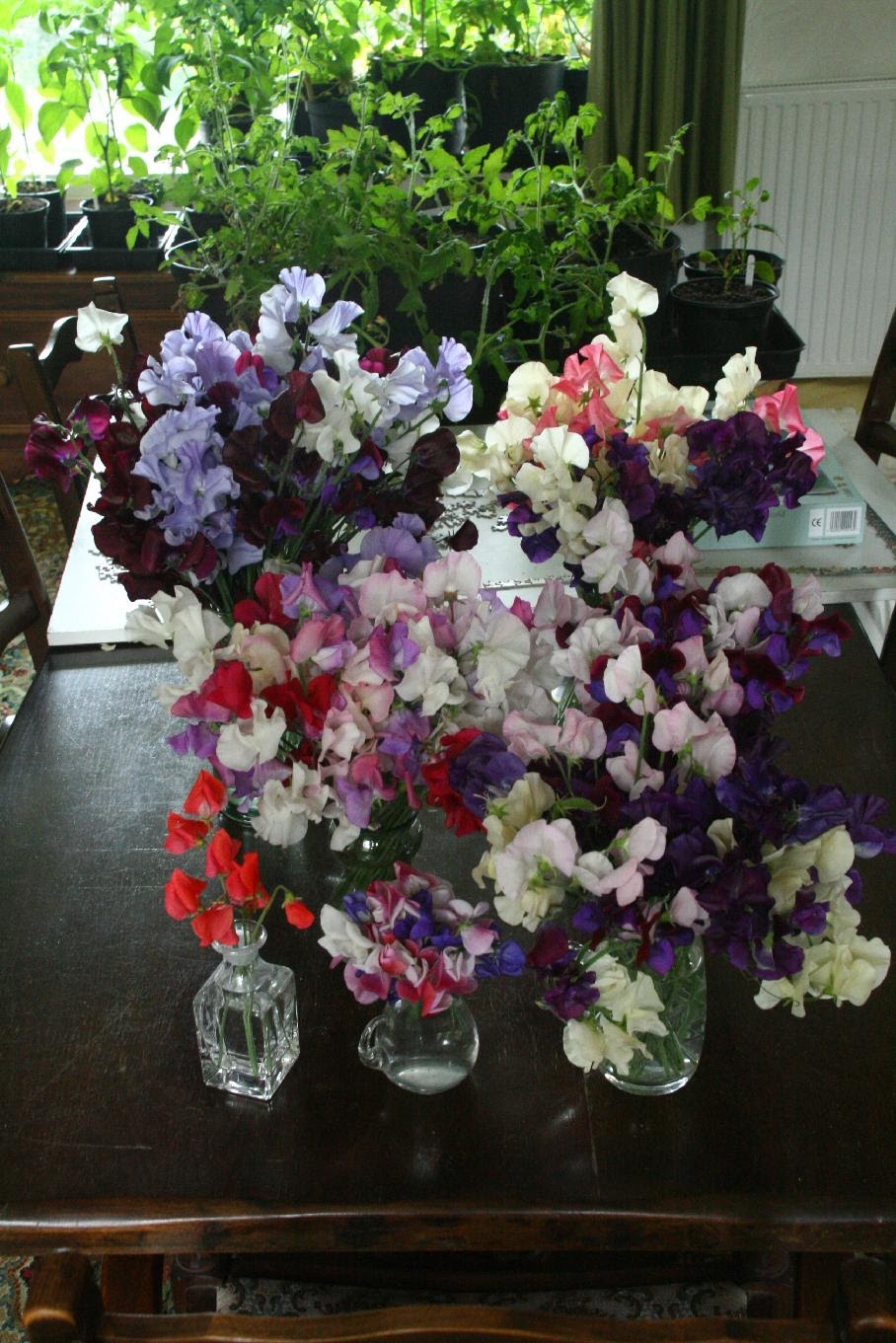
We also lifted the Lad Christl potatoes, having taken up the Swift a little while ago. The yield's noticeably higher (16.8kg of Lady Christl, against 6.3kg of Swift), but not as high as I expected (which would have been about 20kg). They're also not looking fabulous: quite a lot of marking.
Sweet peas ( Ian 2013)
In addition to this, we've had an uneventful weekend, tidying up firewood, lifting the Radar over-wintered onions, the Germidour garlic, and the Elephant garlic (all looking good, and racked in the woodstore to dry over the next few days), and doing odds and ends.
We also lifted the Lad Christl potatoes, having taken up the Swift a little while ago. The yield's noticeably higher (16.8kg of Lady Christl, against 6.3kg of Swift), but not as high as I expected (which would have been about 20kg). They're also not looking fabulous: quite a lot of marking.
Sunday, 19 May 2013
Planting Out
A mixed day, of sorting and planting. We've planted sweet peas around the supports in the new flower bed (I'm going to have to think of a better name); about a dozen plants around each of the smaller wigwams, and about eighteen around the large, central obelisk. We've tried to pair the varieties so that they're distinct, but complementary, so we can identify which one the flowers that we like are from.
We also planted the mangetout plants ('Delikata') on a support in the herb garden, and also planted out the snow-in-summer (Cerastium) and centranthus (C. ruber 'Snowcloud') in a different square. Two squares now have asparagus peas sown in them, and we also planted the eighteen decent box plants we have, and about fifty mixed lavenders, on the edges.
That's reinforced our need for a lot more box plants!
In the kitchen garden, we've planted out thirty-odd spinach plants, and a few modules of salad leaves. The potatoes almost all needed their trenches topping up, too. Pleasingly, the onions seems to have almost unanimously found their way through the holes in the weed-suppressant membrane, and their shoots are growing on.
We've potted on forty celeriac, and Brussels sprouts and caulis, to grow on before planting out in the next couple of months.
I think there's some sign, finally, of the wildflowers on the green roof germinating, which is a relief.
Elsewhere in the garden, the second cherry (Stella) has been in flower for a couple of days, which means it's overlapped with Summer Sun -- hopefully that will mean we finally get a cherry crop. The bluebells are in full swing, which makes that bank look lovely, and the pots of tulips are going strong, making a good display from the kitchen window.
We finished the day sowing some more pots of vegetables: swedes (Golden Ball), cauliflowers (Triomphant and Romanesco), dwarf French beans (Speedy and Castendel), some ornamental sunflowers (Bicentennial and Pastiche), and then planted out a few primroses and geums (which have been around for ages: I think they're Lady Strathden, but I could be very wrong).
Tuesday, 14 May 2013
Spring Creeping Forward
We were visiting Ann and Alan for the weekend, which meant nothing happened in our garden (though we did do a few bits in theirs on Sunday morning, which was rather pleasant (I'm envious of their lovely soil)). However, I managed this evening to walk round the garden, and see how things are coming on.


I made my way down to the kitchen garden, and was delighted to find a bee busily working on the currant and gooseberry flowers. I think it was a common carder bee, but I'm not sure.


Spring has not made itself abundantly obvious (still pretty cold), but things are definitely livening up. There are lots of daffodils out (and many going over):
The Copse Bed (© Ian 2013)
Daffodils, including 'Minnow' (orange corona) and 'White Lion' (white perianth, creamy double corona) (© Ian 2013)
Copse bed, looking up past the new flower bed (with sweet pea wigwams) to the Colour Wheel (© Ian 2013)
I made my way down to the kitchen garden, and was delighted to find a bee busily working on the currant and gooseberry flowers. I think it was a common carder bee, but I'm not sure.
Bee pollinating gooseberry flowers (© Ian 2013)
A little further on, the rhubarb is doing magnificently. One or two of the crowns are either small, or missing, but that's not too bad: there are at least two of each variety doing fine, so I can split these later to fill the gaps.
Rhubarb growing strongly (© Ian 2013)
I remember when it looked like this:
The Rhubarb Bed under construction (© Ian 2011–13)
The first/second early potatoes are doing well, and need earthing up a bit: and the maincrop are now showing above the soil (and so also need earth filling into their trenches). The PSB and cauliflowers are going over, so we need to get them eaten. Almost all of the onions are now poking through the weed-proof membrane, which is very encouraging.
On my way back to the house, through the middle lawn, I spotted two last things. The Japanese Quince is nearly flowering, and the cherry 'Summer Sun' is flowering, which it didn't manage last year. Perhaps this year will see our first cherries, the 'Stella' never having borne any.
Flowers on cherry 'Summer Sun' (© Ian 2013)
Sunday, 14 April 2013
Seedlings
The last of the six cubic metres of topsoil is now cleared from our driveway. Most of the load went on the green roof: we then put a fair bit onto the vegetable beds, which all needed topping up. Two barrow loads went to one side, ready for today's potting-up, and the rest is heaped on the old shed base.
Liz had a fantastic idea, while we did this: re-purposing the old coal bunker as a soil bunker. We typically need quite a bit of soil over the course of a year, for potting things up. There's nowhere neat and tidy to store that much (after all, we're talking about the equivalent of at least a dozen garden centre bags of compost), but it's cheaper (and easier) to buy in bulk. At the same time, we've been eyeing up the coal bunker outside the back door, and thinking 'What use are you?'.
Liz put these two trains of thoughts together, and so (as ever) when we get round to it, we'll empty the coal bunker of the rubbish that's in it (some coal, some kindling, some real rubbish, I expect); I'll construct some sort of better-suited hatch, and we'll start using it to store potting-type compost. Garden compost, of course, will stay in the composting bays until it's needed, but potting compost, which gets brought on-site, can live here.
Having moved the soil, we decided that it's warm enough to plant out the potatoes and onions. For the last two years, we've done this earlier (potatoes on 2nd April 2011, and 1st April 2012: onions on 27th March 2011 and 1st April 2012), but the weather's been so perishingly cold that we've waited. It's now warming up, and looking like it'll stay warmer: it's been averaging about 4°C for the last month, and we haven't wanted to put these into cold soil.
As before, we've done the potatoes in trenches, which we'll fill up. I'm not sure it has any practical impact on their success, but it's nice to be able to keep an eye on how they're growing, so we persist. The trenches are, as before, 18" apart, but we put four tubers in per row, as they haven't felt like the extra space (three per row) was needed in previous years. For now, it's just the earlies: Swift, Lady Christl, and Kestrel. The first and last are new to us; Lady Christl has long been a favourite. In a week or two, we'll put in the maincrop Druid tubers, which get more space: 30" between rows, and three per row. Our experiment in 2011 suggested that this spacing increased the yield (in kg/m2), which is what we're after.
The onions have previously been planted straight into the ground, which has worked fine in many ways, but leads to a very time consuming and tedious job of weeding. Spaced just 6" apart, there's not space to hoe, but onions suffer badly if they're swamped by grass and chickweed and buttercups. Which they get, unweeded. To try to combat this, instead we have planted them through the weed-suppressing membrane with which we've been warming the soil for the last couple of weeks. I worked down the sheet, cutting a cross every 6" by 6", and planted through these. Weighed down along the edges with stones, the membrane seems to be holding in position (necessary, if the shoot of the onion is to find the hole!). We'll now have to see whether (a) it cuts down on weeding, (b) the foliage escapes and grows well, and (c) the membrane interferes in the bulb swelling. Anyway: a hundred of each of Fen Early, Red Fen, and Rumba. The over-wintered onions (Radar) and Germidour garlic, along with the Elephant Garlic, are all doing reasonably. They've been in since September, and although they took a while (the Elephant especially) to get going, they all appear to be doing well. Inevitably, we've lost some Radar to the cold weather, but the garlics appear (at last count) to have all survived.
Today was a mammoth pricking out and potting up exercise. The petunia seedlings are the worst, so we started with them: probably a hundred seedlings, and I only sowed three 3" pots. They're tiny and irritating, because they have almost no root, which also means they almost unfailingly wilt, and I worry about whether they'll survive. Better were the achilleas: A. millefolium, and 'Summer Pastels', which were pleasing plantlets. The tomatoes (also very wilt-y) are now in individual pots, as are the chillis and peppers. We didn't get to the cineraria, but managed the brassicas (couple of dozen sprouts, and about 50 kale, not all of which will be planted out, or will be eaten as greens when small). The celeriac have finally germinated (I think they were too cold to start with), and we're going to have loads of seedlings. We weren't sure the seed would be viable next year, so I sowed the lot, and there are probably about 200 seedlings. I don't like celeriac quite that much, so we'll thin them gradually to the strongest seedling in each module, for around 35-40 to plant out. The sweet peas are now all potted on, and outside with twigs to clamber, except a few that aren't quite as hardy.
We've then sown some more seeds: leeks (Prizetaker, again), peas (Delicata mange-tout), salad leaves (a spicy mix, a more mellow mix for me, Lollo Rosso, and wild rocket), courgettes (a pack of five, of three varieties, which look fun), purple sprouting, 'Mystique' cauliflowers, carrots (Early Nantes, Amsterdam Forcing, and Autumn King), and Festuca blue grass. (No, that's not a vegetable.)
The window-sills are pretty packed, already: that greenhouse is looking more necessary every spring.
Lastly: today is Daffodil Day -- that is, the first daffodils are open in the garden.

As before, we've done the potatoes in trenches, which we'll fill up. I'm not sure it has any practical impact on their success, but it's nice to be able to keep an eye on how they're growing, so we persist. The trenches are, as before, 18" apart, but we put four tubers in per row, as they haven't felt like the extra space (three per row) was needed in previous years. For now, it's just the earlies: Swift, Lady Christl, and Kestrel. The first and last are new to us; Lady Christl has long been a favourite. In a week or two, we'll put in the maincrop Druid tubers, which get more space: 30" between rows, and three per row. Our experiment in 2011 suggested that this spacing increased the yield (in kg/m2), which is what we're after.
The onions have previously been planted straight into the ground, which has worked fine in many ways, but leads to a very time consuming and tedious job of weeding. Spaced just 6" apart, there's not space to hoe, but onions suffer badly if they're swamped by grass and chickweed and buttercups. Which they get, unweeded. To try to combat this, instead we have planted them through the weed-suppressing membrane with which we've been warming the soil for the last couple of weeks. I worked down the sheet, cutting a cross every 6" by 6", and planted through these. Weighed down along the edges with stones, the membrane seems to be holding in position (necessary, if the shoot of the onion is to find the hole!). We'll now have to see whether (a) it cuts down on weeding, (b) the foliage escapes and grows well, and (c) the membrane interferes in the bulb swelling. Anyway: a hundred of each of Fen Early, Red Fen, and Rumba. The over-wintered onions (Radar) and Germidour garlic, along with the Elephant Garlic, are all doing reasonably. They've been in since September, and although they took a while (the Elephant especially) to get going, they all appear to be doing well. Inevitably, we've lost some Radar to the cold weather, but the garlics appear (at last count) to have all survived.
Today was a mammoth pricking out and potting up exercise. The petunia seedlings are the worst, so we started with them: probably a hundred seedlings, and I only sowed three 3" pots. They're tiny and irritating, because they have almost no root, which also means they almost unfailingly wilt, and I worry about whether they'll survive. Better were the achilleas: A. millefolium, and 'Summer Pastels', which were pleasing plantlets. The tomatoes (also very wilt-y) are now in individual pots, as are the chillis and peppers. We didn't get to the cineraria, but managed the brassicas (couple of dozen sprouts, and about 50 kale, not all of which will be planted out, or will be eaten as greens when small). The celeriac have finally germinated (I think they were too cold to start with), and we're going to have loads of seedlings. We weren't sure the seed would be viable next year, so I sowed the lot, and there are probably about 200 seedlings. I don't like celeriac quite that much, so we'll thin them gradually to the strongest seedling in each module, for around 35-40 to plant out. The sweet peas are now all potted on, and outside with twigs to clamber, except a few that aren't quite as hardy.
We've then sown some more seeds: leeks (Prizetaker, again), peas (Delicata mange-tout), salad leaves (a spicy mix, a more mellow mix for me, Lollo Rosso, and wild rocket), courgettes (a pack of five, of three varieties, which look fun), purple sprouting, 'Mystique' cauliflowers, carrots (Early Nantes, Amsterdam Forcing, and Autumn King), and Festuca blue grass. (No, that's not a vegetable.)
The window-sills are pretty packed, already: that greenhouse is looking more necessary every spring.
Lastly: today is Daffodil Day -- that is, the first daffodils are open in the garden.
Spring bulbs in the arbour corner (© Ian 2013)
Sunday, 9 September 2012
300
Yesterday's post marked three hundred entries! I've written less often this year, probably because of diversions from the garden and house, and a poor growing year. Nonetheless, it's a milestone for me.
In other, more interesting news, we've had a really good day in the garden. We started by going out picking blackberries, and came home with a couple of punnets. They've not really hit the peak of ripening, so we'll probably go out again no sooner than next weekend. This first harvest is ten days later than last year, out of interest: that's in line with my guess that most things are a week or two late this year.
Liz has, over the last week, lifted all the maincrop potatoes (Bounty and Cara), which have been really disappointing. I haven't weighed them yet, but there's nothing like the number we got last year. Because the conditions have been abnormally awful, we can't know if it's to do with the change of variety (it was Druid last year). However, I think we'll go back to Druid, which performed really well (and was only marginally more expensive).
With the space this has freed up, we've now planted our over-winter alliums: a hundred Summer Gold onions; three heads' worth of Germidour garlic, and fifteen Elephant Garlics (from our own stock). The remaining space won't have crops on until spring, so I then sowed this with green manure (the same mix as before: two clovers, Italian rye-grass, and mustard). So long as it's reasonable for the next couple of weeks, this should get a good start to see the soil through the autumn and winter.
We also thinned the turnips, scarlet kale and sprouts, which were all sown or planted too thickly. The uprooted kale and sprouts will serve as greens, so there's no waste there, but the turnips have no such reprieve. I don't like thinning, but it's entirely necessary, of course.
We had two dozen penstemons by mail order, and these have now been potted up. They were 'Electric Blue', 'Snowbells', 'Tubular Bells Rose', and 'Carillo Purple'. We also potted on some other small plants, mostly echinacea, geums, and lavenders.
Last thing was to come inside and pickle a kilo of onions. Same as the last batch; hot pickled, which we prefer. After topping-and-tailing, you run boiling water over the onions (makes them easier to peel, and causes less tears), peel them, and add them to boiling spiced vinegar (750ml spirit vinegar, 1–2 tsp of each of mustard seeds, coriander, allspice, and cinnamon; and 15–20 peppercorns). After boiling for 6 minutes, they can be bottled.
Sunday, 12 August 2012
Elephantine
Last September, I planted a dozen elephant garlic cloves, which I've not grown before. They're big, so they go in with more space (9–12") between them than normal garlic, and 2–3" deep. They grew on quite well, and I've been looking forward to harvesting them. They seemed to have stopped growing, and the foliage was starting to yellow and fall (the sign that alliums are done for the season), so up they came at the weekend. They are pleasingly huge. Each one is about the size of a decent cooking apple, and each clove is about as big as a normal head of garlic.

They need trimming, and then to cure for a while, like normal garlic. The biggest cloves, I'll replant in a month or so, and I shall imminently replant the small, round, yellowish bulbils that have formed around the base. They may, or may not, make it into fully formed heads next year: if they don't, but instead form a round bulb, the head the next year should be massive.
I now need to start thinking about ordering the overwinter onions and garlic, along with a new bag of green manure seed.
Clove of elephant garlic, and head of normal garlic for comparison. (© Ian 2012)
I now need to start thinking about ordering the overwinter onions and garlic, along with a new bag of green manure seed.
Subscribe to:
Posts (Atom)


