Showing posts with label seeds. Show all posts

Tuesday, 22 March 2016

Skirting Boards and Seeds

Lots of small jobs, it seems, today. I've sown a load of vegetable and flower seeds, including about half the sweet peas. I need to get the other half done, soon, too, and there are more vegetables for the coming weeks. If the weather keeps looking promising, I shall direct sow the colour wheel seeds soon.

I've set the seed potatoes chitting, which I realised I failed to do earlier. Never mind: they're sitting out in the preservatory, and I'll plant them in a week or two. The onions, which I'll probably plant at about the same time, are on order.

The stone paving slabs for re-laying the floor in the storm porch were delivered this morning. It'll be a week or two until I get to laying them, I think. We'll see: I might take a day off and do them sooner, so that I can get the new doors ordered.

I have skirting boards (delivered last Wednesday) ready to put up all through the house. I started by trying to cut them by hand (with the aid of a mitre box), but they're a bit tall (169mm), and it's been an annoying process, with decidedly inaccurate cuts. Fortunately, one of my neighbours has a proper 240V mitre saw, with a (frankly oversized) circular saw and bevel mount. I've got on and cut almost all the boards for upstairs, and will try to get them fixed over the next couple of weeks.

Sunday, 6 March 2016

Mothering Sunday

I've been at my parents' for the weekend, which has been lovely; film, cheese, table-tennis. Back after lunch today, and Philip and Rachel have been with me mid-afternoon until tomorrow mid-morning, on their way back home from Manchester.

I need to start getting on with sowing seeds—mainly vegetables, but also sweet peas.

Sunday, 10 May 2015

Sweetpea Supports

Last year, I made a number of timber-framed wigwams for growing annual climbers up, but only added the woven willow sides to those for the sweetpeas. They worked really well, though, and it was only time (that is, insulating the walls of the house!) that stopped me doing so for the pea and bean supports in the herb garden. They had to suffice with strings, which didn't work nearly as well. The beauty of the diamond-woven willow is that the tendrils seem to latch on very readily, meaning that they only need a little help to get started, and then the climbers just take off by themselves, with very little twisting in.

Yesterday afternoon, we worked together to get the willows put on the sides of the six remaining supports in the herb garden, spurred on by the growth the beans and peas are putting on while on the dining room windowsill. We're hoping to be able to plant them out next weekend, if the weather's looking stable.

We also managed to sow a number of seeds; some more legumes (to account for germination losses), and a tray of brassicas: cauliflowers, swedes, and turnips.

Today we've mown the lawn, and edged it (have adopted shears from my parents, who don't have any lawn, now), for which it's looking immensely neater; weeded (well, Liz did this), and have started putting a timber frame onto the fruit cages to replace the wire net supports. The nets, and wires that carried them, have gradually deteriorated, mainly because of the combined effect of wind and snow. I'm hoping that timber framework, combined with chicken wire mesh roof, will be longer-lasting. We're about half way on the frame: adding the net/mesh is going to be a bit time-consuming, though.

At lunch, we started a batch of dandelion wine, using flowers picked before I mowed the lawn. The combined yield of the lawn and paths, fittingly, is about perfect for a one-gallon batch. The petals stew (with chopped raisins) until later this week, when lemon and yeast are added. Five more days in the bucket, then it goes into a demi-john until autumn. We've also got round to bottling the two gallons of elderflower, and one of bramble-tip, that I made last year. All very good, so we're planning to make more of both in the coming weeks.

Sunday, 19 April 2015

Tubers

We've had quite a busy weekend, and spent almost all of yesterday weeding the long border, and the herb garden, both of which are looking a lot tidier. While Liz was starting with this, I mowed the lawns, and pulled a couple of areas of moss out of the wood shelter's green roof out. The lawn, after a rather shaggy-looking winter, is much smarter now. I need to find some edging shears that work, in order to tidy up the boundaries, though.

We've also planted out the potatoes: Lady Christl and Red Duke of York. We're only doing those two this year, though more of them—two bags (40&ndash50) Lady Christl, and one bag of Red Duke. Maincrops have been a bit blighty the last few years, and we've had disappointing yields, so this year we've got the Jerusalem Artichokes (Fuseau) and early potatoes, instead. We also planted out the onions: about 200 Red Piroska, and 200 Stuttgarter. I had to re-cut a membrane to plant them through, as the one we used last year was ruined when deer more-or-less danced on it.

The dahlias we potted up a month ago (22nd March) have now gone out to the greenhouse, as the weather seems warm enough overnight to allow this. Some are starting to show shoots, but not all. I'm not, really, expecting them all to come up. One border-planted specimen was badly eaten last year, and I'm not sure it was strong enough going into winter. Similarly, six pots are new garden-centre bought tubers, and while I hope at least half will come up, the shop-bought ones aren't utterly reliable, so I expect some losses. We'll take more side-shoot cuttings, and increase stock. That way, we can afford some losses each winter.

The last thing was a load of seed sowing, meaning that the windowsills are, once more, full.

Monday, 16 February 2015

Seeds

It's been a long weekend off, enabling us to spend Friday in Scarborough with Liz's grandparents, and then staying with my parents until Saturday evening. All very relaxing, and set us up well to get back into some wood chopping. We've been burning wood all winter, but haven't been tackling our backlog of firewood for some time, distracted by work on the house, and put off by bad weather (swinging a splitting maul in the snow isn't the safest activity). The weather's been better, though, and so we spent a few hours yesterday sawing and splitting a couple of cubic metres worth, and stacked it today. We're also making progress on getting the rubble from de-plastering the house walls bagged up and carted away, to build a terrace/silage access ramp for a neighbour.

We've also started sowing seeds in earnest: I did a load of sweet peas at the start of the month, most of which have come up well, so today we've sown all our RHS seeds, some cauliflowers (All The Year Round), some more sweet peas (Orange Dragon, more Fragrantissima, Cream Southbourne), and the broad beans (Witkiem Manita and Green Longpod). We also potted up some bareroot shrubs that have arrived: two Viburnum 'Bodnantense Dawn', two winter honeysuckles (Lonicera fragrantissima), a mahonia 'Charity' and a winter box (Sarcococca confusa).

The RHS seeds:
  • Orlaya grandiflora or white laceflower
  • Molinia caerulea subsp. arundinacea
  • Agastache rugosa or Korean mint
  • Angelica archangelica
  • Cephalaria gigantea or giant scabious
  • Chaerophyllum aureum or golden chervil
  • Erodium manescavii
  • Scabiosa columbaria
  • Succisa pratensis or devil's bit scabious
  • Succisella inflexa
  • Thalictrum delavayi or Chinese meadow rue


Lastly: the snowdrops are doing pretty well, considering that it's their first year. Quite a few are up, but still small, so we're hopeful that this year will be them establishing themselves, and they'll be even better next February.

Sunday, 6 July 2014

Nettle Cordial


The days started with some weeding, and my finishing off the shed-boxes (needed to add weather strips inside the last two boxes' doors, and paint the floor of the one which has the lawnmower in, as this will often be a bit damp). I also added some extra strings to the willow-less legume frames, as they're starting to get going.

Even though we planted out a great number of things earlier, we still have a lot of small plants growing on, mostly around the greenhouse, or on the weed membrane near the kitchen. Today we managed to plant out a number of these—but there are still lots of pots left! It takes many, many plants to fill half an acre, it turns out.

Into the long border have gone several astrantia (A. major, A. minor, A. maxima, as well as a variegated form from my parents' garden—it might be A. major 'Sunningdale Variegated'); a few trios of coreopsis; some more of our seed-grown Stipa tenuissima; and some geums.

More geums, and some mixed achillea, went into the bed on the games lawn side of the septic tank, to balance it with the other side (the geums there are doing marvellously, and look good set against the new green background of the sheds.

A few spare achilleas, and then some campanulas, aquilegias (Magpie and Royal Purple), and lupins (mixed, hopefully nice colours!) went into the two beds around the sweet peas that aren't looking so good (the back one of the three is pretty good, but the others' wildflowers didn't germinate well.

We also had three little dicentra (with rather darker, single-colour flowers: we're not much taken with the pink & white normal form, but this one, and the all-white we already have, are much more to our taste), which have gone in the copse bed.

A bunch of hardy fuchsias (Hawkshead, Delta's Sarah, and Army Nurse), have been potted up, along with a dozen box cuttings, a number of 'Tail Feathers' grass (Pennisetum macrourum), rose campion, and other achilleas.

Over lunch, we moved the elderflower wine into demi-johns (adding yeast nutrient), and also bottled the nettle cordial which we started a week ago. It looks a brighter colour than last time.


Nettle cordial straining (© Ian 2014)

We had hoped to move a load of chippings onto the weed membranes, but only managed about ten barrow-loads, because first we had raspberries and courgettes to pick. The raspberries are doing much better this year, probably because they've been well mulched last year and this, and we got the pruning right last August. The courgettes are just starting to form: it seems earlier than last year. I think we just about had them in mid/late July, so it's earlier than that. The plants seem to be fruiting at a smaller size, too: I don't know how much of all this is down to the variety (Defender), which is new to us.

It's been a good weekend for cat company: they've been much in evidence.

Hungry cat (© Ian 2014)

A number of seedlings are growing on well, including these dierama, which I'm looking forward to having.

Dierama (RHS seed) two weeks ago... (© Ian 2014)

...and now (© Ian 2014)

Friday, 30 May 2014

Quick Strim

We set off at lunch time for a weekend in Cambridge (staying with David & Ann, but seeing everyone else, too!), but there was just time this morning to sow a load of flower seeds (and coriander, in fact; slug-munched), as well as half-strim the hillside (the apple-walk end, which was looking worse, and the two clearings), and for Liz to work on weeding the herb garden. It's the end of a busy week, and a few days rest will be good.

Thursday, 29 May 2014

Old English Plaster

For today's first trick, we learnt how to plaster, in Old English finish. In a way, we're lucky, because the rest of the house is plastered in this style, so we're justified in plastering the garage and the rest of the house, in the same way, without it seeming odd. Lucky because neither of us has plastered before, and flat, smooth plastering was likely to take a while to master, even if I have practised on the odd Christmas cake before. I have to admit that it's not a perfectly flat, smooth surface.

Old English finish, however, is not meant to be. Instead, the surface is uneven, with prominent trowel marks. If it weren't deliberate, you'd think it was incompetent. To its credit, it covers uneven walls very well: if the plaster surface was perfect, the underlying lack of right angles, plumb verticals, and parallel  walls would shout at you.

The experiment appears to have been a success: we'll be sure when its dry and painted, of course. For now, we've plastered only the one board that covers the stud wall: in time, I'll dry line the entire room, but that's not urgent. It was more economic than I thought, too: a quarter bag of plaster (6.5kg, plus 3l water) was enough to cover the board, and do the joints over about half the ceiling, having fortunately taped them before mixing the plaster.

That finished, we then put down the last section of floor that can be done before the doors are replaced with walls and windows. The builder should be starting that work in the next week, so we also needed to clear access to everything he needed, which entailed moving everything previously standing in the front third of the room onto the new floor, leaving the front area (almost exactly three sheets worth of flooring: two deep on the door side, one deep on the far side) bare for him to work in.

We then worked through a stack of almost a hundred pots, planting up small plants that have grown on from seedlings over the past few months, and which are mostly now out on the weed membrane. We also potted up a dozen big pots of tomatoes, and a number of chillies and sweet peppers, which are on the benches in the greenhouse now.

It got rather late, so the cats had to come and shout for us to come in.

Monday, 26 May 2014

Vegetable Planting

It's that time of year when the vegetable beds in the kitchen garden go from bare (or green manure covered), to filled, quite rapidly. The onions and potatoes went in about six weeks ago, and are doing well. We've now planted out a couple of blocks of beetroot (half a variety of mixed colours, and half Boltardy), 32 Brilliant celeriac, six courgettes (Defender), and scarlet kale and cauliflowers amongst the spinach. We've sown some more radishes, and sown a pot of scorzonera, as they haven't germinated in the bed. Some of the summer-sown brassicas (winter cabbage, cauliflowers, swedes) have gone into pots to germinate.

As a result, the kitchen garden's looking a lot more full. There's space, still, for leeks to go out (still in the greenhouse), and of course the potatoes get replaced as we lift them.

At the other end of the garden, the rhubarb had put on loads of new growth, meaning there was about 10kg of stems to pick. With such a large amount at once, it's been worth bottling, so we've preserved four and a half big Kilner jars.

While doing so, I've also made a batch of rhubarb vodka, with 8oz of chopped rhubarb, 4oz of sugar, and a 70cl bottle of vodka. Should be ready in a few months...

That was this morning: this afternoon, we sawed, split, and stacked a load of poplar.

Friday, 25 April 2014

Tidying

We spent all yesterday clearing and tidying the garage and workshop, which now look immeasurably better. The garage is now lined up for conversion into habitable space over the next few months, and we've got rid of a lot of clutter, and better organized it for working, too.

Today was more fun, as we've potted up a load of courgette and tomato plants, sown runner and French beans, potted up and moved outside the broad beans, and planted several pots of gladioli. We're about to set off for Ludlow for the weekend, and a couple of days of rest.

Tuesday, 22 April 2014

Direct Sowing

Having spent yesterday sawing, splitting, and stacking a load of firewood, today we sowed a few things in the vegetable garden. In the spaces around the potatoes we squeezed a few rows of scozonera, which we've never grown (or eaten, indeed), and a few of radishes. In the herb garden, we've planted a couple of sections of asparagus peas, which we grew last year, and which did well. We even had a few in the depths of winter, it was so mild. The sweet pea beds have also been sown with a mix of wildflowers: some collected, some bought. The three sections aren't differentiated this year: we've just mixed the seeds up. The sweet peas are all in the greenhouse, still, getting taller and twining round their sticks, waiting to be allowed out.

Monday, 14 April 2014

A Full Greenhouse

We didn't do anything much in the garden over the weekend other than walk round it, as Philip, Rachel and baby Luke were visiting. It must be said that walking round it was rather nice, as it's an opportunity to ignore the weedy patches, and the not-doing-anything-yet herbaceous perennials, and enjoy the daffodils in full glory, the swelling buds on trees, and the daily lengthening of rhubarb stems.

After they'd set off home, though, we sowed a number of seeds (marigolds, stipa, pennisetum, lupins, verbena, cucomelon, I think), and I pottered briefly in the greenhouse. This is our first spring with a greenhouse, and the young plants we've overwintered in it are much further on than those in open ground. The extra warmth and protection are fantastic. It's full, inevitably. Many of the plants in it are going to be forced out soon: they're hardy plants, that didn't need the greenhouse (even un-heated, it's got no lower than -1°C, and mostly been frost free), but have clearly benefitted. However, with a steady train of seedlings germinating inside, they older plants will need to make way for new plants, and eventually even these will get planted out, to be replaced with tender veg. We've got germinated tomatoes, chillis, sweet peppers, and aubergines, which will all occupy the glasshouse for the summer.

For now, though, it's almost all perennials, and about a hundred sweet peas.


Greenhouse full of young plants, grown on over the winter, and ready to plant out soon (© Ian 2014)

 There are a lot of small lavenders (on the right), which were intended for the edges of the herb garden. We've been doing a bit of a think about this: further work is probably off the cards until the autumn, as anything we do will be trampled by wall insulation this summer. The lavender will have to be planted out in a temporary location. On the far bench are some of the sweet peas, the tulbaghia and agapanthus from Tatton Park, a couple of dozen deschampsia from seed last year, and in the back left the cut-off rootstocks from grafting. These have come into leaf, and look like they've rooted, which is marvellous news. They'll go into a nursery bed for future grafting. On the top shelves on the right are a load of vegetable seedlings: brassicas, beetroot, spinach, chard. There are also some perennials: six herbaceous potentillas, for example. On the left are ungerminated seeds (which don't need so much light), and other perennials: half a dozen astilbes, some geraniums, some clivia (technically not hardy, but they've done fine), and some hostas that are in pots waiting for a bog garden to be built. And, also, a tray of hosta seedlings from last year, which are just coming out for their first 'adult' year.


One-year-old hostas (© Ian 2014)

Monday, 10 March 2014

Noble Potatoes

Our seed potatoes arrived today. This year, we've ordered a collection that are all, in some way, noble, partly for fun, partly because they composed a sensible group.
  • British Queen, a second early. I don't know whether it's for a particular British Queen, but note that it was bred in 1894, when Victoria was on the throne.
  • Red Duke of York, a red sport of Duke of York, and a first early. I assume it was named after Richard, Duke of York (father of Edward IV and Richard III (not, himself, ever Duke of York, as that creation of the title reverted to the crown with Edward IV's accession), and not one of the later creations of the title.
  • Lady Christl, a first early which we've grown each of the last three years. It yields well and early, is tasty, and stores surprisingly well for a first early (right through to spring). Sadly, Lady Christl doesn't appear to be named for anyone.
  • International Kidney, a second early. Grown on Jersey, under trademark, as Royal Jersey. Close enough?
  • Lady Balfour, an early maincrop named after the founder of the Soil Association. (She was 'Lady' Balfour as a courtesy title, her father being the second Earl of Balfour.)
We've gone for earlier varieties, without a late maincrop (Druid was unavailable, sadly), in the hope that it'll avoid wireworm or blight trouble. The seed tubers are now in the spare room, chitting, ready to plant out in a month or so.

Also this evening, we've sown a few ornamental seeds from the RHS's seed scheme, as well as beetroot and swiss chard.

Sunday, 16 February 2014

Beech Bench

When we ordered our bare-root hedging last year, we included a couple of dozen extra purple beech. They've been waiting, heeled in in the vegetable garden, waiting for us to be ready to plant them.

On the north-west edge of the garden, there's a large elder, and a large lilac with a holly growing through it. Between the two, there's a roughly 12' gap, in which a smaller lilac, and a potentilla sat. I have nothing against lilacs, other than that their season of beauty is relatively short, and somewhat unreliable. The potentilla has been a stalwart. However, neither really enhances the boundary, and it feels rather open (nothing in the sight line to the neighbour's big windows.

When we visited York Gate, we saw (though I didn't comment on it here) a bench that had a high beech 'hedge' grown behind and around its sides. It gave a sheltered spot, and formed quite a feature. We thought that the spot between the bigger two trees would be ideal for one, where a bench on the edge of the games lawn would be nicely combined with a feature visible from across the lawn, at the arched entrance to that 'room'.

Of course, this meant moving the lilac. The potentilla was easy, and has gone into the long border, where it's nicely filled a gap on the left end. The lilac was less simple, but eventually we managed to trench around it, cut under it, and drag it to the opposite side of the garden (on runners, which made it easier, if not easy). There, on the raised bank at the edge of the garden, between a silver birch and a sycamore, we dug it a new hole, and planted it in. At the same point, we've given it a good prune, as the shocked and reduced roots won't support as large a canopy: the smaller silhouette will also catch the wind less until its better anchored.


The lilac is now roughly above the blue hose reel, from this angle, in this photo from last year (© Ian 2013–14)

The space, those two out, looked perfect, thankfully, so we marked out a space for a 6' bench, and cleared a suitable border around it, into which we've planted 25 of the bare-root hedging plants. They look awfully twig-like at this moment, of course. Hopefully, though, the beech will grow quickly (it should), and in a few years, we'll have a pleasant, sheltered spot to sit.


Purple beech (left) and 'Golden Hornet' crab-apple (right) (© Ian 2013–14)

After doing this, we then dug the hole for the crab-apple, 'Golden Hornet', that was also waiting in the kitchen garden. This was rather easier than the hole for, say, the apple walk, and was quickly the right size. The apple's now planted (exactly the same mycorrhizal/stake/cage regime as before!), centrally on the games lawn (compensating for a planned border on the lower edge, that is), and is a good focus from the future bench.

The last job of the day was taking two branches down from one of the silver birches at the top of the colour wheel, which were damaged in the high winds of Wednesday. Tomorrow morning, we should be sowing a load of seeds: sweet peas, cineraria, tomatoes, chillies, aubergines; as well as potting up the All Year Round cauliflowers we sowed last month.

Tuesday, 14 January 2014

First Seeds of the Year

It feels very early to be doing so, but we've sown the first seeds of the season. For all the sweet pea varieties we grew last year, we had at least a dozen seeds left, so we've sown eight of each (some needed overnight soaking; others didn't). We've done a couple of pots of All Year Round cauliflowers; a pack of mixed hostas (we sowed some of the same ones last June: they grew on well, but were still rather small when they died back for winter, so although I'm hoping they'll come up in a couple of months, I wanted to get a new batch started rather earlier, in case); and two pots of Pennisetum macrourum 'Tail Feathers'.

Sunday, 6 October 2013

Constructing the Greenhouse

Our new greenhouse arrived earlier in the week, and we've spent a good part of the weekend putting it together. It took longer than I hoped, actually, but then there were an unbelievable number of parts. Although time-consuming, it's been reasonably straightforward, once we had the hang of how it went together: that knowledge was hard won when it came to glazing, and  the first few panes were literally painful (stiff bar capping, and sore fingers!).

We had it pretty much glazed by the end of a long day on Saturday, and then had the roof vents and door to finish this morning. Then we manoeuvred the staging (21" wide, in a U-shape around the edges) in to place, and hung the shelves (4' long, and cunningly suspended): there's a lot of space, when all that's taken into account: probably the equivalent of twice all our downstairs windowsills. That, obviously, is excellent. The windowsills are now clear (except the tomatoes in the dining room: no point, as they're just finishing ripening), and the small deschampsia, lavenders, and hosta seedlings are all under cover, too, along with the few dozen perennials that arrived as plugs six weeks ago. We potted these up into 3" pots, and they're under cover, too. Although they don't strictly need to be inside, they're small, and we hope they'll grow on better for the extra protection.

Sunday, 22 September 2013

Extending the Knot Garden

Ann and Alan were with us for the weekend, but as they had to set off home after breakfast, we've had a day getting on outside. We're going to try planting the overwintering alliums in the knot garden, from now on, to give ourselves a little more flexibility in getting the autumn brassicas into the ground. This year, several of these (notably the romanesco cauliflowers and sprouts) went in a bit late, because the onions and garlic were late, because of the spring. It doesn't look, now, as though the sprouts and caulis are going to do very well.

So, if we get the overwintering onions into the herb garden, the brassicas can be planted out as soon as they're big enough, instead of waiting for their space to be free. To that end, we lifted enough turf for half a dozen more 'knots', and started digging it over. The ground's horrible, though: full of stones, and so we were only able to finish two. Fortunately, that's enough space for sixteen elephant garlic, and 25 'Pink Germidour' garlic. The onions will have to wait another week.

Monday, 29 July 2013

Netting

Our visit to Tatton Park was bracketed by days at home, which we mostly spent outside, of course. Saturday was dominated by going over the hillside with the brushcutter, cutting the grass, and removing or weakening as much of the brambles, gorse, rush-grass, and ragwort as possible. It's hot and hard work, but the hillside is definitely showing improvement. This time last year, it would have been tricky to get to the two 'best' apple trees, and barely possible to get to the other three or so—and impossible to reach the track up into the middle levels or hill-top.

Now, the orchard is easy to walk around, and the main clearing of the middle level is accessible. The bracken there, which I've now cut down three times, is still coming up, but not strongly. By comparison, the bracken on the other side of the wall, and further along the hill, where I've not done anything, is six feet tall, and impenetrable.

I have to confess that we saw a rather fine summer house at Tatton Park, one of the Malvern Collection. It's a few years off, yet, though, but it was very nice, and would be a lovely, secluded hideaway on the hillside.

Enough of that. Otherwise, on Saturday, I checked that the newly installed sprinkler on the woodstore's green roof is working, and established that my beer is ready for barrelling. The chardonnay I started at the same time, incidentally, is in the cellar clearing, and is probably ready for bottling. The dandelion is slowly clearing, having finished its vigorous fermentation; the elderflower is on a warm windowsill, bubbling furiously.

Monday was more varied, although we had to contend with showers. The butterfly netting is now up, covering the two plantings of brassicas (which replaced the alliums in the Q-bed, and the early potatoes up one arm of the C-bed). The sprouts, kale, cauliflowers, purple sprouting, and swedes have all settled in fine, and the rows of 'Golden Ball' turnips we sowed at the same time have germinated well.

We discovered a pot of leeks, which hadn't been planted out, so we filled a few gaps in the rows of leeks where tiny seedlings hadn't transplanted (only about three of thirty, and those three were properly tiny), and put the rest in spaces among the autumn onions. The earliest of these, Early Fen, looks like it's nearly ready. On a similar note, the garlics (Germidour) and summer onions (Radar), which are drying in the wood shelter, are coming along nicely.

We've found that we've been losing a lot of courgettes before they get to a sensible size, rotting from one end. On investigation, I think it's where the flower has started to rot, and this has spread into the fruit. To combat this, I'm going to try to remove the flower as soon as it's gone over, and let the fruit swell. Jenny & Philip are away, so we're also picking their fruit and veg (and sweet peas!), which means we're inundated with courgettes.

The hanging baskets, which we tried with dangling nasturtiums for the first time, are looking splendid: I must get a photo of the front of the house. I'm trying to remember to regularly feed them: strangely, the two on the front of the house proper (rather than on the porch extension) are doing less well, though they get more light (marginally).

Once that, and some weeding, was all done, we spent a little while clearing some spaces for our flower show purchases, before going in for lunch. This afternoon I've spent preparing David and Anne's wedding present: but more on that after their wedding...

Sunday, 28 July 2013

RHS Tatton Park

I've been looking forward to this for some time: this week's seen the 2013 RHS flower show at Tatton Park, and—like last year—we bought tickets for the final day.

Near our entrance, and the first thing we stopped at, was 'The Home Guard-ener', a World War II allotment garden, which uses the Ministry of Food guidelines for crops and spacings, and varieties available at the time. At the end, beyond the Anderson shelter (planted with marrows growing over it), was a really colourful flower bed, which we thought made the whole garden rather ornamental, despite 90% of it being vegetables only in different shades of green. Pleasingly, one of the potatoes was 'Home Guard', introduced in 1945.


'The Home Guard-ener' (photo © Ian 2013)

There were a number of 'Galaxy' themed gardens, which were interesting, and had some pleasing planting, but—perhaps inevitably—didn't really contain anything we'd probably replicate. However, I did rather like the chocolate-scented cosmos (C. atrosanguineus), which cropped up in several gardens.


Chocolate Cosmos in 'NSO: Watch This Space' (photo © Ian 2013)

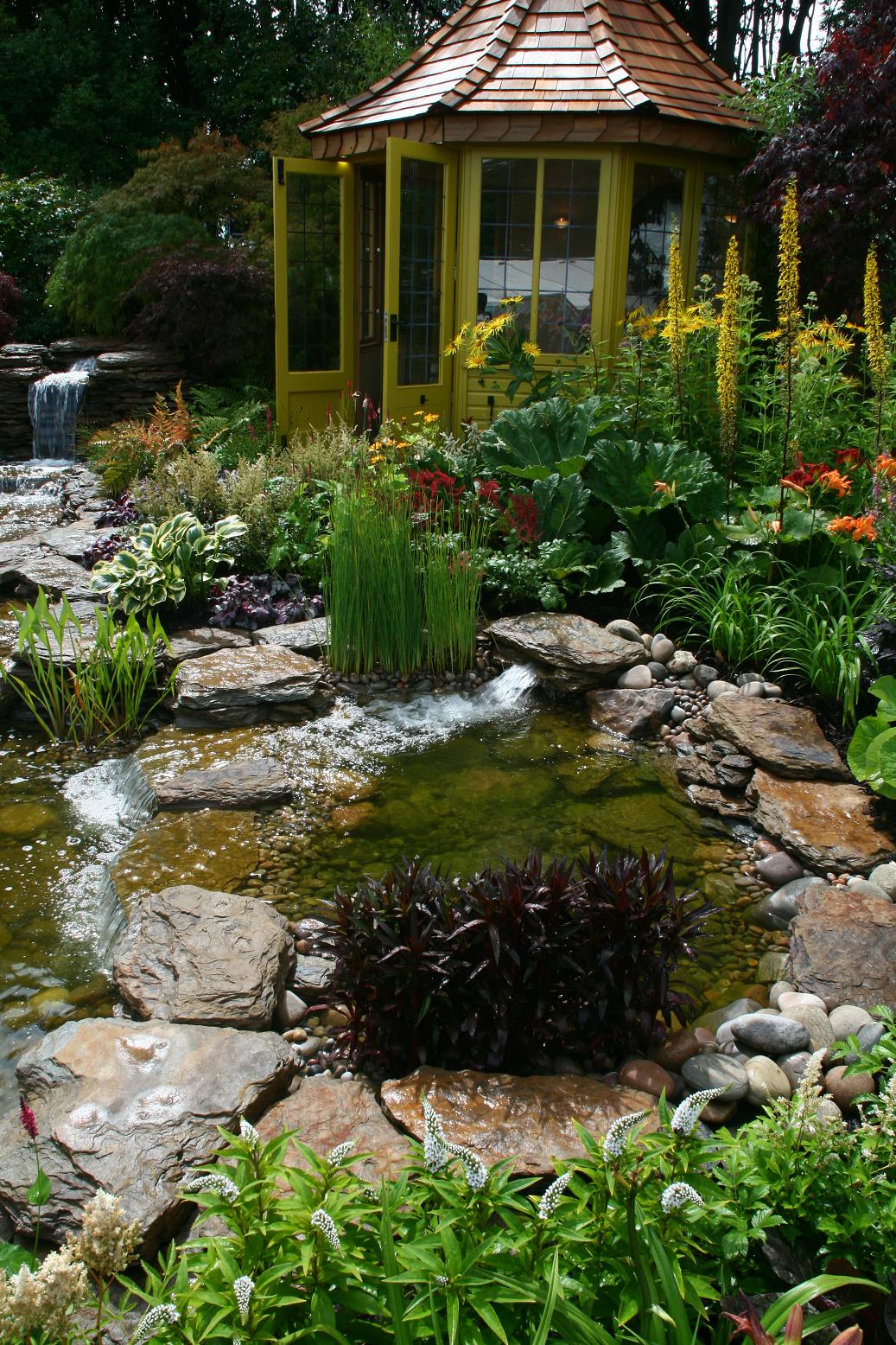
'The Edible Medley' had a pleasing stone rill running through it, which has us wondering whether a rill draining from the colour wheel to the water garden is something we should consider.


'The Edible Medley' (photo © Ian 2013)

I had to take a photo of two woven willow cats, playing with a willow mouse.


'The Animals Went In Two By Two' (photo © Ian 2013)


'The Water Garden' (photo © Ian 2013)

Of the municipal beds, our favourite was the one from Birmingham City Council.


'The Canals of Birmingham' (photo © Ian 2013)

The grass border at the front of Echomap's garden caught our eye.


'Sound Idea' (photo © Ian 2013)

I fear Liz may now want a water wheel as a water feature.


'The Industrious Force of Nature' (photo © Ian 2013)

Whereas I'd rather like a garden observatory.


'The Star-Gazer's Retreat' (photo © Ian 2013)

For that future day when we might keep chickens, I rather like Kate Humble's Flyte So Fancy chicken coop.


Planted-up chicken coop (photo © Ian 2013)

RHS National Young Designer of the Year went to Tony Woods, who designed 'Escape to the City'. Last year's winner (Tristen Knight, with 'Brownfield Beauty') was also one we liked: we obviously share our opinions with the judges. We bought a couple of plants from this during the sell-off, including the brunnera just visible in the bottom left of this photo.


'Escape to the City' (photo © Ian 2013)

The garden leaflet for this one was the best I've seen: it had mug-shots of most (all?) of the plants, which made it really easy to identify something that caught your eye.


'Escape to the City' (photo © Ian 2013)


Cercis canadensis in 'The Bee Garden' (photo © Ian 2013) 

Predictably, we bought a load of plants, and had a struggle back to the car with half a dozen pots in each hand.


Car-load of purchases (© Ian 2013)

To enumerate them: a dark leafed ligularia; a 'Chocolate' eupatorium (E. rugosum); a variegated lysimachia (L. punctata 'Alexander', I think); Sanguisorba 'Tanna'; three 'Ravenwing' cow parsleys; a 'Queen Victoria' lobelia; a replacement 'Miss Willmott's Ghost' eryngium (and tray of seedlings!); three heucheras; a Japanese ginger; an edible tulbaghia 'Silver Lace'; a variegated agapanthus ('Tinkerbell', perhaps?); three 'Bishop of Llandaff' dahlias; a tradescantia; and the Brunnera macrophylla 'Jack Frost' mentioned above. We also bought some heritage seeds, from Pennard Plants, including cucomelon, and a purple climbing French bean, 'Blue Coco'.

I think there are two more plants, too, which I can't remember.


The purchases (© Ian 2013)

Notes for the wishlist:
  • Achillea 'Apple Blossom' has an unusual (for achillea) almost purplish colour.
  • Scented geranium 'Lady Plymouth' is rather attractive.
  • Tomato 'Totem' is remarkably compact: from Pennard Plants, I think.
  • 'Red Malabar' spinach is a pretty climbing form.
  • Potentilla thurberi 'Monarch's Velvet' (a herbaceous potentilla?) has a good colour flower.
  • Hordeum jubatum (foxtail barley) has attractive flowerheads.
  • Coreopsis 'Jive' is nice.

Sunday, 30 June 2013

Bonfire

Earlier this year, we cleared a lot of gorse from the hillside, and have added—during our subsequent clearing and trench digging efforts—brambles, hawthorn and gorse to the heaps. We decided it'd had long enough drying, and the conditions were about right, to burn. It turned into an all-day job, as it burnt better than expected, meaning that we spent the day feeding the bonfire, but it means that it's all done, rather than taking several efforts.

In the nettle-y corner up from the house, I set a small fire (few sheets of newspaper, four bits of kindling and, pleasingly, a single match & firelighter!), and started feeding dry gorse into it. That burnt well, and so as Liz brought over dry material from the various heaps we'd accumulated, I cut the branches from the other hawthorns we wanted to remove, and we burnt them, too. Even though it was wet, it burnt well once there was a good, hot bed of charcoal.

As I say, that took all day, in the end, and we've spent today mostly on the hillside, too. Breaking it into several sections, I've used Sigrid to brushcut almost the entire orchard, clearing grass, gorse, brambles, thistles and ragwort. Liz cleared up behind me, thus replacing a lot of the heaps we burnt only yesterday. So it goes.

Fortunately, the hillside now looks immeasurably better.

In between brushcutting, we got a few jobs done in the garden-proper. All the brassicas have been moved up a pot size (purple sprouting, romanesco cauliflowers, January King cabbages, kale, sprouts), to grow on before being planted out after alliums or potatoes come out. We sorted out the irrigation system in the fruit beds, which had been disturbed when we mulched them in the spring. Lastly, we've sown some more lettuce/salad leaves, and resown Swiss Chard in the barrel (previous sowing was a no-show).