Showing posts with label summer. Show all posts

Wednesday, 10 September 2014

Planting Out

It's been a little while since we actually spent much time in the garden, so it's been nice to get out today. We spent the morning at Harlow Carr, enjoying the start of the transition into autumn in the shrubs and trees, and the long borders are glorious in their late-summer show.

Once we were home, we started by doing some weeding in the herb garden, which really needs it, although the addition of the membrane & chippings path has significantly reduced the impact of walking on the ground. It did get very compacted, which made weeding hard work, and although there's a lot of grass to dig out, it's much better. The grass will, I'm sure, continue to be a problem for a year or more, as we weaken the remaining, creeping roots.

We didn't have time to finish the herb garden, though, so once we'd made a dent in it, we went down to the kitchen garden. Having weeded those beds, I planted out a few clumps of spring cabbages (Durham Early), which may not amount to much, but might provide some useful leaves. Spring cabbages aren't, for us, a particularly useful crop, as they seem to come ready a little late, when actually we want to be putting in new plants in their space. Much more effective, to date, have been the winter Savoy cabbages (January King, the last couple of winters), which is harvested at a more useful moment. Anyway, we had some Durham Early plants, so in they've gone.

We've cut down the fruited raspberry canes, leaving only the stems that have grown this year. Getting the pruning right (last autumn) has made a big difference to the plant health and the size of the harvest this year.

The spring cabbages are the last thing that we'll be planting out in the kitchen garden until spring, now, so the remaining empty space was weeded, raked, and sown with green manure. This is a winter mix of crimson and red clover (leguminous nitrogen fixer and weed suppressors), Italian ryegrass (good soil stabilization, and deep roots for mineral up-lift), and mustard (bulky foliage for digging in). We added extra Caliente mustard, which is a particularly good biofumigant, improving soil health when it's chopped into the ground in spring. The current weather is good for sowing green manure: the soil's still warm, and moist, so it should germinate well, and get a few weeks growth before it gets particularly cold. The mustard nor the crimson clover are particularly hardy, so they won't survive a bitter winter, but there's a window for them to do some work, at least.

The kitchen garden sorted, we spent half an hour tidying the long border, before planting out the plants we bought at York Gate and Wisley.

From York Gate: a white salvia (into the copse bed: Salvia paniculata, I think), a white Jacob's Ladder (P. caeruleum subsp. caeruleum f. album), a white phlox (P. paniculata), a helenium, and a golden oats (Stipa gigantea). Wisley yielded three variegated eupatorium ('Pink Elegans'), two variegated phlox (P. paniculata 'Norah Leigh'), three agastache ('Blackadder'), a crimson sedum ('Red Cauli'), and a molinia ('Skyracer'), which have, apart from 'Norah Leigh', gone into the long border.

Thursday, 4 September 2014

Near the End of Mowing

I was a little pushed for time, and only managed to do the games lawn, but I've mown some of the lawn tonight: that bit grows fastest. It's nearing the end of regular/frequent mowing, and hopefully I'll only have one or two more 'weekly' cuts to make. I shall try to do it once or twice over the winter, if there's a dry spell, to keep it neat.

On the other hand, I also need to cut the grass in the orchard in the next month or so. When I have a spare day.

Friday, 29 August 2014

RHS Wisley

After a very long day yesterday, we got away from Ludlow as soon as we could (eleven), and made the long journey down to Surrey over lunch. We'd resolved to visit RHS Wisley, as we were in the area without Katie and Dan (staying elsewhere, though we're all using their house for two nights).

It's an impressive garden, though, actually, I think Harlow Carr compares well, and has the advantage of being a more locally representative climate.

The orchard, particularly, we enjoyed: there are hundreds of decades-old apples, which give a beautiful impression of what, eventually, we hope our orchard will come to be like.

Wednesday, 27 August 2014

Down to Ludlow

Need list of the morning's work. We had a rather longer list of things to do today than ideal, but we managed to get them done, and set off for Ludlow at half-two, with a car full of presents, foliage, luggage, and flowers. We got to Ludlow castle at about half-five, and then had two hours to get the flowers arranged, with Jenny, and Dan's sister and aunt helping. Amazingly, it all got done, and we staggered back to Molly's for a late supper. The big day awaits tomorrow...

Monday, 25 August 2014

York Gate

In between work on the kitchen, we decided we deserved a break, and took a few hours off to visit York Gate. We went about this time last year, and got good ideas: we hoped for the same again. It's given us a few ideas for plants that will help fill what we find is a slightly 'subdued' period in the garden, where there's less flowering than we'd like.

Photos to come...

Tuesday, 19 August 2014

Late Summer Flowers

After weeks of sweetpea arrangements, they're starting to come to an end, and so this week's centrepiece arrangement is a bit different (apologies for the shaky photo).


Golden rod, achillea, echinacea, grasses, and lysimachia in this week's flower arrangement (© Ian 2014)

We went up on the hillside, too, and it's very pleasing how the apple walk and graftlings are coming on. The apple walk's structure is a lot clearer than I thought it would be, in its first year, and the shoots need tying in again. In the graft bed, I'm delighted that we seem to have three viable Hessle pears, two each of the apples, Crimson Superb and Craggy's Seedling (a third, of each, is in the walk, grafted directly). There's only one of each of quinces Ivan and Vranja, and medlar Dutch, which is, admittedly, all we needed to make the effort a success. Sadly, the medlar Royal didn't take, in any of the three attempts, but there you go. I make that a 12 out of 21 success rate, for my first grafting attempts.

Tonight, we potted on three giant scabious, a load of Lysimachia ephemera, and a tray of Hidcote lavenders; all seed-grown, the first and last from the RHS. That's freed up a couple of module trays for some perennial plugs that will arrive soon.

Friday, 15 August 2014

Onions

We had thought we might get some weeding and lawn-mowing done this evening, but discovered two problems with that plan when we went outside.

Firstly, it was still a bit damp, and the mower doesn't collect wet clippings very well, which means a big raking-up job in addition to the mowing, of which I am not enamoured.

Secondly, there have clearly been deer rampaging through the garden in the last few days, and they've done distressing damage. They've stripped the leaves, flowers, and pods from the runner beans, climbing beans, peas, and French beans (no legumes this year, I suspect, now); nibbled the chicory and Japanese ginger; damaged a forsythia in the copse bed, munched some of a neighbouring heuchera or two; eaten a lot of the strawberry foliage (not necessarily a problem, this one, as that was due for trimming back, anyway); destroyed the last of the spinach; eaten several stems of tay- and loganberries (losing next year's crop); and—as best I can ascertain—done some sort of deer dance on top of the onions. I think it's their route from kitchen garden to games lawn.

Fortunately, the onions were pretty much going over, and ready to be lifted, although they also did a lot of damage to the weed membrane we grow the onions through, which means I'll have to replace, tediously, some of it. Nonetheless, it meant that this evening's job was lifting the onions, trimming their tops, and setting them out on racks in the wood shelter to dry.

We've put some deterrent barriers in what we think the deer's routes in have been: a few gaps in the bottom hedge, some tunnels between kitchen garden and games lawn, and over the wall behind the beech bench. Hopefully that will help. Liz is more sanguine about this than me, and reckons it's a price we pay for enjoying deer roaming on the hillside. I look at the losses and damage to plants, crops, and trees, and think thoughts of venison.

Wednesday, 30 July 2014

Windows

I've made the most of decent weather today (it looks a bit dodgy for the next week), and painted the window frames in the garage. For the same reason, I mowed the lawn last night: very little growth, because it's been dry, but that did make it easier).

The windows look a lot neater now, although this photo's from the (unpainted) inside.


'Garage' interior (© Ian 2014)

I spent a bit of time messing around getting ready for installing an outside tap near the back door (near the greenhouse): there's only an internal tap, which isn't ideal, so I'm going to add a pair of external ones. Hole duly drilled in thick stone wall, and parts ordered for completing the job on some later date.

Other than that, I wasted a lot of time resolving a botched delivery that should have brought us plasterboard, plaster, and battening timber for the wall insulation, which tried to arrive on a 22t lorry, in clear contrast to my clear instruction to bring nothing bigger than 7t. Irritating, as they'll now have to deliver on Saturday morning, which, hopefully, won't badly delay getting started. I did manage to start getting the shelves up in the bedroom, though, and they're rather nice. We ordered planed oak boards from our friendly local timber merchant (ages ago, in January): I'm very fond of oak. I'll be finishing them tomorrow night, hopefully, but it might spill into Friday.

Sunday, 27 July 2014

RHS Tatton Park 2014

This morning, at about 0815, we set off for Tatton Park, as we have the last couple of years, to the RHS flower show. It takes about an hour, and having parked and walked to the showground, we were in the queue at about 0940, giving us a quarter hour to start looking at the show catalogue (and map) before being let in at just before 10. I've been impressed, this year and last, at how quickly they scan the bar-coded tickets and get you in.

There were some really good show gardens, this year. We particularly liked a heritage/allotment fruit and veg stall from a group of local allotmenteers, and were struck by a scarlet mountain spinach (orache) that we've never seen in the flesh before. It's a possible potager plant next year.Grasses were much in evidence, as well as chocolate cosmos, sanguisorba, crocosmia, and brunnera. That suited us nicely, as we've many grasses that could be used in combination. We have one sanguisorba, 'Tanna', and a brunnera, 'Jack Frost', both bought at Tatton last year, and came looking for more brunnera. We have a few crocosmia, but one caught our eye today that is apparently a fairly new introduction; Twilight Fairy 'Gold'. It has lovely bronzed foliage, but sadly wasn't for sale from the show garden (the Young Designer of the Year garden by Sam Ovens).

We saw a couple of water features we liked, which might inform later plans.


(© Ian 2014)


(© Ian 2014)

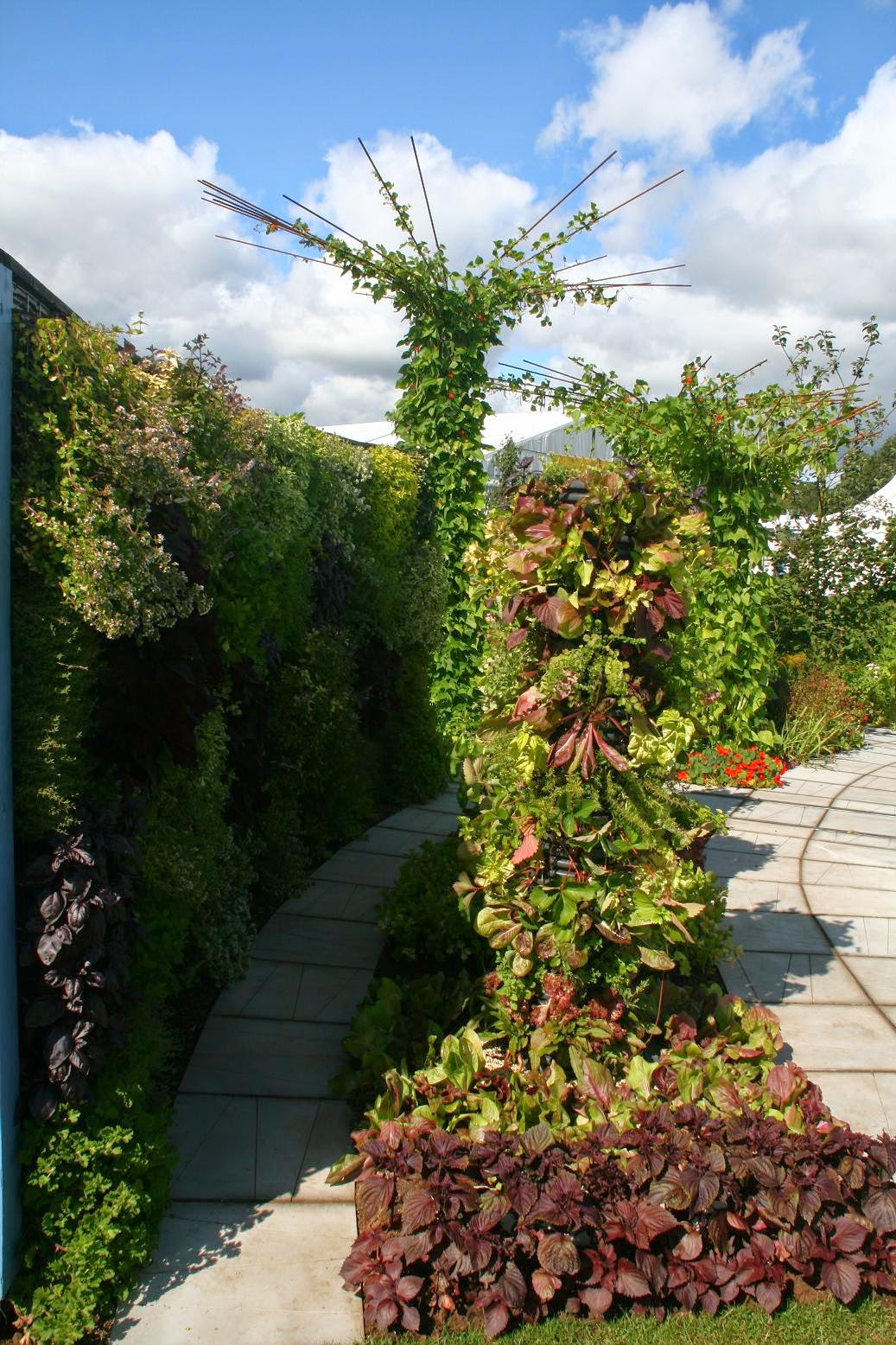
This garden had a rebar construction for its runner beans: apparently I'm not the only one using rebar to construct supports! It also had a rather good green wall, one of which Liz still wants to find a space for.


These garden seats were very good, and next door we saw some very weather resistant swing seats by the well-named Yorkshire Swingseat Company.


(© Ian 2014)


(© Ian 2014)

One feature that we enjoyed was a collection of eight vignette gardens that encapsulated larger gardens' feel in small plots. They're all from Cheshire, and included Arley Hall, which is actually just down the road from Tatton Park, and we thought looked worth a real visit, based on their 'taster' garden.


(© Ian 2014)

The floral marquee was, as ever, phenomenally stocked by nurseries, and although we only bought two plants, the other displays were excellent, and gave us contact details for a number of specialist nurseries. One, near Cambridge, might be a good source of alpines, if we do decide to put a green roof on the mini-sheds. There were a couple of hosta specialists, too, for when we dig the bog garden.


(© Ian 2014)

The two plants we bought were both from the Hampshire Carnivorous Plants: one was a Sarracenia hybrid (a North American Pitcher Plant), which suited us because it actively requires a good cold winter spell, probably in the unheated greenhouse. The other is a dangling/hanging sort of plant, a Monkey Cup called 'Linda' (a hybrid, Nepenthes cv 'Linda') despite being a dioecious male. It now hangs, slightly threateningly, in the sitting room.

For us, though, the Young Designer Gardens were the best. We felt that the television coverage (Thursday and Friday evening) actually let these down, and all three, but particularly Alex Schofield's, were much better in the flesh. In fact, everything else we purchased came from these three gardens.


(© Ian 2014)

Acquisitions were:
  • From Alex Schofield's garden:
    • Brunnera; I need to check the cultivar
    • Astrantia 'Gill Richardson'
    • Sanguisorba (S. officionalis)'Tanna'
    • Sedum (S. spectabile) 'Matrona'
  • From Clare Broadbent's garden:
    • Echinacea 'Secret Love'
    • Eupatorium, I think E. purpureum
  • From Sam Ovens' garden:
    • Scabious 'Pink Mist'

(© Ian 2014)

Wednesday, 23 July 2014

Brassicas

On Friday evening, we lifted the Red Duke of York, the Lady Christl, and some of the International Kidney/Jersey Royal potatoes, as the haulms were clearly going over. They're being washed and bagged up, slowly.

This has created some space, particularly where the earlies were, in the bottom bed, and allowed us to plant out a number of brassicas there yesterday evening: Romanescu cauliflowers, January King savoy cabbages, Mystique cauliflowers, and Rudolph purple sprouting broccoli. We've also sown two rows of Golden Ball turnips, between these and the Defender courgettes. They, incidentally, are just getting into full speed, and producing almost daily courgettes. They seem more upright plants than our previous courgettes, as well as generating better textured (less prone to disintegrating in the pan) courgettes, and I'm rather pleased. I reckon we'll be into a glut in a couple of weeks.

Tonight's been less exciting, as I've mown the lawn—whereas Liz has collected enough sweet peas for eight vases. We're definitely into 'glut' for them.


Sweetpea Centrepiece (© Ian 2014)

Sunday, 20 July 2014

Paths

Today started with a soft-fruit picking session. The raspberries are nearly over: probably one, maybe two more pickings left. However, the gooseberries are really just starting: the fuzziest, first variety at the top of the bed, Invicta (which also seems to have bigger fruit) is mostly ready, and some of the red and golden Hinnonmaki are there, too. While I prickled myself collecting these, and then a bowl full of blackcurrants, Liz collected about 80% of the redcurrants. The whitecurrants are always a bit later, and some of the red weren't ready yet...but it's still a lot of fruit. The bushes have now properly hit their stride, in their fifth year (we planted them in December 2009), although one of the blackcurrants isn't doing nearly as well as the other two. That's a shame, as blackcurrants are my favourite (compared to red/white/pink...I don't know how I'd choose a soft fruit, let alone a fruit, as a favourite), but there you go. I'm hoping that a couple of year's good mulching and pruning might see it straight. Alternatively, it may not be getting as much irrigation, as it's at the top of its bed (which is, literally, the highest point of the kitchen garden, and furthest from the watering system inlet).

A few clumps of ragwort have been growing in the orchard, and while certainly not an infestation (there's a nearby field which is just a mess of ragwort—and, worryingly, is a horse paddock), I wanted to remove it before it sets seed. When we bought the land, there was, comparatively, quite a lot, which a year of strimming and pulling has mostly resolved. Anyway; I pulled up what I found, and checked in on the graftlings, which all seem to be doing ok.

When I'd done so, Liz had weeded beech bench bed, and the bed to either side, and had also put down cardboard mulch sheets around the beech. That was a prerequisite for spreading chippings around the beech, which will now have much less competition for light, water, and soil, and look a lot tidier. I moved the turf stacked in front of them, and the spoil heap of stones (including a couple of large lumps of concrete, and several stones worthy of walling or pond-side). Between us, we've laid out weed-membrane, and covered it with chippings, to form a path down that side of the lawn. During the winter, when we're bringing wood up from the wood shelter, that path quickly gets muddy, so this should be a better route, now.

This was really part of a larger chipping-spreading activity, as we've put a path (membrane and chippings) through the middle of the herb garden. It's not planted, apart from the lavender lines crossing it, and having the lined path will mean a bit less weeding. The un-dug part of the potager, which has had weed membrane down on it for some time, has now also had a layer of chippings, which makes it look much more attractive than black membrane.

Putting this path down meant moving four box that were an edge in the old design, but are no longer, as the edges have moved, and aren't going to be box any more. The four plants have moved into the long border, replacing clumps of alchemilla, and will gradually form balls.

Lastly, I've had to add more strings to the legume supports, as they finally, slowly, start to grow. They went out too late, really, delayed by the work on the back of the house, so it's not going to be a productive pea and bean year, sadly.

Sunday, 13 July 2014

Punting

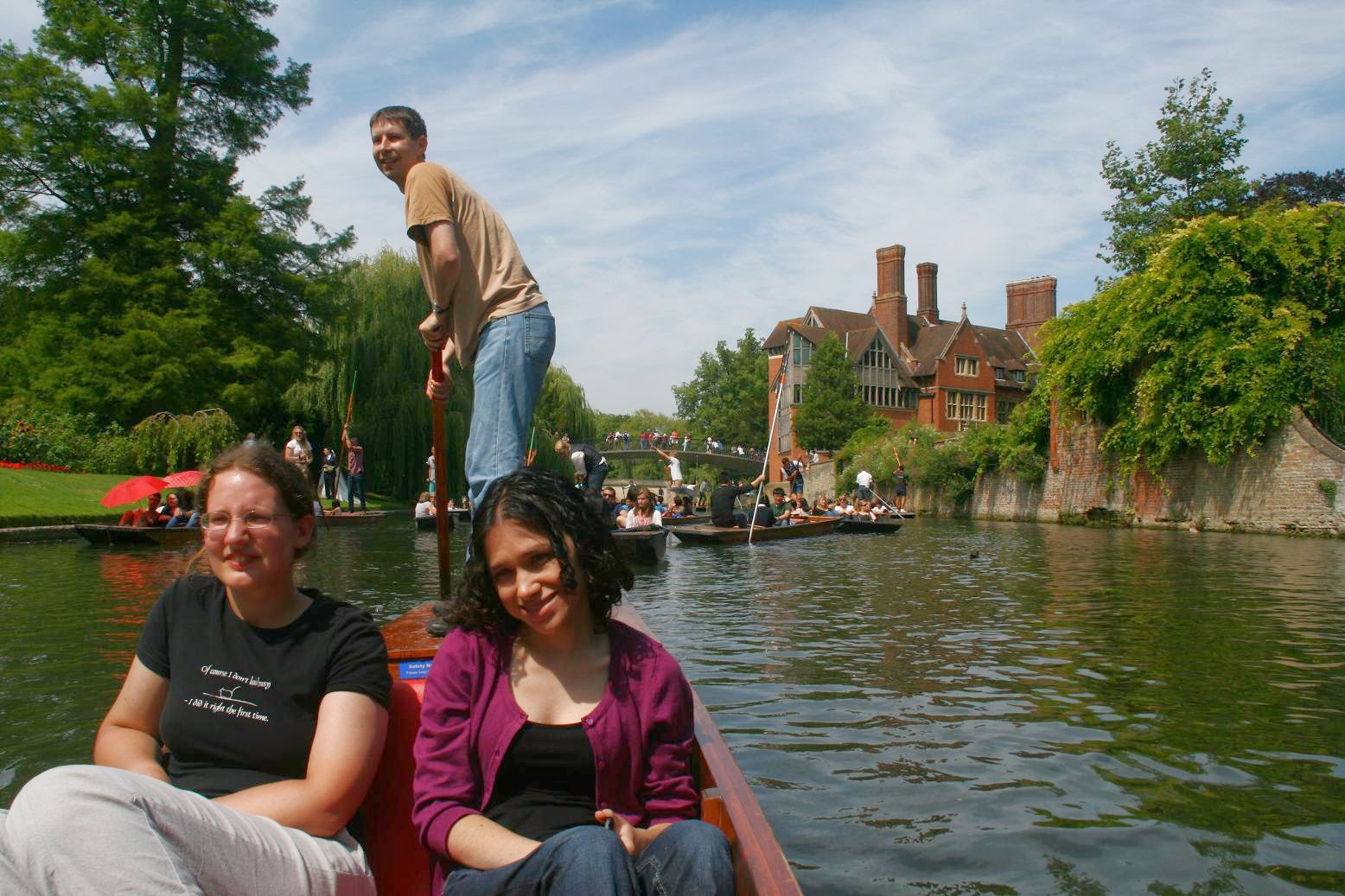
We've enjoyed a weekend in Cambridge, doing nostalgic things like picnicking on the backs, going punting, and wandering round college gardens. I'll cut straight to the photos.


The Cam, from Garret Hostel Bridge (the back of Trinity Hall) (© Ian 2014)


The University Library (© Ian 2014)


The History Faculty (© Ian 2014)


Clare Bridge, and the back of King's (© Ian 2014)


Topiary in King's (© Ian 2014)


King's College Gatehouse (© Ian 2014)


Liz, Philip and Katherine (© Ian 2014)


Clare College Gardens (© Ian 2014)


Clare College Gardens (© Ian 2014)


Clare College Gardens (© Ian 2014)

Wednesday, 9 July 2014

Flower Arrangements

For which Liz must take the credit.


26th July (photo © Ian 2014)


2nd August (photo © Ian 2014)


9th August (photo © Ian 2014)

And three more window decorations from 9th (all photos © Ian 2014):


Sunday, 6 July 2014

Nettle Cordial


The days started with some weeding, and my finishing off the shed-boxes (needed to add weather strips inside the last two boxes' doors, and paint the floor of the one which has the lawnmower in, as this will often be a bit damp). I also added some extra strings to the willow-less legume frames, as they're starting to get going.

Even though we planted out a great number of things earlier, we still have a lot of small plants growing on, mostly around the greenhouse, or on the weed membrane near the kitchen. Today we managed to plant out a number of these—but there are still lots of pots left! It takes many, many plants to fill half an acre, it turns out.

Into the long border have gone several astrantia (A. major, A. minor, A. maxima, as well as a variegated form from my parents' garden—it might be A. major 'Sunningdale Variegated'); a few trios of coreopsis; some more of our seed-grown Stipa tenuissima; and some geums.

More geums, and some mixed achillea, went into the bed on the games lawn side of the septic tank, to balance it with the other side (the geums there are doing marvellously, and look good set against the new green background of the sheds.

A few spare achilleas, and then some campanulas, aquilegias (Magpie and Royal Purple), and lupins (mixed, hopefully nice colours!) went into the two beds around the sweet peas that aren't looking so good (the back one of the three is pretty good, but the others' wildflowers didn't germinate well.

We also had three little dicentra (with rather darker, single-colour flowers: we're not much taken with the pink & white normal form, but this one, and the all-white we already have, are much more to our taste), which have gone in the copse bed.

A bunch of hardy fuchsias (Hawkshead, Delta's Sarah, and Army Nurse), have been potted up, along with a dozen box cuttings, a number of 'Tail Feathers' grass (Pennisetum macrourum), rose campion, and other achilleas.

Over lunch, we moved the elderflower wine into demi-johns (adding yeast nutrient), and also bottled the nettle cordial which we started a week ago. It looks a brighter colour than last time.


Nettle cordial straining (© Ian 2014)

We had hoped to move a load of chippings onto the weed membranes, but only managed about ten barrow-loads, because first we had raspberries and courgettes to pick. The raspberries are doing much better this year, probably because they've been well mulched last year and this, and we got the pruning right last August. The courgettes are just starting to form: it seems earlier than last year. I think we just about had them in mid/late July, so it's earlier than that. The plants seem to be fruiting at a smaller size, too: I don't know how much of all this is down to the variety (Defender), which is new to us.

It's been a good weekend for cat company: they've been much in evidence.

Hungry cat (© Ian 2014)

A number of seedlings are growing on well, including these dierama, which I'm looking forward to having.

Dierama (RHS seed) two weeks ago... (© Ian 2014)

...and now (© Ian 2014)

Wednesday, 2 July 2014

Last Few Jobs

I'm astonished to say that, of our list of jobs we made on Saturday for the past five days, we've actually done them all. Today, I've turned the compost heaps (decomposing beautifully); replaced the satellite cable and LNB (finally we have two signals to the box, reducing recording conflicts); we've painted the bike shelter (it'll need another coat or two, but there you go); installed the loft hatch in the garage (still so named!); and hung ladder hooks in the same (necessitated by putting a hatch in the hole they poked up through). Liz has done a thorough weed of the long border over the last couple of days, and it's looking loads better. We've also managed to move all the stone (and turf) that we put on the septic tank two years ago when digging the beds on either side. This is because, having transformed the garage, we want to get some of the garden tools out; but, lacking a shed, this is tricky. Our solution (long planned) will be a set of storage cupboards along the septic tank, within the living willow structure we're growing over it. Ideally, these will each have a little green roof, probably planted with alpines (which have their interest mostly in the spring, before the willow gets into full leaf). They arrive on Friday, so in order to assemble them this weekend, the tank top needs to be clear.

Having uncovered it, I've been reminded that two of the five manhole covers don't fit at all well. By which I mean they're alarmingly unstable, and seem too small. The concrete lid sections have also 'drifted' towards the bottom end of the tank. We've pushed them back together, but the covers are irredeemably too small. I shall buy a couple of new ones, and mortar them in, which will make it all rather safer.

While we've been working, the cats have kept us company. Chess found somewhere shady to nap (I don't know how he got through the latticework).


Chess sleeping inside a sweet-pea pyramid (© Ian 2014)

We're almost, but not quite, at the point of enough sweet-peas for every downstairs room.


Liz's sweet-pea (and berberis and alchemilla) flower display for the week (© Ian 2014)

Tuesday, 1 July 2014

Harlow Carr

We spent today at Harlow Carr: the first time, actually, we've been not on a weekend or Bank Holiday. Unsurprisingly, it's much quieter!

We found this in the scented garden, but couldn't see a label, sadly.


The Scented Garden, RHS Harlow Carr (© Ian 2014)


A heavenly almond macaroon (© Ian 2014)


Knautia macedonica, which caught our eye for the wide range of colour (© Ian 2014)


Sweetcorn (Snowbaby and Popcorn Fiesta (this one, with red stems)) in containers in the Bramall Learning Garden (© Ian 2014)


Rhododendron auriculatum in the woodland (© Ian 2014)

When we got home, there was enough time to sow some salad leaves (in pots: direct, they keep getting slugged), and a barrel of carrots.

Monday, 30 June 2014

Odd Jobs

Today—as Wednesday will be, I expect—has mostly been little jobs. Liz has finished 'weeding' the orchard, and I've cut paths through the grass. That leaves things flowering (which looks good), and takes less time (also good), while looking deliberate and allowing easier access to the trees and clearings.

I've topped up the chippings on the steps under the greenhouse, and in front of the wood shelter (where they were getting weedy, and decomposing). That's let us re-stack a load of wood, delivered last week, more neatly on the drive. We'll need to spend a day next weekend sawing, splitting, and stacking, though.

The greenhouse is finally sorted, and we've potted a load of things into proper pots, and laid them out on the new 'patio' outside the dining room. That needed levelling, before pots would be stable, and that's done. We need a new load of chippings to spread on the membrane, so that it looks a little less artificial.

We've also been able to collect enough flowers to start 2 gallons of elderflower wine, as well as (yesterday) bramble tips (the first 4" of brambles) for a gallon of wine (a new one for us, to make up for missing the dandelions). The bramble tips steep in hot water overnight, and then get simmered for fifteen minutes (over lunch), before straining the liquor onto sugar (I'll add yeast before I go to bed). The elderflowers have boiling water poured on them, along with sugar; yeast will be added in the morning.

Sunday, 29 June 2014

Quick Morning

We've spent the afternoon with Liz's family, celebrating her grandfather's birthday, but managed to get a fair bit done this morning, all the same.

Liz has weeded most of the orchard (that is, cleared around each tree -- there are still plenty of 'weeds' growing!), and cut back the grass growing between the grafted fruit. Of these, many have taken: sadly, none of one of the medlars, but at least one of each other has, including all the apples and pears, pleasingly.

While she started this, I finished putting the roof on the bike shelter we started a couple of weeks ago. That can be painted tomorrow.

It's been a couple of weeks since I started trying to get round to it, but I've also trained the new growth in the apple walk. That's meant cutting back the inappropriately placed shoots to 10cm or so; tying the espalier-destined shoot onto the horizontal wire, and tying the vertical shoot onto the steel tube. Two apples (Cat's Head and Grandpa Buxton) are tall enough that they've got two tiers tied down, and need the arch itself putting in, as they're almost at the top of the support tube.

Tuesday, 24 June 2014

Leeks and Bouquets

One thing we didn't manage to squeeze into an already busy weekend was planting out the leeks, which have really been ready for a couple of weeks. They've had a space planned, of course, in the kitchen garden, although it's meant taking out the over-wintered cabbages, 'Frostie', which were late to heart up. We're going to be eating a lot of cabbage, I predict, over the next couple of weeks. They should stand for a while with their roots in water, hopefully.

Anyway: the leeks. We sowed a couple of pots of Porbello, which we grew last year. With a lot of the seeds this year, I sowed the seeds in seed compost (sterile and fine, but low in nutrients), but with most of the pot pre-filled with normal compost (not sterile, as it's home made, and a bit lumpy, but able to sustain for a lot longer). This has meant that the seeds can germinate in something fine, and with fewer weeds coming up around them, but their roots quickly hit the fertile compost beneath, so they don't get checked in growing. It's also meant that seedlings have been much happier growing on in their pots, and are bigger when we prick them out.

Planting leeks is quite fun, by my reckoning: I have a sturdy plastic dibber, which makes a nice hole about 1½" across, and 5" deep, or so. I push a row of holes (about 6" apart), and drop the separated seedling in. They're tall enough that they poke out a good few inches, and the soil will settle loosely around them when watered in. Some people seem to advocate trimming the roots somewhat (to encourage strong new growth), and correspondingly reducing the leaves (to maintain root:leaf balance), but I haven't ever tried this.

While I did this, and collected what might be the last rhubarb harvest of the year, Liz picked another tub of strawberries (the fifth, I think: they've done well), and flowers. This is the third lot of sweet peas, and the first significant crop: the first two batches were just enough for a small jug. Soon, though, we'll get to the point where up to a hundred new flowers are opening every day; probably in about 4–5 weeks time.


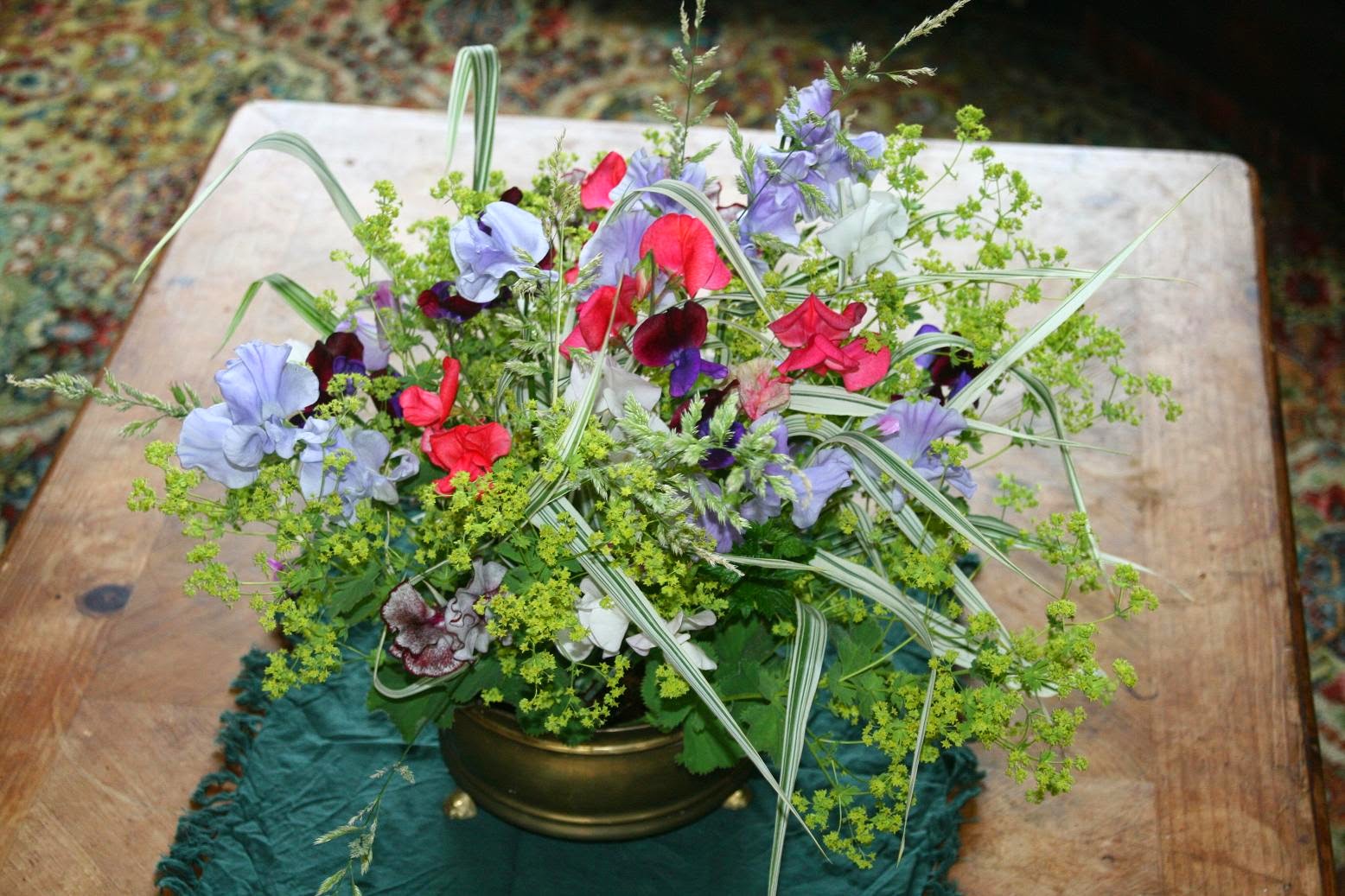
Liz's flower arrangement in brass bowl: sweet peas, Lady's Mantle (alchemilla), and grasses ( Ian 2014)

Sunday, 22 June 2014

Redesigning the Knot Garden

The herb garden's been in the planning for some time, and the design's evolved in the making. Originally, we thought we'd have just box edging, and primarily herbs. We added roses to the planting, and lavender to the edging. Then, when we worked on the design, rather than the concept, we came up with something that needed three edging materials to work well, and so we added step-over apples. The last couple of years of growing the kitchen garden suggested that we actually needed a little extra edibles space, and so we added runner beans, peas, and French beans to the planting -- which helped with height -- and then over-wintered onions, garlic, and elephant garlic. Trying the design last year made it clear that the squares of the design weren't really big enough, so we made them 50% larger. In turn, that meant the design changed, and now we need only two edging types once more. The design, now, is really one of a potager, or ornamental kitchen garden, encompassing roses (technically edible), herbs, apples, and ornamental vegetables -- the attractively podded (and flowered) Shiraz mange tout, Blue Cocoa runner beans, and red/purple Brussels sprouts. Out have gone the inedible box (now to form evergreen box balls in the herbaceous border), and a predominance of herbs.

This weekend, then, we've spent getting as far as possible with the new design. We got started on clearing the ground a week ago, and (after a vet trip that took much of the morning), continued this yesterday. We finished that by about mid-morning today, and then, in an afternoon punctuated by someone coming to finally take away the oil tank, finished preparing the ground by about 5 o'clock.

The oil tank, half-way out ( Ian 2014)

The oil tank has been waiting for removal for a while, and we eventually found someone who wanted it, thus avoiding having to pay (several hundred pounds) for someone to remove something we didn't want. Getting this heavy steel tank off its piers, missing the greenhouse (just the other side of the protective sheet of ply in the photo), across the patio, down two sleeper-built steps, and the length of the games- and pond gardens, and then up the driveway to the truck was, shall we say, tiring.

But now it's gone, and we have a 6x4 space in which a shed might go -- and now no smell of kerosene on warm days.

Now: back to the herb garden. We'd marked out the pattern (basically unchanged) last time, so apart from fine tuning a couple of measurements that had been hindered by rocks (which Liz made excellent progress moving: it really feels thankless work), we were able to immediately see where each square/diamond went.

Into several of these, I sank the climber supports, which Liz started yesterday by painting (I'd only done some of them). We've not had time to add the woven willow sides, so these will have to wait until autumn. For now, there are strings tied round them to get everything growing: they'll be invisible soon, and the willow will be in place for the winter, when it's actually meant to be an attractive feature.

Having sunk the six supports into the ground, we topped up the soil in all of the squares (but not the edges: lavender doesn't want rich soil) with compost, neatly finishing the 'ready' bay of compost, and started planting. The plants are mostly those that we potted up and set outside a few weeks ago, and included enough lavender to complete those edges that we've cleared space for (almost).

From the greenhouse have come the Laguna, Speedy, and Castendel French beans, the White Lady and Blue Cocoa runner beans, and the Shiraz and Delikata peas/mange tout. We've also planted out 32 red sprouts, a load of chicory, a dozen or so bronze fennel, a pot's worth of aniseed, and the Japanese ginger we bought at Tatton. All that obviously needed watering in, and tying to supports where necessary, and it's meant rather a late finish (I came in at 11, and Liz only came in half an hour earlier, to cook)...but it's looking really good.