
Over Easter, we're hiring a micro excavator (mini digger) to dig the pond, and also do some heavy (quick) work preparing the base for the arbour patio, turning over and creating the beds in the colour wheel, and—time permitting—break the ground for the last of the herb garden.
That's lead to us spending a lot of this weekend (and, for me, today) clearing the colour wheel beds, and the pond, of the collected detritus. For several years, although the colour wheel beds were briefly marked out in April 2012, it's not been much of anything, and has had several heaps of brushwood, a few bins of rescued pond plants, and gradually amassing heaps of stones dug out elsewhere. The pond was, for a while, a huge heap of brush from the trees and cotoneaster we took out, until we shredded that over the weekend of the Royal Jubilee later in 2012. It's been misused in the same way, to a smaller extent, since, though, and Liz has spent a good bit of the weekend running things through the smaller Archimedes Screw chipper we have.
In incredible news, we even managed to mow the lawn, with Liz raking ahead of me, which has really helped, and the lawn looks almost respectable for the first time in months. The wet but mild autumn meant that my hoped-for 'last cut' of the year never happened, meaning a scruffy lawn since September, really.
Inside, we've potted up our various dahlias, and chocolate cosmos. When we were weeding in the herb garden, I discovered that the runner beans tubers (or are they corms, or rhizomes?) had survived the winter. They're a perennial, strictly, but not that hardy, so they're usually grown as an annual in the UK. However, we thought we'd pot them up, too, and see if they come into growth as the year warms up.
We've had to do some more wood chopping, too, to clear a path down the drive for the mini-digger. I think it's wide enough, now, but we shall need to do some more, including a few last pieces on the old shed base. If we have time, digging that bit over with the excavator is on the list, which means I need to clear the firewood off it in advance, and check there's not a huge slab of concrete hiding under the timber...
Showing posts with label planning. Show all posts
Showing posts with label planning. Show all posts
Monday, 23 March 2015


Monday, 28 July 2014
Planting and Plastering
The first jobs for today were planting out the plants we bought at Tatton Park yesterday. Apart from the carniverous plants (kitchen and sitting room), and the brunnera (copse bed), the rest have gone into the long border. I need to add proper labels before we lose track of them, as they all came from show gardens as they were dismantled, and thus without labels.


This afternoon, we've stripped the wall paper from the side wall of our bedroom, and from the main wall of the dressing room, and re-plastered both. That's in preparation for putting up the new shelves on both these walls that we've had planned for several months, which I hope to do on Wednesday, all being well. That gets the shelf boards out of the way, along with everything that will go on these shelves, and should make installing the wall insulation easier: that starts next weekend, we plan.
Customary 'before' photo (© Ian 2014)
And gratuitous sleepy/supervisory cat photo (© Ian 2014)
Wednesday, 2 July 2014
Last Few Jobs
I'm astonished to say that, of our list of jobs we made on Saturday for the past five days, we've actually done them all. Today, I've turned the compost heaps (decomposing beautifully); replaced the satellite cable and LNB (finally we have two signals to the box, reducing recording conflicts); we've painted the bike shelter (it'll need another coat or two, but there you go); installed the loft hatch in the garage (still so named!); and hung ladder hooks in the same (necessitated by putting a hatch in the hole they poked up through). Liz has done a thorough weed of the long border over the last couple of days, and it's looking loads better. We've also managed to move all the stone (and turf) that we put on the septic tank two years ago when digging the beds on either side. This is because, having transformed the garage, we want to get some of the garden tools out; but, lacking a shed, this is tricky. Our solution (long planned) will be a set of storage cupboards along the septic tank, within the living willow structure we're growing over it. Ideally, these will each have a little green roof, probably planted with alpines (which have their interest mostly in the spring, before the willow gets into full leaf). They arrive on Friday, so in order to assemble them this weekend, the tank top needs to be clear.


Having uncovered it, I've been reminded that two of the five manhole covers don't fit at all well. By which I mean they're alarmingly unstable, and seem too small. The concrete lid sections have also 'drifted' towards the bottom end of the tank. We've pushed them back together, but the covers are irredeemably too small. I shall buy a couple of new ones, and mortar them in, which will make it all rather safer.
While we've been working, the cats have kept us company. Chess found somewhere shady to nap (I don't know how he got through the latticework).
Chess sleeping inside a sweet-pea pyramid (© Ian 2014)
We're almost, but not quite, at the point of enough sweet-peas for every downstairs room.
Liz's sweet-pea (and berberis and alchemilla) flower display for the week (© Ian 2014)
Sunday, 22 June 2014
Redesigning the Knot Garden
The herb garden's been in the planning for some time, and the design's evolved in the making. Originally, we thought we'd have just box edging, and primarily herbs. We added roses to the planting, and lavender to the edging. Then, when we worked on the design, rather than the concept, we came up with something that needed three edging materials to work well, and so we added step-over apples. The last couple of years of growing the kitchen garden suggested that we actually needed a little extra edibles space, and so we added runner beans, peas, and French beans to the planting -- which helped with height -- and then over-wintered onions, garlic, and elephant garlic. Trying the design last year made it clear that the squares of the design weren't really big enough, so we made them 50% larger. In turn, that meant the design changed, and now we need only two edging types once more. The design, now, is really one of a potager, or ornamental kitchen garden, encompassing roses (technically edible), herbs, apples, and ornamental vegetables -- the attractively podded (and flowered) Shiraz mange tout, Blue Cocoa runner beans, and red/purple Brussels sprouts. Out have gone the inedible box (now to form evergreen box balls in the herbaceous border), and a predominance of herbs.

The oil tank has been waiting for removal for a while, and we eventually found someone who wanted it, thus avoiding having to pay (several hundred pounds) for someone to remove something we didn't want. Getting this heavy steel tank off its piers, missing the greenhouse (just the other side of the protective sheet of ply in the photo), across the patio, down two sleeper-built steps, and the length of the games- and pond gardens, and then up the driveway to the truck was, shall we say, tiring.
But now it's gone, and we have a 6x4 space in which a shed might go -- and now no smell of kerosene on warm days.
Now: back to the herb garden. We'd marked out the pattern (basically unchanged) last time, so apart from fine tuning a couple of measurements that had been hindered by rocks (which Liz made excellent progress moving: it really feels thankless work), we were able to immediately see where each square/diamond went.
Into several of these, I sank the climber supports, which Liz started yesterday by painting (I'd only done some of them). We've not had time to add the woven willow sides, so these will have to wait until autumn. For now, there are strings tied round them to get everything growing: they'll be invisible soon, and the willow will be in place for the winter, when it's actually meant to be an attractive feature.
Having sunk the six supports into the ground, we topped up the soil in all of the squares (but not the edges: lavender doesn't want rich soil) with compost, neatly finishing the 'ready' bay of compost, and started planting. The plants are mostly those that we potted up and set outside a few weeks ago, and included enough lavender to complete those edges that we've cleared space for (almost).
From the greenhouse have come the Laguna, Speedy, and Castendel French beans, the White Lady and Blue Cocoa runner beans, and the Shiraz and Delikata peas/mange tout. We've also planted out 32 red sprouts, a load of chicory, a dozen or so bronze fennel, a pot's worth of aniseed, and the Japanese ginger we bought at Tatton. All that obviously needed watering in, and tying to supports where necessary, and it's meant rather a late finish (I came in at 11, and Liz only came in half an hour earlier, to cook)...but it's looking really good.
This weekend, then, we've spent getting as far as possible with the new design. We got started on clearing the ground a week ago, and (after a vet trip that took much of the morning), continued this yesterday. We finished that by about mid-morning today, and then, in an afternoon punctuated by someone coming to finally take away the oil tank, finished preparing the ground by about 5 o'clock.
The oil tank, half-way out ( Ian 2014)
The oil tank has been waiting for removal for a while, and we eventually found someone who wanted it, thus avoiding having to pay (several hundred pounds) for someone to remove something we didn't want. Getting this heavy steel tank off its piers, missing the greenhouse (just the other side of the protective sheet of ply in the photo), across the patio, down two sleeper-built steps, and the length of the games- and pond gardens, and then up the driveway to the truck was, shall we say, tiring.
But now it's gone, and we have a 6x4 space in which a shed might go -- and now no smell of kerosene on warm days.
Now: back to the herb garden. We'd marked out the pattern (basically unchanged) last time, so apart from fine tuning a couple of measurements that had been hindered by rocks (which Liz made excellent progress moving: it really feels thankless work), we were able to immediately see where each square/diamond went.
Into several of these, I sank the climber supports, which Liz started yesterday by painting (I'd only done some of them). We've not had time to add the woven willow sides, so these will have to wait until autumn. For now, there are strings tied round them to get everything growing: they'll be invisible soon, and the willow will be in place for the winter, when it's actually meant to be an attractive feature.
Having sunk the six supports into the ground, we topped up the soil in all of the squares (but not the edges: lavender doesn't want rich soil) with compost, neatly finishing the 'ready' bay of compost, and started planting. The plants are mostly those that we potted up and set outside a few weeks ago, and included enough lavender to complete those edges that we've cleared space for (almost).
From the greenhouse have come the Laguna, Speedy, and Castendel French beans, the White Lady and Blue Cocoa runner beans, and the Shiraz and Delikata peas/mange tout. We've also planted out 32 red sprouts, a load of chicory, a dozen or so bronze fennel, a pot's worth of aniseed, and the Japanese ginger we bought at Tatton. All that obviously needed watering in, and tying to supports where necessary, and it's meant rather a late finish (I came in at 11, and Liz only came in half an hour earlier, to cook)...but it's looking really good.
Monday, 16 June 2014
Floor Finished
We made a list on Saturday morning of some things we wanted to try to do this weekend (a long one). Pleasing progress has been made, although, as it ever was, not quite everything happened.

That also means we'll only have two sorts of edge: lavender and step-over apples (which I'll try to graft over the winter). The box will be grown on to form box balls in the garden, instead of hedging: we think they might, for one thing, replace some of the Lady's Mantle that's really a weed in the long border. They'd occupy the same niche, of a rounded green mass, but with the advantage of year-round structure, and less invasive self-seeding.
The new pattern fits around the corner nicely, and finishes in about the same place, which is good. We then moved the part-painted climber supports into the beds, settling on a layout that has the taller of these forming a backdrop to the garden, in the boxes furthest from the house. There are only four of these at the moment, but I can always make more in time. The smaller are nearer the house, and there are squares that suitably frame views from the windows with supports. It looks very pleasing, and once the supports are painted, and sunk into the ground, I hope it's going to look really good.
On Saturday afternoon, we constructed a hinged roof that goes over the steps down into the wet cellar from the driveway, which will allow us to store bikes on the steps but keep the worst of the weather off them. It's a simple wooden frame, with tongue and groove cladding, but it looks quite smart...although it does draw my attention to the falling-apart (non-structural!) wall next to it, which edges the pathway. Another day's work there, I think. At the same time, Liz cleared the driveway of a pile of apple prunings that have been sat there drying: they'll be rather fragrant kindling next winter.
They've been sitting around for longer than they should (by some way, really), but we've bottled the five demijohns of wine that were waiting.
In the same vein, this evening we've made a five-pint batch of elderflower cordial. Different process to previously: a dozen flowerheads, a pared then sliced lemon, and then a boiling sugar solution poured over them (1 pint water, 1lb10 sugar). You add 2.5tbsp of citric acid, once cool, and allow to sit for 24 hours before bottling.
The batch of cider that we pressed last autumn has, in turn, finally been racked into two demi-johns. It's not tasting quite 'right', but as I understand it, cider often needs a decent maturation period, so I'll bear with it.
Sunday afternoon was spent, largely, making a hatch for the garage loft, and putting up the last of the insulation. Hanging the hatch will have to wait until I've found the right hinges.
Today, then, was spent finishing the garage floor. The sealant paint was nicely dry by mid morning, so we were able to immediately start work on laying the insulation, screwing down the battens, and filling the gaps with solid insulation. The plywood sheets went on with relatively little fuss, so by about 1530 we'd finished. An hour later, and the room was tidied up, rather than having everything stacked into the half that had a floor, and we've even managed to set out the two armchairs we've had stored in a corner since 2009.
Last thing for the weekend was getting some of the preparatory work done for our new patio doors, which arrived on Friday. They're being fitted on Wednesday (including breaking out the hole for them, replacing the garden window in the dining room), and we've done as much fitting of hardware, and so on, as possible.
Painting the last section (3/8ths) of the garage floor with bituminous sealant happened on Friday evening, Saturday lunch time, and Sunday morning. The plan was that the last coat (Sunday first thing) would then have a clear 24 hours to dry before we put the rest of the floor down.
Saturday morning, before we could do the second coat, we spent digging over a further section of knot garden. While I cut turves, and dug over the stony ground, Liz was busy clearing our stone dyke from last time. We've not worked on extending the herb garden since September, in order to get the overwintering alliums in the ground, so it's nice to once more make progress on it. Although we only did a couple of hours work (too hot!), we returned to the garden on Sunday, and have marked out anew the pattern. We needed to do this because we've changed our mind about the size of the squares (diamonds), which we decided were too small (roughly 1m edges), and needed to be 50% bigger. There wasn't quite enough space in them to allow planting, but still be able to walk through them.
The original (rough) plan for beds and edges in the herb garden (© Ian 2013–14)
The new pattern fits around the corner nicely, and finishes in about the same place, which is good. We then moved the part-painted climber supports into the beds, settling on a layout that has the taller of these forming a backdrop to the garden, in the boxes furthest from the house. There are only four of these at the moment, but I can always make more in time. The smaller are nearer the house, and there are squares that suitably frame views from the windows with supports. It looks very pleasing, and once the supports are painted, and sunk into the ground, I hope it's going to look really good.
On Saturday afternoon, we constructed a hinged roof that goes over the steps down into the wet cellar from the driveway, which will allow us to store bikes on the steps but keep the worst of the weather off them. It's a simple wooden frame, with tongue and groove cladding, but it looks quite smart...although it does draw my attention to the falling-apart (non-structural!) wall next to it, which edges the pathway. Another day's work there, I think. At the same time, Liz cleared the driveway of a pile of apple prunings that have been sat there drying: they'll be rather fragrant kindling next winter.
They've been sitting around for longer than they should (by some way, really), but we've bottled the five demijohns of wine that were waiting.
- Dandelion, from May 2013. For whatever reason, the dandelions rather passed me by this May, so I don't have a new batch on the go. This one seems good, though.
- Greengage from October (a more reasonable time-scale). This was slightly fizzy, so I added a Campden tablet, and bottled it a couple of days later. The taste seemed improved, too, after this.
- Elderflower from July: very good, this one.
- Blackberry from September, a predictably dessert-wine red. It was also slightly fizzy, but a tablet and 36 hours rest sorted this out.
- Chardonnay from a kit, in June last year. It's really rather Chardonnay-like!
In the same vein, this evening we've made a five-pint batch of elderflower cordial. Different process to previously: a dozen flowerheads, a pared then sliced lemon, and then a boiling sugar solution poured over them (1 pint water, 1lb10 sugar). You add 2.5tbsp of citric acid, once cool, and allow to sit for 24 hours before bottling.
The batch of cider that we pressed last autumn has, in turn, finally been racked into two demi-johns. It's not tasting quite 'right', but as I understand it, cider often needs a decent maturation period, so I'll bear with it.
Sunday afternoon was spent, largely, making a hatch for the garage loft, and putting up the last of the insulation. Hanging the hatch will have to wait until I've found the right hinges.
Today, then, was spent finishing the garage floor. The sealant paint was nicely dry by mid morning, so we were able to immediately start work on laying the insulation, screwing down the battens, and filling the gaps with solid insulation. The plywood sheets went on with relatively little fuss, so by about 1530 we'd finished. An hour later, and the room was tidied up, rather than having everything stacked into the half that had a floor, and we've even managed to set out the two armchairs we've had stored in a corner since 2009.
Last thing for the weekend was getting some of the preparatory work done for our new patio doors, which arrived on Friday. They're being fitted on Wednesday (including breaking out the hole for them, replacing the garden window in the dining room), and we've done as much fitting of hardware, and so on, as possible.
Wednesday, 11 June 2014
Task List
I've had today off, though Liz has been working: that made it an ideal day to get a number of little jobs done, and I've had a pleasingly productive day.




It's the time of year when I start trying to get the window frames painted. Last week, two of the last wooden windows on the back of the house were replaced with uPVC, which (in addition to looking rather good, especially for uPVC) means I have two fewer frames to worry about. Of course, the time-consuming Georgian-barred windows on the front are no fewer, and it's those which have always taken the time.
However, before embarking on this year's painting, I decided to install some eye bolts on the front wall, in order to tie down the ladder while using it. I've had enough of bouncing on an unsteady ladder, and don't enjoy working on one at the best of time. The window at the end of the study has always needed a rather extended ladder, as the ground drops off in that direction, and the path has stepped down towards the level of the garage. It's always, therefore, been the worst climb.
To combat this, I've installed two M12 shield anchor bolts (18mm holes, which aren't for the faint of heart, or drill), one on either side of the window, at about 180cm height. Using a ratchet strap passed around each stile and angled down through the bolt, the ladder can now be tightly held in place. The result is revelatory: I felt much more secure, and less conscious of the drop...
That window, and two dining room ones, are now done: I'm only planning to chip away at the painting, with the aim of getting about half done over the next couple of months.
Next, I strimmed the half of the orchard I didn't manage to do eleven days ago. I'm hoping I'll only have to do this regularly for another 12-15 months, and that we can think about a couple of sheep by then.
I've painted some of the remaining legume/sweet pea supports, which means their bituminous feet (the underground bit) are done, and as many of their above-ground elements as I could get to (given that the tarry feet were drying).
I shan't dwell on unblocking the kitchen drain.
The work on the garage has been going on since the end of last week; sorting the foundations took a little while, but the builder started the actual walls yesterday, and has finished them today. The uneven-ness of the walls has complicated things slightly, and none of the windows are going to be quite the same height. The joiner will be along on Monday to measure up, and hopefully the building work will otherwise be done tomorrow. Next up will be the replacement of the dining room window with a set of patio doors.
After lunch, I took the time to do a wander of the garden with camera in hand. It's been a while, but here's where things are up to.
Bees foraging in the wallflower in the front garden (© Ian 2014)
The dining room windows, for now, until the patio doors go in (© Ian 2014)
The sweet pea supports (© Ian 2014)
One of the sweet peas is flowering; several more are on the verge of doing so (© Ian 2014)
The heuchera bed; not sure whether the quince has set fruit (© Ian 2014)
One of the astrantias in the copse bed (© Ian 2014)
The long border in front of the dining room (© Ian 2014)
The mess of the pond aside, the bed next to the septic tank has filled out well, and needs pruning (© Ian 2014)
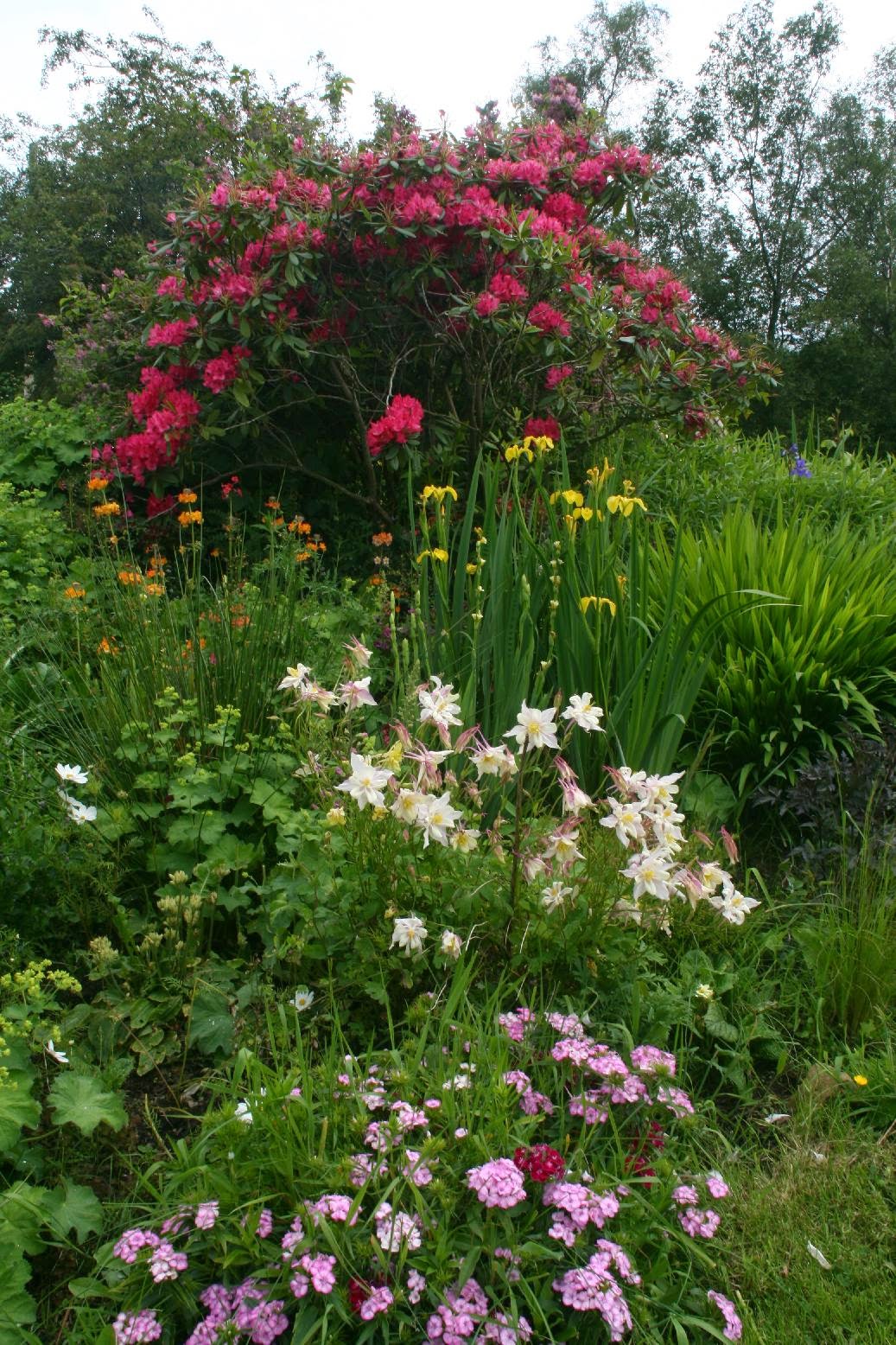
The aquilegia here has gone slightly mad this year (© Ian 2014)
Astrantia flower (© Ian 2014)
Mostly-planted vegetable garden (© Ian 2014)
Red Duke of York potato (© Ian 2014)
Green roof wild flowers, with foraging bees (© Ian 2014)
Green roof on wood store (© Ian 2014)
Day lily which we didn't know was there (© Ian 2014)
Weed-membraned knot garden (© Ian 2014)
Inside the garage before work on the wall/windows (© Ian 2014)
New garage front (© Ian 2014)
Stone cills & jambs being supported while curing (© Ian 2014)
Window apertures ready for windows (© Ian 2014)
Sunday, 6 April 2014
Orchard Enlargement
We've already spent two days hard at work, clearing blackthorn from the back of the orchard and burning it, but the progress we made was largely invisible from the house, as we were working from the back (top) of the bank of blackthorn, effectively hollowing it out. Yesterday, though, we finished the job, and the whole cleared area became visible in one day. It's a space probably ten metres deep, and fifteen wide, and means that the established apple tree in the back left, and the chestnut we planted on that side in February, are both now 'in' the orchard, rather than feeling separate. The James Grieve apple, and the other established apple that were on the back edge of the orchard now have space behind them or the left of them (respectively). We haven't yet gone as far right as the other chestnut: this will create less additional space, but we'll try to do so in the autumn.
The big advantage is that this has cleared the space that one day will hold the plum arch, which will be the feature exit from the back of the orchard into the clearings and woodland above. We've marked our intended position for it with a pair of fence posts, which—now they're visible—will let us assess whether it's in the right place. Pleasingly, it's directly above the hole in the dry stone wall that I'm rebuilding (slowly), which in turn is directly opposite the old door in the dining room (long (decades) since replaced with a window).
We were also able to pop out this morning to plant the second mulberry, King James/Chelsea, which has been in a pot since autumn, waiting to go in the ground. The weather also held just long enough to plant three more hellebores in the copse bed, three primulas in the games lawn's septic tank bed, a sedum 'Thundercloud' in the long border, and a handful of thymes and sedums in the wall in the front garden.
Oh; a note to myself: we saw a rather attractive hydrangea, 'Zorro', which might one day have a place.
Oh; a note to myself: we saw a rather attractive hydrangea, 'Zorro', which might one day have a place.
Wednesday, 26 March 2014
New Beds
Last time we were out in the garden (ten days ago: David and Ann were with us for the weekend, which was a relaxing couple of days filled with food, and no work), I dug a new bed above the beech bench, and we planted a row of lavenders around its edge. Today, it was the turn of the other side, and we now have a matching bed below the bench (between it and the steps down to the wood shelter and kitchen garden). While I dug it over, Liz cleared a heap of shredding that's been accumulating, and we were, as ever, amazed at how small the resulting pile of chipped stuff is.
Having removed a load of stones (as normal), the remaining ground is actually rather nice soil: we planted a row of lavender around it, again, and then filled the space in both beds with other things that were taking up space in the greenhouse: a few dozen deschampsia grasses (D. cespitosa), some sweet rocket (Hesperis matronalis), and some Jacob's ladder (Polemonium): all grown from RHS seed last year.
At the left end of the bed, there's a space towards the wall where we took down the conifer a couple of years ago, which was obscured by the aforementioned shredding heap. This was the destination of the Persian Ironwood (Parrotia persica) which arrived last December, and has remained in its pot over the winter. The space now cleared, we've been able to plant that out, and hopefully it'll add some year-round foliage interest to that corner.
Part of the reason for preparing and planting these beds was to free up small pots and space in the greenhouse. That achieved, we spent the last hour of the day potting up a load of sweet peas (again, no 'Apple Blossom' have germinated: they're on the black-list, now), chilli and sweet peppers, and aubergines. In turn, that meant space in the propagators, so we've also sown more cosmos (an orange mix), tiger tomato seeds collected last year, anise, and a few other ornamentals. Even with the greenhouse, we're still going to wind up with lots of pots on the windowsills: but at least they'll be gone by May this time, and the tender veg (tomatoes, peppers, and aubergines) won't be inside, but out in the greenhouse.
Sunday, 9 February 2014
Rootstocks
The MM106 apple and Quince A rootstocks arrived during the week, and have been heeled into a bucket of compost, waiting to be planted out. That was the first order of the day, so all but two apples are now safely planted in the nursery beds we dug on the hillside. We've put up the chickenwire cage that will protect all three beds from deer, and the rootstocks should now have a couple of weeks to settle in before we graft onto them.
Yesterday afternoon, we then drove the 22 tubes that will support the apple walk arches into the ground. These are 5/8" steel tubes, with the underground section cold-galvanized, and bitumen painted, for corrosion protection. They extend about 90cm above ground, and the rebar arches will slot into them in a few weeks. Alongside are the support stakes, that will ensure that the rootstocks don't suffer windrock while they establish.
 |
| Steel tubes, zinc-painted and ready for bituminous paint over-coat ( Ian 2014) |
Having got these carefully positioned, we then dug the two planting holes for our sweet chestnuts, which are on the same order as the twenty apples and one pear (the last two apples for the walk are amongst the grafting set). This was astonishingly easy: we each went to one hole, planning to get started then reconvene once we knew how difficult they were going to be—and had the holes dug in a few minutes. Working in the very stony (historically terraced) corner with the apple walk has clearly given us a different perspective. The holes dug, I drove an 8' stake for each; this has the advantage of being able to see the position from the house, to check that they seem right.
The two trenches of the apple walk then needed refilling, so we poured in seven bags of sand, to help drainage, and eight trugs of compost, before scraping the spoil heaps back into the trenches. Even with the additions, the loss of all that stone from the trenches means that they were still underfilled.
To make up the shortfall, we've used loam from the stacks of turf we've been building in the copse while lifting turves from the quince, sweet-pea, and copse beds. Trenches topped up, we then decided to put up the chicken-wire cage for the applewalk, having previously thought of leaving it until after planting. However, with the centre of the walk now clear of soil (but still muddy and slippery), we decided there was good enough access, and the greater risk was of kicking a tree over while manoeuvring the heavy roll of wire net. The corner stakes aren't really secure enough to tension a fence (I couldn't drive them deeply enough into the stony soil), but they've sufficed for getting the protective cage round the apple beds. We also had to dig one or two more short drains, to ensure that the ground isn't too wet—the very wet weather of the last month means there are several stream flowing down the hillside, in the main gullies and land-drain, and the ground just inside the gap in the wall is a pond. Fortunately, all our drainage work last year seems to have done the job well, and the existing trees seem protected from the worst of it.
The fruit trees are scheduled to arrive this coming week, and so we should be able to plant up the apple walk next weekend, at long last.
Sunday, 26 January 2014
Stakes
It's been an unpleasant job, in the wet and the wind, but we managed to finish digging the second apple-walk trench, as well as the three nursery-bed trenches. The latter came across far fewer stones, which made it easier than it could have been—we definitely picked the stoniest part of the field to build the apple walk.
Having dug the trench, we drove the first set of posts in: 2½" posts, 5'6" long, and spaced 3' apart. The first set of eleven were straightforward, but getting the second set parallel, with each one squarely opposite its pair, was a slog. Eventually, though, we got them all in, and are happy with their position. They're a bit wonky, in fairness, and not perfectly straight. I hope that we'll be able to drive the tubes for the actual arches a little more accurately. The stakes are off-set from the arches by a few inches (up-hill and outwards): the trees will be planted just outside the arch's tubes. As they're on MM106 rootstocks, they'll only need the stakes for a few years, to protect against wind rocking the roots, and then the stakes can be pulled up, or sawn off at ground level.
The nursery trenches were easier, as they don't have to be too accurate. There's a variety of heights, either 8' posts or 5'6", depending on what we intend for the adjacent tree. We can't be sure that we'll actually need them all for grafting: I've ordered three rootstocks per variety, but if the scion material is short, we may only get one, or two, scions worth from each. That's manageable: the rootstocks will 'keep'.
Once the support stakes were in, we also had posts to drive in around each set of beds (four around the nursery beds, six around the walk), which will support an anti-deer chicken-wire cage. We'll only put that up once the trees are in, to give maximum manoeuvrability for planting.
The nursery trenches were easier, as they don't have to be too accurate. There's a variety of heights, either 8' posts or 5'6", depending on what we intend for the adjacent tree. We can't be sure that we'll actually need them all for grafting: I've ordered three rootstocks per variety, but if the scion material is short, we may only get one, or two, scions worth from each. That's manageable: the rootstocks will 'keep'.
Once the support stakes were in, we also had posts to drive in around each set of beds (four around the nursery beds, six around the walk), which will support an anti-deer chicken-wire cage. We'll only put that up once the trees are in, to give maximum manoeuvrability for planting.
Sunday, 19 January 2014
Second Trench
It's amazing how long some jobs can take.
We've almost finished digging the second 11m trench into which the apples of the apple walk will be planted. To do so, we've had to cut about 10m of drainage ditch, as well; lift (at a guess) six tons of stones out of the trenches (including two >500kg boulders); and flatten out a 35m2 area.
I've kept telling myself that, one day, it'll be beautiful.
We need to finish the last couple of meters of the second trench (ran out of energy and day-light), and then we can start driving the stakes and foundation rods for the metal work. The trees will arrive in the second week of February, and can go straight in the ground. Similarly, the rootstocks and scions for the six varieties we're grafting will get to us in the next few weeks: that means that the nursery bed trenches also need to be finished. Both apple walk and nursery beds will need chicken wire protection, for at least a few years, so that will need building, too.
I've kept telling myself that, one day, it'll be beautiful.
We need to finish the last couple of meters of the second trench (ran out of energy and day-light), and then we can start driving the stakes and foundation rods for the metal work. The trees will arrive in the second week of February, and can go straight in the ground. Similarly, the rootstocks and scions for the six varieties we're grafting will get to us in the next few weeks: that means that the nursery bed trenches also need to be finished. Both apple walk and nursery beds will need chicken wire protection, for at least a few years, so that will need building, too.
Sunday, 12 January 2014
A Trench or Two
We've spent our time outside this weekend digging the trenches for the apple walk. To start with, I had to demolish the large stone (boulder) that we uncovered last time. It took a bit of whacking with the sledge hammer, but I managed to make it small enough that we could drag it out of the area of the walk.
Unfortunately, I then found an even bigger stone sitting the middle of the other (lower) planting line. This one was massive: about 6' by 3', and at least a foot thick: probably the best part of a metric ton. A long while later, I managed to break it in two, then make the larger piece small enough to move out of the way. We've now finished, eventually, digging over the first trench, and will try to get the other one dug next weekend.
We also have to prepare enough ground for 18 rootstocks, for fruit we're planning to graft with material from the National Fruit Collection. The rootstocks should arrive later this month, and scion material thereafter. There's a good spot near the plums where they should all fit, bearing in mind that they'll be there about a year.
Sunday, 22 December 2013
Start of a Break
We finished work for Christmas on Thursday, and spent Friday getting ourselves a little more organized for the holiday. There's a list of things we want/need to to get done, and I think we're on top of the urgent ones. Ideally, we'll spend a day quilting towards the end of the holiday, and there's some things we'd like to work on outside, weather permitting. There's always boring administrative things to get done inside, when the weather fails to cooperate (like filing the receipts for 2013...). We spent a lovely day with my parents yesterday, having a pre-Christmas dinner, and finally watching the first Hobbit film. The pork liver pâté we made in October (and froze in anticipation!) was delicious.
With some luck, we should be able to make progress on preparing the site of the apple walk. We started about a month ago, having had the idea back when we visited Barnsdale. The apple arch there (photo on this website), and a similar one in the Highgrove walled garden, are the kind of thing we're trying to create. Each side of a 33' long, 8' wide tunnel will have apple trees planted (every 3'; eleven up each side). They'll be trained up each arch of the walk (each arch being 4' vertical, then a 4' radius, 180° arch, and back down 4') to the top, where two apples will meet. They'll be trained into one-sided espaliers, with 3' long arms coming off every 18" or so, to create the structure of the apple walk.
Ideally, on a level site, each tree would have arms on both sides, half the length. However, because the walk is going to slope upwards, unavoidably, this won't work. Branches trained downhill will fail to grow.
We've got twenty apples on order, and I've found two more that I can obtain grafting material for, which we'll try grafting ourselves. They all originate (as far as we can tell) in Yorkshire, and date from Roman times, through Norman introductions, and the Victorian boom in apple varieties. Whimsically, we're going to arrange them chronologically, so that the oldest are at the top, and the most recent (just a few decades old) is at the bottom, or start.
However, long before it looks like anything at all, we need to smooth the plot, dig out the stones, and improve the soil. And, probably, dig some drainage.
With some luck, we should be able to make progress on preparing the site of the apple walk. We started about a month ago, having had the idea back when we visited Barnsdale. The apple arch there (photo on this website), and a similar one in the Highgrove walled garden, are the kind of thing we're trying to create. Each side of a 33' long, 8' wide tunnel will have apple trees planted (every 3'; eleven up each side). They'll be trained up each arch of the walk (each arch being 4' vertical, then a 4' radius, 180° arch, and back down 4') to the top, where two apples will meet. They'll be trained into one-sided espaliers, with 3' long arms coming off every 18" or so, to create the structure of the apple walk.
Ideally, on a level site, each tree would have arms on both sides, half the length. However, because the walk is going to slope upwards, unavoidably, this won't work. Branches trained downhill will fail to grow.
We've got twenty apples on order, and I've found two more that I can obtain grafting material for, which we'll try grafting ourselves. They all originate (as far as we can tell) in Yorkshire, and date from Roman times, through Norman introductions, and the Victorian boom in apple varieties. Whimsically, we're going to arrange them chronologically, so that the oldest are at the top, and the most recent (just a few decades old) is at the bottom, or start.
However, long before it looks like anything at all, we need to smooth the plot, dig out the stones, and improve the soil. And, probably, dig some drainage.
Sunday, 1 December 2013
Hedge
In October, we dug a trench for hedge planting, aiming to make planting the hedge a quick job. It needed to be, because the plants we ordered were bare-root, and could arrive at any time. This had its problems, because they'd be stuck in their box for up to a week (if they arrived on a Monday), but we certainly couldn't leave them waiting to plant while we cleared the ground (stones and all), and heeling in 350 plants didn't appeal.
A further 80-odd have been planted along the less-formal boundary in the clearing above. We used all the plums in the lower hedge, so this should be able to get a bit taller, and the higher proportion of beech means it'll keep more leaves over winter. We want this to be more of a screen, so that the clearing feels protected and secluded.

So, we pre-dug the trench, refilled it with stoneless soil, and covered it with weed membrane. The plants arrived on Friday (the perfect day of the week for them to get to us), and we've spent most of the daylight this weekend planting them out. About 170 of them now form the formal hedge up the left of the orchard. These are planted into crosses cut in the weed membrane, having been dipped in mycorrhizal fungi suspension. It's a random mix of myrobalan plums, hazel, crabapples, and purple beech. This should give a good combination of spring blossom, autumn fruit and foliage, and winter cover; good for us, and good for wildlife. We've planted them at 25cm spacing, and I'll top them in late winter, to encourage a dense lower section.
 |
| The bare-root hedging plants (purple beech, myrobalan plums, hazels, and crab-apples) before planting; far right is the crab-apple 'Golden Hornet' (© Ian 2013). |
Lastly, there were twenty 'Midwinter Fire' dogwoods in the delivery, seventeen of which we planted in a long drift in the birch clearing. When grown, they should guide you up into the birch stand, and form a backdrop to it. They look a lot like sticks, at the moment, though. We'll have to be sure to keep the bracken down over the next year, to stop them being overgrown, but that should be manageable.
The same bare-root hedging plants, along with 'Golden Hornet' and the 'Midwinter Fire' dogwoods at top (© Ian 2013).
There's still a bundle of bare-root plants that are heeled in to the vegetable garden, ready to plant as a hedge-edge along the back of the birch clearing. Fortunately, having planted the bulk (300 or so) of the plants, the rest could be heeled in until later. There was also a Parrotia persica (Persian ironwood) in the delivery, which is going near the woodshelter; but that's containerized, and will wait. The last part of the consignment was a 'Golden Hornet' crabapple, which is destined for the centre of the games lawn: that's also heeled in for now. There's not much urgency with that: it'll be happy heeled in until February, I expect.
Sunday, 17 November 2013
Almost Ready
After most of another weekend of work, we're almost ready for our bare-root hedging plants to arrive (whenever that is). It's the time of year when, in reality, there's not much time to be outside. By the time we're up, have eaten, and got ourselves sorted, it's normally half-ten, and the light starts to fail by four. That makes a scant five hours available to work, out of which we lose at least some time for lunch.
These things can't be helped.
I used Sigrid to make a first pass at clearing the middle of what I'm going to term 'the boundary clearing' (on the left of the hillside, and which merges, at present, with the neighbouring territory), before we manually cut back the gorse, and pulled up gorse trunks. Over the years (decades, probably), the gorse bushes have straggled out, and many have six foot trunks, lying on the floor (buried by leafmould), with the bush some distance from its rootstock. Fortunately, once you've cut the spiny top, the branch usually pulls up readily enough. We cleared the clearing's left side, making a huge heap of gorse and brambles, yesterday. Today, we tidied up a little, and have marked where we intend to plant some of our hedging plants, in order to create a continuous barrier at that side. At the moment, you can see straight into Ivy Cottage's windows from the clearing, which suits no-one. Once the beech, hazels, plums, and apples are there, and growing, the clearing will feel more sheltered, secluded, and secure.
We're aiming for something that doesn't feel like a hedge, but a more natural boundary. I won't trim the plants into a squared-off shape, and they're not in a straight line. Once they're established, I'd quite like to grow some roses, and some ivy, through them, for flowers, winter foliage, and wildlife (ivy's a fantastic late-season food for pollinators).
Until then, there are just little cairns of stones, marking each of forty-six spots, running down to the corner where the fence ends. It takes in a number of small trees that are established (hawthorns and blackthorns), and skirts a holly tree. At the moment, you can enter the clearing from the orchard at that end, but eventually, once we've cleared more blackthorn, the entrance will be further along, about a third of the way along the back boundary, where you'll go through an arch of plums, and either left to this clearing, or right into the other.
Once we'd placed these, we used the last hour of light to go back to that other clearing (the birch clearing), and keep cutting back the gorse there. We're done, now, with manual cutting, and I need to go back with Sigrid to clear the brambles and bracken. The structure of the clearing is now clear, and we'll be planting a short run of the same hedge mix at the back of it, to delineate the clearing, and give it some boundary. There'll be a 'gate' above the birches, up the hillside through the heather, or a passage leading left into a cluster of trees, and then on into the boundary clearing.
Monday, 21 October 2013
Trench
A couple of weeks ago, we started digging a trench along the west edge of the hillside, where it borders the neighbour's plot, ready to plant a hedge. We made quite quick progress, covering about 40% of the distance in about an hour, because there weren't too many stones. Today, we got back from a weekend in Ludlow, and decided to get a bit further.
The weekend in Ludlow was very relaxing. We got a few bits done for Liz's grandmother; pruning a few things, moving a few perennials, and shifting a heavy compost bin. On the way home, we stopped at a previously un-visited garden centre, and picked up some seeds, a couple of half-barrel planters, and some free bulbs (autumn saffron crocuses; just ten, but a useful trial).
The hedge up the left/west side of the orchard is part of a plan to properly define the boundary. We'd previously put in a number of fence posts, but only five along the orchard section, and another six or so from there upwards. Ultimately, we'd like to put some sheep to graze the orchard, and the vague edge didn't make the orchard feel tidy, defined, or complete. So we've agreed with Sarah and Peter to put up a stock fence along the edge, which should secure the fields long-term. Of course, fences aren't terribly pretty, nor good wildlife havens, which is why we decided to separately plant a hedge inside the fence, with space between it and the fence to get for maintenance. It's going to be a non-prickly mix of hazel, purple beech, crab apples, and myrobalan plums ('cherry plums'), which should be attractive, good for wildlife, and yield fruit for us, too.
Hedges are best (well, cheapest) when planted as bare-root saplings in the autumn. The disadvantage is that they come with very little warning, and will need planting out within a week. We'll need the weekend to do the planting, so we decided to dig out the necessary trench, clearing the stones and adding grit and compost, in advance, so that planting them will be as quick as possible.
So, today, we dug a bit further up. Only a bit, though, as we hit a really rocky stretch, with some pretty big stones. However, we should be finished before too long.
Wednesday, 2 October 2013
Greenhouse
I've wanted one for about 14 years, and finally, we have one. Our little 8x6' greenhouse arrived today, as a stack of toughened glass panes, and several bundles and boxes of parts. We'll put it up at the weekend, hopefully, on the back patio.
In other news, I've started a bucket of greengage wine, with some frozen fruit we weren't getting round to using (Liz wasn't enamoured of the jam we made originally). Needs 250g pearl barley, unusually, as well as 1.5kg of stoned fruit.
Last night, we finished the spiced berry cordial, by adding 2kg of sugar, three teaspoons of each of nutmeg, allspice, and ginger, two big cinnamon sticks, and thirty cloves. That was simmered for five minutes, then bottled.
We've also picked all the apples from the front left established apple tree (which we pruned into quite a pleasing, goblet shape in the winter), which were starting to fall rather readily. There's probably been 5kg of windfalls, and 20kg of picked fruit, which bodes well. I'm hoping to build a scratter over the weekend, to help pulp/crush apples for pressing.
Sunday, 15 September 2013
Clearing a Clearing
Rachel and Philip were with us for the weekend, and (in return, I suppose, for our help with their thyme lawn) offered to help do something useful in the garden. So we put loppers in their hands, and led them to the clearing on the hillside, where we proceeded to cut down gorse, brambles, and bracken.
Apart from that, we ate a lot, and caught up. We're very grateful for their help, obviously, as the clearing is starting to live up to its name. Another day of work, I reckon, and we'll be in a position to plant out some dogwoods, which we intend to order in the next month.
Sunday, 8 September 2013
Blackberries
After several sessions, I've now finished painting the window frames for the year: I've done a little over half of them, and will do the rest in the spring.
In other DIY, I've replaced the fill mechanism in the downstairs toilet cistern, which seems trivial, but will be much better: it's taken increasingly long to fill since moving in, starting at about 20 minutes, and reaching a couple of hours, before packing in entirely a week ago.
We've sown a number of seeds, including some aquilegia ('Royal Purple' and 'Magpie', as well as some free-pollinated seeds from grandma's garden), and potted up a number of house plants.
It's blackberry season: we picked a couple of ice-cream tubs full -- all from the hillside. It's been really good to step out of the house and collect so much fruit: far better than having to schlep to the quarry, or a stretch of the lane, and lovely to have it growing in our own land. It's looking like nice fruit, as well, and there'll be more to collect in a few days, I think.
Some of the weekend's been spent putting together a plan of works for the next twelve months, to include, hopefully, wall insulation, a small greenhouse for the back patio (the 'big' greenhouse on the hillside will be another few years), the work on the colour-wheel garden, and a pergola/fence structure to enclose the drive. The greenhouse, if we go ahead, will be imminent; the pergola in the next few months; the wall insulation won't be until the spring/summer.
Sunday, 1 September 2013
Potatoes, Parsnips, and Planting
After discovering quite a lot of wireworm damage to a couple of parsnips, we decided to take up the parsnips (4.5kg), carrots, and maincrop potatoes, to limit damage. The Druid potatoes have yielded 28kg, from 20 plants, which is pleasing.


Although taking them up early was a bit frustrating, we've also managed to get our honeyberries in the ground, finally, and get a number of other pots planted into the front copse bed, as well as the goji berries into their new beds on the back patio. The honeyberries, and two cultivated blackberries, have gone into new small beds demarcating the entrance to the kitchen garden, which also feature willow trellis panels. I'll have to get a photo...
A heather, the forsythias, the old astible and heuchera from the pots in the front, have all gone into the copse bed—the astilbe and heuchera having been split. Some of the heucheras have gone into the hanging baskets for the winter, as the nasturtiums (which have been great) have been badly caterpillared in the last couple of weeks, and are rather the worse for wear.
Lastly, a photo of this week's sweet pea harvest: 700 stems. It's probably the peak, but we've been getting about 500 stems each of the last 8-9 weeks, I estimate, which is a staggering number of flowers. Sadly, the plants are showing signs of fatigue, so it won't go on much longer.
The sweet-pea tripods (pre-harvest!) (© Ian 2013)
700 Sweet-Peas (© Ian 2013)
Subscribe to:
Posts (Atom)


