Sunday, 24 February 2013

Pruning

It's getting towards the end of winter, which makes it time to make sure we've pruned many of the plants. The new fruit and ornamental trees need formative pruning, and the fruit bushes in the kitchen garden all need annual attention.

So, today, we have:
  • Cut back all the laterals on the apples and pears below 1.75m (only one is this tall, in fact, so it mostly just meant cutting back all the side shoots). The oldest apple tree, which came with us when we moved in, is now tall enough to have it's leader cut out at the 1.75m mark (or so). All the laterals below this have been trimmed back, and it's got a few lateral shoots at that height, which we'll now train in to become the main lateral framework of the tree.
  • Not done anything with the plums or cherries. We're leaving them another week or two, to minimize the risk of silver leaf infection.
  • Taken out some of the old wood on the oldest blackcurrant, and a few dodgy looking stems on the other two.
  • Tip pruned and shortened side-shoots on the redcurrants and whitecurrants.
  • Taken out damaged wood on the blueberries (still too small to take out old wood).
  • Tidied the gooseberries: they're particularly bad at branches flopping onto the ground, so this always needs quite a lot of work -- they're also bad at growing into the path.
  • Undertaken major work on the three established apples that were already on the hillside. None of these has ever been pruned, we think. One of them isn't too badly formed, but the others are over-grown 'bush' forms. The first just needed a low, unbalanced lateral taking out, and is now pretty neat. The other two both had errant cross-cutting stems, rubbing branches, and dead wood: they're now both considerably better, but will never win prizes for training. Never mind: they should, at least, be healthier, stronger, and better bearers!
Apart from that, we weeded a few beds, chopped down and dug in the green manure, and potted up some new arrivals: four hostas ('Canadian Blue', 'Fire and Ice', 'Touch of Glass' and 'White Feather'); six mixed astilbes; and a dwarf red Japanese azalea.

I forgot to mention some acquisitions from the garden centre during our week of trench and hole digging: three kaffir lilies (the outside variety Schizostylis coccinea, not the houseplant, Clivia miniata, which we also have); an Australian mint bush; and a number of heucheras (two Dayglow Pink, two Can-Can, two Marmalade, and a Paris). All very cheap and out of season...we couldn't resist.

Sunday, 17 February 2013

Orchard

The orchard has now been planted: seventeen fruit trees, and a further five ornamental deciduous trees. Later, we'll add the Scot's Pines, and there's space to add another 2–6 full size trees (that is, some more ornamental or fruit trees) over the next couple of years.

Each tree is in a decent planting pit, with extra compost and sand mixed into the soil. They each have a 6' post (2.5" diameter), and a metre of chicken wire, wrapped into a tube, secured around them with a pair of bamboos (to protect the main stem from deer).

The four plums and one walnut are tall enough to have their leader cut, ready to start growing laterals at that height as standards: most of the rest need to grow on for another year or more. In the next few weeks, we'll trim back any laterals they all have, to encourage the main stem to grow taller and thicker. The aim is to have a clear trunk up to around the 5'6"–6' mark, and then a framework of branches above that. Standards take up more space (but there's plenty of that), but have high yields, and aren't as vulnerable to deer -- in the case of the walnuts, it's also to reduce squirrel nut-theft...

Panorama of the orchard, from the kitchen gate (© Ian 2013)

Friday, 15 February 2013

Trenches and Pits

Finally, the drainage trenches and planting pits are complete. It's been a hell of a day, and we only managed to finish the last half-dozen holes, and the ditches they needed: we're both tired, the ground's soaking, and the last area of ground is full of stones, including a few mammoths.

At last, they're now all done (subject to checking as we plant that they are draining well), and we even managed, on Wednesday, in the snow, to start clearing the patch that the sweet chestnuts and willows will go in, in the first clearing above the tree line.

The lower portion of the hillside looks a mess, currently, with heaps of spoil mud, soggy paths, and gaping holes. But tomorrow we can start planting.

Thursday, 14 February 2013

Mud

We've been spending almost all of the last seven days digging. The hillside, we discovered, is far wetter than expected, and needs serious drainage in order to be sure that our fruit trees will thrive. With some interruptions (a visit to my parents' on Monday; snow on Wednesday; things like that), we've been working on digging the necessary drainage trenches, and the planting pits for the trees.

Needless to say, this has been non-trivial. We're almost there, now, and just have another half-dozen pits (and whatever trenches are required for them!) to go.

It's been a muddy, hard, squelching job, and I shall be very glad when it's done. At the moment, the hillside doesn't look like much, with bamboo canes marking the future position of trees, and then only muddy ditches, wet spoil heaps, and muddy tracks where the grass has broken down under foot.

Sunday, 3 February 2013

Land Drains

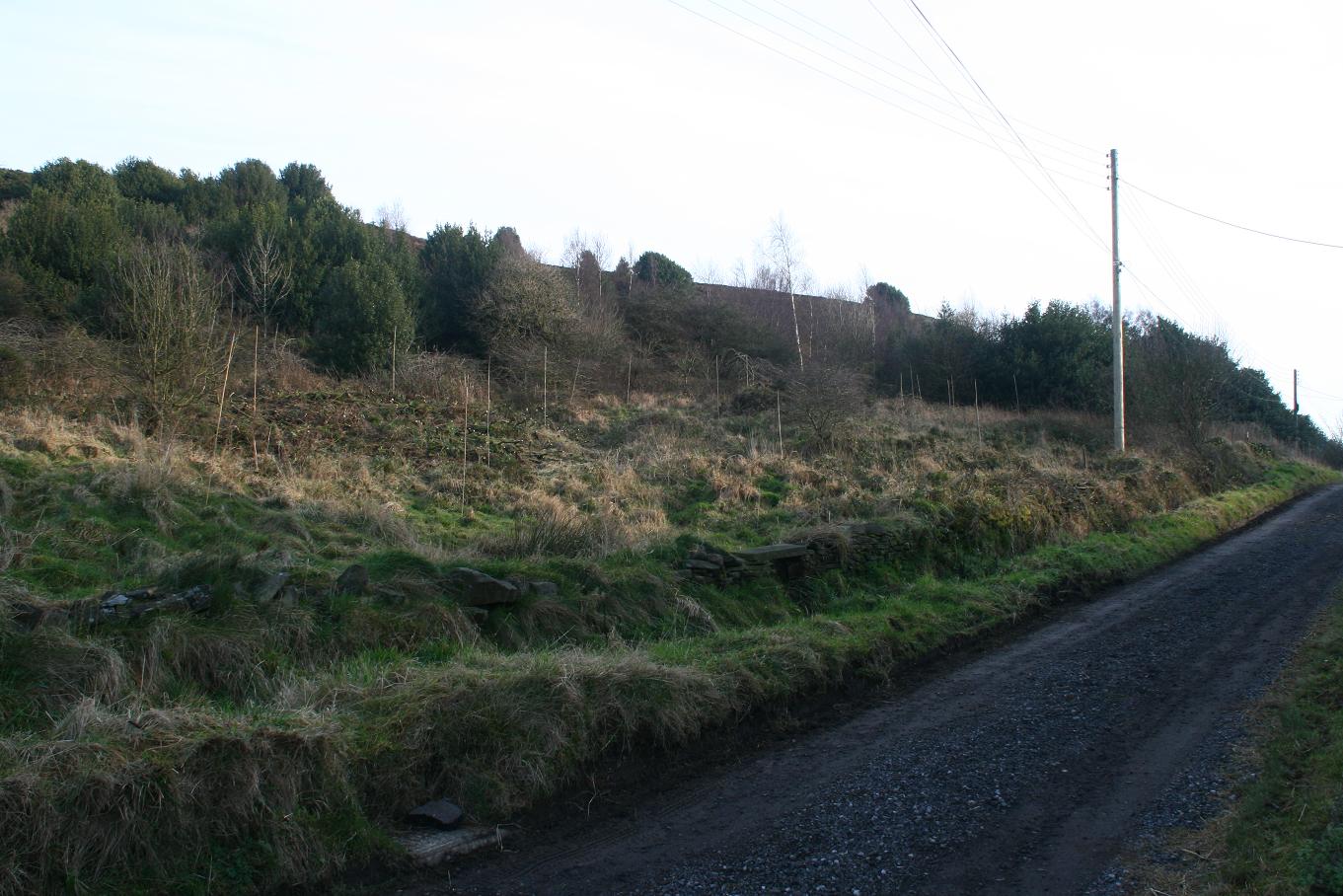
We had hoped to spend the weekend planting fruit trees on the hillside. However, when we came to dig the holes, we found the ground is waterlogged, and not draining at all well. Certainly, it's been wet for the last month, with 10" of snow, followed by 3" of rain: but the ground is downright boggy at the foot of the hillside—and waterlogged even up the slope. The problem, basically, is compacted and humus-poor soil of only 8" depth, on top of impermeable clay.

We've had to change our plans, therefore, and have spent the past two days digging twelve planting pits (a quarter of the total needed), and land drains. There's one herringbone arrangement linking half a dozen of the pits, and a second trench draining two more: these lead to a newly built culvert in the wall flowing into the road-side ditch. Three planting pits further up the hill have trenches leading away from them, to make sure that these pits don't submerge. These are just open ditches at the moment, but in time we'll hope to make them covered drains, possibly leading on to the lower system.

Another six or so holes further along are going to need the same treatment: we've dug the ditches to bring two of them down to a spinal drain, which leads partway to the wall (the rest of the length, and the culvert, will follow). Three above this will definitely need to be linked in; possibly one further.

All in all, this means another weekend of drain digging, at least, and then a glut of planting. We think we can still get everything planted by the end of the month, but it'll mean a bit of a soggy slog!

In more pleasant news, we've sown some more achillea (Summer Pastels, and Cloth of Gold); some Snow in Summer, and aquilegia 'Royal Purple'. We also started the vegetable sowing, with a pot of each of beetroot, leeks, and spinach.

We also need to pack up our Corolle seed potatoes, as they've been recalled: I've ordered some Kestrel tubers, as a replacement.

Monday, 28 January 2013

Potato Chitting

Our seed potatoes arrived a little while ago, and we've now got them out, as traditional, in egg boxes in the study to chit.

After being a bit disappointed with 'Cara' last year, we've returned to 'Druid'. We've got 'Lady Christl' again (delicious, productive, and stores surprisingly well for a first early: past Christmas, in fact), and are trying out 'Swift' and 'Corolle'.

Sunday, 27 January 2013

Two In A Row

For the second weekend running, we've managed to spend a day quilting. It's not exactly speedy work, but we're gradually making progress. We have enough pieces assembled, now, to mock up a reasonable extract of the main central section (roughly a quarter).

Quilt mock-up (© Ian 2013)

We're very pleased with how it's looking so far!

Rain and wind over the last couple of days has meant that that snow has almost all melted away, leaving very wet ground, but no more ice. We went up on the hillside, to check how the weighed down weed-proof fabric was doing (that is, whether it showed any signs of blowing away: all fine), and there are a number of little brooks running down the hill. And a spring which wasn't there before.

We've moved enough weighing-down rocks up, and measured and cut more squares of weed-suppressant, so when the ground's drier, we can cut more patches. Of course, we can probably start digging holes, too, on the next suitable weekend: that'll mean we can start actually planting trees.

Monday, 21 January 2013

Quilting and Snow

We had a very pleasant weekend, getting on top of bits and pieces on Saturday, and then quilting all Sunday. I've now installed trace heating on the pipes in the roof-space of the utility room, which should ensure that they don't freeze. It's been on the to-do list for quite some time (three years), but never hit the top of it, as conditions cold enough to threaten a freeze are relatively infrequent, and we've managed by leaving the door to the kitchen ajar on those nights.

That's suboptimal, though, so thermostatically controlled heating is an improvement. I need to wire a spur socket, to make it a bit neater, but it's now basically sorted.

Sunday was more enjoyable (no fun working through a ceiling hatch with glass fibre insulation everywhere), and we made good progress on the quilt. We now have a complete set of nine appliqué leaves, and a good number of nine-block squares, with more in the works.

Heavy snow over Sunday night meant that today's been a snowed-in working-from-home day, spent in the sitting room with the stove warming us. And very effectively, at that.

Snowy  Lane (© Ian 2013)

The house in its frozen setting, from the hillside (© Ian 2013)

Birch trees on the hillside (© Ian 2013)

View from the hillside (© Ian 2013)

The house from the future site of the orchard (© Ian 2013)


Sunday, 13 January 2013

Orchard Plan

It's been a long and tiring weekend, really, but we've cleared about 50m2 of gorse from the hillside, marked out where the 47 trees will go, and cleared and put down squares of weed-suppression on the spaces for about 17 of them.

The gorse patch from the kitchen gate (© Ian 2013)

The gorse patch from the drive (© Ian 2013)

Clearing the gorse was a matter of loppers (and secuteurs) and good gloves. Liz cleared a lot of brambles (horribly twisted and knotted in the gorse), while I concentrated on gorse. The gorse (unhindered by bramble) was rather quicker, and our respective speed showed. The gorse hid an enormous rabbit warren city, which they will now, no doubt, extend up the hill to better cover.

This, no doubt, explained the cats' interest in what we were doing: they spent most of Saturday supervising us.

Eventually, the gorse and brambles were cut, and today we turned to putting out bamboo canes to represent the trees we have planned.

 After clearing the gorse patch, and putting out the bamboos (© Ian 2013)

Roughly half (25) are for Scot's pines; the other 22 are ornamental or fruit trees. We had a bit of time left, so I got Sigrid out, and cleared patches around the first couple of dozen. Once we'd picked up the debris, we had time before the light failed to place 1m squares of weed suppressant membrane around the canes, and weight them down.

Sigrid worked really well, with the tri-blade attached, mowing through the undergrowth. There's a trick to keeping her clear of the long bramble lengths, and obviously the detritus needs clearing afterwards, but that's fine.

Canes marking future sites for the trees (© Ian 2013)

We finished the weekend by sowing sweet pea seeds: we're trying out a lot of varieties this year (14) in different colours, to work out which ones we think will work well in the corner's colour-wheel beds.

Sunday, 6 January 2013

Quilting and Mincemeat

The last two days of our holiday have been a bit of a mix. We spent most of yesterday working on our quilt: we started cutting the calico squares for snowballs, adding the corners, and then applique-ing the leaves onto them. We're hoping to have at least some time next weekend getting a bit further, but this at least has made it possible to get a sense of how it will all look once finished.

We also undecorated the house, and swept up lots of holly leaves and berries; I put up a new coat hook in the utility room; and we made mincemeat.

Yes, mincemeat, for Christmas 2013. It improves with keeping! Same recipe as last year, a nominally 6lb batch, though it seems a bit less than that.

Friday, 4 January 2013

Portiere Curtains

We've been finding that the house sports a number of draughts that we haven't previously solved. The back door and front door, especially, have a gale howling through the keyhole, and round the door, when the wind gets up (which it does, frequently). I've used foam strips as best I can, but they're not perfect.

Separately, we're aware that heat flows up the stairs, cooling the living rooms (which we'd like warm), and warming the bedrooms (which we'd like cooler).

Longer term, we're considering insulating the walls (the back wall externally, and the front wall internally), but that's a way off, but there are some changes we've been able to make immediately. Firstly, the long-unused curtain rail separating the landing has been put back into use over the last few weeks. Having proved workable, and having made a difference to the landing temperature, I've replaced the track with a pole, which has meant a set of tab-top curtains that were spare have replaced the unattractive curtain that moved there from my dressing room. The curtain now splits the landing into a small area at the top of the stairs and outside the two spare bedrooms, and a longer landing with the master bedroom and bathroom off it. This means that heat from downstairs only really escapes into the new small landing space, and not into the bigger rooms (which also have loft hatches).

I've also put a thick curtain up across the back door. It'll mean access through that door is slightly complicated, and that we won't, during cold weather, go out for any length of time using that door, but it should really help with the drafts.

This obviously doesn't work so well with the front door: a normal curtain across that door couldn't be drawn behind us on leaving, meaning it wouldn't be in place during the day, or if we go away. Instead, I have constructed an ingenious contraption that works to open and close the curtain with the door, while entirely covering it (that is, extending beyond the door's recess on all sides. Photo when I can. Basically, there's a shelf bracket and short vertical pole mounted at the top of the handle edge of the door, with a curtain pole 'cup' at the top. This brings the cup forward out of the door recess, and up above it. The cup can rotate, and the pole can move laterally along it: both of these are necessary freedoms, because of the non-coinciding pivot points of door and curtain pole. On the hinge side, on the wall, the curtain pole's mounted on a bracket modified to include a vertical bolt, through a hole in the pole. This is the pivot of the curtain. When the door's opened, the handle side of the pole moves with the door, rotating around the hinge-side pivot: it also moves hinge-wards, in the door frame of reference, and ceases to be parallel to the door (hence the requirements for sliding and rotating the handle-side fixing).

Relatively simple to make: you can buy portiere curtain poles, but those for recessed doors are expensive (~£100-120), and all this cost was £30, for a curtain pole and a shelf bracket, and a few bits and pieces (scrap wood, to mount things, and a machine bolt for the bearing).

I then put up similar affairs on the doors to the two spare bedrooms, to help compartmentalize the landing. Simpler, because there's no recess; instead of a bracket, the handle-side cup is mounted on a small vertical plank, which means the curtain pole is above the door level. The cup through which the pole slides needs modifying, though, because of the change in angle between door and pole; that's easy enough, though.

Lastly, I've put up the new outside light above the drive (much nicer than the old bulkhead lights), and wired in a PIR sensor so the lights come on when you approach the front door. Needs some tweaking (so it comes on for longer, and doesn't trip until you're closer), but very pleasing.

Saturday, 29 December 2012

Christmas Party

Christmas 'Tree' (© Ian 2012)

We spent Christmas Day, and Boxing Day, with Jenny, Philip, and the fosterlings, and Philip's parents while they visited. It's been a pleasant few days, with lots of food and games and presents (including two rather good garden books by Monty Don and Alan Titchmarsh). Yesterday, we made the most of the garden centre's sale, and found some new/extra lights for the fireplace swag—the lights ceased to function a couple of days ago, but the new, more numerous LED lights are really good.

Our more-tasteful-than-sometimes Christmas cake (© Ian 2012) 

This evening, we hosted a small party, for Jenny, Philip, the children, Cath, Jason, and Cath's parents; we've spent a lot of today, and bits of the last couple of days, making things: including some very tasty mincemeat-laced muffins, and rather tasty cheese nibbles. I might get round to recipes; you never know.

The dining room (© Ian 2012)

Monday, 24 December 2012

Gingerbread

Last year, we made gingerbread houses for the fosterlings. They were good fun, and this year we decided to try something more challenging. It has been.

Can you tell what it is yet?

Parts for the Gingerbread House (© Ian 2012)


Parts for the Gingerbread House (© Ian 2012)

Yesterday we spent making the templates, and baking most of the gingerbread: today we finished baking, and assembled everything.

The 2012 Gingerbread House (© Ian 2012)

Eight kilos of sugar, flour, ginger, and nuts later, a scale replica of Jenny & Philip's house and garden, with a minimum of artistic license. The conservatory was a trigonometry exercise for me (I had to resort to long unused vector maths to work out the triangles involved...), while Liz is responsible for the marzipan and angelica plants, and the chocolate trees.

Jenny & Philip's House in Gingerbread (© Ian 2012)

Saturday, 22 December 2012

The Nutcracker

We had my parents for a pre-Christmas visit last weekend, which we all enjoyed. This has been our last week at work before a couple of weeks of leave, and it's gone by pleasingly quickly (not least because we also had Friday off!). We spent yesterday splitting and stacking a ton of chestnut, which is now safely stowed in the wood shelter. Today's been rather more seasonal, as we went to Leeds Grand to watch the Northern Ballet perform The Nutcracker. It was an excellent production, and a lot of fun: it's been a long time since I've watched a ballet live, although we have a recording of the Royal Ballet's Nutcracker that we can watch at Christmas.

Sunday, 9 December 2012

Christmas Decorations

Fireplace Swag (© Ian 2012)

We've spent most of the weekend putting up the Christmas decorations. This necessitated a trip up the hillside, to collect the holly for making the swag, putting in vases, and doing the stairs' handrails. We bulked this out with conifer from the garden (which is easier to make into a swag), and holly (for the kissing bough and wreath). It's all looking rather good, and decidedly seasonal. We don't have a 'proper' Christmas tree, having decided to do without while our Scot's pines grow. However, I did find two attractive boughs of silver birch, which I spray painted white, and are standing in. Actually, I really like it, and we might keep it for a second tree in future years.

Atypical Christmas tree (silver birch branches, sprayed white) (© Ian 2012)

We also cooked one of the Wiltshire cure hams we made in September. This was a more complex recipe than the previous salting, and included treacle and beer. It was definitely worth it, though: the ham was delicious.

I also unveiled the ginger wine I'd made some time ago for Liz's birthday, and it is, apparently, really tasty. I still think it smells horrible, though.

Sunday, 2 December 2012

Herbs

We had a weekend in Cambridge (a displaced half-yearly get-together, which was really good), and popped in to our old garden centre on the way home. As well as admiring Christmas trees, and finding one decoration we liked (very restrained), we also picked up a second pair of loppers (on offer; we thought they'd come in handy clearing the hillside), and a load of end-of-season herbaceous plants. That included an aquilegia, some bronze fennel, some variegated thymes ('Foxley'), and a pair of white rosemaries (Rosmarinus officinalis var. albus).

They don't have an immediate home: the herbs will be grown on, for the future herb garden. A couple of the thymes might go in the front garden wall, that said, before layering them for more plants.

Not much to report, therein: the weekend was lovely, with much food and games, but no photos. We're at home next weekend, and will probably put up the Christmas decorations, as well as trying one of the hams we cured earlier in the autumn.

Sunday, 25 November 2012

More Trees

As I alluded, we intend to add a number of trees to our new hillside: some utility species, but also enough fruit trees to make a productive orchard on the lower half-acre. These arrived a couple of days ago, and so we've heeled them in to 'keep' until we can clear ground for them. They'll be fine where they are until the spring, so as long as we've put them in their final spots by the end of February (or so), they won't notice the fact that they're in the vegetable garden while dormant.

There are fifteen fruit trees:
  • Apples:
    • Pixie
    • Lord Lambourne
    • Fiesta
    • Falstaff
    • James Grieve
    • Charles Ross
    • Blenheim Orange
    • Bramley's Seedling
  • Pears:
    • Concorde
    • Beth
    • Conference
  • Plums/damsons/gages:
    • Victoria (two of these, as they're great)
    • Oullin's Golden Gage
    • Merryweather Damson

Five ornamental trees:
  • Purple birch
  • Plum 'Spring Glow' and Pissardii
  • 'Royalty' crab-apple
  • Cherry 'Royal Burgandy'

And then thirty willows (ten each of scarlet, osier, and golden); twenty 'Midwinter Fire' dogwoods (some of these are for the garden); and ten sweet chestnuts.

Yes: we have a lot of ground clearing and digging to do...

Sunday, 18 November 2012

Brushcutting with Sigrid

We had a day out yesterday, visiting the media museum in Bradford, in celebration of a fosterling's birthday. Good fun; the exhibits are interesting, and we saw a polar documentary at the Imax.

Today's been a getting-things-done kind of day: some wood stacking, for one thing. We also dug up the older of the two strawberry beds, taking out all of the Honeoye, Cambridge Favourite, and Florence that we put in three years ago (and then lifted into raised beds). They've not fruited brilliantly this year, as you might expect, but the Cambridge and Florence have always disappointed. So, we've replaced them with 25 new ('fresh') Honeoyes, and we've taken the extra step of planting them through weed-suppressant membrane. That should help reduce weeds, but also prevent runners, which lead to a congested and confused bed. Combined with a bit more management of runners (ie, removing most, and deliberately potting the ones we want), this should see better yields.

As we're reusing the same bed, we dug out a good amount of soil, and replaced it from soil that's been in the vegetable garden (that is, un-strawberried), and mixed in plenty of compost. At the same time, I spread compost around the rhubarb: I'll probably add some more later in the winter.

Lastly: my new brushcutter (a Husqvarna 135R, which I have christened Sigrid (shorter than 'the brushcutter', and she's Swedish)) arrived this week, so I gave her a try out. I've trimmed the verge outside the house (with strimmer attachment), and tried out the blade for clearing the hillside. Barely made an impression, in some senses, as there's half an acre to get through and I only did ten minutes' work, but I'm confident it'll do the job well. Strimming the verge was considerably easier than the last time I did so, with an electric strimmer. But that's the advantage of a 1.4kW petrol brushcutter, compared to a 350W electric model, I suppose! The right tool for the job makes such a difference...

Friday, 9 November 2012

Confirmation

Reading these entries, one might realise that I've been buying a lot of trees recently. A pair of walnuts, and twenty-five Scot's pines: and a large order of other trees that won't arrive until next month (more on that later).

And this without making clear where they're all  going to fit, given that although the garden is large, two dozen pines do take up a fair bit of space.

I haven't wanted to commit this to paper, as it were, until it was all finalized, which, pleasingly, it was, last night, with a Land Registry confirmation of title. A couple of months ago, our long-resident neighbour, Bob, put his house on the market. We'd known it was coming, as he'd mentioned planning to move in January, and had been waiting to find his next house before putting the Barn on the market. Since moving here, we've had in mind that we'd like to own the land in front of the house, as it's underutilized (it's scrubby moorland, really, with some trees), and very prominent from the front windows.

Fortunately, Bob was amenable to a sale, and so in mid-September, we purchased half of the field (the half directly outside the house), with Peter and Sara purchasing the other half (directly behind them). Each half is about 1.4 acres: ours is roughly equally split between very rough grazing, trees with some clearings, and gorse and heather with a few holly trees. When I say 'rough', I really mean it. It's boggy, tussocky, and full of patches of poor grass, brambles, quick and black thorn, and gorse. With a lot of love, I hope to turn it into an orchard, probably with orvine lawnmowers.

The trees, once the clearings are reclaimed from the bracken, should be lovely to visit, and we intend to add a few trees to the mix: sweet chestnuts and willow, for example, which have a lot of utility value. The top patch is much too steep for most uses, but I hope one day to erect a few beehives, and collect honey from the heather and gorse.

The view from the top is splendid, and I'll take a photo when I can.

So: plenty of space for all those trees, as well as, hopefully, a greenhouse and a summerhouse hidden in the trees. The woodland clearings are ideal for turning into little sanctuaries, and with some spring bulbs and dogwood will be lovely in the early part of the year. A proper orchard, with plenty of fruit trees, will get us that bit closer to keeping ourselves self-sufficient in fruit.

Now we just need to clear the weeds, and start to make the land properly usable again.

Tuesday, 6 November 2012

Another Walnut

Last year, at about this time, we bought our quince tree ('Serbian Gold', or 'Lescovac'), at our favourite local garden's Christmas launch evening. We typically go to this every year, even though it's early to start Christmas by my reckoning, because they inexplicably give a 15% discount for the evening. Not just on Christmas stock—on everything. Baubles, wellies, perennials, fertilizer: the lot.

Well, that's too good to pass up, isn't it? So off we toddle, round the entire garden centre, and stock up on everything mundane we know we need. I confess to starting a shopping list of necessary-but-not-urgent things we need some months in advance.

The garden centre's loyalty card scheme also sent me a voucher for a half-price outside plant last year, which was the reason for getting the quince: although it excluded Christmas trees and houseplants, all other outside plants were eligible: and half-price off a fruit tree brings their normal ~£40 price tag down to the same region as a 2–3 year old maiden bare-root, but much larger.

They obviously didn't think this was a problem, though I'm sure most of the vouchers get used on shrubs and perennials in the £5–15 range, and so they sent me another one.

That, too, was too tempting to pass up.

We bought a walnut from RHS Harlow Carr in September, which was reduced by 50% at the end of the season (I'm still not really sure why, but there you go: it would have over-wintered perfectly happily, and they still have a number of apples and pears that weren't cleared out, as our visit two weeks ago demonstrated). The walnut variety, Broadview, is nominally self-fertile, but—like all self-fertile fruit trees—will still set more fruit if there's a cross-pollinator available. So I was delighted to find a Buccaneer in the nut aisle at the garden centre, nominally £39.99: but of course I only paid £20, which is still £10–15 less than I've found (cultivated) walnuts elsewhere. I'm delighted, of course.

There was also a sweet chestnut, which would have been nearly as good value (£18), but I'd quite like Marron de Lyon (which this wasn't), and it wouldn't have fitted in the car. The Buccaneer was a good 8–9' tall, and just fitted in: the chestnut was taller and bushier, and wouldn't have had a chance. But it would have been very satisfying.

Sunday, 4 November 2012

Pond Practice

Our visit to Molly was partly with the intention of renovating her garden pond (the traditional exchange of labour for food and company!). She had a small pond, a few feet in diameter, and about a foot deep, but it wasn't entirely satisfactory. The fountain was unimpressive (it had to be turned down low, or it threw the water out of the pond), and it was rapidly out-grown by the plants.

So we dug her a new one.

Newly dug pond: ledge all the way round (bit bigger in top right, due to soakaway pipe) and with a wildlife escape ramp in the top left. The pond's 6'x8', and around 2' deep: there was about three barrows of rubble buried in the soil (© Ian 2012)

Half-way through filling up, before trimming (© Ian 2012)

Pond filled and fountain running. The edging will be tidied up after planting (© Ian 2012)

Of course, no trip to Ludlow is complete without a trip to the plant stalls on the market, and this time was no exception. We found a really lovely oak-leaved hydrangea (H. quercifolia): it has pretty leaves, with good autumn colour. It would hold its own, I think, as a deciduous shrub, but it also flowers (large, white, typical hydrangea flowers) in late summer. We also pinched some cuttings of a red-stemmed variegated willow, and half a dozen kaffir lilies (Schizostylis coccinea). Ample reward for pond digging, I think.

Oak-leaved hydrangea, along with willow cuttings (front left) (© Ian 2012)

Friday, 2 November 2012

Beeston Castle

Uneventful day in the garden yesterday: wood stacking, turning the compost bins, and tidying the garden porch. The compost bins are doing well: the right hand (mature compost) bin was half-full, having been taking compost for it for things like the new shrubs. The middle bay is now ready, so that I turned into the rightmost bay. It is writhing with worms, and looks excellent.

The left hand bay has been filled over the last few months, and hasn't really got very far. Hopefully turning and aerating it will have helped, but I must try to pour some water on to it, and see if that helps. Even though it wasn't well advanced, I had to turn it into the middle bay, as it was full, as was the compost bin in the porch, as was the compost crock in the kitchen. This was unsustainable.

Having come in, we had a more exciting evening, and made our Christmas cake. Took forever to cook, as normal—about four hours twenty, while the recipe suggests 3–3½ hours. It looks delicious, though: I'll water it a few times over the coming couple of months.

Today we travelled down to visit Molly in Ludlow, and called in at Beeston Castle. Liz went there many years ago (and has no recollection of it): it's a 13th century (read: proper Medieval) castle built by Ranulf of Chester in the 1220s on ancient bronze age earthworks. It was siezed by Henry III on the death of Ranulf's heir, and was a Royal castle until it was thought obsolete in the 16th century. Its inner ward is on a peak surrounded on three sides by sheer cliff; the fourth side, connecting with the outer ward, is protected by a deep ditch cut into the rock.

It's impossible to take by storm.

The (modern!) bridge and inner ward's gatehouse, Beeston Castle (© Ian 2012)

View of the inner ward from outside the outer ward (© Ian 2012)

The castle was the site of siege during the Civil War: it started in Parliamentarian hands, was taken by Royalists (by stealth and treachery), and then invested by the Roundheads. A year-long seige eventually ended in November 1645: the Royalist garrison managed to convince their besiegers that their supplies were stronger, and negotiated good terms for surrender. They marched out with colours flying and with their arms; they left practically no food (there's a secure well, 100m deep, in the inner ward).

The Parliamentary forces slighted the castle, to prevent its reuse, and it's been a ruin since.

Later, an extra 40 acre ring of land was enclosed by a Victorian wall, and exotic animals were kept as an attraction, and there are some natural sandstone caves in the grounds.

View of the gatehouse to the inner ward (© Ian 2012)

View from the inner ward across to Peckforton Castle (a Victorian conceit, not really a castle proper) (© Ian 2012)

View from the inner ward: you can see up to 30 miles, to Liverpool, Manchester, the Pennines, and the Welsh mountains (© Ian 2012)

The 40 acres of wooded grounds have numerous oaks of a significant size (© Ian 2012)

Wednesday, 31 October 2012

Christmas Trees

We spent most of yesterday getting some plants into the new bed in front of the copse. To start with, we've put the two dogwoods we already had (Cornus alba 'Elegantissima' and 'Spaethii') near the bottom apex of the bed (near the fruit cages); three new witch-hazels (Hamamelis x intermedia 'Jelena'  and 'Magic Fire, and H. mollis) went further up, on the copse side, and we moved the weigela (W. florida 'Variegata') and the caryopteris (C. x clandonensis 'Worcester Gold') in as well. A group of heathers (white darleyensis: 'Silberschmelze', I think), and two groups of hellebores also found homes.

Then we went to town with bulbs. 180 daffodills (a mix, including jonquillas and narcissi, 'Golden Ducat', 'Pacific Coast', 'White Lion' and 'Minnow'), 100 chionodoxa, and 100 crocus ('Ard Schenk', 'Sieberi Firefly', 'Barr's Purple' and 'Romance').

Having done that, we weeded the bed in front of the dining room window, and planted a further fifty mixed daffodils, fifty Dutch irises, three allium 'Hair' and three A. caeruleum, and 32 of each of A. sphaerocephalon and ostrowskanium.

Today, we'd happily weeded the vegetable beds, and had a pleasing hour planting pots of tulips (loads of them, as you'd expect: 30 mixed Rembrandt; 25 mixed Kaufmanniana; 60 mixed Triumph) and lifting the gladioli (not done well this year, and small bulbs), when a delivery man dropped off twenty five Christmas trees.

Not cut, or very large: twenty-five 2 year old, bare-rooted, Scot's pines (Pinus sylvestris). We're planning on finding a spot for these, and cutting one or two down each year as our Christmas tree (this is, evidently, a longish-term plan)—but we hadn't expected them to arrive until, say, December. Or preferably January. And we didn't have anywhere to put them.

Undeterred, we immediately set to clearing the bed around the Victoria plum, to the side of the future pond. This bed we planned to create in the spring, running round three sides of the pond, and encompassing the fruit trees, and the bed alongside the septic tank. A quick debate about shape and size, and I started lifting turves. I got past the plum, as far as the spot we're planning for a bench, figured that was enough space, and started de-stoning the ground. This part of the operation probably took as long as lifting the turf, and we excavated probably two barrows of stone. Beyond the plum, I met my match, in the shape of a huge stone probably two feet long and one wide, with an unknown depth. I gave up there, and we planted the pines on the other side of the plum. They'll over-winter there, and we'll aim to find permanent sites for them while they're still dormant, and get them there by March.

Monday, 29 October 2012

Ducks

For her birthday, Jenny asked for two pairs of call ducks, which we, Katie, and the fosterlings dutifully obtained. One pair is (I think) 'dark blue silver', and the others are white. They arrived last week, and had been settling in nicely.

This morning, we were getting on with clearing one of the beds in front of the copse, when shouting and hollering from Jenny and Philip's direction suggested a problem. Fearing that one of the cats (both were out, and only one was supervising us) had 'discovered' the ducks, we went round. Instead, the dog had got out, and caught the white drake, Ninada. Unfortunately, he seems to have suffered serious internal injury, and died en route to the vet. I buried him in the copse this afternoon.

In brighter news, the big bed (which already had three fruit trees in it) is now complete, in a sense. The turf has all be cut and lifted (and stacked to rot down), and the heap of chippings that's been there since June has been spread out. It looks suspiciously like a flower bed. We'll start to put more plants in over the next couple of days.

Saturday, 27 October 2012

RHS Harlow Carr at Hallowe'en

Partly for Jenny's birthday, partly to take advantage of the hallowe'en events, we all went to Harlow Carr for the day. They had a monster trail and boggart workshop for the fosterlings, while we enjoyed a woodland crafts (coppicing and woodwork) display, and the plants. Obviously.

The Main Borders, RHS Harlow Carr (© Ian 2012)

Compare and contrast with the same border in September:

Op. cit. (© Ian 2012)

The children spent a while playing in the tree house playground, which I rather liked, too (though I wasn't allowed on...)

Craggle-Top Treehouse, RHS Harlow Carr (© Ian 2012)


Copse of white poplars, RHS Harlow Carr (© Ian 2012)

From the bird hide, RHS Harlow Carr (© Ian 2012)

 We were very restrained, and didn't buy any plants (just a small Christmas decoration: more on that in a month, perhaps).

Tuesday, 23 October 2012

Chimney

As we're starting to need the stove (we had it running on Saturday, and it worked a treat keeping the house toasty during the day), I decided it was time to sweep the chimney. It turned out to be more straightforward than it could have been, and the chimney doesn't seem to have been too dirty. Fair bit of soot came down, but no huge lumps, or anything alarming.

The stove (© Ian 2012)

Roll on a winter of toasty stove use.

Sunday, 21 October 2012

Seeds, Settlers, and St Honoré

Alan and Ann were with us for the weekend, as I alluded to last week. The Gateau St Honoré was a great success. We modified the recipe somewhat, filling the choux buns with crème pâtissière, and I've now bought a piping bag, so the filling of the gateau was neatly piped. I didn't quench the spun sugar, so that was still molten and spinnable, too. All in all, very good.

And then the cat happened. We (stupidly) left the gateau unattended for all of a few minutes, and the custard monster spotted it, hopped onto the sideboard, and helped himself to the (obviously delicious) crème pâtissière. As a result, it was no longer photogenic (sorry), although he'd taken a relatively small amount, so we repaired it and served it (Liz got the catted bit*).

*He's her cat, in these circumstances, in the same way that Domino's mine at three in the morning when he needs the loo, but wants company finding the litter tray in the dark. His superior night vision notwithstanding.

We played two games of Settlers (an entirely epic Greater Catan plus Cities and Knights, which lasted about seven hours), and a more normal Cities and Knights of a couple of hours. Greater Catan was, as normal, an excellent treat, and worth the set-up time!

After they left this afternoon, we've also sown some centranthus and achillea seeds, and will be putting a pack of Leymus arenarius seeds (blue-grey clump-forming grass) in the fridge to pre-chill. They'll be sown in about six weeks.

Sunday, 14 October 2012

Test Run Bakery

We've got visitors next weekend, and want to try something new for dessert; having been inspired by The Great British Bake-Off, we thought we'd try a Gateau St Honoré. No, neither of us has made crème pâtissière before. No, we've never made choux pastry. Nope, not made spun sugar before. What could go wrong?

As it turns out, the caramel. Which, on quenching in the saucepan, solidified. Tasted good; much too solid to do anything with. I shall have to attempt it again.

Anyway: we found a recipe that uses an almond pastry for the base; a crème pâtissière recipe that isn't too extravagant on the eggs, and uses (whole) milk instead of cream; and I picked my mum's brains about making the choux buns (she's made profiteroles before, I haven't...).

It wasn't the most artistically perfect, but by goodness did it taste excellent.

Gateaux St Honoré (© Ian 2012)

In other news, I've almost finished the boiler room work, and we pottered in the garden for a bit. We pulled up another parsnip (similarly large, but tasted much better and sweeter, I think due to the colder weather since the last one), and also replanted the hanging baskets ready for winter. Out came the petunias and lobelias, and in went supplementary cineraria, and new primroses. They're looking good, and will improve as they grow on.

Because the likelihood of proper frosts is increasing, we also lifted all the geraniums and potted fuchsias from the front, and took them into the workshop, where they'll overwinter. In doing so, we discovered that several pots had chafer grubs in them, which had eaten a lot of the roots of the affected heucheras and primroses (fortunately, only two of each, I think). The affected plants have been re-potted (having checked through the roots!), and the soil from those planters is in the compost bin, having squashed as many grubs as I could see.

Sunday, 7 October 2012

Birthday and Cordial

This weekend was Liz's grandma's birthday, which meant a big family gathering at Liz's uncle's house. It was a nice day, and it was good to see everyone. Katie made rather an attractive cake:

The cake that Katie made (© Ian 2012)

Yesterday, though, was spent outside, sorting out wood. However, we managed to pop out to collect blackberries, the fourth lot this autumn. Having done so, we amassed the remains of last year's frozen blackberries, bilberries, and damsons, with a view to making a spiced berry cordial for the winter. Last year we had a (roughly) 50:50 split between blackberries and elderberries—but there are almost no elderberries this year. We managed to collect a miserly 100g.

Nonetheless, we pulled together 4.5kg of fruit, made it up to 6l with hot water, and then boiled it down to 4.5l. Tonight, I've added pectolase, which will break down the fruit, and release more juice, and then tomorrow I can squeeze and strain all the juices out. Next, you add 2.25kg of sugar (500g for every original kilo of fruit), and boil it for five minutes with spices (allspice, ginger, cinnamon, nutmeg, cloves).

Bottled, it should store into the new year.

Tuesday, 2 October 2012

Bracken

The blueberries in the fruit garden aren't doing too well; the smaller ones haven't grown much this year, and the leaves haven't looked especially healthy. My opinion is that they need mulching, but the problem is that they're ericaceous, and need an acidic, sequestered-iron-rich soil to cope. The topsoil we filled the beds with is, probably, not quite what they want, and although it will gradually become more suitable, I don't think they're happy.

So: what to mulch with? I don't want to buy ericaceous compost, and would rather find an alternative. Pleasingly, there seems to be one: composted bracken. Composted pine needles, bark, heather, and bracken all appear to create an ericaceous compost—Monty Don has a Guardian article some years ago extolling it. Bracken is something we have lots of. There's probably half an acre on the hillside opposite the house that's covered with it, so this evening we've been up and filled a cubic-metre dumpy bag with bracken.

I'm going to set up a Dalek-style plastic composter somewhere inobtrusive, and fill it up with the bracken (and some 'active' compost, to get it going), with the aim of mulching the blueberries with something they'll like in the spring. If it works, there's more than enough bracken out there to compost significant amounts, which will be invaluable as a mulch for all the calcifruge plants in the garden: the heathers, raspberries, rhododendrons will all prefer it, as well as the Vaccinum fruits (cranberry, blueberry, bilberry and so on).

Sunday, 30 September 2012

Beetroot

We've had a largely uneventful weekend, doing bits and pieces around the house and garden (workshop sorting; splitting and stacking wood; housework), with one highlight: lifting the beetroot.

In a year of mediocre crops, and difficult growing conditions, the beetroot have excelled. We planted out a couple of hundred seedlings, Boltardy and Cylindra, and they've done really well. The largest are about the size of a cricket ball (Boltardy), or 20cm long and 5cm across (Cylindra). We had some for dinner, along with our first parsnip (having had one or two frosts), and they taste really good, too. Fortunately, despite their size, they're not woody, either.

Good to have at least one success story!

Sunday, 23 September 2012

Blood Cakes and Sausages

One of the new things we wanted to try this year with our half pig is black pudding, which is hard to find in a 'happy' form. Because the pig's from a local smallholder, abattoir, and butcher, it was possible to collect the blood on slaughter day.

I froze this, because I needed fat from the rest of the pig (only collected a week later), and defrosted it above simmering water this morning.

To make the puddings:
  • The night before, cook 500g of pearl barley (done in advance as it takes about an hour to cook), and set 500g of oatmeal (I used porridge oats that went through the blender) soaking in enough water to make a porridge.
  • Chop 1kg of back fat into small pieces. Put some of this in a big pan (I used an 8l stock pot, which was just big enough), and add 1kg of finely diced onion. Sweat this very gently, until the onion's translucent, then add the rest of the fat. Cook this gently until the fat's running.
  • Add the oatmeal, the barley, 600ml of double cream, and plenty of seasoning. We used coriander, cumin, mace, salt, pepper.
  • Stir in the blood. Preheat the oven to 170°C.
  • Cook until it start to thicken, then pour into lined & greased loaf tins: we needed about twelve 500ml tins. Cover loosely with greased foil.
  • Put in water baths in the oven, at 170°C, for about 80–90 minutes, until a knife goes into them cleanly.
Once cool, I've sliced and frozen ours. These aren't, strictly, black puddings, but blood cakes. You can funnel the mix into large sausage skins, and poach them, but this runs the risk of explosive mess, which I didn't want on our first attempt.

Verdict: extremely good. Could do with slightly more seasoning, though.

Alongside this, we also made two dishes of brawn: basically, put all the 'bits' in a big pan, cover with water, add a big handful of herbs, cloves, mace, salt and pepper, and simmer for 4–5 hours. By bits, I mean anything you have left over. In our case, I put in the trotters, bones, ears, and some of the cheeks (I took off the properly meaty bits for sausages).

Once it's cooked, you can pull apart the meat, and put everything you fancy eating into a flat dish. The remaining stock gets boiled down by 50–60%, and then poured on top. We had disproportionately many trotters (we got the spares), so the stock was properly gelatinous, and set really firm. The brawn gets chilled, and I'll then cut it into portion-sized pieces, and it'll go in casseroles or other dishes where a little meat is useful.

Last thing was the sausages. We decided to limit ourselves to pork & leek, and Welsh Dragon (leek and chilli), which were the most successful (and versatile) of last year's trials.

The basic recipe for sausages is a mix of meat (not too lean or too fatty), to which you add 1% salt (10g per kilo of meat); 5–10% cereal (100g/kilo: I use chopped up porridge oats); 5–7% water; and 0.1% pepper.

I think that 10% oats, and 7% water, is about right. Cereal isn't a cost-saving filler; it's really important to the flavour and texture. Last year's batch had 5%, and was actually too meaty, and too greasy. I say 'too': it was, in fact, delicious, and that was my only criticism.

To this, you can then add anything you fancy. Spices should be around 1% (again, 10g or 2 tsp per kilo); fruit or vegetables (apples or leeks, for examples) should be 5–10%. Therefore, the Welsh Dragon sausages are:

  • 1kg ground pork, mixed lean and fatty
  • 100g chopped oats/oatmeal
  • 75ml cold water
  • 10g (2 tsp) salt
  • a few twists of black pepper
  • 100g chopped leeks
  • 10g (2 tsp) chilli powder
The leek ones just omit the chilli. Tasty? Oh, yes. We started the sausages yesterday, and will finish them shortly: we've just tried the black pudding, bacon, and some of the sausages for a cooked breakfast, and they're really, really, good.

Wednesday, 19 September 2012

Bacon and Hams

I collected the rest of our half pig today, from the local butcher who's prepared it. The first order of business is getting the bacon and hams into brine, and the other joints into the freezer. The meat that will become sausages, and the fat I need for the black puddings, will go to one side in the fridge, and we'll make them at the weekend.

After the success of last year's bacon, we've decided to repeat a wet cure for the bacon: 2 litres of cold water, 500g of salt, 15g of saltpetre, and some ground black pepper. The belly goes into this (weighed down with a plate) for 24 hours: tomorrow evening, I'll slice it, package it, and freeze it.

For the hams, we've decided to try something different: a Wiltshire cure. As I can't smoke things (yet!), it'll just be the curing part of the process, after which it'll be frozen until needed. It's more extravagant ingredients, so we're trying just two hams: if it's really worth it, we might do more next year. The hams will be in from tonight until Sunday morning.

Sunday, 16 September 2012

Construction

It's been a busy, and long weekend, doing some construction and tidying in the garage/workshop. When the biomass boiler was installed, it required taking down an internal wall in the garage (next to the old boiler), which included the door into the workshop. Since then, the new boiler has largely blocked the access into the workshop from the garage: it's been manageable, but far from ideal.

The first task, then, was to take the old door and frame, and re-install them in the partition wall. It's only a chipboard wall, with timber supports, so I cut a suitable aperture, affixed studs, and put in the frame and door. Slightly inelegant, perhaps, but it's worked pretty well. It's nice to have unimpeded access to the workshop once more!

This necessitated moving the workbench along the room (out of the way of the new doorway), and so while I dealt with the door, Liz did a mammoth tidying job in the workshop, which has got, frankly, out of hand. This continued into today, while I started to rebuild the breeze-block wall that had come down, and started to construct an insulated boiler room within the workshop (to reduce heat loss from the boiler and accumulator tank).

The wall is about 60% done, but I needed a break from the job. There'll still be a gap, as I'm not going to completely rebuild the wall, but that will be filled with a stud wall. We're still looking forward to converting the garage into a second sitting room, and I want to make that stud wall easier to remove, should access to the side of the boiler space be needed.

My boiler room sub-section of the workshop is going to comprise a big door in front of the boiler and tank, which will be heavily insulated. I'm also going to massively increase the amount of insulation on the tank and pipework, to conserve the energy put into the thermal store, which will be easier with the confined space. I reckon constructing the rest of the boiler door, and the wall, will probably be another day's work, sometime over the next couple of weekends.

Friday, 14 September 2012

Blood

We ordered a half pig from a smallholding a few weeks/months ago, and the pig has gone to the abattoir today. The carcase will go to the butcher after a weekend hanging, and be ready for me to collect middle of next week.

In the meantime, though, I called in at the slaughterhouse and collected a gallon of the blood. We're planning to make black pudding, and need a couple of litres. Once the rest of the meat has arrived, we'll need some of the back fat, along with other ingredients (pearl barley, breadcrumbs, cream, seasoning), and can make the puddings next weekend. We'll also be making sausages, again, as they've been very tasty.

I'm glad I wasn't pulled over, and asked to explain a tub of blood.