
Showing posts with label autumn. Show all posts
Showing posts with label autumn. Show all posts
Tuesday, 19 September 2017
Cabinets
Plenty of progress on the downstairs bathroom this weekend! The new floor has gone down (the left over oak from the kitchen; I knew I had hung on to the last two packs for seven years for a reason), and looks really good. It should also be warm, as it's over a foil-based underfloor insulation layer. We then spent a day sorting out plumbing, and installed the units (basin unit, cupboard, and toilet concealed cistern), which all went relatively smoothly, and with only a short patch of frustration caused by a missing O-ring in a cistern fitting I hadn't noticed. That replaced, everything appears to be leak-free.


Sunday, 20 November 2016
Harrogate and Baking
We went to the Harrogate Christmas Market yesterday, which was a lot of fun. Harrogate's a lovely town, and the market enabled us to get very close to finishing our Christmas shopping.

The latter was delicious with crumpets, which were the other thing we baked.
Pumpkin Apple Streusel Muffins
Heat oven to 175°C. Oil a 12-hole muffin tin.
Mix dry ingredients; combine wet ingredients separately. Fold together. Pour into tin.
Rub the butter into the other streusel topping. Sprinkle onto the muffins.
Bake for 35–40 minutes.
Spiced Pumpkin Scones
Heat oven to 200°C.
Combine dry ingredients. Rub butter into them. Mix the wet ingredients, then stir into the dry to form a soft dough.
Shape into 12 scones (either roll out and cut/punch, or just form them freestyle).
Place on baking sheet and cook for 10–12 minutes.
Today was a pleasant day of baking. Baking many things, many involving pumpkin (we have a pumpkin feast planned for Thursday evening).

Spiced Pumpkin Scones (© Ian 2016)
These we accompanied by spiced apple and pumpkin muffins, pumpkin and sultana cake, apple and Cheddar bread, and a pumpkin pie.
We also made several bottles of apple purée to store for later (hot bottled and heat treated), and a 4lb batch of apple butter (NT Preserves recipe).
We also made several bottles of apple purée to store for later (hot bottled and heat treated), and a 4lb batch of apple butter (NT Preserves recipe).
The latter was delicious with crumpets, which were the other thing we baked.
Pumpkin and Sultana Cake
- 300g self-raising flour
- 300g light muscavado sugar (we used soft light brown)
- 3tsp mixed spice
- 2tsp bicarbonate of soda
- 175g sultanas
- ½ tsp salt
- 4 eggs, beaten
- 200g butter, melted
- zest 1 orange
- 1tbsp orange juice
- 500g pumpkin purée
Heat oven to 180°C. Butter a 30x20cm baking tin.
Combine the dry ingredients.
Add everything else other than the pumpkin.
Fold in the pumpkin
Pour into the tin.
Bake for 30 minutes.
Pumpkin Apple Streusel Muffins
- 2.5 cups plain flour
- 1 cup granulated sugar
- ½tsp mixed spice
- ½tsp cinnamon
- ½tsp nutmeg
- ½tsp ginger
- 1tsp bicarbonate of soda
- ½tsp salt
- 2 eggs, beaten
- 1 cup pumpkin purée
- 2 cups grated apple
- 2tbsp plain flour
- 2tbps white sugar
- ½tsp cinnamon
- 1tbsp butter
Heat oven to 175°C. Oil a 12-hole muffin tin.
Mix dry ingredients; combine wet ingredients separately. Fold together. Pour into tin.
Rub the butter into the other streusel topping. Sprinkle onto the muffins.
Bake for 35–40 minutes.
Spiced Pumpkin Scones
- 2 cups plain flour
- 1/3 cup brown sugar, packed
- 1tsp cinnamon
- 1tsp baking powder
- ¾tsp ground cloves
- ½tsp ground ginger
- ½tsp ground nutmeg
- ½tsp baking soda
- ¼tsp salt
- 225g unsalted butter, cut into cubes
- ½ cup pumpkin puree
- 3tbsp milk
- 1 large egg
- 2tsp vanilla extract
Heat oven to 200°C.
Combine dry ingredients. Rub butter into them. Mix the wet ingredients, then stir into the dry to form a soft dough.
Shape into 12 scones (either roll out and cut/punch, or just form them freestyle).
Place on baking sheet and cook for 10–12 minutes.
Sunday, 13 November 2016
Honey
We had a fun trip to the Ideal Homes Christmas Show yesterday, picking up a few presents for people—and a moose for us. For no better reason than we liked him.


Giles the Moose (© Ian 2016)
From the ridiculous to the sublime: we managed to get our new grandfather clock working this afternoon. As we thought, the chains for two of the weights had got jammed too high: my theory is that it was wound with a little too much enthusiasm, and the chains pulled too far, which sprang the hooks off the weights' rods. With a little care and persuasion, and aided considerably by the fact that the case has the removable side panels I hoped it would, we were able to work the chains down fair enough to rehang the weights. There's a bit of damage to the brass shells of the weights, but it's pretty cosmetic, and I've been able to resecure the weights (luckily, the threads don't appear damaged by being yanked free).
It's now up and running, and we'll next check whether it keeps time.
This afternoon's project was processing our first batch of honey from the bees. This has been sat, still in the honeycomb, for a few weeks since coming off the hive. First step is to slice the top off the comb (the cappings) using a large serrated knife. The frames then go into the centrifugal extractor, and are spun round to drag the honey out of one side of the comb. We flip them over, and do the other side, before draining the honey from the tank. From fourteen sides (two frames were only filled on one side), we've got about 14lb, which is a good rate. The cappings are now in a sieve, draining the last of the honey, and then we can clean the cappings and melt them: this wax is, typically, the 'best', as it's only been in the hive briefly (so less time for bees to traipse muddy feet over it), and only for honey (the comb that's used to raise baby bees gets dirtied from the process). It will probably be very light in colour.

A comb of honey ready for uncapping and extracting (© Ian 2016)
Wednesday, 2 November 2016
First Frost
We had our first frost of the year last night. Later than I'd normally expect, but it's been lovely mild autumn.
Monday, 31 October 2016
Tulips
One of the last 'urgent/important' jobs for us this autumn has been getting some tulips planted. We ordered 256 mixed 'perennial' tulips, to go into the herb garden. Technically, all tulips are perennials, as bulbs, but in the UK then many of them only flower for one or two years, before fading, flowering less well and then reducing to just foliage before vanishing. These are meant to be longer-lived, and (combined with planting them as deeply as I could) I hope they'll brighten the herb garden for some time.
I planted a hundred of these last autumn, but forgot to make a note of it: however, they're similar to some we've had a few years, and which I wrote about in 2013&emdash; when they're pictured with the nascent herb garden in the background.
They looked good, earlier this year, but a hundred wasn't enough, hence rather increasing numbers. They're now all over the herb garden, in and amongst other things.
Saturday, 29 October 2016
Orchard Mown
It's been a rather long and tiring day, but the grass of the orchard is now all cut. It always looks a little sorry for itself at this point (yellow patches, brown patches...patches I missed with Sigrid), but it will soon look reasonable—and will continue to look tidy over the winter, which it wouldn't otherwise. Cutting it back at least once a year also means that the brambles and thistles don't slowly dominate, and the grass stays tidy, rather than gradually forming tussocks, which are a pain underfoot.


Conversely, only cutting it annually means that the non-grass plants have a chance to complete their lifecycle, growing, flowering, and setting seed, which makes for a much more wildlife friendly landscape, and a much prettier one, as we get the succession of flowers and seeds—including the grass, a lot of the varieties of which have pretty flowers, and then good autumn colouring.

The hillside strimmed, and ready for winter (© Ian 2016)
It's been a good autumn for colours: I think the combination of reasonable rainfall, but no high winds, coupled with warm (well, not cold) days and cool (but not freezing) nights has meant that leaves have developed good colours, and not been shed. This is the beautiful moment where the Virginia Creeper (I love the Latin name, Parthenocissus quinquefolia, which tells you everything) has completely turned colour, to bright scarlet, but hasn't lost too many leaves. At the same time, the two acers in front of it, which spend the summer clothed in light green, have turned yellow, and are just getting the red-orange highlights they'll sport until the leaves drop.
It's ephemeral, but for a few days, we get both.

The house in autumn colours (© Ian 2016)
Wednesday, 26 October 2016
Autumn Cut
After cutting the paths in the orchard, the verges, and the copse ten days ago, we spent a few hours this morning starting to tackle the longer grass of the orchard. This needs the solid blade on Sigrid, rather than the strimmer head, because the grass, thistles, brambles, ragwort and blackthorn is rather too tough for a nylon string. We managed to do just less than a third of the job (equating to most of the left-hand area delineated by hedge and path), and get the cut material raked up and heaped at the compost bins. That was limited by my only having half a day at home (I'm effectively working a late shift), and also by our stamina: Sigrid isn't light, or quiet, or sweet-smelling!
However, even though it's going to take another couple of stints of work, hopefully over the coming weekend, the bit that we've done does look a lot better. It's nice to have it neat going into the winter, and cutting the grass back regularly does reduce the formation of tussocks, which makes it very much less even underfoot.
Sunday, 23 October 2016
Bees and Yarn
We've had a truly lovely weekend with David and Ann, who came up on Friday night, and leave in the morning. There has been a lot of baked goodness, including my cinnamon rolls, which I promised to note here.
- 250g strong white flour
- 1tsp salt
- 75g butter
- 2½tsp yeast
- 100g granulated sugar
- 250ml warm milk
Make that into a dough, and knead it well (it's a rich dough, so it needs a good knead). When it's doubled, roll it out into about a 16" square. Pour 75g of melted butter over it, then pour 140g light brown sugar mixed with 3tbsp cinnamon onto it. Roll it up, and cut it into eight. I like using a length of cotton to radially guillotine the roll: it is immeasurably neater than trying to slice.
Arrange into a baking dish, and allow to rise again. Bake at 180°C for about 20 minutes. They can either be served warm, or they store fine for a couple of days.
If you make up a cream cheese icing (85g butter/soft margarine, 120g icing sugar, 45g cream cheese, ½tsp vanilla extract and a pinch of salt), and spread it on the top before microwaving for a minute per roll...then that works really, really well.
We managed a walk, and a few games, and a film. As well as a lot of coffee, gin, wine, and knitting. I managed to start building a beehive, too (a stand, floor, and roof), which will go in the garden in time.

WBC-style stand and roof, with an open mesh floor and 70mm eke, all in BS National pattern (© Ian 2016)
Wednesday, 19 October 2016
Mown
That, I think, is likely to be last lawn-mow of the year. I might be wrong—have often been—but I doubt I'll get to it again, unless we wind up with surprising weather.
Sunday, 16 October 2016
Beehive Parts
Yesterday was a long but lovely day, spent driving over to Lincolnshire to collect a large order of beehive parts, ready to expand our stock next year. It was an end-of-season sale, so we made the most of it (see also: Tatton Park).


A finely calibrated van-full (© Ian 2016)
There are enough parts there to expand to a dozen colonies, and we got some very good prices on some equipment while we were there, too. The metal cylinder is a centrifugal honey extractor (duly named the Honey Monster), for example, which was about a third of the normal price. We also stocked up on thirds-quality wooden flatpacked parts, which were about an eighth of the normal (firsts-) price...and less again than the assembled prices. Fortunately, I do love making things, including from flatpacks, which is just as well, as I calculate there are in excess of five thousand components in that van...
Today was quieter: making sure Honey Monster works as expected (not with honey, yet), and starting to strim the hillside. That's far from complete (technical issues), but the verges and copse are all done, and the hillside's started.
Friday, 30 September 2016
RHS Harlow Carr
To mark the start of a week off, we managed to get away early from work (well, I did—Liz has been off all day, cleaning and tidying!), and drove over to Harlow Carr. We picked up a couple of cakes from Betty's, and then had a wander. It was, as you'd expect for 1600 on a term-time weekday at the end of September, pretty quiet. But tranquil and lovely for that.


Acer near the streamside (© Ian 2016)

Gunnera manicata in the streamside (© Ian 2016)

A variegated brunnera ("Hadspen Cream") (© Ian 2016)

The herbaceous borders (© Ian 2016)

Molinia 'Poul Petersen' (© Ian 2016)

Another grass (Calamagrostis brachytricha) we liked (© Ian 2016)

The herbaceous borders (© Ian 2016)

Espalier trained apples in the kitchen garden: the spacing is similar to that in our apple walk (© Ian 2016)

Fruitful espalier trained apple (© Ian 2016)

Espalier apple (© Ian 2016)
Sunday, 18 September 2016
Autumn Fruit
It's been a long time, because the blackberries have been ready in August for several years, but this year it's September and they're ready. It feels more like the 'proper' time for us both, as we remember picking blackberries in September when we were small.
Anyway, we managed to collect a number of tubs from the orchard.

Start of the blackberry harvest (© Ian 2016)
And also a number of apples. These are Yorkshire Greening, from the apple walk.

Yorkshire Greening apples (© Ian 2016)
We also spent a while sorting out some firewood, and the wood shelter is almost at capacity, which is a good point to be at.
Saturday, 10 September 2016
Willow Arches
The honeybees have been settling in well, and enjoying the late good weather. We had a thorough look through the hives this morning to check on them, and tidied up a few bits of extraneous honeycomb (brace comb) they'd built. Which means it was immediately necessary to make crumpets so we could have the honey contained in the brace comb for tea.

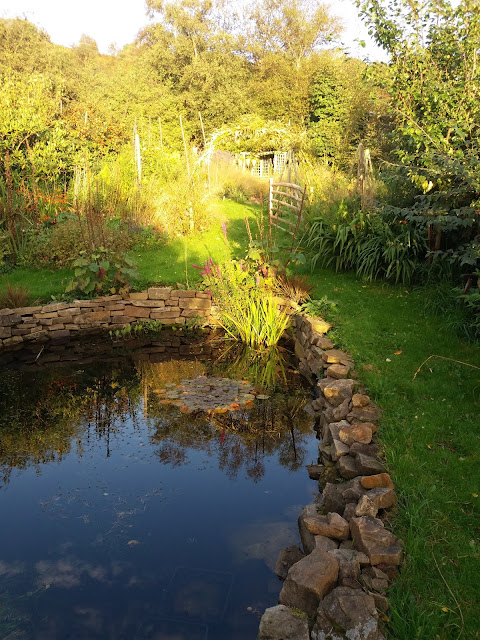


This afternoon, we've been sorting out the willows that form the arches to either end of the pond garden, and disguise the sheds on the septic tank. They had got rather out of control, so it looks an awful lot better pruned and tied in.

The Pond Garden (© Ian 2016)

The Long Border (© Ian)

The arch from the pond up to the colour wheel (© Ian 2016)
Wednesday, 7 September 2016
Winter Hanging Baskets Planted
After getting the plants for them a week ago, we've now planted up the winter hanging baskets. They're hanging about on the arbour, for now, until the summer ones are past their best, when they'll go up on the front of the house.


Winter hanging basket (© Ian 2016)
We also discovered that we had a bowl full of plums on one of the Victorias on the hillside. They are utterly delicious.

Victoria Plum (© Ian 2016)
Sunday, 9 November 2014
The Pink Bathroom
After, I think, five years and three months bemoaning it, we've finally demolished (as it were) the pink 'house' bathroom. Tiled lovingly from floor to ceiling in a pink rose pattern, with monolithic shower plinth, and 'cosy' loo in the corner (tucked between said plinth and the wall), it's never been much loved. The tiles were augmented with two mismatched white tiles at some date, too. Anyway, it is gone.
We started on Saturday by taking out the sink, and then took the ceiling down. It sounds drastic, but it was a false ceiling, with the 'real' ceiling hidden a couple of feet above it. We're not entirely sure why it was put in: it's got some quirkiness to it, though. The upper ceiling is higher than any of the other first floor ceilings, with a sloped section at the front/back of the house. However, the finish matches the ceiling material in the far end of the house (~15cm T&G planks)—where, in fact, the ceiling is lowest. The lower ceiling, which is at the same sort of level as the middle compartment of the house (master bedroom and landing), matched the finish there, which is a kind of long panelled effect.
We decided we had to take it down, because, oddly, the master en suite and house bathroom had the false, dropped ceiling, but the airing cupboard, between them, didn't. Because the new guest room was going to absorb the bathroom, airing cupboard, and a slice of the master en suite, the ceiling had to be consistent; and as it was, it was carried on a beam affixed to the wall we were going to take out.
Down it came, in not too horrible a fashion.
Next, we started to dismantle the walls: the walls separating the bathroom from the master en suite, and forming the airing cupboard between them, were all coming down, replaced by a new stud wall that made the en suite slightly smaller, but the soon-to-be-guest-bedroom a better size.
Eventually, by mid-morning today, we had all the walls down, generating a huge heap of cement blocks (breeze-blocks) outside the kitchen. It revealed a number of pipes and cables we'll need to sort out, that were previously hidden in the airing cupboard. We've then taken out the toilet, and attacked the shower plinth.
I described it as monolithic above, which proved unexpectedly accurate: when we took apart the tiled ply exterior, we discovered that the shower tray had been set into a three inch slab of concrete, itself held in a timber frame and on top of a foam base. Why, I have no idea. I managed to lever it up, and then break it into lumps, but it must have weighed around 200kg. In combination with the high-density cement block walls, the floor was carrying an unexpectedly enormous weight, which, to be frank, I'm glad it won't have to support any more.
By early evening, we had the contents of the room removed, now forming an absurd glacis of bagged plaster, tiles, and cement blocks outside the kitchen window, waiting an eventual skip/grabber truck plan. We then set to work stripping the plaster from the walls, with the remaining pink tiles. Eventually, we finished about ten, and the room is bare.
I'm going to try to sort out the pipes in evenings this week, and next weekend we'll insulate and plasterboard the room, and, with a little luck, start plastering first floor walls.
Tuesday, 4 November 2014
First Frost
This morning saw our first frost of the winter—coincidentally, on the same date as last year.
Fortunately, it wasn't a hard frost, hitting only the windscreen of the car, and not quite reaching the ground, which is as well, because we've not lifted anything. A frost was predicted for Wednesday morning, but not last night, so we were lucky. The house, too, protects the front garden, where the zonal pelagoniums are: we only have a limited number of non-hardy perennials, and these are a high fraction of the total.
As a result, we went out after getting back from work to lift the other vulnerable plants, as well as the geraniums in the front garden. The variegated agapanthus, Tinkerbell, and tulbaghia from Tatton last year, the three chocolate cosmos from this year, and the Queen Victoria lobelia (also Tatton Park 2013, I realise) have all been potted, and are in the greenhouse. That extends the time they can stay outside, before we have to find windowsills for them to go on, although they can't stay out there over winter, as the greenhouse isn't heated.
We've left the dahlias (Bishop of Llandaff, Twying's After Eight) for now, as they can wait until a proper frost kills the top-growth, before we lift the tubers for the winter.
We've left the dahlias (Bishop of Llandaff, Twying's After Eight) for now, as they can wait until a proper frost kills the top-growth, before we lift the tubers for the winter.
Sunday, 2 November 2014
Solid Door
Yesterday, we spent a bit of time getting on with the 'left behind' insulation in the kitchen and sitting room. In the former, there's a patch of wall near the old front door, which is partly an internal wall (dividing kitchen from sitting room), partly a cross-section through the old cottage wall, and partly a cavity'ed external wall (part of the kitchen extension from 30–40 years ago). In previous years, it's suffered from condensation, and been quite cold, although it's not a proper solid external wall, so we thought it worthwhile insulating it. It's been left to do, though, as it's just a single metre width of wall, which we're not insulating to quite the same standard as elsewhere, due to the scale of the problem (limited), the stone arch that's adjacent, and the limited space. The insulation and electrical bit of this is done, and the plasterboard will follow: the stash of plasterboards is currently buried under adopted furniture in the garage, so it has to wait.
We've also put up the roller blinds we ordered: new, more durable ones for the kitchen, matching ones for the bathroom windows, and a very wide, insulated blind for the patio doors. That also required us to get round to putting back the curtain poles in the kitchen, and to hang the curtains, which are now back up, which is good.
Today—a short day because Cath and Jason came round for dinner—we've replaced the utility room door with a new one. The old one was, bizarrely for an external door, a hollow-core door, which was neither secure nor warm, so we've replaced it with a solid wood door. The hollow-core door will serve in the short term as a bathroom door upstairs: we hope to replace all the first floor doors with attractive natural wood doors in a few years.
The solid wood door came blank, so it took me a while to mount the hinges, cut the recess and holes for the handle and lock mechanism, and re-mount the rack bolts, as well as hang it. Fortunately, the size was off-the-shelf, so I haven't had to trim it down, which would have been fraught with peril.
Wednesday, 29 October 2014
Logs
Just a short note: after several months of not doing so, I've spent this afternoon sawing, splitting, and stacking a load (or thereabouts) of logs. Several loads have built up on the drive, and we needed to clear some space. Secondly, as we're now running the stove, we're starting to burn wood for the winter, so it's time to start filling the shelter as it's emptied. Liz was working today, but helped with transporting the wood down, and stacking. Light ran out after 19 barrows (25 is a full load), but there we go.
In other news, Jenny and Philip have properly moved out, their sale/purchase completing at noon, and the new owners beginning to move in.
Wednesday, 15 October 2014
Plumbing Woes
I don't enjoy plumbing. I much prefer electrics, despite their greater inherent danger, because I know what I'm doing, and I can normally tell if it's not working properly. Plumbing, with the potential for leaking pipes (worse, leaking pipes sealed behind expensive tiling), troubles me more.
Partly, of course, it's because it often takes me a while to get things nicely sealed up. Today I've been getting some of the plumbing ready for the new en suite. That's meant identifying the cold water supply where it runs through the room, breaking into it to install a pair of equal-tees (one to feed bath and shower; one for sink and toilet cistern), and getting pipe and valves to roughly the right places. Trickier was identifying the little-used hot supply, and doing the same. It's all done, but I'm sure that something's not quite sealed properly, as there's a bit too much water around. Some's inevitable, as I'm cutting into pipes that are full of water, and they won't drain fully, even with a low-level tap opened. But I think there's too much...
Other than that, we've finished insulating and dry lining the new en suite with plasterboard, now that the drain is in, and I've made a big shopping list of the last (hopefully) things we need to finish the bulk of the work, starting on Saturday.
Tuesday, 30 September 2014
Wiltshire Cured Ham
As I noted, we collected the half-pig from the butchers after getting home from Ludlow yesterday. As normal, we're turning some of it into bacon and hams, and leaving some as joints for casseroles or roasting. There are also a number of chops (which, it turns out, are huge), and we've also got a bag of 'bits' (tails, trotters, kidney, heart, liver), which need different processing.
In previous years we've also made sausages, but we've actually still got loads left from last year, so we're not doing that. (It must be said, we also don't really have time for sausage-making at the moment.) Instead, we're mincing the trimmed scraps of meat (about 5lb), mixing them into sausagemeat, and freezing them in patties. If we do run out of sausages before next autumn, and want to, we can always make them as needed, after all.
The sausagemeat made, we mixed up the curing brine for the bacon and hams. We're repeating the Wiltshire cure, which is a beer-based brine:
- 4l beer (again, the Harvest Mild I brewed a few months ago)
- 1900g salt
- 1000g black treacle
- 65g saltpetre
- 50g black peppercorns
- 50 juniper berries
Subscribe to:
Posts (Atom)



