
Showing posts with label local. Show all posts
Showing posts with label local. Show all posts
Wednesday, 9 October 2013
A Gallon of Blood
As last year, we're buying a half pig from a local smallholding. The pig's gone to slaughter today, so we called in at the abattoir on the way home, to pick up a bucket of blood. Destringed, and poured into tubs, it's now in the freezer, ready to make black pudding at the weekend, when the rest of the pig will be ready to collect from the butcher.


Monday, 26 August 2013
York Gate
David and Ann were with us for the weekend, and having dropped them off at the station, we carried on to visit York Gate Garden, which is on the outskirts of Leeds. It's on a similar scale to our own garden, and is pleasingly divided into a number of smaller gardens, which is the kind of approach we're trying to take. It had a pretty pond, a nut walk, and a productive kitchen garden.


York Gate Gardens (© Ian 2013)
And, inevitably, a small nursery. We picked up three alpine Lady's Mantles (Alchemilla conjuncta), which is more delicate than A. mollis, with leaves that are more divided, and silver edged. It is, apparently, less prone to seeding everywhere, and is better behaved.
Having got home, we pottered in the garden, including a contemplative look at the games lawn: Liz is floating the possibility of cutting an oval flower bed in its centre, and making the surrounding beds that bit bigger. Doing so would prevent badminton (but the combination of warm, dry and still weather necessary for a reasonable game is extremely rare), and formal croquet; but modified croquet, boules, lawn darts, and similar would all be possible. And it would make more space for plants, and probably look more attractive.
I also hooked up some new watering equipment, which arrived last week: a timer computer, which can set water going up to eight times each day, and an automatic distributor from Gardena. The latter's rather clever: each time the water comes on, it sends it out the next outlet of six, in sequence. By connecting each irrigation zone to a different outlet, and using the computer to turn the water on (and off) the same number of times, each zone will be watered. It will mean I only have to turn the water on/off once, instead of five or so times, in an evening, and the kitchen garden (and green roof) will be watered. It will also mean that the watering can be done while we're away, without laboriously inconveniencing a neighbour.
Saturday, 1 September 2012
Rushbearing
Every year, there's a rushbearing festival in Sowerby Bridge, a revival of an old custom of bringing new flooring rushes to the churches in the area. It's been going on since 1977, and now features a rush cart, morris dancing teams, and a lot of ancillary events. We went along today, with Jenny, Philip, and the children.


The cart (filled with rushes, bearing a girl, and pulled by sixty men) makes its way along the country roads, stopping off for refreshments, and accompanied by half a dozen dance teams. I think the cart-top seat is a little precarious, myself.
Morris dancers and rush-cart (© Ian 2012)
Sunday, 24 June 2012
Sculptural
Alex and Hazel visited us for the weekend, and today we went to the Yorkshire Sculpture Park (having spent a very wet Saturday inside, playing Risk and Settlers (a mammoth composite scenario that takes forever)).
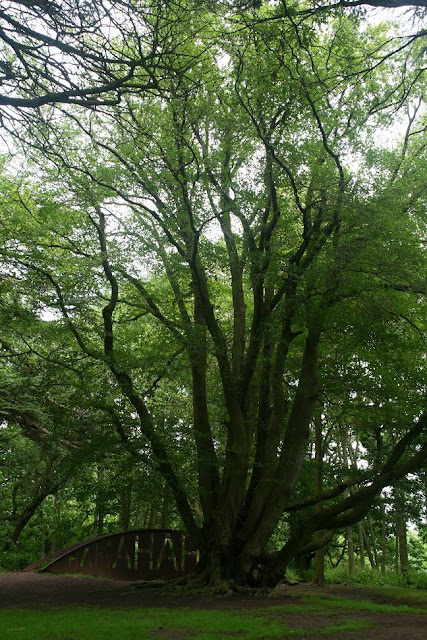


The park is very large (500 acres), and contains a wide variety of sculptures, as well as four interior galleries with more sculptures and other art. We went round a fair bit of the park, and all of the galleries.
Multi-stemmed birch and ha-ha bridge at YSP (© Ian 2012)
We rather liked this multi-stemmed birch, which looks like it might be an over-grown coppicing stool. The bridge behind, as you might guess from the cut-out letters, spans a dry-stone walled ha-ha.
Jonathan Borofsky's 'Molecule Man' at YSP (photo © Ian 2012)
Cedar sculpture in the Camellia House, YSP (photo © Ian 2012)
Inside a rhododendron (© Ian 2012)
A bank of rhododendrons was outside the Camellia House; they're obviously rather old, and the stems and roots have become massive and entangled.
Waterfall (© Ian 2012)
Primarily, this photo's to remind me of the sort of waterfall we'd like to build above the pond.
Alec Finlay's 'The Bee Library' at YSP (photo © Ian 2012)
This is one of 24 bee-related books that have been converted into bee habitats and hung around the Lakeside section of the park.
I didn't take a photo, but outside the Bothy Gallery there's a curved south-facing wall, against which have been grown a series of cordon/fan trained apples. Some of them, by the tags, have been there over 200 years—and it shows. The trunks are 9" across, and they're big, vigorous, and covered in fruit. It's a shame we have no sheltered south-facing wall, as I'd love to grow some cordon fruit trees. Never mind: half standards it is.
I didn't take a photo, but outside the Bothy Gallery there's a curved south-facing wall, against which have been grown a series of cordon/fan trained apples. Some of them, by the tags, have been there over 200 years—and it shows. The trunks are 9" across, and they're big, vigorous, and covered in fruit. It's a shame we have no sheltered south-facing wall, as I'd love to grow some cordon fruit trees. Never mind: half standards it is.
Sunday, 20 May 2012
Steam
It's Philip's birthday later this week, so we all went out for the day on Saturday, to Haworth. Coincidentally, and unknown to us until we arrived, it was a 1940's Vintage Day, which meant the streets of Haworth were filled with people dressed for the period, many in service uniforms from the War. Commonwealth, USA, and a couple of Axis, too. We walked through the village, stopping at the traditional sweetshop, and pausing briefly at the churchyard, before walking on to Oxenhope and back for a picnic lunch. We then went on to Oakworth on the Keighley and Worth Valley Railway steam service, before walking back to Haworth.


KWVR Steam train arriving at Oakworth; waiting at Oakworth station; and between Haworth and Oxenhope (© Ian 2012)
Sunday was spent in the garden, mostly clearing and pruning. The last of the cotoneaster is finally out of the top bank (as in, cut to ground level: there are still roots I'd like to pull up); we also decided that the conifer in that bank wasn't worth saving. It was dead and bare where the cotoneaster had engulfed it, and its location wasn't good, blocking the view from the dining room quite badly. Down it came, and it's much better without it. There's also a laurel/bay that has a bare back from where the cotoneaster was behind it. However, it's otherwise quite an attractive bush, so we're going to leave it to see if it re-sprouts. If it does, I'll try digging it up and moving it to a better spot, as it's not in the right location.
A scraggy conifer next to the vegetable garden was next to come down, along with a sorry excuse for a conifer that's struggled along in the copse, and two sad looking pines near the fence. I also took the opportunity to trim back the leylandii along the bottom fence, and tie them into a more up-right pose.
Finally, we pruned the two flowering currants (one of them rather hard, continuing the rejuvenation program we started last summer), and other shrubs in the lower bank that have finished flowering. Our pile of brush-to-be-chipped is now enormous: fortunately, we've got a larger, petrol-driven shredder booked for the upcoming bank holiday weekend, and hope to get it turned into mulch then.
Tuesday, 1 May 2012
Swallow Returns
A swallow has arrived and taken up residence in the nest in the porch. I'm hoping it's the male of the same pair who built the nest last year, but I don't think I can check! It's almost certain to be a male (they arrive first), and I've been hoping to see him for the last week or two. On Monday evening I spotted a couple of swallows on the drive home, for the first time, so presumably the birds are arriving in the area.

With a little luck, his mate will get back soon, and they'll get a clutch of eggs laid soon. Last year they seemed to be a bit late, and we never saw any fledglings.

Newly arrived male barn swallow (© Ian 2012)
Sunday, 11 September 2011
Chutney, Jam, and Wine
Having collected the apples on Thursday, we've got on with making this year's chutney. We enjoyed the Grandma's Hot Apple Chutney we tried last year, so we did a double batch of that (12 jars). Instead of the basic apple chutney, we made a batch of the National Trust's Windfall Chutney (not with windfalls, but never mind), which was another 8 jars. A statutory batch (5 and a half jars) of mango chutney (another 850g tin of kesar mango puree!) followed; I think the spice blend worked better. We then tried a spiced elderberry chutney (cooked and sieved berries), which is extremely purple-red (5 jars). The Windfall Chutney has a couple of tablespoons of turmeric in, so that's rather yellow, making this years jars quite colourful: the Grandma's Hot is quite molasses-y, the Windfall is yellow, the mango orange, and the elderberry strongly anthocyanin!
We'll do a round of mincemeat next weekend (it requires an overnight steep of the ingredients), which will use more apples—the rest will be eaten as they are, or made into puree for cooking or eating.
One of our neighbours was given a large quantity of greengages, which were surplus to her requirements, so she gave us a few kilos. As a result, we've tried a new recipe, for greengage and almond jam. The greengages defrosted brown (they went in green), but it doesn't appear to have mattered. They also didn't require stoning before cooking, contrary to some instructions—though that did mean Liz had to keep vigilant watch for stones while to cooked, fishing them out as they floated. It's very tasty, and reminiscent of a marvellous gooseberry jam we made some years ago. Not too sweet, with a good 'plum' flavour.
To round off the preserving weekend, I started a batch of Hedgerow Port: elderberry, sloe, and blackberry wine. Nothing unusual: 800g blackberries, 300g sloes, and 400g elderberries, crushed, with 4.5l of boiling water poured over them. I added some pectolase once it'd cooled a bit, and yeast will go in tomorrow. The must'll ferment for four-five days, and then I'll strain it onto sugar in a demi-john.
The elderflower and elder rosé wines look like they've slowed considerably, so fermentation may be nearly complete. I'll probably leave them for another few weeks, then rack them.
Wednesday, 9 December 2009
Local Plants
Found this article on the BBC Gardeners' World blog, which (in turn) links to a Natural History Museum site where you can find out the plants local not to your country, not to your region, nor even your town, but to your postcode.
Shucks.
In addition to a large number of plants not considered 'garden worthy', there are a few interesting finds:
Shucks.
In addition to a large number of plants not considered 'garden worthy', there are a few interesting finds:
- Common poppy, which I've seen about, but not many. Would be nice to try, alongside some not-so-common poppies;
- Crane's Bill (cut-leaved, meadow, and dove's-foot), which a neighbour has in profusion, and is rather pretty;
- Autumn Gentian;
- Foxglove, which--again--the same neighbour grows plentifully, and which does rather well;
- Harebell;
- Honeysuckle, hop, and ivy (just as well, as the first and third are quite popular with us!);
- Daffodil;
- Yellow iris;
- Wild pansy;
- Wild strawberry, so hopefully the cultivars will do well;
- Crab apple (ditto re. cultivars);
- Elder and holly (absolutely no surprise there, as the moorland around us is studded with both);
- Yellow loosestrife (so, again, hopefully the cultivated Lysimachias will thrive);
- Common comfrey (useful for green manure/plant food purposes!);
- Bilberry, gooseberry, bramble, raspberry, which all bodes well for the fruit bushes;
- Alder, ash, beech, field maple, hornbeam, oak, rowan, silver birch, white willow and wild cherry are all 'native', which pretty much covers what's already present, tree-wise.
Subscribe to:
Posts (Atom)



