Showing posts with label kitchen garden. Show all posts

Tuesday, 29 August 2017

RHS Harlow Carr

Nothing exciting this weekend, but good progress on a few things. We spent most of Saturday painting windows (a bit late in the year, but hey-ho), and have probably done a bit less than half. We had a day out on Sunday and went to Harlow Carr, which is looking lovely (as you might expect).


RHS Harlow Carr (© Ian 2017)

Most of Monday was spent with the bees, who are winding down for the autumn. And today was spent making a bit of progress on our bathroom renovation plan (ie, progress on making a plan), and measuring the garden paths. Having previously used forestry/hedging chippings for these, we're planning to upgrade to aggregate. It's more expensive in the first place, but shouldn't need replacing every few years, which is both a lot of effort, and ongoing expense. The trouble is getting a suitably large load here, given the access difficulties—and in deciding on a satisfactory type of gravel...

Monday, 1 August 2016

Climbers

It's been a long weekend for us, including a day trip to Leeds to go bowling with my family. But we also made a trip to the garden centre on the way somewhere else, intending to pick up slug pellets.

We did manage to get the slug pellets...

A shopping trip for sundries (© Ian 2016)

...and a few other bits. It turns out that they had a lot of climbers 50% off. And we need climbers for the pergola that's going along the sides of the driveway, so it seemed opportune. No, the pergola isn't built yet. Details, details...

We also got some heavily reduced sedums (which are always good value), and some purple sprouting broccoli plugs (ours didn't make it, for some reason, and they'd be missed in the kitchen garden over winter). There was also a nice variegated Chlorophytum which I fancied, and a few ivies to plant around my new(ish) Calathea in the Victorian plant stand in the sitting room, to soften it a bit.

Anyway, the climbers: variegated jasmine, golden hops, climbing hydrangea, and a grape. No, I don't expect a crop; but the leaves are pretty, and they get good colour progression through the seasons, so it'll earn it's place.

Sunday, 20 September 2015

Painting, Plumbing, and Green Manure

Liz has spent a lot of the weekend painting: priming, basecoat and topcoat in the master bathroom (two walls), and the guest bathroom (just behind the towel radiator), so that I could finish plumbing them in. Plumbing them in was the last part of getting ready to run a system cleanser round the central heating system for a while, before I then run a leak sealant (just in case), and top up the system ready for the winter. The cleanser is because of the two new radiators, and the new piping in the preservatory, and because it's been a while since it was last done.

While Liz was doing this, I finished connecting the preservatory radiator to the central heating circuit. I'd got the pipework from the radiator along the wall of the room, and up into the loft, but then had to take it around the loft space, through the wall into the porch loft (heavy going, even with the big SDS drill!), through that loft, and then t-junction the two pipes into the flow and return. I was rather trepidatious of that stage, as they're big, 28mm pipes, and I really didn't want to go wrong, as that would mess up the central heating for the house, not just the preservatory. Anyway, although it took ages to get there, I've jointed them in, and they seem to be watertight.

We've managed a few other bits, in and between: the lawn is mown, and we've pulled up the beetroot and onions. I've sown green manure in those two spaces, to overwinter (it's caliente mustard): the sowing I made where the potatoes went is starting to come up nicely.

Tomorrow evening we'll plant out the overwintering onions, which are going to go around the bean/pea supports in the herb garden.

Friday, 29 May 2015

Renovating the Fruit Cages

Over the last couple of days, we've been doing some work reconstructing the fruit cages. When we built the raised beds, we put 3" square posts at the corners, 8' tall in the raspberry beds, and 6' tall in the others. We then ran wire between these, and draped bird-proof netting (knitted 1" nylon stuff) over them, secured at the bottom, and sewn together at the seams and ends. It worked really well, from a bird-proofing perspective, but had disadvantages. First, it was a real pain to get in and out of the beds, and so we didn't weed as much as we might. It was similarly awkward to pick the fruit, prune, and mulch. Secondly, the 1" mesh worked really well to catch snow, and the wire supports weren't strong enough to carry the weight of the loaded net, and broke; or, the netting tore under the strain. This meant, every spring for the past few years, having to sew up the netting, and repair the wires, and it all got a bit too frustrating.

As we've been left with quite a lot of spare timber from the construction of, mainly, the wood shelter, which has been lying around, we decided to change how the fruit cages work. We've used some of the 3" laths to build a ring beam around the posts, and across the span in key positions. Onto that, we'll roll a roof of chicken wire, and staple walls of the nylon mesh onto the beam, posts, and raised bed walls. Hopefully, the chicken wire roof will be strong enough to carry a load of snow; the disadvantage is that the mesh is 2", which will be wide enough to allow birds in. We'll see if that's a problem, but if it is, we'll need to place bird net on top of the wire mesh, so we have the strength of the latter, but the bird-resistance of the former.

Sunday, 15 March 2015

Rearranging the Fruit Beds

Over the last couple of years, pruning the gooseberries, and then picking the fruit, has been a rather painful, thorny proposition. In addition, the plants have always tended to grow out into the path, which has made the journey along the fruit garden a little perilous when wheeling a barrow, and the wide handles almost always bring you rather close to the gooseberries spines.

Enough of that: we've dug up the nine gooseberries, and replanted them: the three red and green are now spaced out along the centre of the bed where all nine were previously, meaning they're much further from the edges. The three golden/yellow ones are where the bottom blueberry was. It's never really got going, in many years, so we're cutting our losses.

At the same time, we've lifted all the raspberry canes, and replanted the strongest along the centre of those beds: we were finding that the double row wasn't cropping well, and was a pain to weed and pick.

The revolution hasn't ended there, either. We've taken off all the nets, too. Over the next couple of months, I'll be replacing the wires which ran between the posts to support the cages with timber bearers. The roof is then going to be chicken wire, and the sides will either be netting, or wire. However, we're going to have doors at each end of the passage, making it one big contained cage, rather than four. It ought to make weeding, mulching, pruning, and picking an awful lot more pleasant, which seems sensible.

Today we've sawn, split, and stacked a load of wood, and spent this morning sorting out the garage, which now looks like a room once more.

Wednesday, 10 September 2014

Planting Out

It's been a little while since we actually spent much time in the garden, so it's been nice to get out today. We spent the morning at Harlow Carr, enjoying the start of the transition into autumn in the shrubs and trees, and the long borders are glorious in their late-summer show.

Once we were home, we started by doing some weeding in the herb garden, which really needs it, although the addition of the membrane & chippings path has significantly reduced the impact of walking on the ground. It did get very compacted, which made weeding hard work, and although there's a lot of grass to dig out, it's much better. The grass will, I'm sure, continue to be a problem for a year or more, as we weaken the remaining, creeping roots.

We didn't have time to finish the herb garden, though, so once we'd made a dent in it, we went down to the kitchen garden. Having weeded those beds, I planted out a few clumps of spring cabbages (Durham Early), which may not amount to much, but might provide some useful leaves. Spring cabbages aren't, for us, a particularly useful crop, as they seem to come ready a little late, when actually we want to be putting in new plants in their space. Much more effective, to date, have been the winter Savoy cabbages (January King, the last couple of winters), which is harvested at a more useful moment. Anyway, we had some Durham Early plants, so in they've gone.

We've cut down the fruited raspberry canes, leaving only the stems that have grown this year. Getting the pruning right (last autumn) has made a big difference to the plant health and the size of the harvest this year.

The spring cabbages are the last thing that we'll be planting out in the kitchen garden until spring, now, so the remaining empty space was weeded, raked, and sown with green manure. This is a winter mix of crimson and red clover (leguminous nitrogen fixer and weed suppressors), Italian ryegrass (good soil stabilization, and deep roots for mineral up-lift), and mustard (bulky foliage for digging in). We added extra Caliente mustard, which is a particularly good biofumigant, improving soil health when it's chopped into the ground in spring. The current weather is good for sowing green manure: the soil's still warm, and moist, so it should germinate well, and get a few weeks growth before it gets particularly cold. The mustard nor the crimson clover are particularly hardy, so they won't survive a bitter winter, but there's a window for them to do some work, at least.

The kitchen garden sorted, we spent half an hour tidying the long border, before planting out the plants we bought at York Gate and Wisley.

From York Gate: a white salvia (into the copse bed: Salvia paniculata, I think), a white Jacob's Ladder (P. caeruleum subsp. caeruleum f. album), a white phlox (P. paniculata), a helenium, and a golden oats (Stipa gigantea). Wisley yielded three variegated eupatorium ('Pink Elegans'), two variegated phlox (P. paniculata 'Norah Leigh'), three agastache ('Blackadder'), a crimson sedum ('Red Cauli'), and a molinia ('Skyracer'), which have, apart from 'Norah Leigh', gone into the long border.

Friday, 15 August 2014

Onions

We had thought we might get some weeding and lawn-mowing done this evening, but discovered two problems with that plan when we went outside.

Firstly, it was still a bit damp, and the mower doesn't collect wet clippings very well, which means a big raking-up job in addition to the mowing, of which I am not enamoured.

Secondly, there have clearly been deer rampaging through the garden in the last few days, and they've done distressing damage. They've stripped the leaves, flowers, and pods from the runner beans, climbing beans, peas, and French beans (no legumes this year, I suspect, now); nibbled the chicory and Japanese ginger; damaged a forsythia in the copse bed, munched some of a neighbouring heuchera or two; eaten a lot of the strawberry foliage (not necessarily a problem, this one, as that was due for trimming back, anyway); destroyed the last of the spinach; eaten several stems of tay- and loganberries (losing next year's crop); and—as best I can ascertain—done some sort of deer dance on top of the onions. I think it's their route from kitchen garden to games lawn.

Fortunately, the onions were pretty much going over, and ready to be lifted, although they also did a lot of damage to the weed membrane we grow the onions through, which means I'll have to replace, tediously, some of it. Nonetheless, it meant that this evening's job was lifting the onions, trimming their tops, and setting them out on racks in the wood shelter to dry.

We've put some deterrent barriers in what we think the deer's routes in have been: a few gaps in the bottom hedge, some tunnels between kitchen garden and games lawn, and over the wall behind the beech bench. Hopefully that will help. Liz is more sanguine about this than me, and reckons it's a price we pay for enjoying deer roaming on the hillside. I look at the losses and damage to plants, crops, and trees, and think thoughts of venison.

Sunday, 27 July 2014

RHS Tatton Park 2014

This morning, at about 0815, we set off for Tatton Park, as we have the last couple of years, to the RHS flower show. It takes about an hour, and having parked and walked to the showground, we were in the queue at about 0940, giving us a quarter hour to start looking at the show catalogue (and map) before being let in at just before 10. I've been impressed, this year and last, at how quickly they scan the bar-coded tickets and get you in.

There were some really good show gardens, this year. We particularly liked a heritage/allotment fruit and veg stall from a group of local allotmenteers, and were struck by a scarlet mountain spinach (orache) that we've never seen in the flesh before. It's a possible potager plant next year.Grasses were much in evidence, as well as chocolate cosmos, sanguisorba, crocosmia, and brunnera. That suited us nicely, as we've many grasses that could be used in combination. We have one sanguisorba, 'Tanna', and a brunnera, 'Jack Frost', both bought at Tatton last year, and came looking for more brunnera. We have a few crocosmia, but one caught our eye today that is apparently a fairly new introduction; Twilight Fairy 'Gold'. It has lovely bronzed foliage, but sadly wasn't for sale from the show garden (the Young Designer of the Year garden by Sam Ovens).

We saw a couple of water features we liked, which might inform later plans.


(© Ian 2014)


(© Ian 2014)

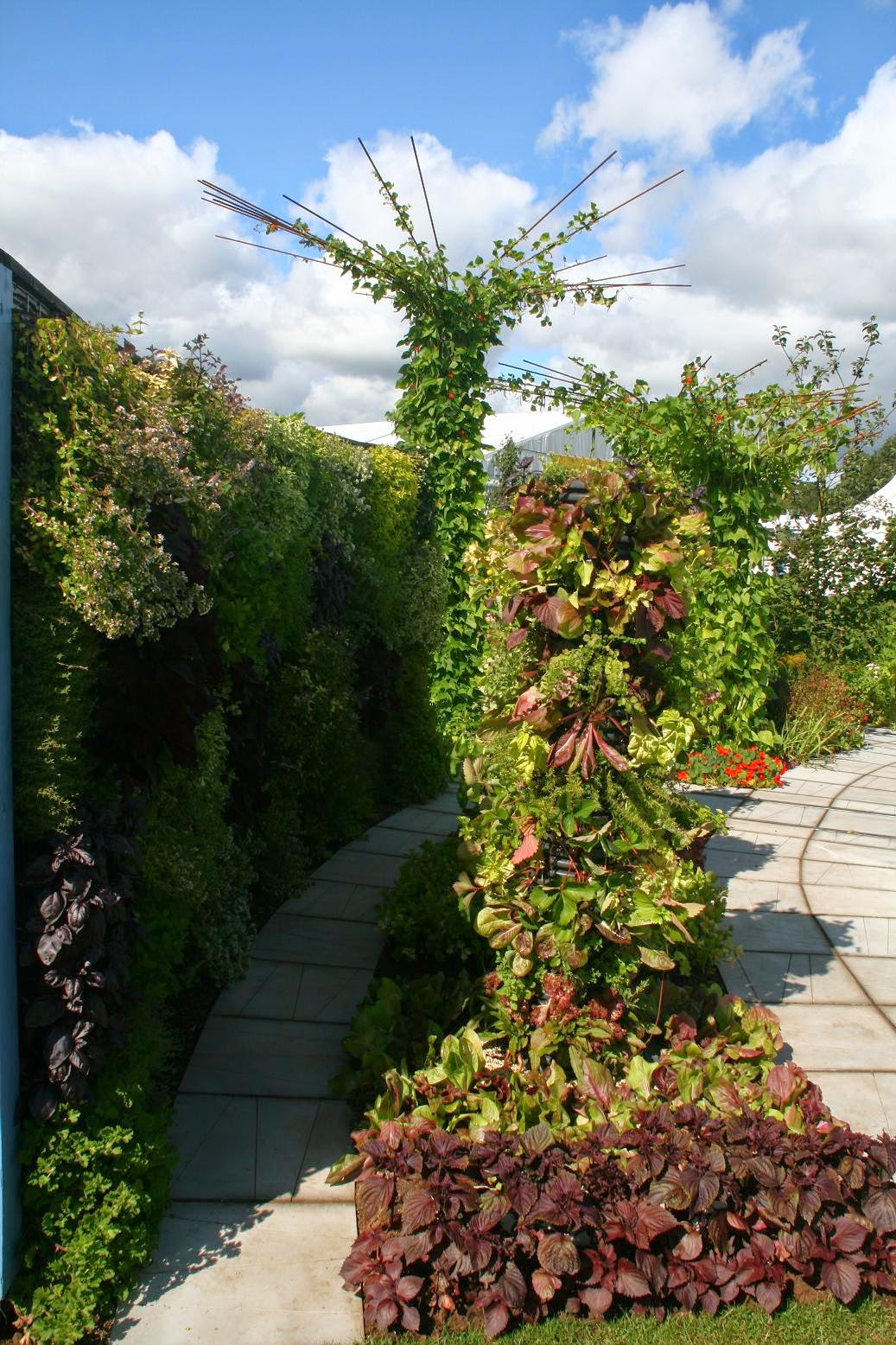
This garden had a rebar construction for its runner beans: apparently I'm not the only one using rebar to construct supports! It also had a rather good green wall, one of which Liz still wants to find a space for.


These garden seats were very good, and next door we saw some very weather resistant swing seats by the well-named Yorkshire Swingseat Company.


(© Ian 2014)


(© Ian 2014)

One feature that we enjoyed was a collection of eight vignette gardens that encapsulated larger gardens' feel in small plots. They're all from Cheshire, and included Arley Hall, which is actually just down the road from Tatton Park, and we thought looked worth a real visit, based on their 'taster' garden.


(© Ian 2014)

The floral marquee was, as ever, phenomenally stocked by nurseries, and although we only bought two plants, the other displays were excellent, and gave us contact details for a number of specialist nurseries. One, near Cambridge, might be a good source of alpines, if we do decide to put a green roof on the mini-sheds. There were a couple of hosta specialists, too, for when we dig the bog garden.


(© Ian 2014)

The two plants we bought were both from the Hampshire Carnivorous Plants: one was a Sarracenia hybrid (a North American Pitcher Plant), which suited us because it actively requires a good cold winter spell, probably in the unheated greenhouse. The other is a dangling/hanging sort of plant, a Monkey Cup called 'Linda' (a hybrid, Nepenthes cv 'Linda') despite being a dioecious male. It now hangs, slightly threateningly, in the sitting room.

For us, though, the Young Designer Gardens were the best. We felt that the television coverage (Thursday and Friday evening) actually let these down, and all three, but particularly Alex Schofield's, were much better in the flesh. In fact, everything else we purchased came from these three gardens.


(© Ian 2014)

Acquisitions were:
  • From Alex Schofield's garden:
    • Brunnera; I need to check the cultivar
    • Astrantia 'Gill Richardson'
    • Sanguisorba (S. officionalis)'Tanna'
    • Sedum (S. spectabile) 'Matrona'
  • From Clare Broadbent's garden:
    • Echinacea 'Secret Love'
    • Eupatorium, I think E. purpureum
  • From Sam Ovens' garden:
    • Scabious 'Pink Mist'

(© Ian 2014)

Wednesday, 23 July 2014

Brassicas

On Friday evening, we lifted the Red Duke of York, the Lady Christl, and some of the International Kidney/Jersey Royal potatoes, as the haulms were clearly going over. They're being washed and bagged up, slowly.

This has created some space, particularly where the earlies were, in the bottom bed, and allowed us to plant out a number of brassicas there yesterday evening: Romanescu cauliflowers, January King savoy cabbages, Mystique cauliflowers, and Rudolph purple sprouting broccoli. We've also sown two rows of Golden Ball turnips, between these and the Defender courgettes. They, incidentally, are just getting into full speed, and producing almost daily courgettes. They seem more upright plants than our previous courgettes, as well as generating better textured (less prone to disintegrating in the pan) courgettes, and I'm rather pleased. I reckon we'll be into a glut in a couple of weeks.

Tonight's been less exciting, as I've mown the lawn—whereas Liz has collected enough sweet peas for eight vases. We're definitely into 'glut' for them.


Sweetpea Centrepiece (© Ian 2014)

Sunday, 20 July 2014

Paths

Today started with a soft-fruit picking session. The raspberries are nearly over: probably one, maybe two more pickings left. However, the gooseberries are really just starting: the fuzziest, first variety at the top of the bed, Invicta (which also seems to have bigger fruit) is mostly ready, and some of the red and golden Hinnonmaki are there, too. While I prickled myself collecting these, and then a bowl full of blackcurrants, Liz collected about 80% of the redcurrants. The whitecurrants are always a bit later, and some of the red weren't ready yet...but it's still a lot of fruit. The bushes have now properly hit their stride, in their fifth year (we planted them in December 2009), although one of the blackcurrants isn't doing nearly as well as the other two. That's a shame, as blackcurrants are my favourite (compared to red/white/pink...I don't know how I'd choose a soft fruit, let alone a fruit, as a favourite), but there you go. I'm hoping that a couple of year's good mulching and pruning might see it straight. Alternatively, it may not be getting as much irrigation, as it's at the top of its bed (which is, literally, the highest point of the kitchen garden, and furthest from the watering system inlet).

A few clumps of ragwort have been growing in the orchard, and while certainly not an infestation (there's a nearby field which is just a mess of ragwort—and, worryingly, is a horse paddock), I wanted to remove it before it sets seed. When we bought the land, there was, comparatively, quite a lot, which a year of strimming and pulling has mostly resolved. Anyway; I pulled up what I found, and checked in on the graftlings, which all seem to be doing ok.

When I'd done so, Liz had weeded beech bench bed, and the bed to either side, and had also put down cardboard mulch sheets around the beech. That was a prerequisite for spreading chippings around the beech, which will now have much less competition for light, water, and soil, and look a lot tidier. I moved the turf stacked in front of them, and the spoil heap of stones (including a couple of large lumps of concrete, and several stones worthy of walling or pond-side). Between us, we've laid out weed-membrane, and covered it with chippings, to form a path down that side of the lawn. During the winter, when we're bringing wood up from the wood shelter, that path quickly gets muddy, so this should be a better route, now.

This was really part of a larger chipping-spreading activity, as we've put a path (membrane and chippings) through the middle of the herb garden. It's not planted, apart from the lavender lines crossing it, and having the lined path will mean a bit less weeding. The un-dug part of the potager, which has had weed membrane down on it for some time, has now also had a layer of chippings, which makes it look much more attractive than black membrane.

Putting this path down meant moving four box that were an edge in the old design, but are no longer, as the edges have moved, and aren't going to be box any more. The four plants have moved into the long border, replacing clumps of alchemilla, and will gradually form balls.

Lastly, I've had to add more strings to the legume supports, as they finally, slowly, start to grow. They went out too late, really, delayed by the work on the back of the house, so it's not going to be a productive pea and bean year, sadly.

Tuesday, 1 July 2014

Harlow Carr

We spent today at Harlow Carr: the first time, actually, we've been not on a weekend or Bank Holiday. Unsurprisingly, it's much quieter!

We found this in the scented garden, but couldn't see a label, sadly.


The Scented Garden, RHS Harlow Carr (© Ian 2014)


A heavenly almond macaroon (© Ian 2014)


Knautia macedonica, which caught our eye for the wide range of colour (© Ian 2014)


Sweetcorn (Snowbaby and Popcorn Fiesta (this one, with red stems)) in containers in the Bramall Learning Garden (© Ian 2014)


Rhododendron auriculatum in the woodland (© Ian 2014)

When we got home, there was enough time to sow some salad leaves (in pots: direct, they keep getting slugged), and a barrel of carrots.

Tuesday, 24 June 2014

Leeks and Bouquets

One thing we didn't manage to squeeze into an already busy weekend was planting out the leeks, which have really been ready for a couple of weeks. They've had a space planned, of course, in the kitchen garden, although it's meant taking out the over-wintered cabbages, 'Frostie', which were late to heart up. We're going to be eating a lot of cabbage, I predict, over the next couple of weeks. They should stand for a while with their roots in water, hopefully.

Anyway: the leeks. We sowed a couple of pots of Porbello, which we grew last year. With a lot of the seeds this year, I sowed the seeds in seed compost (sterile and fine, but low in nutrients), but with most of the pot pre-filled with normal compost (not sterile, as it's home made, and a bit lumpy, but able to sustain for a lot longer). This has meant that the seeds can germinate in something fine, and with fewer weeds coming up around them, but their roots quickly hit the fertile compost beneath, so they don't get checked in growing. It's also meant that seedlings have been much happier growing on in their pots, and are bigger when we prick them out.

Planting leeks is quite fun, by my reckoning: I have a sturdy plastic dibber, which makes a nice hole about 1½" across, and 5" deep, or so. I push a row of holes (about 6" apart), and drop the separated seedling in. They're tall enough that they poke out a good few inches, and the soil will settle loosely around them when watered in. Some people seem to advocate trimming the roots somewhat (to encourage strong new growth), and correspondingly reducing the leaves (to maintain root:leaf balance), but I haven't ever tried this.

While I did this, and collected what might be the last rhubarb harvest of the year, Liz picked another tub of strawberries (the fifth, I think: they've done well), and flowers. This is the third lot of sweet peas, and the first significant crop: the first two batches were just enough for a small jug. Soon, though, we'll get to the point where up to a hundred new flowers are opening every day; probably in about 4–5 weeks time.


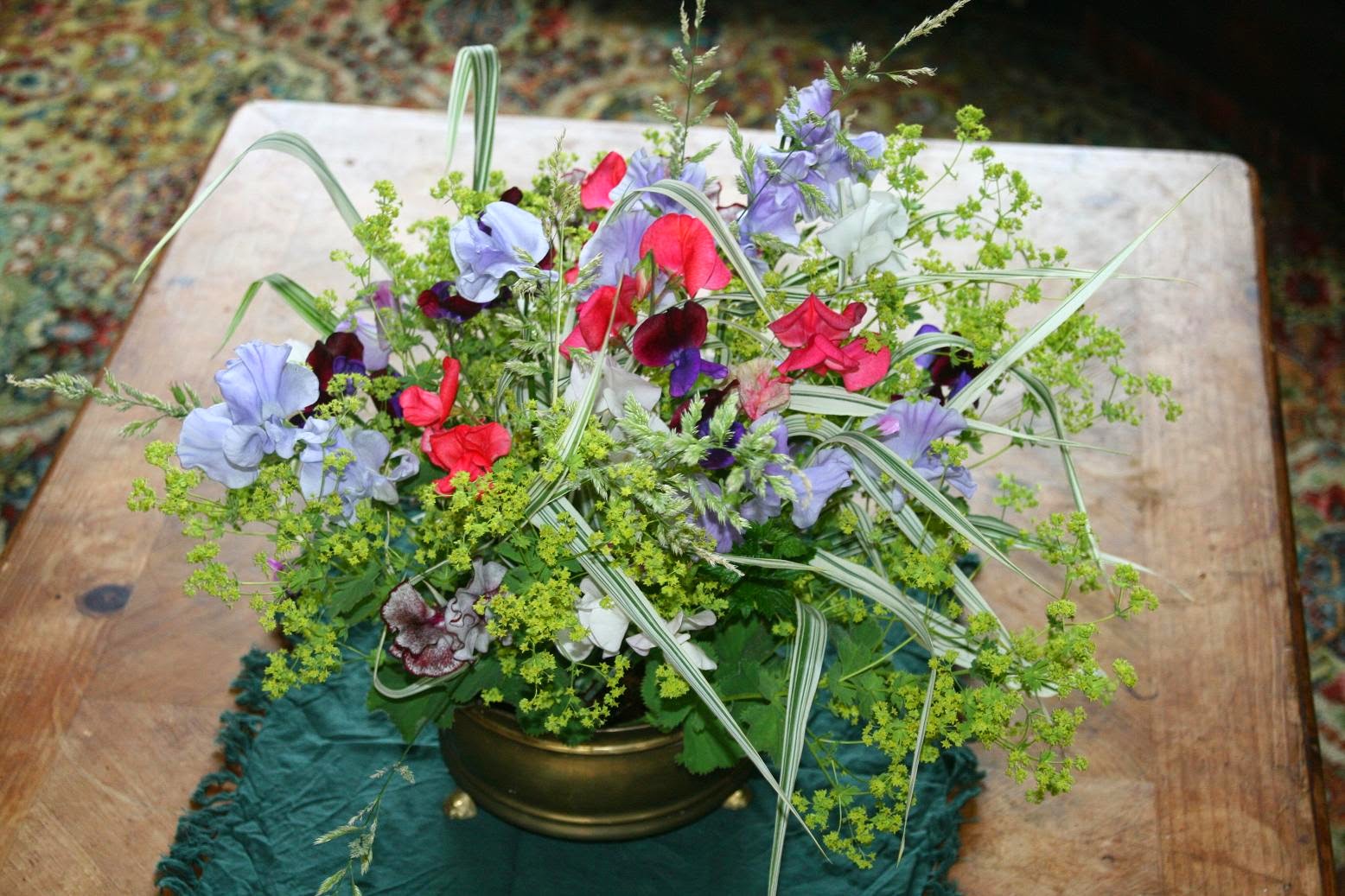
Liz's flower arrangement in brass bowl: sweet peas, Lady's Mantle (alchemilla), and grasses ( Ian 2014)

Sunday, 22 June 2014

Redesigning the Knot Garden

The herb garden's been in the planning for some time, and the design's evolved in the making. Originally, we thought we'd have just box edging, and primarily herbs. We added roses to the planting, and lavender to the edging. Then, when we worked on the design, rather than the concept, we came up with something that needed three edging materials to work well, and so we added step-over apples. The last couple of years of growing the kitchen garden suggested that we actually needed a little extra edibles space, and so we added runner beans, peas, and French beans to the planting -- which helped with height -- and then over-wintered onions, garlic, and elephant garlic. Trying the design last year made it clear that the squares of the design weren't really big enough, so we made them 50% larger. In turn, that meant the design changed, and now we need only two edging types once more. The design, now, is really one of a potager, or ornamental kitchen garden, encompassing roses (technically edible), herbs, apples, and ornamental vegetables -- the attractively podded (and flowered) Shiraz mange tout, Blue Cocoa runner beans, and red/purple Brussels sprouts. Out have gone the inedible box (now to form evergreen box balls in the herbaceous border), and a predominance of herbs.

This weekend, then, we've spent getting as far as possible with the new design. We got started on clearing the ground a week ago, and (after a vet trip that took much of the morning), continued this yesterday. We finished that by about mid-morning today, and then, in an afternoon punctuated by someone coming to finally take away the oil tank, finished preparing the ground by about 5 o'clock.

The oil tank, half-way out ( Ian 2014)

The oil tank has been waiting for removal for a while, and we eventually found someone who wanted it, thus avoiding having to pay (several hundred pounds) for someone to remove something we didn't want. Getting this heavy steel tank off its piers, missing the greenhouse (just the other side of the protective sheet of ply in the photo), across the patio, down two sleeper-built steps, and the length of the games- and pond gardens, and then up the driveway to the truck was, shall we say, tiring.

But now it's gone, and we have a 6x4 space in which a shed might go -- and now no smell of kerosene on warm days.

Now: back to the herb garden. We'd marked out the pattern (basically unchanged) last time, so apart from fine tuning a couple of measurements that had been hindered by rocks (which Liz made excellent progress moving: it really feels thankless work), we were able to immediately see where each square/diamond went.

Into several of these, I sank the climber supports, which Liz started yesterday by painting (I'd only done some of them). We've not had time to add the woven willow sides, so these will have to wait until autumn. For now, there are strings tied round them to get everything growing: they'll be invisible soon, and the willow will be in place for the winter, when it's actually meant to be an attractive feature.

Having sunk the six supports into the ground, we topped up the soil in all of the squares (but not the edges: lavender doesn't want rich soil) with compost, neatly finishing the 'ready' bay of compost, and started planting. The plants are mostly those that we potted up and set outside a few weeks ago, and included enough lavender to complete those edges that we've cleared space for (almost).

From the greenhouse have come the Laguna, Speedy, and Castendel French beans, the White Lady and Blue Cocoa runner beans, and the Shiraz and Delikata peas/mange tout. We've also planted out 32 red sprouts, a load of chicory, a dozen or so bronze fennel, a pot's worth of aniseed, and the Japanese ginger we bought at Tatton. All that obviously needed watering in, and tying to supports where necessary, and it's meant rather a late finish (I came in at 11, and Liz only came in half an hour earlier, to cook)...but it's looking really good.

Wednesday, 11 June 2014

Task List

I've had today off, though Liz has been working: that made it an ideal day to get a number of little jobs done, and I've had a pleasingly productive day.

It's the time of year when I start trying to get the window frames painted. Last week, two of the last wooden windows on the back of the house were replaced with uPVC, which (in addition to looking rather good, especially for uPVC) means I have two fewer frames to worry about. Of course, the time-consuming Georgian-barred windows on the front are no fewer, and it's those which have always taken the time.

However, before embarking on this year's painting, I decided to install some eye bolts on the front wall, in order to tie down the ladder while using it. I've had enough of bouncing on an unsteady ladder, and don't enjoy working on one at the best of time. The window at the end of the study has always needed a rather extended ladder, as the ground drops off in that direction, and the path has stepped down towards the level of the garage. It's always, therefore, been the worst climb.

To combat this, I've installed two M12 shield anchor bolts (18mm holes, which aren't for the faint of heart, or drill), one on either side of the window, at about 180cm height. Using a ratchet strap passed around each stile and angled down through the bolt, the ladder can now be tightly held in place. The result is revelatory: I felt much more secure, and less conscious of the drop...

That window, and two dining room ones, are now done: I'm only planning to chip away at the painting, with the aim of getting about half done over the next couple of months.

Next, I strimmed the half of the orchard I didn't manage to do eleven days ago. I'm hoping I'll only have to do this regularly for another 12-15 months, and that we can think about a couple of sheep by then.

I've painted some of the remaining legume/sweet pea supports, which means their bituminous feet (the underground bit) are done, and as many of their above-ground elements as I could get to (given that the tarry feet were drying).

I shan't dwell on unblocking the kitchen drain.

The work on the garage has been going on since the end of last week; sorting the foundations took a little while, but the builder started the actual walls yesterday, and has finished them today. The uneven-ness of the walls has complicated things slightly, and none of the windows are going to be quite the same height. The joiner will be along on Monday to measure up, and hopefully the building work will otherwise be done tomorrow. Next up will be the replacement of the dining room window with a set of patio doors.

After lunch, I took the time to do a wander of the garden with camera in hand. It's been a while, but here's where things are up to.


Bees foraging in the wallflower in the front garden (© Ian 2014)


The dining room windows, for now, until the patio doors go in (© Ian 2014)


The sweet pea supports (© Ian 2014)


One of the sweet peas is flowering; several more are on the verge of doing so (© Ian 2014)


The heuchera bed; not sure whether the quince has set fruit (© Ian 2014)


One of the astrantias in the copse bed (© Ian 2014)


The long border in front of the dining room (© Ian 2014)


The mess of the pond aside, the bed next to the septic tank has filled out well, and needs pruning (© Ian 2014)


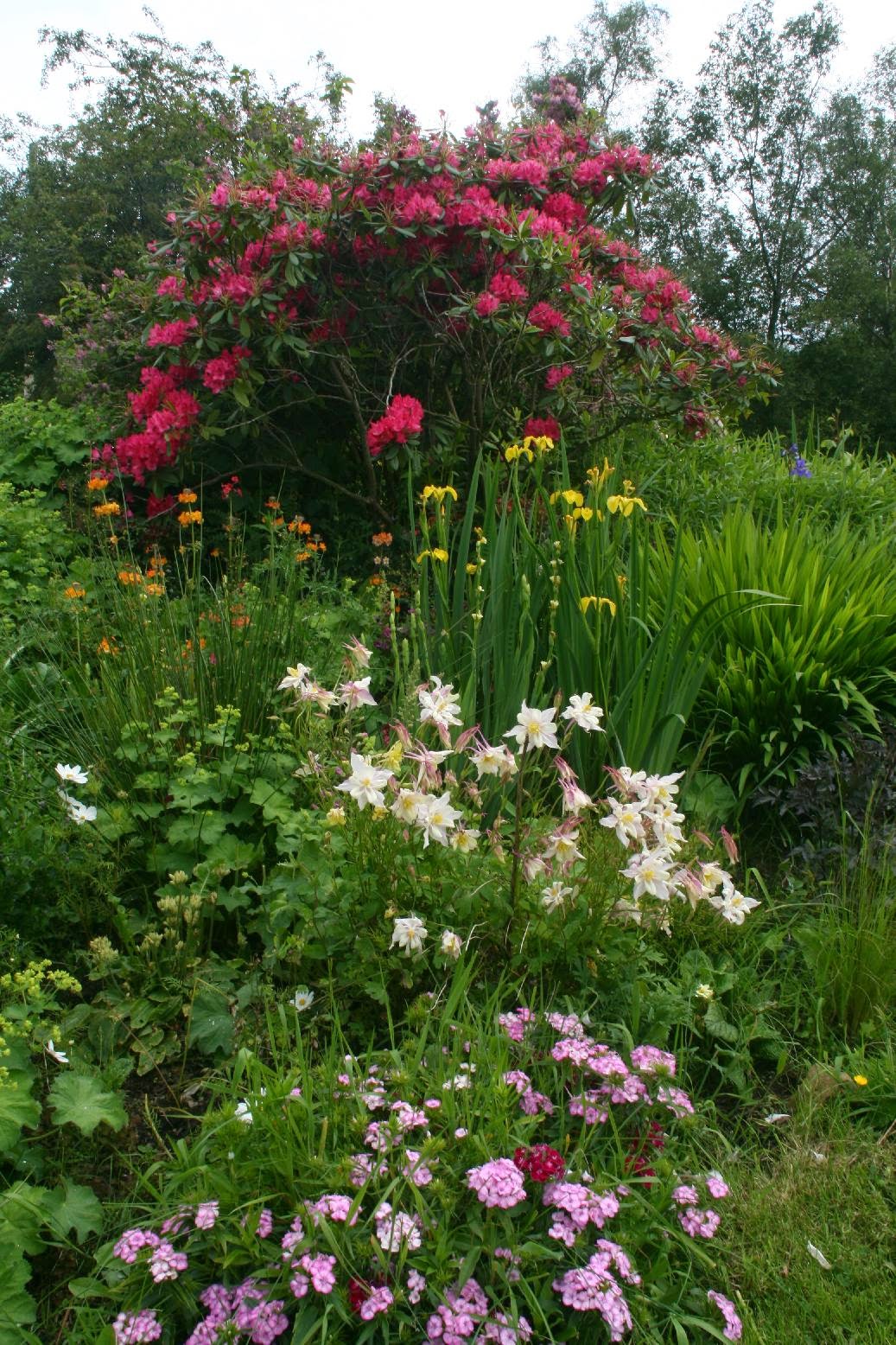
The aquilegia here has gone slightly mad this year (© Ian 2014)


Astrantia flower (© Ian 2014)


Mostly-planted vegetable garden (© Ian 2014)


Red Duke of York potato (© Ian 2014)


Green roof wild flowers, with foraging bees (© Ian 2014)


Green roof on wood store (© Ian 2014)


Day lily which we didn't know was there (© Ian 2014)


Weed-membraned knot garden (© Ian 2014)


Inside the garage before work on the wall/windows (© Ian 2014)


New garage front (© Ian 2014)


Stone cills & jambs being supported while curing (© Ian 2014)


Window apertures ready for windows (© Ian 2014)

Monday, 26 May 2014

Vegetable Planting

It's that time of year when the vegetable beds in the kitchen garden go from bare (or green manure covered), to filled, quite rapidly. The onions and potatoes went in about six weeks ago, and are doing well. We've now planted out a couple of blocks of beetroot (half a variety of mixed colours, and half Boltardy), 32 Brilliant celeriac, six courgettes (Defender), and scarlet kale and cauliflowers amongst the spinach. We've sown some more radishes, and sown a pot of scorzonera, as they haven't germinated in the bed. Some of the summer-sown brassicas (winter cabbage, cauliflowers, swedes) have gone into pots to germinate.

As a result, the kitchen garden's looking a lot more full. There's space, still, for leeks to go out (still in the greenhouse), and of course the potatoes get replaced as we lift them.

At the other end of the garden, the rhubarb had put on loads of new growth, meaning there was about 10kg of stems to pick. With such a large amount at once, it's been worth bottling, so we've preserved four and a half big Kilner jars.

While doing so, I've also made a batch of rhubarb vodka, with 8oz of chopped rhubarb, 4oz of sugar, and a 70cl bottle of vodka. Should be ready in a few months...

That was this morning: this afternoon, we sawed, split, and stacked a load of poplar.

Wednesday, 7 May 2014

Above Ground

I've had a day at home, starting work on the long-planned permanent support frames for the sweet peas, and vegetable climbers, as well as being around to receive a number of garage-related deliveries.

While in the garden though, I've been delighted to see that the quince is, finally, going to flower this year. The cherries and plums are already doing so (not brilliantly, in the latter's case), and the apples, in the garden and orchard, are on the cusp.

In the vegetable garden, many of the potatoes now have shoots above ground, and a large fraction of the onions have shoots. That's a lot faster than in previous years, for both, which I credit with the later planting, and—therefore—warmer ground.

Friday, 25 April 2014

Tidying

We spent all yesterday clearing and tidying the garage and workshop, which now look immeasurably better. The garage is now lined up for conversion into habitable space over the next few months, and we've got rid of a lot of clutter, and better organized it for working, too.

Today was more fun, as we've potted up a load of courgette and tomato plants, sown runner and French beans, potted up and moved outside the broad beans, and planted several pots of gladioli. We're about to set off for Ludlow for the weekend, and a couple of days of rest.

Tuesday, 22 April 2014

Direct Sowing

Having spent yesterday sawing, splitting, and stacking a load of firewood, today we sowed a few things in the vegetable garden. In the spaces around the potatoes we squeezed a few rows of scozonera, which we've never grown (or eaten, indeed), and a few of radishes. In the herb garden, we've planted a couple of sections of asparagus peas, which we grew last year, and which did well. We even had a few in the depths of winter, it was so mild. The sweet pea beds have also been sown with a mix of wildflowers: some collected, some bought. The three sections aren't differentiated this year: we've just mixed the seeds up. The sweet peas are all in the greenhouse, still, getting taller and twining round their sticks, waiting to be allowed out.

Sunday, 20 April 2014

First Planting

We've had a busy few days, with friends visiting on Good Friday (much baking), and then getting the vegetable garden ready for the new season of crops. It's never been empty, with leeks, beetroot, celeriac, kale, cabbages, sprouts, and purple sprouting all still in, to say nothing of the green manure (mustard) that I only chopped in a few weeks ago.

However, we've finally had to lift these, to make space for new things. That's meant that we've been able to spread the last of the mulch, and the beds are all looking lovely as a result. Liz planted out a stretch of spinach, which will come out before we need the room for a later crop, and I prepared the trenches for the potatoes. Today, with a fosterling's help, we planted the 300 onion sets (150 Piroska Red, 150 Stuttgarter), and the potatoes: twenty each of Lady Christl, Red Duke of York, British Queen, International Kidney, and Lady Balfour (two first earlies; two second earlies; and a maincrop).

We've repeated the system we found worked well last year; 4 (early) or 3 (maincrop) chitted tubers planted at the bottom of a trench, 18" (earlies) or 30" (maincrops) apart. As they come up, we'll backfill the trenches, slowly. The main crop are up the wood-shelter side of the C-bed, with the second earlies along the top. The first earlies are in the bottom bed. The onions are all the way up the right side of the C-bed, leaving a small gap between them and the second earlies (probably a catch crop). The space at the fruit-garden end of the bottom bed will have the courgettes in; there's also space for a catch crop in between, I reckon.

It's later than last year, for planting, but the weather's now turning a bit warmer (and we didn't have a chance earlier!), so hopefully they'll grow quickly.

With the last of the time, we tried making our own potting compost: a 50:50 mix of compost and leaf mould, which we sieved together. There's some potting up we'll need to do later this week, which it'll be used on.

Wednesday, 26 March 2014

New Beds

Last time we were out in the garden (ten days ago: David and Ann were with us for the weekend, which was a relaxing couple of days filled with food, and no work), I dug a new bed above the beech bench, and we planted a row of lavenders around its edge. Today, it was the turn of the other side, and we now have a matching bed below the bench (between it and the steps down to the wood shelter and kitchen garden). While I dug it over, Liz cleared a heap of shredding that's been accumulating, and we were, as ever, amazed at how small the resulting pile of chipped stuff is.

Having removed a load of stones (as normal), the remaining ground is actually rather nice soil: we planted a row of lavender around it, again, and then filled the space in both beds with other things that were taking up space in the greenhouse: a few dozen deschampsia grasses (D. cespitosa), some sweet rocket (Hesperis matronalis), and some Jacob's ladder (Polemonium): all grown from RHS seed last year.

At the left end of the bed, there's a space towards the wall where we took down the conifer a couple of years ago, which was obscured by the aforementioned shredding heap. This was the destination of the Persian Ironwood (Parrotia persica) which arrived last December, and has remained in its pot over the winter. The space now cleared, we've been able to plant that out, and hopefully it'll add some year-round foliage interest to that corner.

Part of the reason for preparing and planting these beds was to free up small pots and space in the greenhouse. That achieved, we spent the last hour of the day potting up a load of sweet peas (again, no 'Apple Blossom' have germinated: they're on the black-list, now), chilli and sweet peppers, and aubergines. In turn, that meant space in the propagators, so we've also sown more cosmos (an orange mix), tiger tomato seeds collected last year, anise, and a few other ornamentals. Even with the greenhouse, we're still going to wind up with lots of pots on the windowsills: but at least they'll be gone by May this time, and the tender veg (tomatoes, peppers, and aubergines) won't be inside, but out in the greenhouse.