Showing posts with label bees. Show all posts

Saturday, 14 October 2017

Road Trip

It's been a really quite varied weekend, with different things each day; it's been rather fun.

Today, we went to the Thorne sale at their Lincolnshire site. We went last year, with the benefit of a van, because we had a large order of equipment to collect. This year, our order was rather smaller, because we aren't expanding as much in the coming 12 months (well, probably), so we only took the car. Still, we managed to fill it really well.


Car full of beehives (© Ian 2017)


There's parts for another five Q-type beehives in there. These are our modification of normal BS National beehives, and allow two brood boxes to be stacked on top of one another, each one split horizontally. That resembles a Q-type house, which is a cluster of four homes, each being a corner-quarter of a square-ish building (we nearly bought one, years and years ago). Anyway: they let us split smaller colonies of bees off main beehives, and 'grow them on' in the smaller box until they're big enough, but it takes less resources (in hive materials), and they stay warmer (as they share a volume), which I reckon makes life easier for them. However, it's designed so that each colony's entrance is the only one on that side of the hive (ie, one is north, one south, etc), which reduces the confusion for the bees, and the number that go home to the wrong place.

We're planning more of these, so the parts for these were the core of the order, along with lots of frames for the bees to build comb in. I also had a few bits and pieces, and then we found a number of bargains on the day. This included some Q-type parts I was planning to order later, but were nicely reduced (they need some minor repairs), and some 'mating' hives. These, you add a small number of adult bees, and a newly emerged queen. She gets looked after while she finishes maturing (after she pupates for eight days, for about four days), and then flies out to mate with (hopefully) a dozen or so drones from the surrounding area (though she has to wait if the weather's poor). After another few days, she starts to lay eggs. That's when you can tell she's 'ready', and can either move her to head up a full or part sized colony, or&emdash;if so inclined—sell her. After that, you can add another newly-emerged queen to the mating hive, and the cycle starts again. We had a number of problems with our queens this year, and so having a plan for a succession of new queens in reserve next year seems sensible.


Mini mating hive (© Ian 2017)

Tuesday, 10 October 2017

Construction

It's mostly been a weekend of construction, in one way or another. On Saturday we continued work on the beehive insulation: painting the EPS with masonry paint (to protect it from slugs and UV degradation; it is, of course, waterproof intrinsically), and preparing the parts to attach them to each hive.

On Sunday, while Liz did some work on the downstairs bathroom (the paint we used appears to have created a rather unpleasant smell, so we're washing the walls down, and repainting) and other bits in the house, I built a storage rack on the hillside. It's for storing spare beehive components, especially the boxes in which they produce honey, because they aren't needed for six months of the year, and there will, in time, be the best part of a hundred of them. I've built the storage as an extension of the original platform we made, by driving three new support posts about 1.4m downhill from the lower edge of that. I've then thrown up wooden beams from the old posts to the new, and along each set of three, before adding extra joists and beams to create a set of square sites, each 460mm across. That's the footprint of all the beehive boxes for the design we use, so anything (almost) can be stacked on any one of the fifteen spaces, up to about a metre high.


Construction of storage rack (all © Ian 2017)

All of that done, yesterday we were able to wrap the bees in their insulated jackets (well, the hives, not the individual bees), which means that, between that and their fondant feed, the bees are pretty much settled for the winter. I shall keep visiting them every week or two, to make sure they don't go hungry.

Today, though, has been a mammoth list of work. We've got the plasterboard and spare cabinet boards out of the preservatory, ready to go upstairs (for the last bits of work, long overdue, in the guest suites). To further clear the room, the mahogany shelves are going to Jenny and Philip (staged from the dining room), and the spare bathroom cabinets are also in there while we decide their fate. All the spare insulation board is now cut into manageable sizes, and is in the loft (from which I even remembered to extract the tile cutter, ready for use in the bathroom!). The smaller windows (the new ones) have almost been tidied up with reveals and caulk—they just need false fronts to the windowboards, which will happen when I set up the router for a session. I popped out to collect the car from the garage on a bike, and get a haircut, while Liz cleaned the preservatory. Then we made a set of drawer fronts for the beehive's monitoring trays, and I installed these and took some spare hive boxes up to the newstorage rack. Lastly, we've set up the dining table we received from my parents in the middle of the newly cleaned room, which is now in a fit state to press apples and extract honey.

Tuesday, 3 October 2017

Hive Cosies

It's the time of year when the bees start to retreat into their hive, ready for winter, which they'll spend clustered together, gradually eating their stored honey to keep warm. To help them with this, we've been taking a few steps. Yesterday morning, we went to a wholesaler, to collect 400kg of bakers fondant, which is essentially 88% sugar, with some glucose and water. As such, it's a good food source for the bees, partly because it's a similar sugar:water ratio to honey, so they don't have as much processing to do to it to get it ready to store. We've put a 12.5kg block of this in the top of each hive, which, over the next few weeks, the bees will store in their honeycomb. The fondant is an absolute pain to slice up to fit; in the end, my preferred solution is a spade, and my full weight.

Apart from that, we've also been slicing expanded polystyrene sheets into smaller pieces, to form four-piece 'wraps' that will go around the sides of each beehive. The hive roofs already have PU foam insulation in them, so between that and these external wraps, the hives will be a bit warmer. That reduces the amount of honey/stores that the colony needs to survive the winter. It also has the effect of dissuading woodpeckers from attacking the hive—which they otherwise correctly identify as a wooden box containing highly nutritious (proteinaceous) insects. Rather valued insects.

The other thing of note was delivery of ten tonnes of gravel, which will be going down on paths at some point.

Tuesday, 19 September 2017

Cabinets

Plenty of progress on the downstairs bathroom this weekend! The new floor has gone down (the left over oak from the kitchen; I knew I had hung on to the last two packs for seven years for a reason), and looks really good. It should also be warm, as it's over a foil-based underfloor insulation layer. We then spent a day sorting out plumbing, and installed the units (basin unit, cupboard, and toilet concealed cistern), which all went relatively smoothly, and with only a short patch of frustration caused by a missing O-ring in a cistern fitting I hadn't noticed. That replaced, everything appears to be leak-free.

Tuesday, 5 September 2017

Bathroom

Saturday was mostly spent peering inside beehives, and counting bees (answer: lots, broadly). They're definitely slowing down, now, for the end of the season. To help prepare the hives for that, I've prototyped a beehive cosy, which, once tested and refined, I'll be making a set of, to help keep them warm, and also protect the hives from woodpeckers (who correctly a wooden structure containing insects that are highly nutritious, and sometimes attempt to break and enter).

We managed, also, to finish painting the window frames, which is a job we came to a bit late, this year (as in, in August), but went really quickly. We've even managed to get a couple of coats on the new windows in the gable end of the preservatory, and everything's looking much smarter. However, we're struggling to get the bike shelter roof/lid painted—the primer isn't priming very effectively. Further effort will be applied.

In the garden, the lawn's been mown, which sets of the late-summer garden much better, and we pruned the apple walk's trees. There are several, now, that have reached the apex, which is great, and the structure is really obvious now. There are even a few dozen apples to pick.

Today, we got on to a job that's long been awaited, and started work re-fitting our downstairs toilet. First out were the green/brown suite (vintage 1978), which have been much disliked by us for each of the eight years we've been here. Astonishing, therefore, that it's taken us so long to get to doing this room. (In truth, it's been too useful as a room with a sink for mixing plaster and washing paint brushes: now that those jobs are mostly done seems time for the re-fit.)


The 1978 suite (© Ian 2017)

The suite came out remarkably easily, actually—I was expecting a bit of a battle—with only slight difficulty with the basin's pipes.


It is gone! (© Ian 2017)


I could then set about removing the tiles. They've been easy enough, too, with SDS chisel. There's some making-good needed around the window, and some of the plasterwork is inevitably damaged.


Radiator off wall, tiles gone (© Ian 2017)

Next is the floor (you can see I've started), which I ran out of time for before we had to load up and get the debris to the tip. The floor won't be quite as easy, but there you go: I hope once I get started, I can get the chisel under them. Once they're up, I can figure out what to do: might need a levelling screed if we re-tile the floor, but if we decide to put wood down, it'll just need a ply base. Decisions, decisions.

Tuesday, 15 August 2017

Paint

So much paint.

It's been a busy few days, since David and Ann left, getting work done on the preservatory and workshop, mainly so that the dining room can be tidied (it's currently a warehouse of beehive parts, and some more domestic stuff that lives out there) before we have a house full of guests next weekend.

We've primed, painted, and top-coated the three walls of the preservatory that we've plastered, as well as painting the skirting boards. The floor, which was still bare plywood around the perimeter, is now also painted (in the same green we started with a couple of years ago). The two windows in the gable end of the room, which were still single-glazed, have been replaced by the ever-effective John, with double-glazed windows that match (kind of; they're landscape aspect ratio, unlike the rest, which are all portrait) the rest of the front of the house. They look really good.

In the workshop, as well as tidying and sorting, we've painted the breeze block walls, which were stained and sooty, and are now a lovely white. The ceiling, which especially near the boiler was horrible, was primed with some remarkably effective shellac based primer, and is now beautifully clean white. It looks so much nicer in there, especially after also painting the floor (concrete paving slab) with a green garage floor paint. It looks really nice, and will be a lot easier to keep clean, compared to eternally-dusty concrete.

We even got rid of a load of plasterboard scraps, which have remained unused since the big insulate and remodel, and are likely to remain so.

Lastly, everything came back in from the dining room, and the preservatory is starting to look really ordered, with a big stock of beekeeping parts and equipment arrayed along the front benches.

Tuesday, 1 August 2017

Plaster Progress

It's been a weekend of two main activities: working on the preservatory and workshop, and checking on the bees (which took most of Saturday, and a bit of Monday). The bees are doing well:


Bee hive entrances (© Ian 2017)


Work on the house is also going quite smoothly. We started by sorting out the workshop a fair bit— tidying, and moving things in order to build a stud wall dividing the workshop from the section that houses the boiler and where firewood gets stored inside before it's burned. We got most of the way there on Sunday afternoon, before finishing it on Monday afternoon, which let us get started with plastering. Both workshop and preservatory are done, barring the back wall of the preservatory, which we've had to store everything against. That wall will have to be last. Last thing was attaching skirting board—which always makes a really big difference to how 'finished' a room looks, I find. (Attaching it was a lot more fun with my nail gun. For the record.)


Dividing wall between workshop and boiler room (© Ian 2017)

Tuesday, 18 July 2017

Preservatory Plaster

Half of this weekend has been continuing work on the garage conversion, and half outside, mostly tending to the bees. The bees are doing fine, but the queen issues we've had are still working out (it takes a while to get new queens pupated, mated, and laying well), so it's quite intensive at the moment. Fortunately, the preservatory is going well. We've got all of the electrics sorted, now (sockets and lights), including new two-way switches for the lights in the preservatory and the workshop. Meanwhile, Liz has finished doing the base coat plaster (the one that bonds direct to the cement blocks), and is about half-way with the top coat. It's looking more and more like a real room!

Sunday, 13 November 2016

Honey

We had a fun trip to the Ideal Homes Christmas Show yesterday, picking up a few presents for people—and a moose for us. For no better reason than we liked him.


Giles the Moose (© Ian 2016)

From the ridiculous to the sublime: we managed to get our new grandfather clock working this afternoon. As we thought, the chains for two of the weights had got jammed too high: my theory is that it was wound with a little too much enthusiasm, and the chains pulled too far, which sprang the hooks off the weights' rods. With a little care and persuasion, and aided considerably by the fact that the case has the removable side panels I hoped it would, we were able to work the chains down fair enough to rehang the weights. There's a bit of damage to the brass shells of the weights, but it's pretty cosmetic, and I've been able to resecure the weights (luckily, the threads don't appear damaged by being yanked free).

It's now up and running, and we'll next check whether it keeps time.

This afternoon's project was processing our first batch of honey from the bees. This has been sat, still in the honeycomb, for a few weeks since coming off the hive. First step is to slice the top off the comb (the cappings) using a large serrated knife. The frames then go into the centrifugal extractor, and are spun round to drag the honey out of one side of the comb. We flip them over, and do the other side, before draining the honey from the tank. From fourteen sides (two frames were only filled on one side), we've got about 14lb, which is a good rate. The cappings are now in a sieve, draining the last of the honey, and then we can clean the cappings and melt them: this wax is, typically, the 'best', as it's only been in the hive briefly (so less time for bees to traipse muddy feet over it), and only for honey (the comb that's used to raise baby bees gets dirtied from the process). It will probably be very light in colour.


A comb of honey ready for uncapping and extracting (© Ian 2016)

Sunday, 23 October 2016

Bees and Yarn

We've had a truly lovely weekend with David and Ann, who came up on Friday night, and leave in the morning. There has been a lot of baked goodness, including my cinnamon rolls, which I promised to note here.

  • 250g strong white flour
  • 1tsp salt
  • 75g butter
  • 2½tsp yeast
  • 100g granulated sugar
  • 250ml warm milk
Make that into a dough, and knead it well (it's a rich dough, so it needs a good knead). When it's doubled, roll it out into about a 16" square. Pour 75g of melted butter over it, then pour 140g light brown sugar mixed with 3tbsp cinnamon onto it. Roll it up, and cut it into eight. I like using a length of cotton to radially guillotine the roll: it is immeasurably neater than trying to slice.

Arrange into a baking dish, and allow to rise again. Bake at 180°C for about 20 minutes. They can either be served warm, or they store fine for a couple of days.

If you make up a cream cheese icing (85g butter/soft margarine, 120g icing sugar, 45g cream cheese, ½tsp vanilla extract and a pinch of salt), and spread it on the top before microwaving for a minute per roll...then that works really, really well.

We managed a walk, and a few games, and a film. As well as a lot of coffee, gin, wine, and knitting. I managed to start building a beehive, too (a stand, floor, and roof), which will go in the garden in time.


WBC-style stand and roof, with an open mesh floor and 70mm eke, all in BS National pattern (© Ian 2016)

Sunday, 16 October 2016

Beehive Parts

Yesterday was a long but lovely day, spent driving over to Lincolnshire to collect a large order of beehive parts, ready to expand our stock next year. It was an end-of-season sale, so we made the most of it (see also: Tatton Park).


A finely calibrated van-full (© Ian 2016)

There are enough parts there to expand to a dozen colonies, and we got some very good prices on some equipment while we were there, too. The metal cylinder is a centrifugal honey extractor (duly named the Honey Monster), for example, which was about a third of the normal price. We also stocked up on thirds-quality wooden flatpacked parts, which were about an eighth of the normal (firsts-) price...and less again than the assembled prices. Fortunately, I do love making things, including from flatpacks, which is just as well, as I calculate there are in excess of five thousand components in that van...

Today was quieter: making sure Honey Monster works as expected (not with honey, yet), and starting to strim the hillside. That's far from complete (technical issues), but the verges and copse are all done, and the hillside's started.

Sunday, 9 October 2016

Beer, Bees, Lawn, and Painting

This weekend rounds off a week off for us, and there've been a few bits to get done. Firstly the beehives needed preparing for winter, which meant taking off the (modest) honey crop, wrapping them up with bubble-wrap for warmth, and preparing some space in the top of the hive for winter feed.

We also needed to paint the new front door, and touch up the paint on the apple walk, which is looking really good.


Apple Arch (© Ian 2016)

Having got about two-thirds of the way through the current barrel, it's necessary to start a new batch of beer, which is now glugging cheerfully to itself in the corner of the sitting room. Less excitingly, we mowed and edged the lawn...not many more times for that job left this year.

Saturday, 24 September 2016

Logs

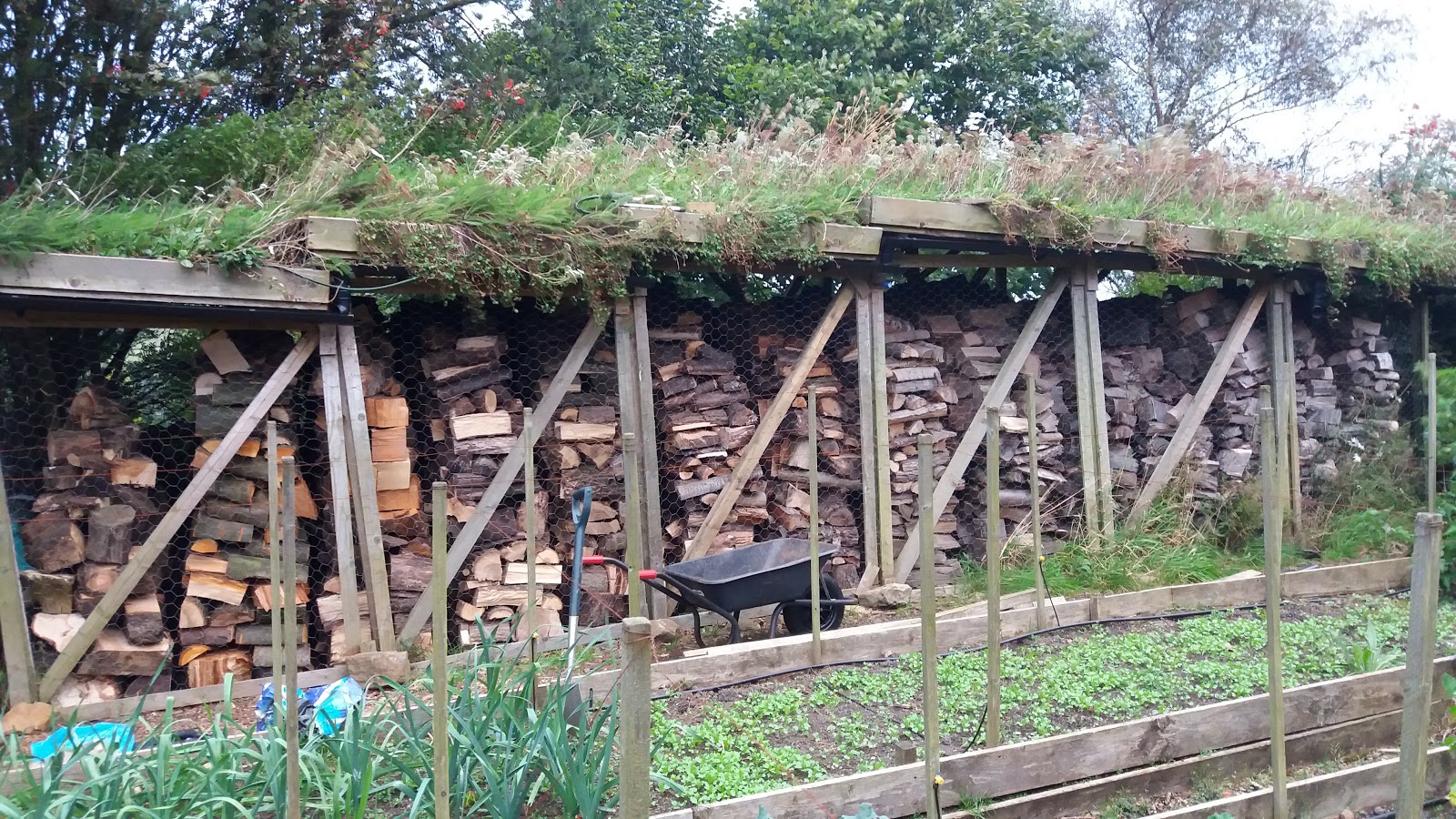
For the very first time since the start of 2012, the driveway doesn't have any firewood on it. We've finally caught up, and got everything sawn, split, and stacked into the woodshelter. In turn, the woodshelter is full. Precisely. Astonishingly precisely.


An empty driveway (© Ian) 


And a full woodshelter (© Ian)

The last stack (on the left) can't be as tall or as full as the others, because I can't stack from alongside it—I have to build the stack as I work out, off the support frame ('ladder'). That seriously limits how well and thus how high it can be built, so it only contains about half as much firewood as the stack next to it.

Saturday, 10 September 2016

Willow Arches

The honeybees have been settling in well, and enjoying the late good weather. We had a thorough look through the hives this morning to check on them, and tidied up a few bits of extraneous honeycomb (brace comb) they'd built. Which means it was immediately necessary to make crumpets so we could have the honey contained in the brace comb for tea.


This afternoon, we've been sorting out the willows that form the arches to either end of the pond garden, and disguise the sheds on the septic tank. They had got rather out of control, so it looks an awful lot better pruned and tied in.


The Pond Garden (© Ian 2016)


The Long Border (© Ian)


The arch from the pond up to the colour wheel (© Ian 2016)

Sunday, 14 August 2016

Badminton, Bees, Babies

Today, we went over to Cheshire to celebrate friends' second child, who arrived early this year. It was a nice trip, and it was good to see them.


Newly arrived honeybee colonies (© Ian 2016)

Our long-awaited honeybees arrived yesterday. We made the platform (in deference to the sloping hillside) some time ago, but the bees were a bit delayed. They've arrived today. The far colony is slightly stronger, but both are doing well. They need proper stands, and I have a plan for strapping them down directly onto the platform.

Sunday, 26 June 2016

Bee Platform

For many years, I've wanted to keep honeybees. We're finally getting round to it, partly because we discovered that a colleague of Liz's keeps them, and is set up to provide equipment and colonies. They need, obviously, somewhere to go, and we decided that one of the clearings on the hillside was ideal. However, the ground slopes rather dramatically, so we needed to create a stable and flat platform for the hives to go on, as well as stand on when working on them.


Bee Platform (© Ian 2016)

I don't like to do things by halves! The platform's about 8' by 5', which is big enough for two hives (with space for one or two more later); because of the slope, the right hand edge is only slightly above ground level—but the balustraded edge is about 4' tall. I think this justifies a construction. It's made of 100mm posts in drive-in stake/supports, with 6x2" joists and subjoists, with 6x1.5" decking, and although we need to make a set of steps, it's basically good to go. The hives will go on the back (right) edge, with the entrances facing uphill (away from the prevailing weather) towards the heather.


Cat basket/trug (© Ian 2016)

While we've been busy, Chess found a comfortable spot to sleep.