Showing posts with label plants. Show all posts

Tuesday, 25 November 2014

New Hostas

New hostas arrived today, barerooted and looking more like multi-tentacled aliens. I've potted them up, and popped them in the greenhouse to overwinter. Although they don't need the protection, I prefer having them there, where I can keep a better eye on them.

They are:
  • Wide Brim
  • Sieboldiana 'Elegans'
  • Francee
  • Halcyon
  • Pizzazz
  • Snow Cap

Tuesday, 4 November 2014

First Frost

This morning saw our first frost of the winter—coincidentally, on the same date as last year.

Fortunately, it wasn't a hard frost, hitting only the windscreen of the car, and not quite reaching the ground, which is as well, because we've not lifted anything. A frost was predicted for Wednesday morning, but not last night, so we were lucky. The house, too, protects the front garden, where the zonal pelagoniums are: we only have a limited number of non-hardy perennials, and these are a high fraction of the total.

As a result, we went out after getting back from work to lift the other vulnerable plants, as well as the geraniums in the front garden. The variegated agapanthus, Tinkerbell, and tulbaghia from Tatton last year, the three chocolate cosmos from this year, and the Queen Victoria lobelia (also Tatton Park 2013, I realise) have all been potted, and are in the greenhouse. That extends the time they can stay outside, before we have to find windowsills for them to go on, although they can't stay out there over winter, as the greenhouse isn't heated.

We've left the dahlias (Bishop of Llandaff, Twying's After Eight) for now, as they can wait until a proper frost kills the top-growth, before we lift the tubers for the winter.

Sunday, 6 July 2014

Nettle Cordial


The days started with some weeding, and my finishing off the shed-boxes (needed to add weather strips inside the last two boxes' doors, and paint the floor of the one which has the lawnmower in, as this will often be a bit damp). I also added some extra strings to the willow-less legume frames, as they're starting to get going.

Even though we planted out a great number of things earlier, we still have a lot of small plants growing on, mostly around the greenhouse, or on the weed membrane near the kitchen. Today we managed to plant out a number of these—but there are still lots of pots left! It takes many, many plants to fill half an acre, it turns out.

Into the long border have gone several astrantia (A. major, A. minor, A. maxima, as well as a variegated form from my parents' garden—it might be A. major 'Sunningdale Variegated'); a few trios of coreopsis; some more of our seed-grown Stipa tenuissima; and some geums.

More geums, and some mixed achillea, went into the bed on the games lawn side of the septic tank, to balance it with the other side (the geums there are doing marvellously, and look good set against the new green background of the sheds.

A few spare achilleas, and then some campanulas, aquilegias (Magpie and Royal Purple), and lupins (mixed, hopefully nice colours!) went into the two beds around the sweet peas that aren't looking so good (the back one of the three is pretty good, but the others' wildflowers didn't germinate well.

We also had three little dicentra (with rather darker, single-colour flowers: we're not much taken with the pink & white normal form, but this one, and the all-white we already have, are much more to our taste), which have gone in the copse bed.

A bunch of hardy fuchsias (Hawkshead, Delta's Sarah, and Army Nurse), have been potted up, along with a dozen box cuttings, a number of 'Tail Feathers' grass (Pennisetum macrourum), rose campion, and other achilleas.

Over lunch, we moved the elderflower wine into demi-johns (adding yeast nutrient), and also bottled the nettle cordial which we started a week ago. It looks a brighter colour than last time.


Nettle cordial straining (© Ian 2014)

We had hoped to move a load of chippings onto the weed membranes, but only managed about ten barrow-loads, because first we had raspberries and courgettes to pick. The raspberries are doing much better this year, probably because they've been well mulched last year and this, and we got the pruning right last August. The courgettes are just starting to form: it seems earlier than last year. I think we just about had them in mid/late July, so it's earlier than that. The plants seem to be fruiting at a smaller size, too: I don't know how much of all this is down to the variety (Defender), which is new to us.

It's been a good weekend for cat company: they've been much in evidence.

Hungry cat (© Ian 2014)

A number of seedlings are growing on well, including these dierama, which I'm looking forward to having.

Dierama (RHS seed) two weeks ago... (© Ian 2014)

...and now (© Ian 2014)

Wednesday, 11 June 2014

Task List

I've had today off, though Liz has been working: that made it an ideal day to get a number of little jobs done, and I've had a pleasingly productive day.

It's the time of year when I start trying to get the window frames painted. Last week, two of the last wooden windows on the back of the house were replaced with uPVC, which (in addition to looking rather good, especially for uPVC) means I have two fewer frames to worry about. Of course, the time-consuming Georgian-barred windows on the front are no fewer, and it's those which have always taken the time.

However, before embarking on this year's painting, I decided to install some eye bolts on the front wall, in order to tie down the ladder while using it. I've had enough of bouncing on an unsteady ladder, and don't enjoy working on one at the best of time. The window at the end of the study has always needed a rather extended ladder, as the ground drops off in that direction, and the path has stepped down towards the level of the garage. It's always, therefore, been the worst climb.

To combat this, I've installed two M12 shield anchor bolts (18mm holes, which aren't for the faint of heart, or drill), one on either side of the window, at about 180cm height. Using a ratchet strap passed around each stile and angled down through the bolt, the ladder can now be tightly held in place. The result is revelatory: I felt much more secure, and less conscious of the drop...

That window, and two dining room ones, are now done: I'm only planning to chip away at the painting, with the aim of getting about half done over the next couple of months.

Next, I strimmed the half of the orchard I didn't manage to do eleven days ago. I'm hoping I'll only have to do this regularly for another 12-15 months, and that we can think about a couple of sheep by then.

I've painted some of the remaining legume/sweet pea supports, which means their bituminous feet (the underground bit) are done, and as many of their above-ground elements as I could get to (given that the tarry feet were drying).

I shan't dwell on unblocking the kitchen drain.

The work on the garage has been going on since the end of last week; sorting the foundations took a little while, but the builder started the actual walls yesterday, and has finished them today. The uneven-ness of the walls has complicated things slightly, and none of the windows are going to be quite the same height. The joiner will be along on Monday to measure up, and hopefully the building work will otherwise be done tomorrow. Next up will be the replacement of the dining room window with a set of patio doors.

After lunch, I took the time to do a wander of the garden with camera in hand. It's been a while, but here's where things are up to.


Bees foraging in the wallflower in the front garden (© Ian 2014)


The dining room windows, for now, until the patio doors go in (© Ian 2014)


The sweet pea supports (© Ian 2014)


One of the sweet peas is flowering; several more are on the verge of doing so (© Ian 2014)


The heuchera bed; not sure whether the quince has set fruit (© Ian 2014)


One of the astrantias in the copse bed (© Ian 2014)


The long border in front of the dining room (© Ian 2014)


The mess of the pond aside, the bed next to the septic tank has filled out well, and needs pruning (© Ian 2014)


The aquilegia here has gone slightly mad this year (© Ian 2014)


Astrantia flower (© Ian 2014)


Mostly-planted vegetable garden (© Ian 2014)


Red Duke of York potato (© Ian 2014)


Green roof wild flowers, with foraging bees (© Ian 2014)


Green roof on wood store (© Ian 2014)


Day lily which we didn't know was there (© Ian 2014)


Weed-membraned knot garden (© Ian 2014)


Inside the garage before work on the wall/windows (© Ian 2014)


New garage front (© Ian 2014)


Stone cills & jambs being supported while curing (© Ian 2014)


Window apertures ready for windows (© Ian 2014)

Friday, 25 April 2014

Tidying

We spent all yesterday clearing and tidying the garage and workshop, which now look immeasurably better. The garage is now lined up for conversion into habitable space over the next few months, and we've got rid of a lot of clutter, and better organized it for working, too.

Today was more fun, as we've potted up a load of courgette and tomato plants, sown runner and French beans, potted up and moved outside the broad beans, and planted several pots of gladioli. We're about to set off for Ludlow for the weekend, and a couple of days of rest.

Friday, 18 April 2014

Good Friday

A few photos taken this evening. Some are just for our records, of gaps in the bulb planting that we can fill in the autumn.


Acer coming into leaf (© Ian 2014)


A record for planting in the autumn: gaps in the bulbs in the sweet pea beds (© Ian 2014)


The Quince/Heuchera Bed (© Ian 2014)


The Front Copse Bed (© Ian 2014)


Front Copse Bed (© Ian 2014)


Looking Up The Copse (© Ian 2014)


White Lion Daffodil (© Ian 2014)


Gaps for bulbs in the copse bed (© Ian 2014)


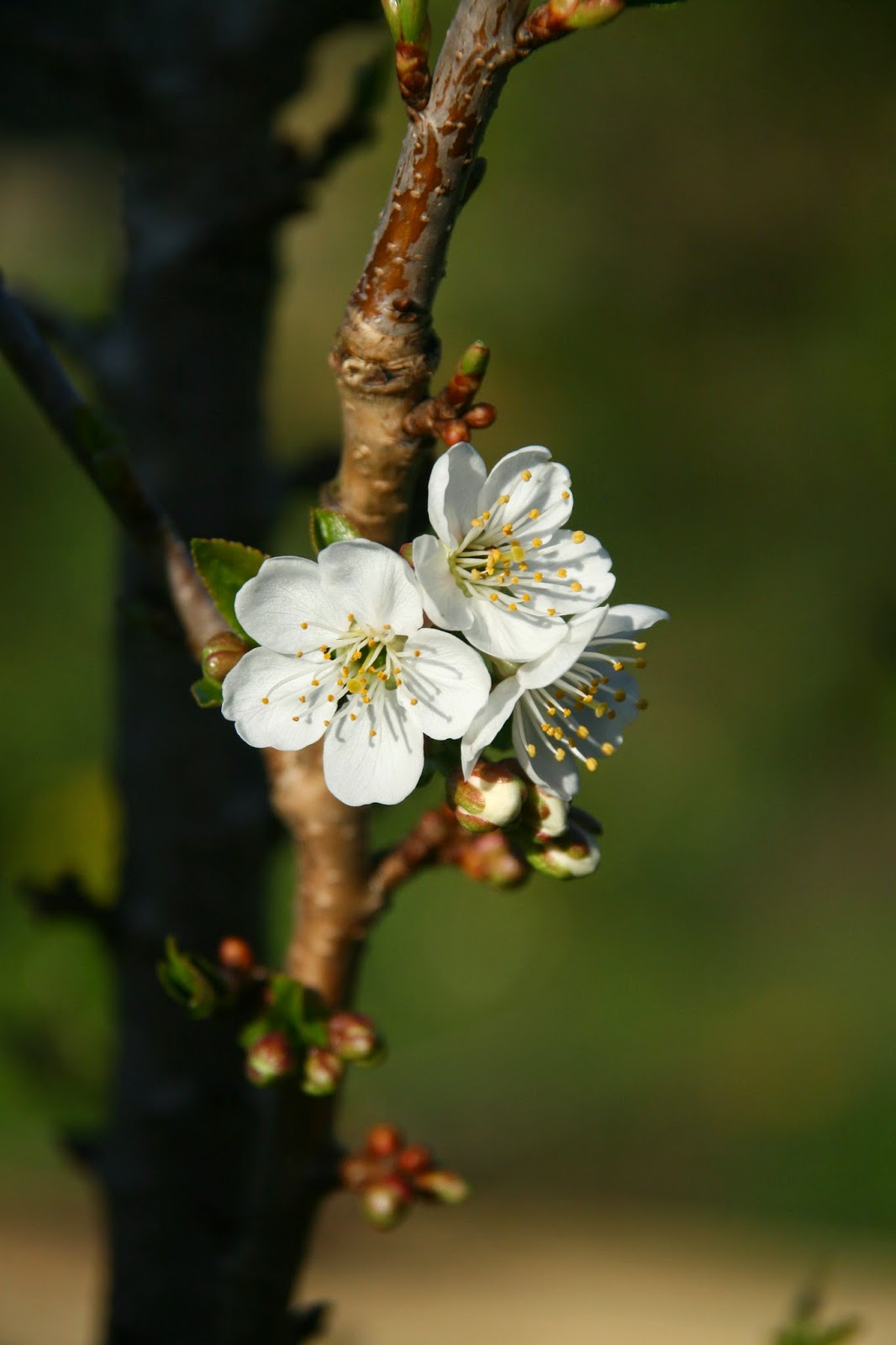
Cherry blossom ( Ian 2014)


Pulsatilla in long bed (© Ian 2014)


Primroses (© Ian 2014)


More double daffodils (© Ian 2014)


The long border: gaps for spring bulbs (© Ian 2014)

Wednesday, 26 March 2014

New Beds

Last time we were out in the garden (ten days ago: David and Ann were with us for the weekend, which was a relaxing couple of days filled with food, and no work), I dug a new bed above the beech bench, and we planted a row of lavenders around its edge. Today, it was the turn of the other side, and we now have a matching bed below the bench (between it and the steps down to the wood shelter and kitchen garden). While I dug it over, Liz cleared a heap of shredding that's been accumulating, and we were, as ever, amazed at how small the resulting pile of chipped stuff is.

Having removed a load of stones (as normal), the remaining ground is actually rather nice soil: we planted a row of lavender around it, again, and then filled the space in both beds with other things that were taking up space in the greenhouse: a few dozen deschampsia grasses (D. cespitosa), some sweet rocket (Hesperis matronalis), and some Jacob's ladder (Polemonium): all grown from RHS seed last year.

At the left end of the bed, there's a space towards the wall where we took down the conifer a couple of years ago, which was obscured by the aforementioned shredding heap. This was the destination of the Persian Ironwood (Parrotia persica) which arrived last December, and has remained in its pot over the winter. The space now cleared, we've been able to plant that out, and hopefully it'll add some year-round foliage interest to that corner.

Part of the reason for preparing and planting these beds was to free up small pots and space in the greenhouse. That achieved, we spent the last hour of the day potting up a load of sweet peas (again, no 'Apple Blossom' have germinated: they're on the black-list, now), chilli and sweet peppers, and aubergines. In turn, that meant space in the propagators, so we've also sown more cosmos (an orange mix), tiger tomato seeds collected last year, anise, and a few other ornamentals. Even with the greenhouse, we're still going to wind up with lots of pots on the windowsills: but at least they'll be gone by May this time, and the tender veg (tomatoes, peppers, and aubergines) won't be inside, but out in the greenhouse.

Sunday, 16 March 2014

Mulch

A fair bit of the weekend's been spent dealing with the 6m3 of mulch that arrived on Thursday. After putting a good layer on the vegetable garden then, on Saturday we worked along the fruit beds, giving the currants and berries a thick mat. We spared a bit for the rhubarb, too, which I've already spread several trugs of compost onto, but more is definitely better for this hungry perennial. I think we'll take our first harvest next weekend: the oldest Timperley Early is doing well (and is earliest!).

The fruit beds will get a weed-suppressing layer of cardboard, and then a topping of chippings, when we next have some: this reduces the weeding so much that it only needs an annual blitz (my job yesterday), which is much better.

We've also gone along the fruit trees on the hillside (excluding the apple walk, and the pear 'Hessle', as they're too small to need it), putting a trug full of mulch under each one's anti-weed membrane. The ornamental plums are on the verge of coming into leaf and flowering.

The heuchera/quince bed is a little too full of rather dainty spring bulbs to want to mulch it (should have done so in January or February!), so we've filled two Dalek-style composters with mulch, on a nearby path, ready to spread once the bulbs die back. Lesson learnt for 2015.

That still left us with a good heap of mulch, so the last job today was spreading twenty-odd trugs over the long border. This bank is reasonably fertile, having had cotoneaster leaves dropping on it annually for twenty years, but it could still do with building up. Liz had been weeding the bank over Thursday, Saturday, and today, so the mulch has gone (as it should) straight onto clear ground, and it looks really good.

While she weeded, I've tidied the over-grown grass in the wild-er bit near the flowering currant and behind the copse bed. I should, really, have strimmed this in late autumn, as it's now full of daffodils, which obviously I don't want to damage. This made it a manual job, which is more tedious, but there you go.

Last short job yesterday was digging an exploratory trench to work out the fate of the land drain we uncovered when preparing the bed for the sweetpeas last spring. We've gone about two metres up-hill, on the other side of the path (which I didn't want to disturb just yet), and found two breaks in the pipe -- but no herringbone joint yet. I'm still hoping that we'll find some: there's no chance it's draining the whole section of garden unless there's either herringbone drains running off from it, or a second drain (hitherto undiscovered) further along. That said, the broken sections, which have filled with organic debris, would explain why they're not working. It's going to take a bit more work to get to the bottom of it all.

This afternoon, my digging was on the opposite side of the garden, as I was preparing what will become beds in front/beside the beech bench. I've cleared the turf from both, but only dug over the bed above the bench (very stony and laborious). The soil's quite nice, actually, once the stones are prised out. Fortunately, one bed was enough to plant 28 lavenders out, as a border, which has freed up enough 2½–3" pots to pot up the 'Alicanta' tomato seedlings that have been outgrowing their communal pots.

Astonishingly, it actually feels like we're more-or-less on track, without too many specific or substantial jobs that should have been done but which we've not got round to. As for actually managing to mulch 'on schedule'... I'm sure it shan't last.

Saturday, 26 October 2013

Chilli Oil

The chilli oil we painted onto the fruit trees in August seems to have worked, and we've not noticed any more deer/bunny damage on the fruit or pines. As the weather's starting to turn autumnal, and it's been a while, we thought we'd re-apply the deterrent. We mixed three heaped dessertspoons of hot chilli powder into about 700ml of oil, and worked round the orchard, daubing each tree with some. As we went, I sorted out a few too-vertical branches, and cleared weeds from around the trunks.

This afternoon, we've continued tidying the garden, getting it sorted for winter, and moving the last few things into the greenhouse, or workshop: the tuhlbergia, agapanthus, and pelargoniums all needed to come in. The three Bishop of Llandaff dahlias can wait a little longer, we reckon, as there's not been any frosts yet.

Our batch of spiced apple mincemeat has gone into its jars (one and about three-quarters of a 1.5kg kilner), and we then spent some time juicing apples. My mechanized scratter hasn't worked as planned (difficulty connecting axle with rollers), but the aluminium drums with screws set in them work really well as manual graters, and we were able to create good milled apples for pressing. The yield is pleasing: about 55% (ie, 550ml from a kilo of fruit), or nearly 5l from a filled (nominal 12l) press. The juice has been pasteurized (70°C) and bottled.

Sunday, 1 September 2013

Potatoes, Parsnips, and Planting

After discovering quite a lot of wireworm damage to a couple of parsnips, we decided to take up the parsnips (4.5kg), carrots, and maincrop potatoes, to limit damage. The Druid potatoes have yielded 28kg, from 20 plants, which is pleasing.

Although taking them up early was a bit frustrating, we've also managed to get our honeyberries in the ground, finally, and get a number of other pots planted into the front copse bed, as well as the goji berries into their new beds on the back patio. The honeyberries, and two cultivated blackberries, have gone into new small beds demarcating the entrance to the kitchen garden, which also feature willow trellis panels. I'll have to get a photo...

A heather, the forsythias, the old astible and heuchera from the pots in the front, have all gone into the copse bed—the astilbe and heuchera having been split. Some of the heucheras have gone into the hanging baskets for the winter, as the nasturtiums (which have been great) have been badly caterpillared in the last couple of weeks, and are rather the worse for wear.

Lastly, a photo of this week's sweet pea harvest: 700 stems. It's probably the peak, but we've been getting about 500 stems each of the last 8-9 weeks, I estimate, which is a staggering number of flowers. Sadly, the plants are showing signs of fatigue, so it won't go on much longer.


The sweet-pea tripods (pre-harvest!) (© Ian 2013)


700 Sweet-Peas (© Ian 2013)

Friday, 30 August 2013

Survey

It's the time of year to take semi-ripe cuttings of perennials, so yesterday, with the help of a fosterling, I took a number of pots of lavender, box, willow, dogwood ('Midwinter Fire'), Cornelian cherry, and a yellow-flowered herbaceous perennial from Jenny's garden the name of which constantly eludes me. They were all treated with rooting hormone (apart from the willows), and are in warmed propagators to give them some warmth and humidity. Before that, then I painted half of the window frames on the front of the house, and Liz weeded, as well as painting the trough planter for the goji berries.

We spent most of today on the hillside, which has been strimmed again. It might need doing once more this autumn, but that might not happen. Having done so, we went around and painted the trees with an anti-deer concoction of chilli powder in oil. Hopefully that will help keep them away: they've browsed the leaves from one of the tall shoots on one of the Victoria plums. While going round, I used a GPS app on my phone to take a reading of each tree's location, as we don't actually have a plan of which tree is where. I'm not sure it's worked perfectly, but it provides some idea.

Location of the Fruit & Ornamental Trees in the Orchard ( Ian 2013)
I'm going to work on plotting it with labels, too.

I also measured the length of the putative apple walk we're thinking of building in the 'top right' (left in the plan above) corner, which an avenue of trees leads you towards, and which takes you up into the first clearing. It looks like it'll be about 24' long: as we're planning trees 6' apart (probably with imitation 'trunks' intercalated), in an arch 8' across; each tree can then be espalier trained 3' each side. That makes for five trees up each side, so we need to start planning varieties -- and digging two planting trenches.

Finally, as we went round, I've done a bit of work training the primary laterals on the fruit trees which are tall enough, so that they're more, well, lateral. For example, most of the plums have reached a height where their leader shoot was cut, which promotes several new shoots to break into growth at the tip (about 6' tall). These will be the primary framework of lateral branches, which will ideally be reasonably horizontal (for many reasons, not least that this makes a larger crotch angle between trunk and branch, which is much stronger, mechanically). However, they start life really vertical, and need to be tied down, which I've done with guy twines.

Monday, 26 August 2013

York Gate

David and Ann were with us for the weekend, and having dropped them off at the station, we carried on to visit York Gate Garden, which is on the outskirts of Leeds. It's on a similar scale to our own garden, and is pleasingly divided into a number of smaller gardens, which is the kind of approach we're trying to take. It had a pretty pond, a nut walk, and a productive kitchen garden.


York Gate Gardens (© Ian 2013)

And, inevitably, a small nursery. We picked up three alpine Lady's Mantles  (Alchemilla conjuncta), which is more delicate than A. mollis, with leaves that are more divided, and silver edged. It is, apparently, less prone to seeding everywhere, and is better behaved.

Having got home, we pottered in the garden, including a contemplative look at the games lawn: Liz is floating the possibility of cutting an oval flower bed in its centre, and making the surrounding beds that bit bigger. Doing so would prevent badminton (but the combination of warm, dry and still weather necessary for a reasonable game is extremely rare), and formal croquet; but modified croquet, boules, lawn darts, and similar would all be possible. And it would make more space for plants, and probably look more attractive.

I also hooked up some new watering equipment, which arrived last week: a timer computer, which can set water going up to eight times each day, and an automatic distributor from Gardena. The latter's rather clever: each time the water comes on, it sends it out the next outlet of six, in sequence. By connecting each irrigation zone to a different outlet, and using the computer to turn the water on (and off) the same number of times, each zone will be watered. It will mean I only have to turn the water on/off once, instead of five or so times, in an evening, and the kitchen garden (and green roof) will be watered. It will also mean that the watering can be done while we're away, without laboriously inconveniencing a neighbour.