
Forgot to mention: I was finally able to mow the lawn yesterday, too, after not being able to coincide good weather and time for three weeks. The games lawn really needed it, but actually the rest wasn't too bad.
Showing posts with label cats. Show all posts
Showing posts with label cats. Show all posts
Wednesday, 20 August 2014
More Perennial Plugs
As expected (though we didn't think it would follow quite so hot on emptying the module trays last night), today we received 96 perennial plugs: 24 each of 'Mussinni' catmint (nepeta), echinacea 'Deep Rose', achillea 'Cassis', and a dozen each of 'Blue Queen' salvia, and 'Lady Strathden' geum. Interestingly, the cats don't seem as interested in the catmint as our other plants, grown from seed or 'Walkers Low', which bodes well for actually being able to plant it out.


Monday, 28 July 2014
Planting and Plastering
The first jobs for today were planting out the plants we bought at Tatton Park yesterday. Apart from the carniverous plants (kitchen and sitting room), and the brunnera (copse bed), the rest have gone into the long border. I need to add proper labels before we lose track of them, as they all came from show gardens as they were dismantled, and thus without labels.


This afternoon, we've stripped the wall paper from the side wall of our bedroom, and from the main wall of the dressing room, and re-plastered both. That's in preparation for putting up the new shelves on both these walls that we've had planned for several months, which I hope to do on Wednesday, all being well. That gets the shelf boards out of the way, along with everything that will go on these shelves, and should make installing the wall insulation easier: that starts next weekend, we plan.
Customary 'before' photo (© Ian 2014)
And gratuitous sleepy/supervisory cat photo (© Ian 2014)
Sunday, 6 July 2014
Nettle Cordial
The days started with some weeding, and my finishing off the shed-boxes (needed to add weather strips inside the last two boxes' doors, and paint the floor of the one which has the lawnmower in, as this will often be a bit damp). I also added some extra strings to the willow-less legume frames, as they're starting to get going.
Even though we planted out a great number of things earlier, we still have a lot of small plants growing on, mostly around the greenhouse, or on the weed membrane near the kitchen. Today we managed to plant out a number of these—but there are still lots of pots left! It takes many, many plants to fill half an acre, it turns out.
Into the long border have gone several astrantia (A. major, A. minor, A. maxima, as well as a variegated form from my parents' garden—it might be A. major 'Sunningdale Variegated'); a few trios of coreopsis; some more of our seed-grown Stipa tenuissima; and some geums.
More geums, and some mixed achillea, went into the bed on the games lawn side of the septic tank, to balance it with the other side (the geums there are doing marvellously, and look good set against the new green background of the sheds.
A few spare achilleas, and then some campanulas, aquilegias (Magpie and Royal Purple), and lupins (mixed, hopefully nice colours!) went into the two beds around the sweet peas that aren't looking so good (the back one of the three is pretty good, but the others' wildflowers didn't germinate well.
We also had three little dicentra (with rather darker, single-colour flowers: we're not much taken with the pink & white normal form, but this one, and the all-white we already have, are much more to our taste), which have gone in the copse bed.
A bunch of hardy fuchsias (Hawkshead, Delta's Sarah, and Army Nurse), have been potted up, along with a dozen box cuttings, a number of 'Tail Feathers' grass (Pennisetum macrourum), rose campion, and other achilleas.
Over lunch, we moved the elderflower wine into demi-johns (adding yeast nutrient), and also bottled the nettle cordial which we started a week ago. It looks a brighter colour than last time.

Nettle cordial straining (© Ian 2014)
We had hoped to move a load of chippings onto the weed membranes, but only managed about ten barrow-loads, because first we had raspberries and courgettes to pick. The raspberries are doing much better this year, probably because they've been well mulched last year and this, and we got the pruning right last August. The courgettes are just starting to form: it seems earlier than last year. I think we just about had them in mid/late July, so it's earlier than that. The plants seem to be fruiting at a smaller size, too: I don't know how much of all this is down to the variety (Defender), which is new to us.
It's been a good weekend for cat company: they've been much in evidence.

Hungry cat (© Ian 2014)
A number of seedlings are growing on well, including these dierama, which I'm looking forward to having.

Dierama (RHS seed) two weeks ago... (© Ian 2014)

...and now (© Ian 2014)
Wednesday, 2 July 2014
Last Few Jobs
I'm astonished to say that, of our list of jobs we made on Saturday for the past five days, we've actually done them all. Today, I've turned the compost heaps (decomposing beautifully); replaced the satellite cable and LNB (finally we have two signals to the box, reducing recording conflicts); we've painted the bike shelter (it'll need another coat or two, but there you go); installed the loft hatch in the garage (still so named!); and hung ladder hooks in the same (necessitated by putting a hatch in the hole they poked up through). Liz has done a thorough weed of the long border over the last couple of days, and it's looking loads better. We've also managed to move all the stone (and turf) that we put on the septic tank two years ago when digging the beds on either side. This is because, having transformed the garage, we want to get some of the garden tools out; but, lacking a shed, this is tricky. Our solution (long planned) will be a set of storage cupboards along the septic tank, within the living willow structure we're growing over it. Ideally, these will each have a little green roof, probably planted with alpines (which have their interest mostly in the spring, before the willow gets into full leaf). They arrive on Friday, so in order to assemble them this weekend, the tank top needs to be clear.


Having uncovered it, I've been reminded that two of the five manhole covers don't fit at all well. By which I mean they're alarmingly unstable, and seem too small. The concrete lid sections have also 'drifted' towards the bottom end of the tank. We've pushed them back together, but the covers are irredeemably too small. I shall buy a couple of new ones, and mortar them in, which will make it all rather safer.
While we've been working, the cats have kept us company. Chess found somewhere shady to nap (I don't know how he got through the latticework).
Chess sleeping inside a sweet-pea pyramid (© Ian 2014)
We're almost, but not quite, at the point of enough sweet-peas for every downstairs room.
Liz's sweet-pea (and berberis and alchemilla) flower display for the week (© Ian 2014)
Friday, 20 June 2014
Patio Doors
Over the last week, we've had the picture window in the dining room taken out, the wall lowered, and folding patio doors installed instead. (At the same time, the big windows in the kitchen and sitting room have been replaced, as the timber frames of both were rotting slowly away, and needed annual maintenance.)

With the folding doors, you now have more of a sense of the garden, and with them open, you really feel in the garden from inside the room.


The view before was fine enough. But from most of the room, what you saw was mostly the borrowed landscape, not the garden.
Picture window in dining room, pre-work (frame on left; doors propped on table, right; dustsheets everywhere!) (© Ian 2014)
With the folding doors, you now have more of a sense of the garden, and with them open, you really feel in the garden from inside the room.
New folding doors into knot garden (© Ian 2014)
The doors are really good; smooth action, good locking, and they fold away to one side (right, above) very neatly. The 'access' door, on the left, opens independently, and the drop bolts (silver, between the right pair) hold the others in place while you do so.
It's still a bit of a mess outside, and I need to build steps to them, as there's a nearly two-foot drop at the moment.
The cats seem to like the extra entrance, at least.
Chess examining the new view (© Ian 2014)
Thursday, 29 May 2014
Old English Plaster
For today's first trick, we learnt how to plaster, in Old English finish. In a way, we're lucky, because the rest of the house is plastered in this style, so we're justified in plastering the garage and the rest of the house, in the same way, without it seeming odd. Lucky because neither of us has plastered before, and flat, smooth plastering was likely to take a while to master, even if I have practised on the odd Christmas cake before. I have to admit that it's not a perfectly flat, smooth surface.
Old English finish, however, is not meant to be. Instead, the surface is uneven, with prominent trowel marks. If it weren't deliberate, you'd think it was incompetent. To its credit, it covers uneven walls very well: if the plaster surface was perfect, the underlying lack of right angles, plumb verticals, and parallel walls would shout at you.
The experiment appears to have been a success: we'll be sure when its dry and painted, of course. For now, we've plastered only the one board that covers the stud wall: in time, I'll dry line the entire room, but that's not urgent. It was more economic than I thought, too: a quarter bag of plaster (6.5kg, plus 3l water) was enough to cover the board, and do the joints over about half the ceiling, having fortunately taped them before mixing the plaster.
That finished, we then put down the last section of floor that can be done before the doors are replaced with walls and windows. The builder should be starting that work in the next week, so we also needed to clear access to everything he needed, which entailed moving everything previously standing in the front third of the room onto the new floor, leaving the front area (almost exactly three sheets worth of flooring: two deep on the door side, one deep on the far side) bare for him to work in.
We then worked through a stack of almost a hundred pots, planting up small plants that have grown on from seedlings over the past few months, and which are mostly now out on the weed membrane. We also potted up a dozen big pots of tomatoes, and a number of chillies and sweet peppers, which are on the benches in the greenhouse now.
It got rather late, so the cats had to come and shout for us to come in.
Monday, 6 January 2014
As They Mean To Go On
I suspect the cats are meaning to spend 2014 in their accustomed manner.


Somnolescent cats (both © Ian 2014)
Sunday, 11 August 2013
Onions, Potatoes, Gooseberries
We've had a day of mixed maintenance (that's probably the best way to put it). The first of the summer onions (Fen Early) have collapsed, which means they're ready to lift, so up they've come. They're not particularly big, unfortunately, and there's only about 65 (I planted 100 sets), but there you go. I think the cats walk over that corner of the beds, which probably hasn't helped them.

The cats' garden skills are not impressive: Chess 'incubating' seeds (© Ian 2012–13)
They went onto a rack in the wood-shelter (a great secondary use for it!), replacing the Radar onions which came up three weeks ago. The garlic is probably also dry, when I have time to plait it.
We then put stakes in alongside the Brussels sprouts and kale (which don't like getting rocked by wind, of which we get plenty), and planted out some spare January King cabbages. I sowed a tray of Frostie spring cabbages earlier in the week, which will fill that bed.
These went straight in where the second early potatoes, Kestrel, had been, which we lifted his morning. They've yielded about 15kg, which makes them slightly more productive than the Lady Christl. Fortunately, they show no sign of blackleg, which lost us about a quarter of the Lady Christl tubers shortly after lifting.
After that, we had a mammoth fruit picking session: I've picked the rest of the gooseberries (barring a few handfuls), and Liz collected another big bowlful of blackcurrants. There's still the same again to ripen, and many more blueberries, which are gradually colouring up.
Once we'd had lunch, we planted a few things in the copse bed: our hydrangea (H. aborescens) 'Haye's Starburst', the three heucheras we bought at Tatton Park, and another that we had previously, along with a handful of stipa (S. tenuissima), a winter box, and a 'Pink Lemonade' blueberry (which has pink coloured fruits). Two more pinkberries went into the quince bed, which already has heucheras, stipas, and winter box, which means the two beds should feel coordinated.
Lastly, we've started clearing a few spots in the long border, taking up spent foxgloves and Lady's Mantle, in order to make room for the other perennials from Tatton Park: we hope to get them in the ground next weekend.
Sunday, 28 July 2013
RHS Tatton Park
I've been looking forward to this for some time: this week's seen the 2013 RHS flower show at Tatton Park, and—like last year—we bought tickets for the final day.


'The Edible Medley' had a pleasing stone rill running through it, which has us wondering whether a rill draining from the colour wheel to the water garden is something we should consider.

I had to take a photo of two woven willow cats, playing with a willow mouse.

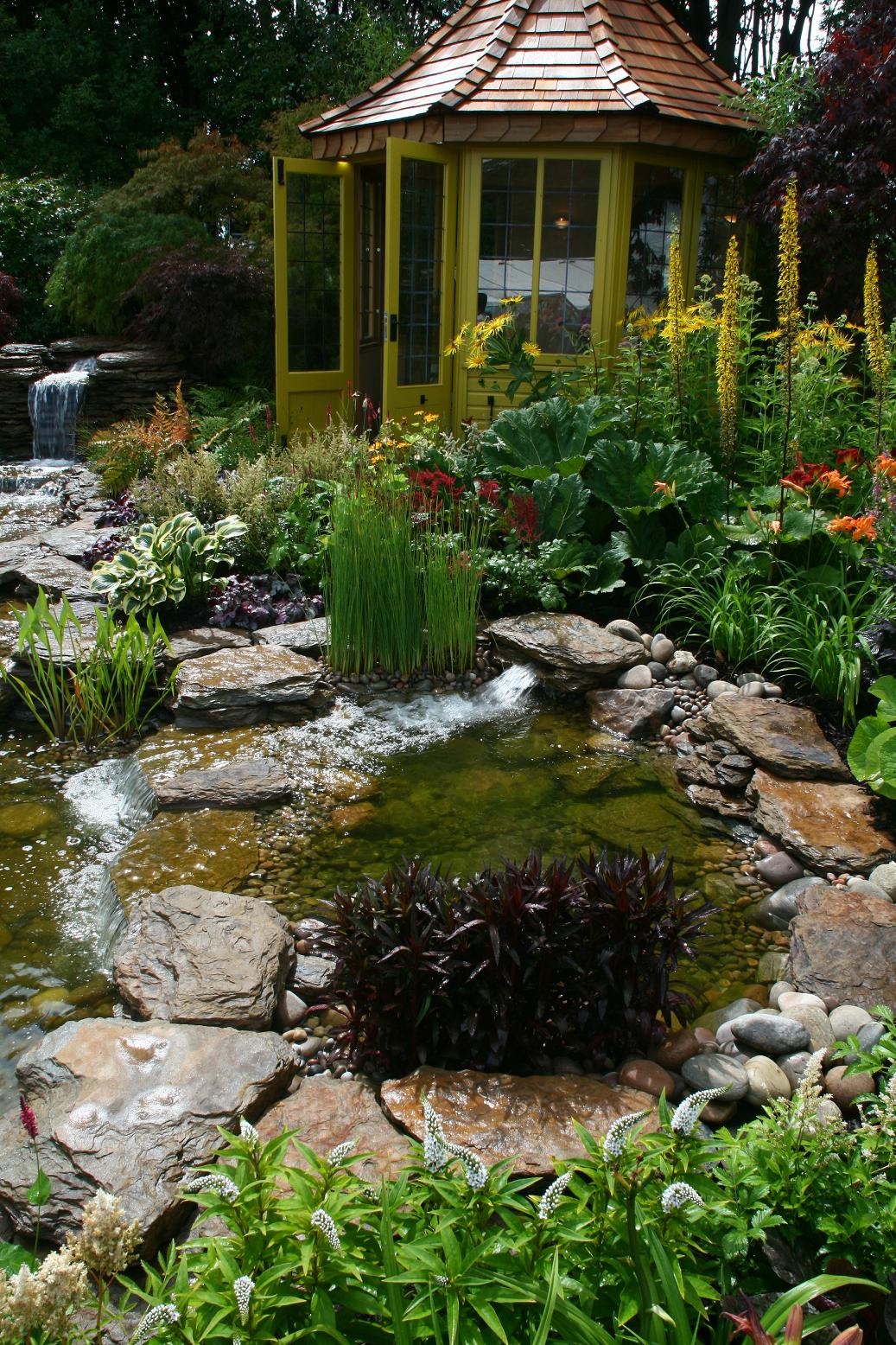

The grass border at the front of Echomap's garden caught our eye.

I fear Liz may now want a water wheel as a water feature.

Whereas I'd rather like a garden observatory.

For that future day when we might keep chickens, I rather like Kate Humble's Flyte So Fancy chicken coop.

RHS National Young Designer of the Year went to Tony Woods, who designed 'Escape to the City'. Last year's winner (Tristen Knight, with 'Brownfield Beauty') was also one we liked: we obviously share our opinions with the judges. We bought a couple of plants from this during the sell-off, including the brunnera just visible in the bottom left of this photo.

The garden leaflet for this one was the best I've seen: it had mug-shots of most (all?) of the plants, which made it really easy to identify something that caught your eye.


Predictably, we bought a load of plants, and had a struggle back to the car with half a dozen pots in each hand.

To enumerate them: a dark leafed ligularia; a 'Chocolate' eupatorium (E. rugosum); a variegated lysimachia (L. punctata 'Alexander', I think); Sanguisorba 'Tanna'; three 'Ravenwing' cow parsleys; a 'Queen Victoria' lobelia; a replacement 'Miss Willmott's Ghost' eryngium (and tray of seedlings!); three heucheras; a Japanese ginger; an edible tulbaghia 'Silver Lace'; a variegated agapanthus ('Tinkerbell', perhaps?); three 'Bishop of Llandaff' dahlias; a tradescantia; and the Brunnera macrophylla 'Jack Frost' mentioned above. We also bought some heritage seeds, from Pennard Plants, including cucomelon, and a purple climbing French bean, 'Blue Coco'.
I think there are two more plants, too, which I can't remember.

Near our entrance, and the first thing we stopped at, was 'The Home Guard-ener', a World War II allotment garden, which uses the Ministry of Food guidelines for crops and spacings, and varieties available at the time. At the end, beyond the Anderson shelter (planted with marrows growing over it), was a really colourful flower bed, which we thought made the whole garden rather ornamental, despite 90% of it being vegetables only in different shades of green. Pleasingly, one of the potatoes was 'Home Guard', introduced in 1945.
'The Home Guard-ener' (photo © Ian 2013)
There were a number of 'Galaxy' themed gardens, which were interesting, and had some pleasing planting, but—perhaps inevitably—didn't really contain anything we'd probably replicate. However, I did rather like the chocolate-scented cosmos (C. atrosanguineus), which cropped up in several gardens.
Chocolate Cosmos in 'NSO: Watch This Space' (photo © Ian 2013)
'The Edible Medley' had a pleasing stone rill running through it, which has us wondering whether a rill draining from the colour wheel to the water garden is something we should consider.
'The Edible Medley' (photo © Ian 2013)
I had to take a photo of two woven willow cats, playing with a willow mouse.
'The Animals Went In Two By Two' (photo © Ian 2013)
'The Water Garden' (photo © Ian 2013)
Of the municipal beds, our favourite was the one from Birmingham City Council.
'The Canals of Birmingham' (photo © Ian 2013)
The grass border at the front of Echomap's garden caught our eye.
'Sound Idea' (photo © Ian 2013)
I fear Liz may now want a water wheel as a water feature.
'The Industrious Force of Nature' (photo © Ian 2013)
Whereas I'd rather like a garden observatory.
'The Star-Gazer's Retreat' (photo © Ian 2013)
For that future day when we might keep chickens, I rather like Kate Humble's Flyte So Fancy chicken coop.
Planted-up chicken coop (photo © Ian 2013)
RHS National Young Designer of the Year went to Tony Woods, who designed 'Escape to the City'. Last year's winner (Tristen Knight, with 'Brownfield Beauty') was also one we liked: we obviously share our opinions with the judges. We bought a couple of plants from this during the sell-off, including the brunnera just visible in the bottom left of this photo.
'Escape to the City' (photo © Ian 2013)
'Escape to the City' (photo © Ian 2013)
Cercis canadensis in 'The Bee Garden' (photo © Ian 2013)
Predictably, we bought a load of plants, and had a struggle back to the car with half a dozen pots in each hand.
Car-load of purchases (© Ian 2013)
To enumerate them: a dark leafed ligularia; a 'Chocolate' eupatorium (E. rugosum); a variegated lysimachia (L. punctata 'Alexander', I think); Sanguisorba 'Tanna'; three 'Ravenwing' cow parsleys; a 'Queen Victoria' lobelia; a replacement 'Miss Willmott's Ghost' eryngium (and tray of seedlings!); three heucheras; a Japanese ginger; an edible tulbaghia 'Silver Lace'; a variegated agapanthus ('Tinkerbell', perhaps?); three 'Bishop of Llandaff' dahlias; a tradescantia; and the Brunnera macrophylla 'Jack Frost' mentioned above. We also bought some heritage seeds, from Pennard Plants, including cucomelon, and a purple climbing French bean, 'Blue Coco'.
I think there are two more plants, too, which I can't remember.
The purchases (© Ian 2013)
Notes for the wishlist:
- Achillea 'Apple Blossom' has an unusual (for achillea) almost purplish colour.
- Scented geranium 'Lady Plymouth' is rather attractive.
- Tomato 'Totem' is remarkably compact: from Pennard Plants, I think.
- 'Red Malabar' spinach is a pretty climbing form.
- Potentilla thurberi 'Monarch's Velvet' (a herbaceous potentilla?) has a good colour flower.
- Hordeum jubatum (foxtail barley) has attractive flowerheads.
- Coreopsis 'Jive' is nice.
Monday, 24 June 2013
Last of the Rhubarb
As it's the end of June (that is, midsummer), it's time to stop harvesting rhubarb. It's done really well: we planted it in December 2011, and the combination of young plants and awful conditions meant that we didn't really have any stems from it last year. But this year it's been prolific.
The Timperley Early has done fine, but the late spring probably reduced its usefulness, as by the time it was really growing, the Victoria had come into its own. The stalks on Victoria have been monstrous, as the photo below suggests. Leaf and stem, together, have been nigh-on four feet long, and each stem's weighed about a pound. We've had rhubarb available whenever we wanted it for the last six weeks or so, and it's been delicious.
The Sutton's Seedless hasn't particularly impressed, but we'll have to see how all three do next spring.
Tonight I've taken the last picking, leaving the crowns with a few stems to recover for the rest of the year.

Rhubarb 'Victoria' stem, with Chess for scale (© Ian 2013)
Sunday, 13 January 2013
Orchard Plan
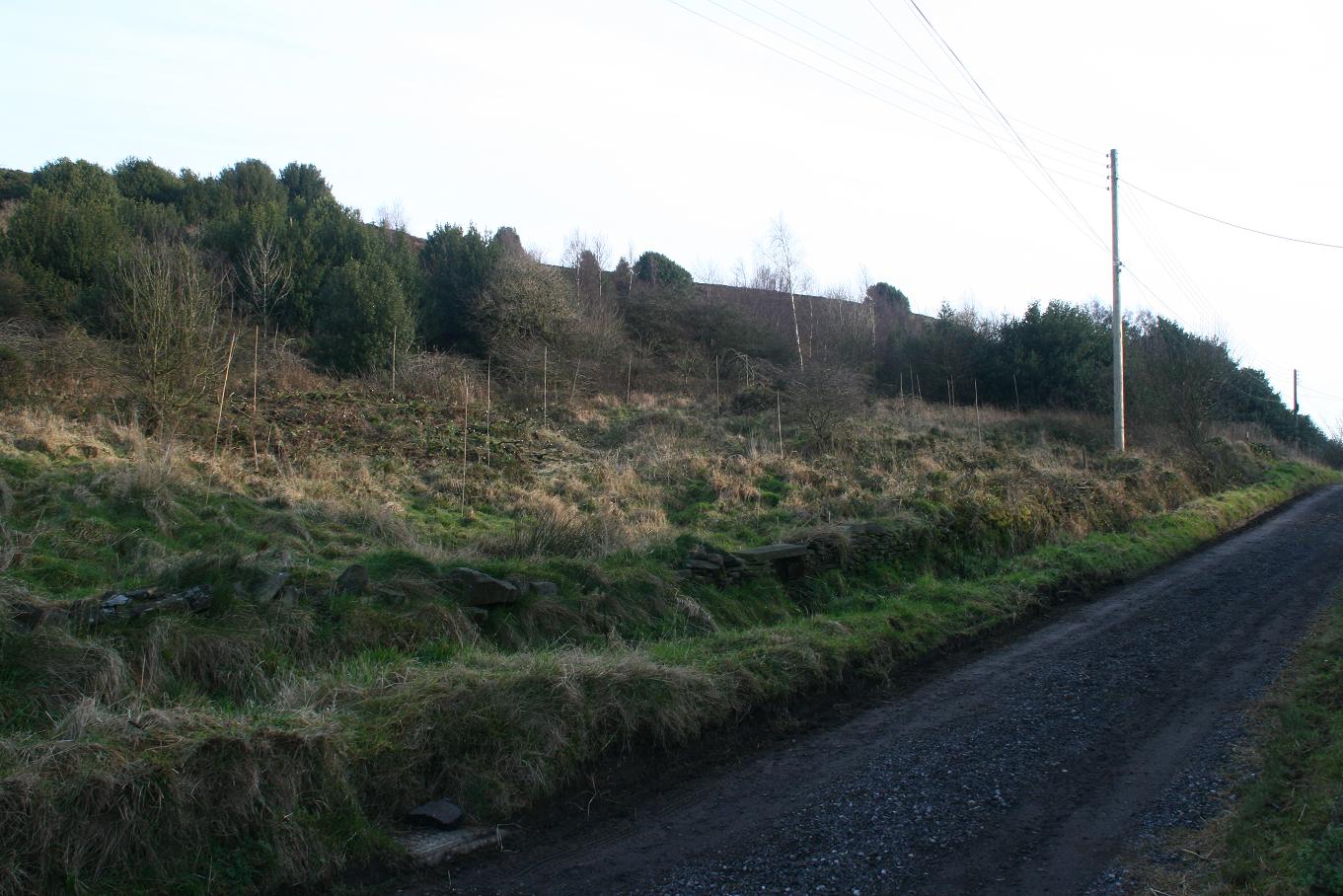
It's been a long and tiring weekend, really, but we've cleared about 50m2 of gorse from the hillside, marked out where the 47 trees will go, and cleared and put down squares of weed-suppression on the spaces for about 17 of them.


Roughly half (25) are for Scot's pines; the other 22 are ornamental or fruit trees. We had a bit of time left, so I got Sigrid out, and cleared patches around the first couple of dozen. Once we'd picked up the debris, we had time before the light failed to place 1m squares of weed suppressant membrane around the canes, and weight them down.
Sigrid worked really well, with the tri-blade attached, mowing through the undergrowth. There's a trick to keeping her clear of the long bramble lengths, and obviously the detritus needs clearing afterwards, but that's fine.

We finished the weekend by sowing sweet pea seeds: we're trying out a lot of varieties this year (14) in different colours, to work out which ones we think will work well in the corner's colour-wheel beds.
The gorse patch from the kitchen gate (© Ian 2013)
The gorse patch from the drive (© Ian 2013)
Clearing the gorse was a matter of loppers (and secuteurs) and good gloves. Liz cleared a lot of brambles (horribly twisted and knotted in the gorse), while I concentrated on gorse. The gorse (unhindered by bramble) was rather quicker, and our respective speed showed. The gorse hid an enormous rabbit warren city, which they will now, no doubt, extend up the hill to better cover.
This, no doubt, explained the cats' interest in what we were doing: they spent most of Saturday supervising us.
Eventually, the gorse and brambles were cut, and today we turned to putting out bamboo canes to represent the trees we have planned.
After clearing the gorse patch, and putting out the bamboos (© Ian 2013)
Roughly half (25) are for Scot's pines; the other 22 are ornamental or fruit trees. We had a bit of time left, so I got Sigrid out, and cleared patches around the first couple of dozen. Once we'd picked up the debris, we had time before the light failed to place 1m squares of weed suppressant membrane around the canes, and weight them down.
Sigrid worked really well, with the tri-blade attached, mowing through the undergrowth. There's a trick to keeping her clear of the long bramble lengths, and obviously the detritus needs clearing afterwards, but that's fine.
Canes marking future sites for the trees (© Ian 2013)
Sunday, 21 October 2012
Seeds, Settlers, and St Honoré
Alan and Ann were with us for the weekend, as I alluded to last week. The Gateau St Honoré was a great success. We modified the recipe somewhat, filling the choux buns with crème pâtissière, and I've now bought a piping bag, so the filling of the gateau was neatly piped. I didn't quench the spun sugar, so that was still molten and spinnable, too. All in all, very good.
And then the cat happened. We (stupidly) left the gateau unattended for all of a few minutes, and the custard monster spotted it, hopped onto the sideboard, and helped himself to the (obviously delicious) crème pâtissière. As a result, it was no longer photogenic (sorry), although he'd taken a relatively small amount, so we repaired it and served it (Liz got the catted bit*).
*He's her cat, in these circumstances, in the same way that Domino's mine at three in the morning when he needs the loo, but wants company finding the litter tray in the dark. His superior night vision notwithstanding.
We played two games of Settlers (an entirely epic Greater Catan plus Cities and Knights, which lasted about seven hours), and a more normal Cities and Knights of a couple of hours. Greater Catan was, as normal, an excellent treat, and worth the set-up time!
After they left this afternoon, we've also sown some centranthus and achillea seeds, and will be putting a pack of Leymus arenarius seeds (blue-grey clump-forming grass) in the fridge to pre-chill. They'll be sown in about six weeks.
Sunday, 29 July 2012
Potting On
The numerous plants we bought at Tatton Park, combined with a number of other plants that have outgrown their pots, and lots of seedlings, conspired to require a potting up session.

The clematis, hydrangea, deschampias, and eryngium are all fine in their pots, but the heucherellas needed bigger pots, and most of the other grasses needed either bigger pots or topping up. I realise I forgot the fifteenth new plant in my Tatton round-up: we also bought a variegated reed grass, Calamagrostis x acutiflora 'Overdam'.
The box I obtained from Witley Court needed bigger pots (very root-bound!), and looks much more sensible in 2l pots. A tray of angel hair stipa (S. tenuissima) that we sowed earlier in the year has done really well: nominally 40 seeds, but we've potted on over fifty little plants, which is great. (Far left in the photo.)

Newly potted-up plants (© Ian 2012)
Lastly, we potted up a few dozen lavender seedlings and cuttings (far right).
Domino appears to think he was important in this process, as he's guarding the plants in the photo. I'm not sure I'd agree, though.
Saturday, 31 December 2011
Seeds
We've now placed our seed orders for next year: five, in total. I shan't list them here, but I'll put the plans on the kitchen garden page at some point, along with variety details. We've also got some way with the activity plan for the year—as normal, March and April are hectic, with lots and lots to sow and plant. We think there's enough space on windowsills, but I always worry.
The Daft Cat (Domino) managed to hurt his leg (probably a fight), and has been, reluctantly (read: with claws) allowing us to examine him. I think it'll heal soundly, having been caught early, cleaned, and dressed. He still seems happy to eat cream, though.

The Daft Cat (Domino) managed to hurt his leg (probably a fight), and has been, reluctantly (read: with claws) allowing us to examine him. I think it'll heal soundly, having been caught early, cleaned, and dressed. He still seems happy to eat cream, though.
Domino with Cream (© Ian 2011)
Saturday, 25 June 2011
Incubation
We might have discovered why a tray of petunia didn't come up.

I didn't expect Chess to get broody, but it appears he thought the seeds needed incubating.
© Ian 2011
I didn't expect Chess to get broody, but it appears he thought the seeds needed incubating.
Sunday, 5 June 2011
Winged Weekend
Another busy weekend, for us, and for barn swallows who have been building a nest in our porch.

They're building their nest (out of mud pellets) on top of the keystone in the arch, on the 'in' side; it's nicely sheltered, but it does mean they get disturbed whenever we come or go. If we're doing anything for any length of time on the driveway, they perch on the telegraph wire opposite, and noisily complain.
Aside from the antics of these new tenants; we got an early start to the weekend, as we were telecommuting on Friday, so I got out to mow the lawn after work. First, admittedly, I had to mend the mower: the bolt that holds the blade was jammed stuck, and it took some work to get it to shift. By 'work', I mean destructive dismantling. New bolt installed, and mowing completed. It was swelteringly hot, though, so I was glad to finish. Liz started to clear weeds growing around the puschkinia and bluebells, which is another good thing to have done.
On Saturday, we had a busy day in the garden. The butterfly net (8mm square mesh) for the brassicas arrived a while ago, and so we put that over the rectangular vegetable bed. It went on really easily, after the shenanigans with the fleece covers, and it has reinforced edges which hooked over the existing nails neatly. We've stiched the ends together (non-permanently, so the same mesh can be reconfigured, wherever the brassicas are next year) with polypropylene cord. Earlier this week, we mended one of the split fruit cages with the same cord, with some success—they had been stiched with hemp twine, but that's rotting.
We also put some bird netting (inch mesh) over the peas, beans, and carrots. It's actually cat netting, rather than bird netting, for the carrots: the boys appear to have taken to sitting on the carrots. I wouldn't otherwise object (too much), but I don't want them bruising the foliage and attracting carrot root fly.
Belatedly, we realised we hadn't sown any butternut squash, so we planted a pair of seeds where we had put gourds, and covered them with bottle-cloches. The gourds joined another half-dozen from a windowsill in a large half-barrel, filled with compost and topsoil. They're a little crowded, I expect, but I only want a few fruits.
Sunday came, and we nipped out to the garden centre. The bitter winter saw off the clematis 'Pink Champagne' growing near the front door, and we also wanted a climber to go up trellis near the kitchen (disguising the old door). We found two new clematis to do this; an 'Angelique', and 'Marie Boisselot'. We also picked up a dozen petunias (pale yellow/cream), and planted these into two of the new hanging baskets. The other two hanging baskets received three verbena, three pelargoniums, and a small fuchsia or two; these are now near the door, and the petunia baskets are on the front of the house. The dahlias we got at the same time have graduated into bigger pots, too, to grow on until they're needed once pansies in the troughs have gone over.
We also re-planted the Christmas tree, into a larger bucket-pot, and sowed some more salad leaves. We've been eating salads with lunch for the last three days, as they're leafing nicely. The spinach is especially good.
Lastly, and least glamorously, I trimmed back the ivy where it was threatening to block the study window. Needs to be done a few times each year: I try to prevent it from adhering to the wooden window-frame. We also weeded the front garden, and reshuffled a couple of the hellebores under the acer, as there were a couple of gaps, and a bit of congestion. The front garden, with its two new clematis, four new hanging baskets, and weeded beds, is looking much better!
Sunday, 3 April 2011
Summer Bulbs
Another day pottering in between spring showers: a big effort to sort out the containers split between the kitchen patio and the lower patio (near the workshop) was required, as many are now out of season, or empty, and we needed to plant summer bulbs.
We isolated the empty containers (read 'dead') and put them to one side, and swapped the others around to get those in season, or coming into season, onto the patio outside the kitchen, and those that have gone over or are a way off being attractive back on the lower patio (the 'storage' patio). This meant moving the 100-odd strawberry runners that took out of sight (ready to go in the putative second strawberry bed), and bringing things like an astilbe, lilac and rose round to be seen.
The empty pots were crucially needed, though, for summer bulbs. We've planted 40 gladioli into some, with the same number again to go in in a couple of weeks; they'll either be put somewhere attractive when they bloom, or cut to bring inside. We also planted 25 single freesias, for the same purpose. I think they may be a little tricky to bring into bloom every year, but it'll be an interesting challenge.
We then dug out more plastic pots to continue the sowing extravaganza that is March/April. Fifteen new sowings, including pumpkins, courgettes, tomatoes, various salad leaves, coleus, clarkia, beetroot, beans, and chrysanthemums. We are rapidly running out of window-sill space (which annoys the cats, who like to watch the world go by)! The germinated seeds are doing quite well inside, and we'll probably start planting them out in a week or two.
Sunday, 27 March 2011
An Alphabetic Weekend
A is for Alliums
After the onion sets' arrival last week, we thought it was time to get them in the ground. The forecast's for quite a mild week, so—coupled with 'F' below—we thought it augured well. Anyway: 'assisted' by the in-laws' current respite-care foster children (see 'C'), we planted out the sets. I didn't count them as they went in, but I reckon (based on number per row averaged over the first three rows, and number of rows) there's around 480 of them. Which is quite pleasing, as I was expecting 100 per bag. A few had started to sprout (unsurprising, as the first of them arrived in February, when it was still too cold (here) to put them in), so they should get going quickly, I hope.
B is for Bunnies, Bicycle Bottom Brackets and British Summer Time
Bunnies, because the cats decided to bring a friend home for dinner. Said friend was a little traumatised, but intrinsically unhurt, so after distracting the boys, and scooping that bunny up, he was released back onto the hillside. Some nose-twitching later, he scarpered.
After coping with a clanking bike for a week or two, I decided it was about time to investigate and remediate, so I removed the bottom bracket bearing from my bike and discovered rather more movement than ideal. Now, I'm happy to subscribe to the WD-40/duct-tape principles of maintenance (If it moves, and it shouldn't: duct-tape it. If it doesn't move, and it should: WD-40 it.), but this wasn't a suitable opportunity. Thus, new bottom bracket fitted.
BST started on Saturday night: nothing to report (other than to lament the lost hour of sleep), but it is nice to have an extra hour of light in the evening for getting things done: it's still more-or-less light by the time we leave for work, which is fine.
C is for Children, Cages, and Compost*
The in-laws' current foster children (who are on a respite placement) are an energetic set aged 2, 5, and 7. Their assistance in onion planting was, shall we say, not optimized for efficiency, and basically consisted of one holding the bag of sets and passing them to me to plant, while the other (with Liz, de rigeur) brought cans of water to douse the rows. Meanwhile, the youngest would meticulously plant his own sets. In fairness, they were usually within a couple of inches of where they should be (with some prompting, but rather good), and 80% right-side-up.
I mentioned wood and fleece deliveries: the wood arrived safely on Saturday morning, and we spent the afternoon putting up the fleece supporting posts, and filling the last stretch of the C-bed (completed two weeks ago) with some of that huge pile of top-soil (the Compost). We managed to start putting up the horizontal wires, but ran out of light. Having finished constructing the cages on Sunday morning, and once we'd removed a few obnoxiously spiny berberis branches from nearby, we suspended the fleece. It now looks as though we have a slightly too short marque in the vegetable garden, which does rather spoil the aesthetic, but will help warm the beds and get everything off to a good start. The fleece will probably come down mid-May, and the cages will then be used to net those things that need it over the summer. The fleece might re-appear in the autumn, to extend the other end of the season: we'll see.
D is for Daffodils
Which are now looking marvellous. Interestingly, the bulbs we planted in 2009 are considerably behind the 2010 planting. I don't know the cause: either they're just earlier varieties (unlikely, perhaps), or their summer in Cornwall made them more energetic than those spending summer in Yorkshire, and they consequently started sooner. We'll see, next year, if the same thing happens...
We've also determined where the gaps in the spring-bulb planted bank are. The bluebells are starting to show, so a good succession is hoped for—however, I think we'll need another few hundred puschkinia, and we think 4–500 snowdrops would help bring the display forward. They, at least, should be easy to plant: if we get them 'in the green' in March next year, we'll be able to see where the daffs, puschkinia, scilla, and bluebells are, and plant between them.
E is for Electric propagator
Yes, this is a bit of a stretch. More seeds planted, including peas and beans direct in the bed, more leeks, aubergines, peppers, celeriac, tomatoes, ipomoea, gourds, and herbs. We are quite rapidly running out of window-sill space, which is, admittedly, helpfully advancing the argument for a greenhouse.
F is for Fleece
Well, see 'Constructing'. It's made a discernible difference, though: sitting inside it (as an experiment, I hasten to add, not because I was pretending to be a seedling) was warmer than outside, and still very bright.
*I've just noticed the unfortunate juxtaposition in this title. The children, I must highlight, were not caged...although they were rather curious about why we were messing around with bits of wood, wire, and fabric. I'm not entirely sure they're any the wiser, frankly.
Sunday, 6 March 2011
Potatoes and Cat-Doors
On Tuesday, a new cat-flap arrived. We've had some trouble with a local tom (we think) breaking in, terrorising the cats, and stealing food. He, or our two in response, have also been doing some marking, which is fun for no-one. We've looked at cat-flaps which use a magnetic collar to identify the cats and allow the right ones in, but—given that Domino seems to loose collars every six months or so—this didn't seem optimal. However, we have found one that uses the RFID microchips that the cats have implanted to identify them. Once 'learnt', it detects the chips when the cats approach the flap, and allows only our two in. Tail-gating could be a problem, I suppose, but it should reduce the problem. Anyway: the new flap is now installed (very straightforwardly, I should add).
A myriad of tidying and sorting tasks have also been completed, and we also made five litres of carrot soup (from a sack of horse-carrots that were going a bit...wild). Finally, we've put the seed potatoes out into egg cartons to chit, and sown some more seeds (Early Nantes carrots, scarlet kale, peas, Brussels sprouts, celeriac, and ipomoea).
Sadly, we have to go back to work tomorrow, but we managed to finish manuring the beds, by bringing up another 14-odd barrows to finish the second raspberry bed, the 'Q' vegetable bed, and the long vegetable bed. The 'C' bed is going to be roots, so no manure for it. In 2009, when we brought manure up, we had to take a long route round, but this time I removed a couple of fence-planks, so we could bring the barrow to the fence near the kitchen garden, lift it over, and carry on. It's reduced the journey to almost a third, which is vastly better. I've now re-attached the fence planks with screws, so it'll be even easier next time.
Tuesday, 23 November 2010
Raspberries
After very few (about eight) of the raspberries showed any sign of life this year, we've assumed that most didn't survive, and ordered thirty more. These arrived today, so—as we were working at home—we nipped out at lunch to plant them. They're not in any order, as we've just put them in to fill gaps, but there's ten of each of Glen Cova (June-July), Tulameen (July-August), and Malling Jewel (June-July). I'm hoping that, although they've gone in the ground two days later than last year, they'll establish better: they won't need to be moved around as we construct the raised beds around them, and with a little luck there'll be a milder winter—there was a continuous covering of snow for a month from mid-December last year.
Such a shame that it'll now be summer 2012 before we see any fruit from them!
This evening, I installed the light in the pantry, and also replaced the RCD in the consumer unit for the cooker/lights. It was nuisance tripping when the grill or standard oven was switched on, which was a little problematic. The new RCD has a trip current of 100mA, instead of the standard 30mA: less good for preventing electrocution, but provides fire safety. As it only covers the cooker (next door to the unit) and lighting, this seems reasonable.
Looking back, we had a good weekend, visiting my parents; I also painted the remaining window frames. I also note that, as planned, I did install the new cat flap on the 16th. The boys are getting used to it...slowly.
Subscribe to:
Posts (Atom)



