Friday, 30 August 2013

Survey

It's the time of year to take semi-ripe cuttings of perennials, so yesterday, with the help of a fosterling, I took a number of pots of lavender, box, willow, dogwood ('Midwinter Fire'), Cornelian cherry, and a yellow-flowered herbaceous perennial from Jenny's garden the name of which constantly eludes me. They were all treated with rooting hormone (apart from the willows), and are in warmed propagators to give them some warmth and humidity. Before that, then I painted half of the window frames on the front of the house, and Liz weeded, as well as painting the trough planter for the goji berries.

We spent most of today on the hillside, which has been strimmed again. It might need doing once more this autumn, but that might not happen. Having done so, we went around and painted the trees with an anti-deer concoction of chilli powder in oil. Hopefully that will help keep them away: they've browsed the leaves from one of the tall shoots on one of the Victoria plums. While going round, I used a GPS app on my phone to take a reading of each tree's location, as we don't actually have a plan of which tree is where. I'm not sure it's worked perfectly, but it provides some idea.

Location of the Fruit & Ornamental Trees in the Orchard ( Ian 2013)
I'm going to work on plotting it with labels, too.

I also measured the length of the putative apple walk we're thinking of building in the 'top right' (left in the plan above) corner, which an avenue of trees leads you towards, and which takes you up into the first clearing. It looks like it'll be about 24' long: as we're planning trees 6' apart (probably with imitation 'trunks' intercalated), in an arch 8' across; each tree can then be espalier trained 3' each side. That makes for five trees up each side, so we need to start planning varieties -- and digging two planting trenches.

Finally, as we went round, I've done a bit of work training the primary laterals on the fruit trees which are tall enough, so that they're more, well, lateral. For example, most of the plums have reached a height where their leader shoot was cut, which promotes several new shoots to break into growth at the tip (about 6' tall). These will be the primary framework of lateral branches, which will ideally be reasonably horizontal (for many reasons, not least that this makes a larger crotch angle between trunk and branch, which is much stronger, mechanically). However, they start life really vertical, and need to be tied down, which I've done with guy twines.

Wednesday, 28 August 2013

Mulberry

It's been a busy couple of days, but it somehow doesn't feel like we've got too much done.

Today was mostly spent getting the mulberry ('Jerusalem') in the ground. We had to take down a hawthorn that occupied the spot (we didn't feel it was earning its keep, and it was rather prominent), which was straightforward. Digging the hole went reasonably well, until I uncovered two massive stones: one about 250kg, the other about 100kg. Eventually, we managed to drag them down the hill to the boundary (using fence posts as sleds), where the bigger will hopefully form a bridge over the ditch, and the smaller will be incorporated into the wall as I rebuild it.

Once they were out of the way, we followed the same protocol as before: big hole, incorporate compost, ensure there's good drainage with a ditch leading out, and then a square metre of weed-membrane on top. An eight-foot post and 35cm diameter chicken-wire cage completes it. We'll water it in for the next week, to help it establish, but it's looking good.

I then made a wooden planter trough that will sit on top of the (somewhat pointless) gravel bed outside the workshop door, on the back patio. There's nowhere near enough soil for anything to grow, but with an extra 30cm deep, 30x170cm trough, we'll have somewhere to plant three goji berries we bought in January last year, and which have been consigned to pots since. We'll give the wood a coat of fence paint on the inside, and line it with plastic.

Yesterday was a day in the kitchen garden: weeding, turning the compost bins (almost full), cutting down fruited raspberry canes to make space for the new canes (next year's crop), lifting the rest of the onions (which went in in mid-May: Rumba, Fen Early, and Red Fen). They're now in the woodstore, on racks, to dry off.

Monday, 26 August 2013

York Gate

David and Ann were with us for the weekend, and having dropped them off at the station, we carried on to visit York Gate Garden, which is on the outskirts of Leeds. It's on a similar scale to our own garden, and is pleasingly divided into a number of smaller gardens, which is the kind of approach we're trying to take. It had a pretty pond, a nut walk, and a productive kitchen garden.


York Gate Gardens (© Ian 2013)

And, inevitably, a small nursery. We picked up three alpine Lady's Mantles  (Alchemilla conjuncta), which is more delicate than A. mollis, with leaves that are more divided, and silver edged. It is, apparently, less prone to seeding everywhere, and is better behaved.

Having got home, we pottered in the garden, including a contemplative look at the games lawn: Liz is floating the possibility of cutting an oval flower bed in its centre, and making the surrounding beds that bit bigger. Doing so would prevent badminton (but the combination of warm, dry and still weather necessary for a reasonable game is extremely rare), and formal croquet; but modified croquet, boules, lawn darts, and similar would all be possible. And it would make more space for plants, and probably look more attractive.

I also hooked up some new watering equipment, which arrived last week: a timer computer, which can set water going up to eight times each day, and an automatic distributor from Gardena. The latter's rather clever: each time the water comes on, it sends it out the next outlet of six, in sequence. By connecting each irrigation zone to a different outlet, and using the computer to turn the water on (and off) the same number of times, each zone will be watered. It will mean I only have to turn the water on/off once, instead of five or so times, in an evening, and the kitchen garden (and green roof) will be watered. It will also mean that the watering can be done while we're away, without laboriously inconveniencing a neighbour.

Tuesday, 20 August 2013

Swelling Apples

A four day weekend allows you to get a lot more done.

On Friday, some of our time was occupied by a wall insulation surveyor, which may or may not come to anything, and taking the car to be serviced. We managed, though, to get some planting out done, around that: the plants from Tatton Park, and others, are now in the ground, which they'll appreciate

Saturday, we dodged showers to mow the lawn, weed, and pot up a number of perennials that have arrived (all little plugs: delphiniums, echinacea, penstemon, and salvia)—this also meant potting on some of the 96 lavenders which arrived in June, and which have filled their 30mm modules. We then spent the evening with Cath & Jason, which was relaxing.

On Sunday, we went on a trip to Harlow Carr. Part of the impetus was the £5 voucher for the cafe which they kindly sent us. I bought a vanilla slice (iced mille-feuille and crème pâtissière) and a raspberry tart (shortcrust, with white chocolate crème pâtissière and raspberries on top, with a piped white chocolate garnish), which came to £5. Coincidentally. They were truly delicious.


Helenium in late summer borders (© Ian 2013)

The main borders are looking glorious, full of late summer colour, grasses, and the slightly lower light of August.


Main borders, Harlow Carr (&copy Ian 2013)

I've admired this bench before, and still like it. We're thinking about how to incorporate something similar into the edge of the games lawn.


Bench in Scented Garden (© Ian 2013)

We also rather liked these sinuous bean supports, and admired some 'Lupini' beans nearby.


Bean supports in Kitchen Garden, Harlow Carr (© Ian 2013)

On the way out, through the garden centre, we couldn't help but notice that the top fruit was on 50% off sale—much as it was last year, when I bought a walnut. No walnuts, this time, but a half-price quince (which I manfully ignored, as it was Leskovac, or Serbian Gold, which we already have)—and a mulberry, 'Jerusalem', which I couldn't leave, not for £22.50.

It'll go on the hillside, of course, probably to replace a prominent and only briefly attractive hawthorn. Around it, the older apple trees are all nicely loaded with fruit, which is gradually ripening. Weeks until the apple harvest, I think.

We got home, and made a batch of Danish pastry dough. Today, we've spent the whole day tidying the garage and workshop, which are now really pleasingly organized. In between, we turned the pastry into pain aux raisin, which are lovely, ready for visitors over the next month or so. Altogether, a pleasing, tasty, and plant-filled weekend.

Sunday, 11 August 2013

Onions, Potatoes, Gooseberries

We've had a day of mixed maintenance (that's probably the best way to put it). The first of the summer onions (Fen Early) have collapsed, which means they're ready to lift, so up they've come. They're not particularly big, unfortunately, and there's only about 65 (I planted 100 sets), but there you go. I think the cats walk over that corner of the beds, which probably hasn't helped them.


The cats' garden skills are not impressive: Chess 'incubating' seeds (© Ian 2012–13)

They went onto a rack in the wood-shelter (a great secondary use for it!), replacing the Radar onions which came up three weeks ago. The garlic is probably also dry, when I have time to plait it.

We then put stakes in alongside the Brussels sprouts and kale (which don't like getting rocked by wind, of which we get plenty), and planted out some spare January King cabbages. I sowed a tray of Frostie spring cabbages earlier in the week, which will fill that bed.

These went straight in where the second early potatoes, Kestrel, had been, which we lifted his morning. They've yielded about 15kg, which makes them slightly more productive than the Lady Christl. Fortunately, they show no sign of blackleg, which lost us about a quarter of the Lady Christl tubers shortly after lifting.

After that, we had a mammoth fruit picking session: I've picked the rest of the gooseberries (barring a few handfuls), and Liz collected another big bowlful of blackcurrants. There's still the same again to ripen, and many more blueberries, which are gradually colouring up.

Once we'd had lunch, we planted a few things in the copse bed: our hydrangea (H. aborescens) 'Haye's Starburst', the three heucheras we bought at Tatton Park, and another that we had previously, along with a handful of stipa (S. tenuissima), a winter box, and a 'Pink Lemonade' blueberry (which has pink coloured fruits). Two more pinkberries went into the quince bed, which already has heucheras, stipas, and winter box, which means the two beds should feel coordinated.

Lastly, we've started clearing a few spots in the long border, taking up spent foxgloves and Lady's Mantle, in order to make room for the other perennials from Tatton Park: we hope to get them in the ground next weekend.

Saturday, 10 August 2013

Apple Cheese

An unexciting day, spent sawing, splitting, and stacking a couple of cubic metres of firewood. Good to have done, but not scintillating.

More pleasing was making apple cheese last night. Last weekend, we thinned the apples on the established trees, which had set a lot of fruit: far more than the one per spur recommendation. Accordingly, we took off a number of fruitlets (about 3kg), which we didn't really want to waste. A look through the various preserving books we have led us to a crab apple cheese recipe, which looked promising, unripe apples having a lot in common with crabs, I reckon.

Anyway, it was simple enough to make, though a bit time consuming (in a waiting around way, rather than actual work). I trimmed the stems off the apples, chopped each in two, and put in the preserving pan. After just covering with water, the apples were simmered until pulpy, and then pushed through a sieve. This was surprisingly productive: we only threw away a couple of mug-fulls of fibrous matter. We weighed up, and added the same amount again of sugar, along with a half teaspoon each of cinnamon and ground cloves per 450g. Gently brought to the boil, and then set it reducing.

The normal recipe is to boil until you can leave a clear spoon track, but I didn't want to overdo it, and the cheese was pretty deep. It's not, therefore, set as thickly as it should, and would probably be too soft to demould in the traditional fashion for a cheese. Nonetheless, it's gone a lovely rich red-brown, and tastes lovely (a little sweet for Liz, apparently, but I like it). It's made about a dozen jars, of about 350–400g each, which is probably a year's supply.

Tuesday, 6 August 2013

Barrelled

A little while ago, I started a bucket of 'Harvest Mild' beer, which has been gradually fermenting. The specific gravity, when I checked it last Thursday, was low enough for transferring to a barrel, so I did so this evening, adding 2oz of sugar (for a secondary, carbonating ferment). It will probably need two to four weeks before it's at its best, and we'll use some, I expect, for curing hams next month.

It's about the same time as barrelling a keg of beer last year, though this is a different variety. Last year's barrel is finished; there are just some dregs left, which I should get out of the barrel, which I'm hoping, all being well, to fill with cider in a few months.

Sunday, 4 August 2013

Cambridge Wedding

We went down to Cambridge late on Thursday, returning early today. The main reason for the trip was David and Anne's wedding, on Saturday, but we wanted to take the opportunity to meet up with other friends who were going: hence going down early.

Friday was spent pottering round Cambridge, going through some of the colleges, and lazily eating lunch, before going across to Rachel and Philip's for dinner. Their thyme lawn is looking really good, and the plants are just starting to touch in a few places.

The wedding service was in St John's College Chapel, and the reception (drinks; cake; 'breakfast'; ceilidh) was at Sidney Sussex (the college kitchens are closed for refurbishment at St John's). Our gift, finished and wrapped on Thursday morning, survived the journey.


Self-assembled picnic hamper (© Ian 2013)

Both colleges looked lovely, with a red-and-white palette. David always smartens up well (tails can only help!), and Anne looked lovely, in an ivory dress with some nice embroidery and a surprisingly well-behaved train.


Bridal bouquet, at the reception in Sidney Sussex gardens (© Ian 2013) 

We headed back to Katherine's rooms at about midnight, after a lovely day (and an excellent meal), and came home around lunchtime today.

The sweet peas are looking excellent, having not been picked for a week.


Sweet pea wigwams (© Ian 2013)

We then spent an hour or so cutting sweet peas, and then collecting gooseberries, the last of the red & white currants, some of the blackcurrants, and some raspberries. It's a multiple-night job, I think: the gooseberries are all ready to pick, and the blackcurrants are starting. The blueberries are gradually ripening, too.

Monday, 29 July 2013

Netting

Our visit to Tatton Park was bracketed by days at home, which we mostly spent outside, of course. Saturday was dominated by going over the hillside with the brushcutter, cutting the grass, and removing or weakening as much of the brambles, gorse, rush-grass, and ragwort as possible. It's hot and hard work, but the hillside is definitely showing improvement. This time last year, it would have been tricky to get to the two 'best' apple trees, and barely possible to get to the other three or so—and impossible to reach the track up into the middle levels or hill-top.

Now, the orchard is easy to walk around, and the main clearing of the middle level is accessible. The bracken there, which I've now cut down three times, is still coming up, but not strongly. By comparison, the bracken on the other side of the wall, and further along the hill, where I've not done anything, is six feet tall, and impenetrable.

I have to confess that we saw a rather fine summer house at Tatton Park, one of the Malvern Collection. It's a few years off, yet, though, but it was very nice, and would be a lovely, secluded hideaway on the hillside.

Enough of that. Otherwise, on Saturday, I checked that the newly installed sprinkler on the woodstore's green roof is working, and established that my beer is ready for barrelling. The chardonnay I started at the same time, incidentally, is in the cellar clearing, and is probably ready for bottling. The dandelion is slowly clearing, having finished its vigorous fermentation; the elderflower is on a warm windowsill, bubbling furiously.

Monday was more varied, although we had to contend with showers. The butterfly netting is now up, covering the two plantings of brassicas (which replaced the alliums in the Q-bed, and the early potatoes up one arm of the C-bed). The sprouts, kale, cauliflowers, purple sprouting, and swedes have all settled in fine, and the rows of 'Golden Ball' turnips we sowed at the same time have germinated well.

We discovered a pot of leeks, which hadn't been planted out, so we filled a few gaps in the rows of leeks where tiny seedlings hadn't transplanted (only about three of thirty, and those three were properly tiny), and put the rest in spaces among the autumn onions. The earliest of these, Early Fen, looks like it's nearly ready. On a similar note, the garlics (Germidour) and summer onions (Radar), which are drying in the wood shelter, are coming along nicely.

We've found that we've been losing a lot of courgettes before they get to a sensible size, rotting from one end. On investigation, I think it's where the flower has started to rot, and this has spread into the fruit. To combat this, I'm going to try to remove the flower as soon as it's gone over, and let the fruit swell. Jenny & Philip are away, so we're also picking their fruit and veg (and sweet peas!), which means we're inundated with courgettes.

The hanging baskets, which we tried with dangling nasturtiums for the first time, are looking splendid: I must get a photo of the front of the house. I'm trying to remember to regularly feed them: strangely, the two on the front of the house proper (rather than on the porch extension) are doing less well, though they get more light (marginally).

Once that, and some weeding, was all done, we spent a little while clearing some spaces for our flower show purchases, before going in for lunch. This afternoon I've spent preparing David and Anne's wedding present: but more on that after their wedding...

Sunday, 28 July 2013

RHS Tatton Park

I've been looking forward to this for some time: this week's seen the 2013 RHS flower show at Tatton Park, and—like last year—we bought tickets for the final day.

Near our entrance, and the first thing we stopped at, was 'The Home Guard-ener', a World War II allotment garden, which uses the Ministry of Food guidelines for crops and spacings, and varieties available at the time. At the end, beyond the Anderson shelter (planted with marrows growing over it), was a really colourful flower bed, which we thought made the whole garden rather ornamental, despite 90% of it being vegetables only in different shades of green. Pleasingly, one of the potatoes was 'Home Guard', introduced in 1945.


'The Home Guard-ener' (photo © Ian 2013)

There were a number of 'Galaxy' themed gardens, which were interesting, and had some pleasing planting, but—perhaps inevitably—didn't really contain anything we'd probably replicate. However, I did rather like the chocolate-scented cosmos (C. atrosanguineus), which cropped up in several gardens.


Chocolate Cosmos in 'NSO: Watch This Space' (photo © Ian 2013)

'The Edible Medley' had a pleasing stone rill running through it, which has us wondering whether a rill draining from the colour wheel to the water garden is something we should consider.


'The Edible Medley' (photo © Ian 2013)

I had to take a photo of two woven willow cats, playing with a willow mouse.


'The Animals Went In Two By Two' (photo © Ian 2013)


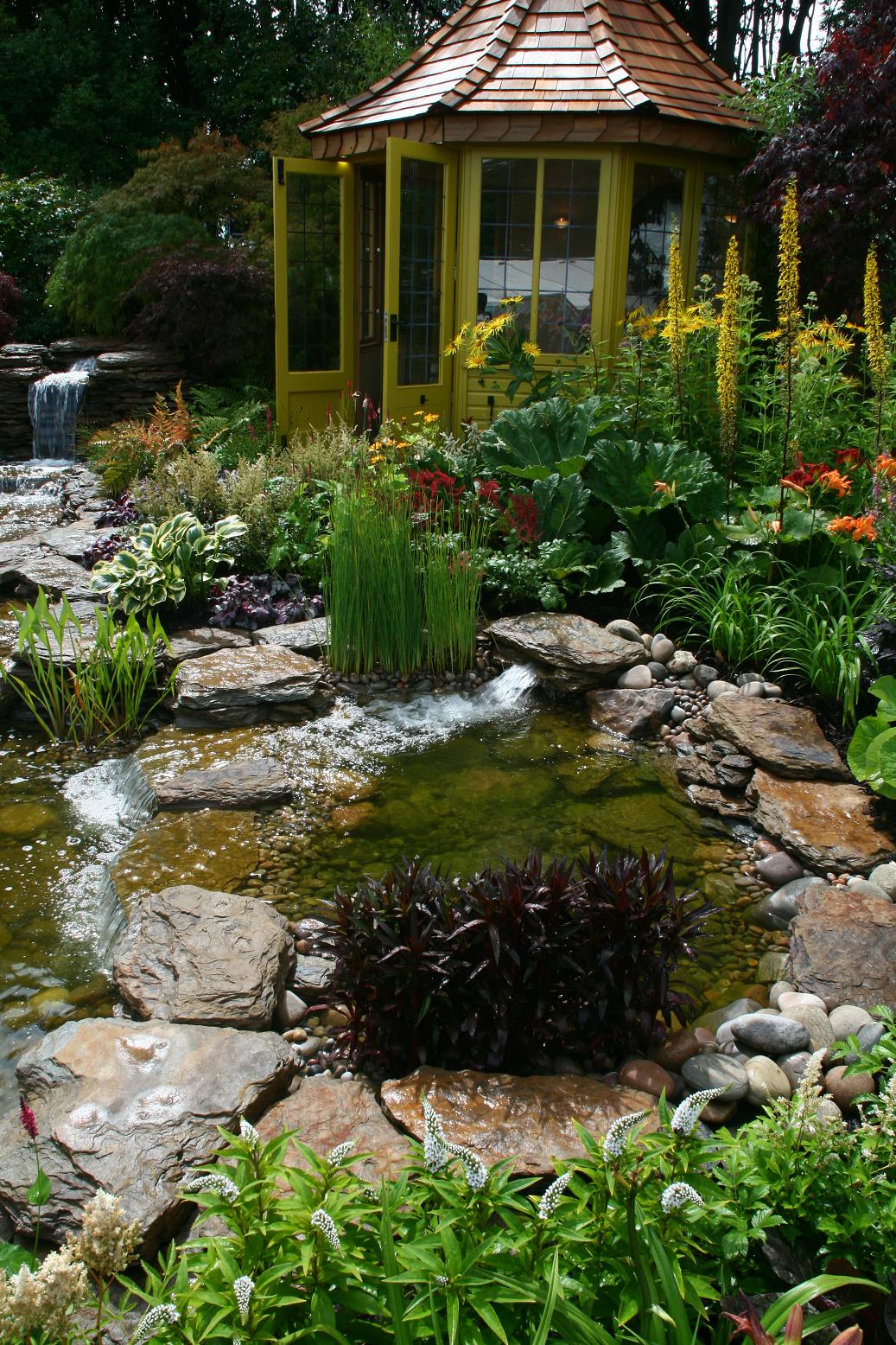
'The Water Garden' (photo © Ian 2013)

Of the municipal beds, our favourite was the one from Birmingham City Council.


'The Canals of Birmingham' (photo © Ian 2013)

The grass border at the front of Echomap's garden caught our eye.


'Sound Idea' (photo © Ian 2013)

I fear Liz may now want a water wheel as a water feature.


'The Industrious Force of Nature' (photo © Ian 2013)

Whereas I'd rather like a garden observatory.


'The Star-Gazer's Retreat' (photo © Ian 2013)

For that future day when we might keep chickens, I rather like Kate Humble's Flyte So Fancy chicken coop.


Planted-up chicken coop (photo © Ian 2013)

RHS National Young Designer of the Year went to Tony Woods, who designed 'Escape to the City'. Last year's winner (Tristen Knight, with 'Brownfield Beauty') was also one we liked: we obviously share our opinions with the judges. We bought a couple of plants from this during the sell-off, including the brunnera just visible in the bottom left of this photo.


'Escape to the City' (photo © Ian 2013)

The garden leaflet for this one was the best I've seen: it had mug-shots of most (all?) of the plants, which made it really easy to identify something that caught your eye.


'Escape to the City' (photo © Ian 2013)


Cercis canadensis in 'The Bee Garden' (photo © Ian 2013) 

Predictably, we bought a load of plants, and had a struggle back to the car with half a dozen pots in each hand.


Car-load of purchases (© Ian 2013)

To enumerate them: a dark leafed ligularia; a 'Chocolate' eupatorium (E. rugosum); a variegated lysimachia (L. punctata 'Alexander', I think); Sanguisorba 'Tanna'; three 'Ravenwing' cow parsleys; a 'Queen Victoria' lobelia; a replacement 'Miss Willmott's Ghost' eryngium (and tray of seedlings!); three heucheras; a Japanese ginger; an edible tulbaghia 'Silver Lace'; a variegated agapanthus ('Tinkerbell', perhaps?); three 'Bishop of Llandaff' dahlias; a tradescantia; and the Brunnera macrophylla 'Jack Frost' mentioned above. We also bought some heritage seeds, from Pennard Plants, including cucomelon, and a purple climbing French bean, 'Blue Coco'.

I think there are two more plants, too, which I can't remember.


The purchases (© Ian 2013)

Notes for the wishlist:
  • Achillea 'Apple Blossom' has an unusual (for achillea) almost purplish colour.
  • Scented geranium 'Lady Plymouth' is rather attractive.
  • Tomato 'Totem' is remarkably compact: from Pennard Plants, I think.
  • 'Red Malabar' spinach is a pretty climbing form.
  • Potentilla thurberi 'Monarch's Velvet' (a herbaceous potentilla?) has a good colour flower.
  • Hordeum jubatum (foxtail barley) has attractive flowerheads.
  • Coreopsis 'Jive' is nice.

Monday, 22 July 2013

Brassicas

Having taken up the over-wintered onions and garlic, and also the adjacent spinach, we had space to plant out the brassicas, which have been growing on in increasingly large pots, waiting for their allotted space to free up. So, in went nine scarlet kale, nine purple sprouting broccoli, nine Brussels sprouts, nine January King cauliflowers, and fifteen swedes. We still need to plant out the other cauliflowers, sow the turnips, and add the Frostie cabbages, which are going where the potatoes are gradually coming out.

Sunday, 21 July 2013

Sweet Peas

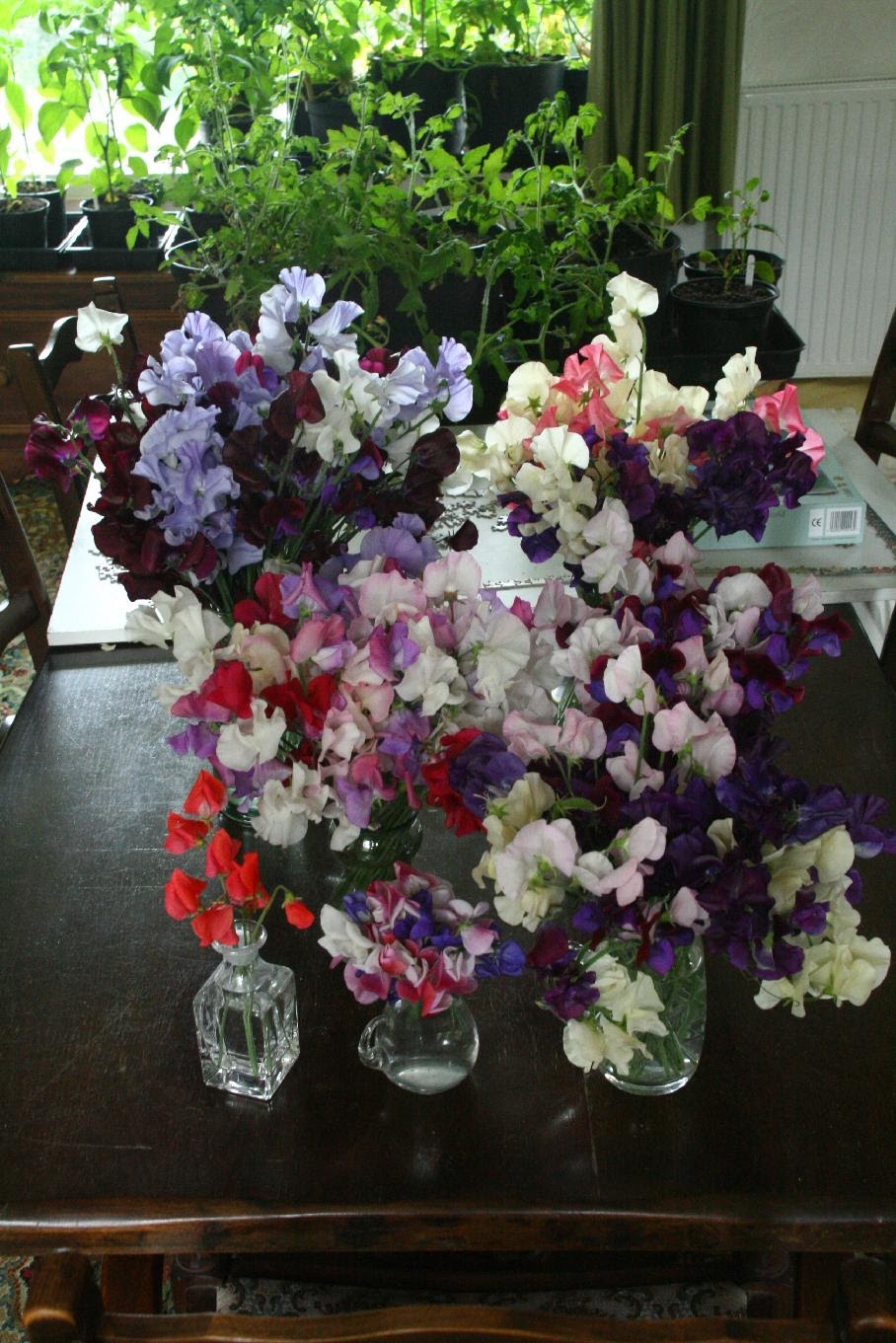
The sweet peas are at that glorious stage where, the morning after you pick the whole obelisk-worth of flowers...there's more open.


Sweet peas ( Ian 2013)

In addition to this, we've had an uneventful weekend, tidying up firewood, lifting the Radar over-wintered onions, the Germidour garlic, and the Elephant garlic (all looking good, and racked in the woodstore to dry over the next few days), and doing odds and ends.

We also lifted the Lad Christl potatoes, having taken up the Swift a little while ago. The yield's noticeably higher (16.8kg of Lady Christl, against 6.3kg of Swift), but not as high as I expected (which would have been about 20kg). They're also not looking fabulous: quite a lot of marking.

Wednesday, 17 July 2013

Elderflower Wine

We would have done this last week (which is closer to previous years batches), but my trip and then going to Cambridge made it hard to fit in, so we've had to delay until today before brewing a batch of elderflower wine. While I mowed the lawn and watered, Liz cut all the flowers off a big bowl of elderflower blossom, and after dinner, I set it off. That entails pouring a gallon of boiling water over the flowers, and adding 250g of chopped raisins, 1.5kg of sugar, the juice of three lemons, and a splash of strong tea (for tannin). In the morning, I'll add yeast and yeast nutrient: next Monday, I'll strain it into a demi-john.

Tuesday, 16 July 2013

Cambridge in Summer

We had yesterday to ourselves in Cambridge, and spent the day pottering around the city: the market, Clare College gardens (looking lovely as ever), and lunch on St John's backs.

Today, Liz was speaking at her conference, so I had another day on my own in Cambridge. I spent a little while in the Fitzwilliam Museum this morning, mostly in their Greek, Roman, and Egyptian galleries. Unfortunately, they don't allow photography inside. No matter:


Portico Ceiling, Fitzwilliam Museum (© Ian 2013)

I then met Alan for lunch in the University's Botanic Gardens (Ann doesn't work in Cambridge any more, so she couldn't join us). We sat near some well-worked lavender at one end of the site, and went round the rest of the grounds.


Lavender and Bee (© Ian 2013)


Waterlilies (© Ian 2013)


Water Garden (© Ian 2013)


Member of the aster family? (© Ian 2013)


Echinops (© Ian 2013)

I met Liz mid-afternoon, in Murray Edwards (New Hall), and we drove home, stopping briefly at a garden centre. Old habits.


Murray Edwards (nee New Hall) gardens (© Ian 2013)

Sunday, 14 July 2013

Thyme Bed

One of the reasons for visiting Rachel and Philip is that they've been planning to lift some of their patio and make a small lawn, of either chamomile or thyme, but have been struggling to make time. The patio's mostly rectangular slabs, but there's a circle set into it, about 2.5m in diameter, with three rings of slabs.

Using a crowbar, we managed to lift the centre slab, and the next ring of slabs, this morning before going to their church. It was considerably quicker than their previous method of wedging a screwdriver under, because of the strength and length of the crowbar. We next used a sledgehammer to break apart the mortar fixing the slabs down, before using the pick-axe to get out the mortar, and the hardcore from below. Rachel riddled the hardcore, so we could put the stones back in to help with drainage, and we dug the bed down to the depth of the clay subsoil. Refilling with stones and topsoil, we had a 6-foot circular bed by mid-afternoon: it's another example of the right tools making the job easy, as the lack of crowbar, sledgehammer, and pickaxe were what was making it insurmountable.

We planted it up with twelve thyme plants: three each of four varieties (pink, purple, white, and lemon, I think they were), and hopefully when we go back in a few weeks (for David's wedding), it'll be starting to knit together.

Saturday, 13 July 2013

Barnsdale Gardens

We've travelled down to Cambridge today, to stay with Rachel and Philip until Tuesday (Liz is speaking at a conference, and so we've come down early for a visit). On the way, we stopped at Barnsdale Gardens, which were the work of Geoff Hamilton.

There are a number of relatively small plots, many of which are discrete gardens. One is the Artisan's Cottage Garden, which had a few interesting ideas, mostly home-made furniture.


Arbour, storage, and plant support from the Artisan's Cottage Garden (© Ian 2013)

The Reclaimed Garden had an interesting fence/archwork which we thought might be suited to the sides of the driveway/ramp.


The Reclaimed Garden (© Ian 2013)

The Parterre Garden, like several others, combined fruit, vegetables, and ornamentals rather well. We thought the Parterre was probably most successful.


Parterre Garden (© Ian 2013)

This Achillea (I think) was at the edge of the Mediterranean Garden.


Achillea (© Ian 2013)

This Bishop's Weed (Aegopodium podagraria 'Variegatum') was in the Woodland Walk: we rather liked it, so we picked one up in the nursery. (I liked this: height 10cm, spread indeterminate.)


Variegated Bishop's Weed (© Ian 2013)

This was in the Artisan's Cottage Garden, and I don't recognise it. Any ideas?


Plant from the Artisan's Cottage Garden (© Ian 2013)

Sunday, 7 July 2013

Hot

It's been a very hot week, and it's looking like it'll continue until at least next weekend, so we've had to take the step of watering the fruit trees on the hillside. Established trees probably wouldn't need it after a single hot week, but, of course, these are in their first year after planting, and their root systems won't be very extensive or established. Fortunately, I had a spare 50m hose in the garage, which, combined with the normal reel, was enough to get to all the trees (though not the sweet chestnut and willow bed in the clearing, although they're more sheltered and cool), and it didn't take too long, in the end.

Otherwise, we've done some tidying and sorting: split and stacked some wood, Liz has tidied the driveway up, I've painted some window frames, and we potted up some vegetables and weeded.

The first of the sweet peas have flowered, and are now nicely scenting the house.

Thursday, 4 July 2013

Tidied Verge

We managed to get a couple of little jobs done this evening, in glorious weather. Liz weeded the gaps in the weed-suppressant membranes around the fruit trees (the slit where we fitted the membrane around the trunk, inevitably, gets some weeds growing), while I folded down the top of the chicken-wire cages that protect the plum trees. These are already at about the right height to start training in permanent laterals, but a couple of these have been damaged by rubbing against the cage: hence folding it down out of the way. That still leaves about 150cm of cage height to protect against deer.

Then Sigrid and I cut back the grass (and docks, nettles, and weeds) along the verge outside the house and hillside, which has needed doing for a while. I've delayed because the daffodil foliage is only just about gone—there's still some, which I tried to avoid. It's startling that there's still some showing in early July, but it's an obvious consequence of the delayed flowering. The verge now looks a lot better, which is good, because it was starting to irritate me, and some of it was making visibility poor when pulling out of the driveway.

It looks as though one of the blackcurrants has lost a lot of its fruit, which is a great shame. I fear it may be a lack of watering (it's never felt dry enough to need to irrigate the fruit, but I might have been mistaken): alternatives are a potash shortage, a pest (no idea what), or a cold spell shortly after fruit set (I don't remember one). So, I gave the fruit beds a good water, and I'll spread some food, as they're the two possible causes that I can affect.

Sunday, 30 June 2013

Bonfire

Earlier this year, we cleared a lot of gorse from the hillside, and have added—during our subsequent clearing and trench digging efforts—brambles, hawthorn and gorse to the heaps. We decided it'd had long enough drying, and the conditions were about right, to burn. It turned into an all-day job, as it burnt better than expected, meaning that we spent the day feeding the bonfire, but it means that it's all done, rather than taking several efforts.

In the nettle-y corner up from the house, I set a small fire (few sheets of newspaper, four bits of kindling and, pleasingly, a single match & firelighter!), and started feeding dry gorse into it. That burnt well, and so as Liz brought over dry material from the various heaps we'd accumulated, I cut the branches from the other hawthorns we wanted to remove, and we burnt them, too. Even though it was wet, it burnt well once there was a good, hot bed of charcoal.

As I say, that took all day, in the end, and we've spent today mostly on the hillside, too. Breaking it into several sections, I've used Sigrid to brushcut almost the entire orchard, clearing grass, gorse, brambles, thistles and ragwort. Liz cleared up behind me, thus replacing a lot of the heaps we burnt only yesterday. So it goes.

Fortunately, the hillside now looks immeasurably better.

In between brushcutting, we got a few jobs done in the garden-proper. All the brassicas have been moved up a pot size (purple sprouting, romanesco cauliflowers, January King cabbages, kale, sprouts), to grow on before being planted out after alliums or potatoes come out. We sorted out the irrigation system in the fruit beds, which had been disturbed when we mulched them in the spring. Lastly, we've sown some more lettuce/salad leaves, and resown Swiss Chard in the barrel (previous sowing was a no-show).

Wednesday, 26 June 2013

Long Border

I went out this evening to mow the lawn, which was a frustrating experience, as I first had to replace the motor's drive belt (it snapped halfway through last week's mow, and the replacement part only arrived yesterday). Fundamentally, this is a relatively straightforward operation (although I'm not certain that all eight of the screws holding the motor unit in the body are strictly necessary), but it wasn't in practice. Four of the screws are pretty unprotected, and, as they're under the platform, they get covered with wet clippings, and inevitably rust.

The first wasn't too bad; the second yielded with some penetrating oil and care; the fourth was trickier, but came out. The third was a pig. Despite some care, the (nominally superior) Torx head stripped before the screw loosened, and I had to resort to unprofessional methods to get it out. Success eventually came by way of drilling into the head, and wedging a slightly large bit into the new hole. We shall never speak of this again.

The new drive belt then went on in about five minutes, and the mower's actually much improved. I assume that the belt was loose and worn after three year's use: the suction on the impeller is greater (which means better clipping collection), which I expect means that the power transfer is more efficient. A silver cloud to soothe my frustration at an hour lost.

There was enough light left this evening to take a photo of the long border which replaces the cotoneaster bed that took so long to remove. We started in August 2010, with a modest patch at the kitchen end: more progress that autumn (I note that this is when we uncovered the silver birch and rhododendron: they're both doing much better, and the rhododendron is starting to leaf up nearer the ground); and nearly completed it March last year. The last of it was out and shredded last June.

You can get a feel for what it was like to start with from the two photos here.


Before marking the pond, June 2011 ( Ian 2011)


The last stretch that was cleared in March 2012 (© Ian 2012)

Last year, an enormous number of foxgloves came up. As they're biennial, they were just little rosettes, of course, but this year they're all flowering. We guess that a huge seed bank accumulated under the cotoneaster, but didn't germinate because of it. With that removed, the rich soil (loads of leaf mould!) and fresh disturbance has made them all spring into life. A number of shrubs that were part buried in the rampant cotoneaster are now making a comeback, and, of course, we've added considerably to the planting over the past two years. Not everything has survived: my theory is that it's good soil, but exposed, and only those plants that can cope with the exposure live to make the most of the soil, and the rest vanish.


The Long Border (click through for bigger version) (© Ian 2013)


Foxgloves and perennials near the boundary with the pond garden (© Ian 2013)


Dutch Irises outside the dining room (© Ian 2013)


Lupin at the boundary between games lawn and pond garden (© Ian 2013)


Perennials at kitchen end: the rhododendron is the one we uncovered in November '11 (© Ian 2013)


Looking back along the Long Border (© Ian 2013)

Elsewhere in the garden, the currants and berries are swelling (there's going to be a bounty of both), and so I've sewn up the tears in the netting caused by the snow over the winter. The raspberries are laden with flowers (which are a-swarm with pollinators, pleasingly). The potatoes are doing well, although the Swift are noticeably smaller than the Lady Christl, which is leading us to suspect that we may swear off growing Earlies other than her ladyship (I'd love to know whether it's named after someone). The sweet peas are, I'm sure, growing as you watch them: even though Liz added some more tiers of strings for them at the weekend, they almost need more now. They're on the verge of flowering, too (as are the mange tout), which I'm looking forward to.