Sunday, 12 August 2012

Elephantine

Last September, I planted a dozen elephant garlic cloves, which I've not grown before. They're big, so they go in with more space (9–12") between them than normal garlic, and 2–3" deep. They grew on quite well, and I've been looking forward to harvesting them. They seemed to have stopped growing, and the foliage was starting to yellow and fall (the sign that alliums are done for the season), so up they came at the weekend. They are pleasingly huge. Each one is about the size of a decent cooking apple, and each clove is about as big as a normal head of garlic.
Clove of elephant garlic, and head of normal garlic for comparison. (© Ian 2012)

They need trimming, and then to cure for a while, like normal garlic. The biggest cloves, I'll replant in a month or so, and I shall imminently replant the small, round, yellowish bulbils that have formed around the base. They may, or may not, make it into fully formed heads next year: if they don't, but instead form a round bulb, the head the next year should be massive.

I now need to start thinking about ordering the overwinter onions and garlic, along with a new bag of green manure seed.

Saturday, 11 August 2012

Keg

Shockingly, I appear to have failed to record this: about a fortnight ago, I started a kit of beer. Nothing fancy, nothing sophisticated, just a kit-in-a-can of lager. The beer kits eliminate a lot of the intricacies of beer brewing (steeping, boiling, cooling, and a balancing of malts, wheats, hops, and so on), which adds to the effort and expense. I'm not a great beer connoisseur, though I enjoy the occasional glass, so the kit approach is one I prefer. It lets me brew it myself, but scaled-down complexity from the complete experience.

So: on (I think) Tuesday 31st, I poured the contents of the can, and 1.5kg of sugar, into my fermenting bin, added some boiling water, and topped it up to 5 gallons. Once it cooled to 30ÂșC, I added the yeast, and sat it on the landing (which has been nice and warm for the last fortnight).

Yesterday, I drew off a pint, and checked the specific gravity, which had fallen to 1.002. The beer is ready for bottling when the SG falls to 1.006, and so this morning I added 2oz of sugar to my barrel (newly cleaned of (rather cloudy) cider remnants), and syphoned in the beer. The added sugar will secondarily ferment, carbonating the beer, which should clear over the next couple of weeks and be ready to drink. The pint I drew off for testing was (although flat) tasty, and I'm looking forward to a proper pint in a fortnight or so.

The yeasty dregs, meanwhile, have gone as bait in the slug traps.

Sunday, 5 August 2012

Anniversary Weekend

This weekend (well, Friday evening) is the third anniversary of moving to the cottage. I don't feel that we've accomplished as much in the last year, in house and garden, but here's a round-up, nonetheless.


Our first successful crop of cauliflowers started last August.


It was a good year for cut flowers (in contrast to this year: the gladioli are nowhere near flowering).


We had an inspirational visit to Witley Court, and bought the 'seed' plants for the box edging to the herb garden. 

We made our first sausages!

The autumn preserving was productive, with jams, chutneys, and jellies.

We bought and planted a quince, and other fruit trees, making the garden, technically, an orchard.

I installed FreeSat, meaning we've had working TV for the last nine months.

We had a 4kWp solar PV installation, meaning we're now a net generator of electricity.

We've had two big house parties, at Christmas and summer.

We eventually got started on our leafy quilt.

Several poplars came down.


Our biomass heating system has been a disappointment, and has diverted a lot of time and energy towards making it workable since March. It's still unmanageable at the moment: the last few weekends have been spent constructing a proper wood shelter for seasoning, and it'll still take several more weeks. With that built, we're still looking at a lot of wood, far more than planned, but hopefully a split-able amount when spread properly over the year.


We laid out a plan for the seating corner of the garden, which was later fleshed out with a top-level planting scheme following RHS Tatton Park.


We were very pleased with how the front garden looked this spring, and it's continued looking good all summer.

The top bank of cotoneaster was finally cleared, and we uncovered the pond outline by clearing the chippings sat upon it.


The shed came down, making the space for the rose garden.

It's been a good year for brewing, new plants, and visits to other gardens. It's been a difficult growing year, with poor weather and too many slugs. Yields are down on last year, and some things (peas, beans, courgettes) have almost entirely failed. On the other hand the soft fruit (especially the currants) have done well, and the new rhubarb has settled in and grown strongly.

Perhaps not that bad a year. In the next twelve months, we'd like to dig and drain the seating corner, start the herb and rose garden, and maybe (start to) dig the pond. It'd be nice to also start the beds in the copse, but that might be too much. Less significant, but really useful would be getting the weed suppressant membrane down in the vegetable garden's paths. And maybe, just maybe, we can get the heating sorted.

Monday, 30 July 2012

Weigela

Behind a pond-side bench, between two of the fruit trees, there's a rather large weigela. As with most of the large shrubs, it's not been 'properly' pruned for some time (that is, a few decades). This is problematic, as it's starting to outgrow its space, and lacks new growth from the ground to enable the older branches to be replaced—that is, it's a bit dead inside.

However, we've grasped the bull by the horns, and started a risky rejuvenation, as we did with the flowering currants, and will have to continue with the other large shrubs. It's risky, because if they don't form new branches from nearer the ground, they'll look awful, and will have to come out. However, if we don't do it, the plant will just get too large for the space, not flower well, be an unattractive shape—and have to come out. Better to risk it.

We gave it a general hair-cut, and removed or shortened most of the branches, some of them significantly, where they were eccentrically long, and then I crawled into it and cut out about a fifth of the old stems. It means there are some gaps in the canopy, and a large 'hole' in the front, but the theory is that the pruning will provoke strong new growth, hopefully from near the base, and the plant will start to rejuvenate. By doing this every year, the plant stays small(er), compact, flowers well, and fixed in a juvenile state. Effectively, the average age of any stem is around 3–4 years, as 1-in-5 is removed each year.

Newly pruned weigela  (bit bare at the front!) (© Ian 2012)

Sunday, 29 July 2012

Potting On

The numerous plants we bought at Tatton Park, combined with a number of other plants that have outgrown their pots, and lots of seedlings, conspired to require a potting up session.

The clematis, hydrangea, deschampias, and eryngium are all fine in their pots, but the heucherellas needed bigger pots, and most of the other grasses needed either bigger pots or topping up. I realise I forgot the fifteenth new plant in my Tatton round-up: we also bought a variegated reed grass, Calamagrostis x acutiflora 'Overdam'.

The box I obtained from Witley Court needed bigger pots (very root-bound!), and looks much more sensible in 2l pots. A tray of angel hair stipa (S. tenuissima) that we sowed earlier in the year has done really well: nominally 40 seeds, but we've potted on over fifty little plants, which is great. (Far left in the photo.)

Newly potted-up plants (© Ian 2012)

Lastly, we potted up a few dozen lavender seedlings and cuttings (far right).

Domino appears to think he was important in this process, as he's guarding the plants in the photo. I'm not sure I'd agree, though.

Tuesday, 24 July 2012

Another Legume Attempt

We've had a modest crop of broad beans over the last month or so: we only planted a dozen, or so, and they never seem that prolific. However, they've come to an end—unfortunately, the peas and runner and French beans we expected to take over have failed to really come on. We've had a few handfuls of mangetout, but the beans haven't done well, and the peas have more-or-less stalled (for no clear reason). We had enormous trouble with molluscs/rodents eating the bean seedlings (probably the snails and slugs, which have been phenomenally numerous this year, due to the very mild winter and wet weather since).

However, we picked up a new pack of 'Speedy' beans, which we've now sown around the tripods on the top bank, and where the broad beans (what remained thereof, anyway) were, having taken them up. In theory, they only take seven weeks to get a crop, so we might yet have some.

While we were out there, we also thoroughly weeded, and have lifted some of the (deliberately) over-planted onions. The beetroot are the big success so far: the Boltardy and Cylindra are both doing well, and we're going to have plenty to eat. Next to them, the carrots are mixed. Again, we had a lot of problems with slugs eating seedlings as fast as they germinated, but we persevered, and there's a reasonable number. Some have bolted, so we lifted them, while out, and had some for dinner, along with Red Duke of York potatoes. Not wild about them, sadly, they're more floury than I like spuds. They probably want a little longer to bulk up, as the yield per plant wasn't magnificent. Still, it's good to have potatoes on the way.

Sunday, 22 July 2012

RHS Tatton Park

We went to the last day of RHS Tatton Park today: our first trip to an RHS show. 'Twas marvellous. The gardens were excellent, and there were loads of really good plants on the stalls, and we came away with lots of ideas. And lots of plants. The weather was much better than it could have been: warm, sunny, dry. Bit too sunny, really, and we're a little pink and dehydrated, but I won't complain.

Photos galore:


One for the wishlist, this: we liked it as a screen to grow things up, behind a bench.


An inspiringly colourful herb garden; one of the plant stalls in the floral marquee.


'Brownfield Beauty', the winner of the Young Designer of the Year award (Tristen Knight), and source of some of our plants...


'A Taste of Ness', which gave us some ideas for planting scheme in the seating corner. It's designed around a  colour wheel: the bed runs from the front right corner (white) into yellows and oranges in the back right; reds along the back to purples in the back left; and then blues down the left and part-way along the front.

More from A Taste of Ness:


'Enchantment': a lovely, calm, green-and-white planting scheme.


Also from 'Enchantment', a good alternative for growing a clematis.


'The Mornflake Garden', which also provided some of our plants! It won Best in Show for the show gardens.


A box ball, within an informal bed: see, it can be done!


A nice example of the sort of stream we want ('Making a Splash').


And the sort of planting in front of a hedge that we plan for next to the pond.

All photos © Ian 2012.

We bought two clematis (C. florida 'Alba Plena') which has lovely white flowers that open to double, and then have attractive seed-heads; a hydrangea with distinctive star-shaped white flowers (H. arborescens 'Hayes' Starburst'), which really caught our eye; and, from the Hardy Plants Society, a white eryngium (E. giganteum 'Miss Wilmott's Ghost').

As it was the final day, the show gardens were dismantled at 4, when we were able to pick up two grasses from the Mornflake Garden (Deschampia cespitosa 'Bronzeschleier' and 'Goldschleier') in big pots, and eight plants from the Brownfield Beauty garden: two 'Sweet Tea' heucherellas, two Molinia caerulea grasses (ssp. arundinacea 'Skyracer'), a Panicum virgatum 'Heavy Metal' grass, one each of achillea 'Terracotta' and 'Paprika, and a Stipa arundinacea.

All in all, a fantastic day, which has given us some great ideas and some lovely plants. I expect we'll go again next year!


Sunday, 15 July 2012

Shed to Deck

After several years of planning, we've finally taken down the shed. When we moved in, we were a little baffled by the choice of location for the shed: straight outside the kitchen window. It's not the loveliest of things, with faded/worn paint and a grubby roof. Then we discovered the roof was increasingly leaky, and there were rotting patches in the floor (which covers several mouse houses, I suspect) and walls. However, it took until earlier this year to sort the contents of the shed (which was, despite lack of aesthetic charm, vital storage space) into the garage, and fill the shed with items with varied destinies: installation in the garden (trellis, wall thermometer, clock), council recycling centre (old mattress), scrap metal merchant (old bike frames) or resale (the old fireplace). This made a different problem: sorting these things to their future homes. We almost managed that on Saturday. The to-the-tip stuff is actually to be collected by the council; the scrap metal will go there next Friday, when we're on leave; the others have, once again, been moved back into the garage. You can't win them all. This did, however, mean that we could take down the shed! It was a nasty job: the roof has been re-covered at some point, so there were several layers of grit/felt/tarred fabric to remove, and the frame isn't really designed for dismantling. Accordingly, it's taken all day, but the shed has gone. Not far, mind: the sides are now covering the wood stack, the roof slats are merely piled up, and the base is still in situ. But it's a vast improvement. Customary before vs after photos, showing the base-cum-decking:


From the back door (© Ian 2012)


From the corner of the patio (© Ian 2012)

Saturday, 14 July 2012

At Last, Potatoes

After a long wait, it looks as though the potatoes are finally ready to begin harvesting. We planted them at the start of April, but they've been slow, on account of the miserable weather. However, today we lifted three of the Lady Christl, and behold, there was a reasonable crop. One of the three wasn't very impressive above ground, and similarly lacklustre below (three tubers, I think): the other two are more satisfactory. 4.5lb from the three: I think we averaged 2lb per plant last year, so that's not bad if you exclude the worst plant.

They were very, very, tasty.

The first Lady Christl potatoes of the year (© Ian 2012)

Wednesday, 11 July 2012

Elderflower Champagne

Funnily enough, it's exactly the same date that I made elderflower wine two years ago. Having so enjoyed that batch, but wanting to branch out, this time I've made more: about three gallons.
  • 500ml of elderflowers (roughly trimmed from the stalks, and loosely pressed into the measuring jug)
  • 1.5kg sugar
  • 250g of chopped raisins/sultanas
  • 4.5l boiling water
  • 2-3 lemons' juice
  • yeast nutrient & yeast
Tripled, in this case, but those are the quantities for one demi-john. One puts all the ingredients except the yeast into the bucket, and leaves it until it's about (or no warmer than) 20–25°C, when the yeast is added (tomorrow morning, realistically). I'm using Gervin GV3, which copes with higher alcohol content, and ferments well in the 12–30°C range, which is roughly what it will experience: it's also designed for sparkling wine.

That's because, this time, when the hydrometer reckons that the specific gravity has dropped to 1.010, I'm going to syphon off several bottles for transforming into champagne. I've been stockpiling strong/fizzy drink bottles of about 1l, specifically for this purpose: I'm planning about six bottles of champagne, and will leave the rest to become 'normal' wine.

Of course, last year's elderflower wine has only just been bottled, but these things take time, and we're out of 2010 vintage.

Friday, 6 July 2012

Lavender and Deer

Some new lavender plug plants arrived from T&M yesterday (a Gardeners' World offer): 12 each of Hidcote, Munstead, and Elegance Sky. They're really rather dinky; about 1cc per root ball, but rooting well, and compact strong plants. I potted them up, three to a pot, to grow on a bit (a lot) before planting out.

New lavender plants (Hidcote, Munstead, Elegance Sky) (© Ian 2012)

Then, this morning, we had a brazen visitor to the garden.

Roe deer in the garden (© Ian 2012)

Monday, 2 July 2012

Well Fed

The increasingly traditional six-monthly house party was at the weekend, and everyone managed to make it this time, apart from David's newly-promoted-from-girlfriend fiancée. It was a lovely weekend, with, as you might expect, plenty of food (including a BBQ lit in the porch), games, a film, and a lot of catching up.

Baking for the weekend (© Ian 2012)

We managed to get outside briefly in the afternoon yesterday, to tidy a few bits up in the garden, too. Our new slug traps (baited with water, sugar, and yeast) appear to be working well, which is good, and things are growing on properly, at long last. The gooseberries are forming well (on half the plants, at least), and there are loads of currants. The rhubarb is settling in nicely, and I even managed to pick a few stems that have broken off. The blueberries aren't as happy this year, though: I think they'd benefit from a good mulching.

We're definitely behind schedule, though, with the cold weather. At almost exactly the same time last year, at the same summer get-together, we were happily harvesting new potatoes, a kilo of strawberries, and several trays of currants. There are no potatoes ready yet, we've had four strawberries, and a handful of currants.

Wednesday, 27 June 2012

Syphoned

A big bottling session! The elderflower rosé, the elderflower, and hedgerow port have all been bottled: about half a dozen bottles of each, with some leftovers. The elderflower is good; the rosé and port need to mature a little, I think.


That leaves the dandelion wine fermenting in the airing cupboard, and the Demi-John That Must Not Be Named hidden elsewhere. In the next few weeks I'll get some more elderflower going: the trees aren't quite ready yet, though.

Sunday, 24 June 2012

Sculptural

Alex and Hazel visited us for the weekend, and today we went to the Yorkshire Sculpture Park (having spent a very wet Saturday inside, playing Risk and Settlers (a mammoth composite scenario that takes forever)).

The park is very large (500 acres), and contains a wide variety of sculptures, as well as four interior galleries with more sculptures and other art. We went round a fair bit of the park, and all of the galleries.

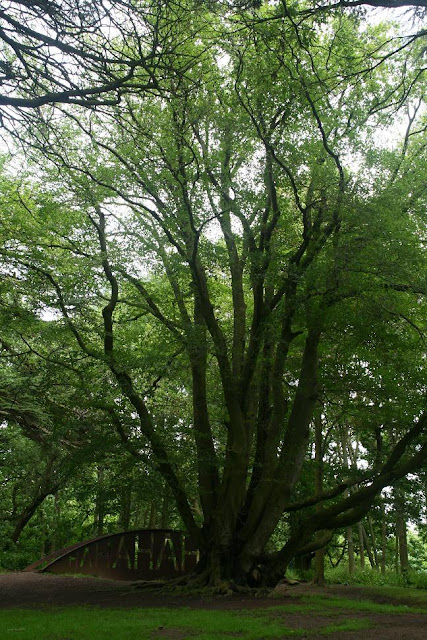
Multi-stemmed birch and ha-ha bridge at YSP (© Ian 2012)

We rather liked this multi-stemmed birch, which looks like it might be an over-grown coppicing stool. The bridge behind, as you might guess from the cut-out letters, spans a dry-stone walled ha-ha.

Jonathan Borofsky's 'Molecule Man' at YSP (photo © Ian 2012)

Cedar sculpture in the Camellia House, YSP (photo © Ian 2012)

Inside a rhododendron (© Ian 2012)

A bank of rhododendrons was outside the Camellia House; they're obviously rather old, and the stems and roots have become massive and entangled.

Waterfall (© Ian 2012)

Primarily, this photo's to remind me of the sort of waterfall we'd like to build above the pond.

Alec Finlay's 'The Bee Library' at YSP (photo © Ian 2012)

This is one of 24 bee-related books that have been converted into bee habitats and hung around the Lakeside section of the park.

I didn't take a photo, but outside the Bothy Gallery there's a curved south-facing wall, against which have been grown a series of cordon/fan trained apples. Some of them, by the tags, have been there over 200 years—and it shows. The trunks are 9" across, and they're big, vigorous, and covered in fruit. It's a shame we have no sheltered south-facing wall, as I'd love to grow some cordon fruit trees. Never mind: half standards it is.