
I had some insulation left after packing out the utility room loft (after the frozen pipes at Christmas), so I've put it down in the loft above the main bedroom. It seems as good a place as any, seeing as the guest room and study are less heated, and the bathrooms' loft is pretty full of plumbing. That now means that loft has around 60cm of insulation, which seems plenty.
This was rather a hot day to be doing such things, but I had a couple of hours spare after an administrative day, and one in which we spent a couple of hours playing with the youngest foster-child. We're planning to spend the day looking after him on Wednesday, but wanted to have a preparatory visit (so he gets used to being just with us for less than a day). We're just at the start of a week off, so there was no mad urgency to get things done, which was rather nice!
Saturday, 25 June 2011


Incubation
We might have discovered why a tray of petunia didn't come up.

I didn't expect Chess to get broody, but it appears he thought the seeds needed incubating.
© Ian 2011
I didn't expect Chess to get broody, but it appears he thought the seeds needed incubating.
Thursday, 23 June 2011
Bottled
The elderflower cordial we started at the weekend is ready, so I've strained the fruit, squished the juice out, and bottled the cordial. As before, it's in pint milk bottles, about three-quarters full (which we find a convenient quantity), and is now in the freezer.
The recipe calls for two days of steeping, but longer does work well. However, you have to be scrupulous about sterility. Given that I also make wine, this is something I'm used to!
The wine will need until, roughly, the weekend, before it gets strained into a demi-john. I'll probably try to get the elderflower rosé and hedgerow port going at the same time; the airing cupboard will then be full of demi-johns! Which is, perhaps, as it should be.
The recipe calls for two days of steeping, but longer does work well. However, you have to be scrupulous about sterility. Given that I also make wine, this is something I'm used to!
The wine will need until, roughly, the weekend, before it gets strained into a demi-john. I'll probably try to get the elderflower rosé and hedgerow port going at the same time; the airing cupboard will then be full of demi-johns! Which is, perhaps, as it should be.
Wednesday, 22 June 2011
Hellebores
We ordered them ages ago (last August), and they've just arrived: ten mixed hybridized hellebores. They're small ('jumbo plugs', which means a root ball about an inch across, and two tall), but that also means they were very good value, and I hope they'll grow on quickly over the summer. For now, I've just potted them on, into 9cm plastics. I love hellebores for giving us flowers at a dark patch, and I'm hoping to find some attractive variants in the mix. We'll see, this Christmas...
Tuesday, 21 June 2011
A Long Day Digging
Admittedly, I only spent a couple of hours digging, but it's the longest day of the year (the solstice was at about 1715). The hole for the apple tree is taking a long time to excavate, as there was—I discover—a large piece of iron sheet where I want the tree, as well as a big stone. The sheeting is out, but the big stone will have to wait. I'm worried that the same sort of problems will confront us when digging the pond, which may mean re-visiting the mini-digger idea. Which would, in principle, be fine—so long as the weather cooperated on the booked hire period!
Sunday, 19 June 2011
Turf Cutting
A weekend of unexpectedly favourable weather has meant we've got on well with a number of things. Least exciting was a spring-clean and bike-maintenance session. Never mind; needs must.
More interestingly, we finished digging a hole for the plum tree to go in (no, it's not the 'right' time of year to plant it out), having removed two large trugs of stones, bricks, and a square foot of corrugated iron from the spot we wanted. Plenty of compost, topsoil, and feed added, and the plum tree looks much happier. Liz then started on a hole for the apple tree, with my help when needed; meanwhile, I cut the turves marking the edge of the planned pond. This means that the sticks-and-string markers can come out (removing a trip-hazard, and one that might be nibbled by passing deer), and I can mow right up to the edge. It also makes it easier to see, so we can consider the shape, and be sure we're happy. I'll take and post a photo of progress, to also show the shape of the pond. Actually digging the pond is going to be quite an effort, based upon the two—much smaller—holes we've attempted for the fruit trees. The apple tree's hole is hard work; there are several large stones in the way, and we're only about half-way there.
Taking advantage of the dry day on Saturday, we collected up several dozen elderflower heads, and proceeded to make this year's elderflower cordial, and I started a batch of elderflower wine. We're making the cordial a couple of weeks earlier than last year, as the flowers are further ahead; the wine's about three weeks earlier. However, there are still plenty of flowers; I plan to make a batch of elderflower rosé in a week or so (half elderflower, half elderberry (from frozen stock)).
Sunday afternoon has been spent weeding, sowing some more spring onions and radishes, and harvesting some produce! We've been eating salad leaves and spinach for about three weeks, now: the salad leaves in the small central bed have been doing really well, and the spinach has grown quickly. The first lot of radishes are now nearing the size of tennis balls, so we've taken up the last ones to finish this week. The kale was planted too densely (deliberately), so we're now eating every other plant, to leave them at the proper spacing as they grow. The Brussels Sprouts had a better germination/growing-on rate than we expected, so they were also too dense. We've taken up about two-thirds, and will eat the young leaves (taste sprouts-like, and kale-y). We also brought up about eight of the baby carrots (a mix of Parmex and Early Nantes); there are going to be some peas this week, too. I'm also expecting us to run out of last year's potatoes this week, so we can lift some of the first earlies (which still haven't flowered, though I'm sure they should have)—it's all starting to pay off!
More interestingly, we finished digging a hole for the plum tree to go in (no, it's not the 'right' time of year to plant it out), having removed two large trugs of stones, bricks, and a square foot of corrugated iron from the spot we wanted. Plenty of compost, topsoil, and feed added, and the plum tree looks much happier. Liz then started on a hole for the apple tree, with my help when needed; meanwhile, I cut the turves marking the edge of the planned pond. This means that the sticks-and-string markers can come out (removing a trip-hazard, and one that might be nibbled by passing deer), and I can mow right up to the edge. It also makes it easier to see, so we can consider the shape, and be sure we're happy. I'll take and post a photo of progress, to also show the shape of the pond. Actually digging the pond is going to be quite an effort, based upon the two—much smaller—holes we've attempted for the fruit trees. The apple tree's hole is hard work; there are several large stones in the way, and we're only about half-way there.
Taking advantage of the dry day on Saturday, we collected up several dozen elderflower heads, and proceeded to make this year's elderflower cordial, and I started a batch of elderflower wine. We're making the cordial a couple of weeks earlier than last year, as the flowers are further ahead; the wine's about three weeks earlier. However, there are still plenty of flowers; I plan to make a batch of elderflower rosé in a week or so (half elderflower, half elderberry (from frozen stock)).
Sunday afternoon has been spent weeding, sowing some more spring onions and radishes, and harvesting some produce! We've been eating salad leaves and spinach for about three weeks, now: the salad leaves in the small central bed have been doing really well, and the spinach has grown quickly. The first lot of radishes are now nearing the size of tennis balls, so we've taken up the last ones to finish this week. The kale was planted too densely (deliberately), so we're now eating every other plant, to leave them at the proper spacing as they grow. The Brussels Sprouts had a better germination/growing-on rate than we expected, so they were also too dense. We've taken up about two-thirds, and will eat the young leaves (taste sprouts-like, and kale-y). We also brought up about eight of the baby carrots (a mix of Parmex and Early Nantes); there are going to be some peas this week, too. I'm also expecting us to run out of last year's potatoes this week, so we can lift some of the first earlies (which still haven't flowered, though I'm sure they should have)—it's all starting to pay off!
Sunday, 12 June 2011
Pondering
Although Sunday was rather wet, Friday (a day's leave) and Saturday were dry for reasonable stretches, so it's been a fairly effective weekend.
I started dismantling some more old pallets on Friday, to augment the compost bins with, while Liz weeded the onions. We didn't get all that far, unfortunately, before rain stopped play; we did, though, therefore sew the last curtain tie-backs for the kitchen. Saturday morning also started out wet, so we began the day by lifting the paperwhite narcissi that gave us some much-needed winter flowers. The flowers ended in January, but we gave the foliage as long as possible to die back, and fed the bulbs a few times (Chempak's low nitrogen #8, with NPK 12.5:25:25, to encourage root and flowers, but not foliage). The bulbs are now dry and dormant, so we've lifted them, cleaned them, and will put them somewhere cool and dark to wait out the summer. We started with 45, but there are several that have started to split, and have (currently joined) offspring forming, so hopefully next year the stock will be noticeably increased.
When the rain cleared, we got back outside, and continued where we'd left off. I finished assembling a third compost bay (a bit smaller than the first two, because of space constraint), and turned the contents of the existing bays (bay 2 into 3, then 1 into 2). The older heap (2) isn't doing as well—a bit dry, and not rotting very well, so I watered it after mixing it. Bay 1 was doing well: nice and hot, and rotting nicely, so hopefully it will go still better after aerating.
Liz's mammoth weeding session has left all the vegetable and fruit beds looking much better, although she's left with sore hands and back.
Sunday morning dawned clear, so we got straight outside to ponder our plans for the middle lawn. It's divided in two by the cover of the septic tank, which we have to build into our ruminations.
 The Middle Lawn (from the north end).
It is, however, a very good size. We'd always wanted to keep the bigger, more level, more regular shaped part (the foreground above) for a 'games' lawn—somewhere large enough for badminton, short tennis, clock golf, boules, croquet, and the like. However, we've never checked whether it's actually the right size, rather than just looking about right. So, we dug out Liz's grandfather's length of rope, marked up for a badminton court, and set about laying it out. It's the circumference of the court, with marks for where the main lines go, so it makes it all rather easy. The lawn, it transpires, is approximately 7 feet short, but also about 7 feet wide; so the badminton court won't be quite regulation, but is eminently playable.
Yes, we checked it was playable. In wellies. And a breeze.
This, obviously, is excellent—the septic tank is immovable, and we don't want to reduce the beds. It won't be Olympic regulation size, but I'm not that fussed. We also checked croquet-suitability. It's a little small for serious use, but for a casual game, entirely satisfactory.
The culmination of this is that we can now go about laying the extra beds at the edges of this lawn, and remove the gorse/cotoneaster we don't want, knowing that the grass area is sufficient, and we don't need to revise our plan for which bit of lawn to leave large and quadrilateral.
We've also been intending to get our three pot-grown fruit trees (a plum, an apple, and a cherry) into the ground. They've not been really happy for the last 18 months, and we think they need to get out of their pots. Our master plan calls for a pond on the opposite side to the tank in the photo above—that's the foreground of the next photo. We've marked something tentative out with sticks'n'string (as normal), and we'll see how it feels. However, it's basically right, so I've lifted turves where the fruit trees will go, near the pond (yes, I know I'll need to clear leaves from the pond!). These appear like monumental mole hills in the photo—but as soon as it's dry for long enough, they'll be replaced with fruit trees.
 Looking onto the Middle Lawn from the east corner.
I started dismantling some more old pallets on Friday, to augment the compost bins with, while Liz weeded the onions. We didn't get all that far, unfortunately, before rain stopped play; we did, though, therefore sew the last curtain tie-backs for the kitchen. Saturday morning also started out wet, so we began the day by lifting the paperwhite narcissi that gave us some much-needed winter flowers. The flowers ended in January, but we gave the foliage as long as possible to die back, and fed the bulbs a few times (Chempak's low nitrogen #8, with NPK 12.5:25:25, to encourage root and flowers, but not foliage). The bulbs are now dry and dormant, so we've lifted them, cleaned them, and will put them somewhere cool and dark to wait out the summer. We started with 45, but there are several that have started to split, and have (currently joined) offspring forming, so hopefully next year the stock will be noticeably increased.
When the rain cleared, we got back outside, and continued where we'd left off. I finished assembling a third compost bay (a bit smaller than the first two, because of space constraint), and turned the contents of the existing bays (bay 2 into 3, then 1 into 2). The older heap (2) isn't doing as well—a bit dry, and not rotting very well, so I watered it after mixing it. Bay 1 was doing well: nice and hot, and rotting nicely, so hopefully it will go still better after aerating.
Liz's mammoth weeding session has left all the vegetable and fruit beds looking much better, although she's left with sore hands and back.
Sunday morning dawned clear, so we got straight outside to ponder our plans for the middle lawn. It's divided in two by the cover of the septic tank, which we have to build into our ruminations.
 The Middle Lawn (from the north end).
It is, however, a very good size. We'd always wanted to keep the bigger, more level, more regular shaped part (the foreground above) for a 'games' lawn—somewhere large enough for badminton, short tennis, clock golf, boules, croquet, and the like. However, we've never checked whether it's actually the right size, rather than just looking about right. So, we dug out Liz's grandfather's length of rope, marked up for a badminton court, and set about laying it out. It's the circumference of the court, with marks for where the main lines go, so it makes it all rather easy. The lawn, it transpires, is approximately 7 feet short, but also about 7 feet wide; so the badminton court won't be quite regulation, but is eminently playable.
Yes, we checked it was playable. In wellies. And a breeze.
This, obviously, is excellent—the septic tank is immovable, and we don't want to reduce the beds. It won't be Olympic regulation size, but I'm not that fussed. We also checked croquet-suitability. It's a little small for serious use, but for a casual game, entirely satisfactory.
The culmination of this is that we can now go about laying the extra beds at the edges of this lawn, and remove the gorse/cotoneaster we don't want, knowing that the grass area is sufficient, and we don't need to revise our plan for which bit of lawn to leave large and quadrilateral.
We've also been intending to get our three pot-grown fruit trees (a plum, an apple, and a cherry) into the ground. They've not been really happy for the last 18 months, and we think they need to get out of their pots. Our master plan calls for a pond on the opposite side to the tank in the photo above—that's the foreground of the next photo. We've marked something tentative out with sticks'n'string (as normal), and we'll see how it feels. However, it's basically right, so I've lifted turves where the fruit trees will go, near the pond (yes, I know I'll need to clear leaves from the pond!). These appear like monumental mole hills in the photo—but as soon as it's dry for long enough, they'll be replaced with fruit trees.
 Looking onto the Middle Lawn from the east corner.
Sunday, 5 June 2011
Winged Weekend
Another busy weekend, for us, and for barn swallows who have been building a nest in our porch.

They're building their nest (out of mud pellets) on top of the keystone in the arch, on the 'in' side; it's nicely sheltered, but it does mean they get disturbed whenever we come or go. If we're doing anything for any length of time on the driveway, they perch on the telegraph wire opposite, and noisily complain.
Aside from the antics of these new tenants; we got an early start to the weekend, as we were telecommuting on Friday, so I got out to mow the lawn after work. First, admittedly, I had to mend the mower: the bolt that holds the blade was jammed stuck, and it took some work to get it to shift. By 'work', I mean destructive dismantling. New bolt installed, and mowing completed. It was swelteringly hot, though, so I was glad to finish. Liz started to clear weeds growing around the puschkinia and bluebells, which is another good thing to have done.
On Saturday, we had a busy day in the garden. The butterfly net (8mm square mesh) for the brassicas arrived a while ago, and so we put that over the rectangular vegetable bed. It went on really easily, after the shenanigans with the fleece covers, and it has reinforced edges which hooked over the existing nails neatly. We've stiched the ends together (non-permanently, so the same mesh can be reconfigured, wherever the brassicas are next year) with polypropylene cord. Earlier this week, we mended one of the split fruit cages with the same cord, with some success—they had been stiched with hemp twine, but that's rotting.
We also put some bird netting (inch mesh) over the peas, beans, and carrots. It's actually cat netting, rather than bird netting, for the carrots: the boys appear to have taken to sitting on the carrots. I wouldn't otherwise object (too much), but I don't want them bruising the foliage and attracting carrot root fly.
Belatedly, we realised we hadn't sown any butternut squash, so we planted a pair of seeds where we had put gourds, and covered them with bottle-cloches. The gourds joined another half-dozen from a windowsill in a large half-barrel, filled with compost and topsoil. They're a little crowded, I expect, but I only want a few fruits.
Sunday came, and we nipped out to the garden centre. The bitter winter saw off the clematis 'Pink Champagne' growing near the front door, and we also wanted a climber to go up trellis near the kitchen (disguising the old door). We found two new clematis to do this; an 'Angelique', and 'Marie Boisselot'. We also picked up a dozen petunias (pale yellow/cream), and planted these into two of the new hanging baskets. The other two hanging baskets received three verbena, three pelargoniums, and a small fuchsia or two; these are now near the door, and the petunia baskets are on the front of the house. The dahlias we got at the same time have graduated into bigger pots, too, to grow on until they're needed once pansies in the troughs have gone over.
We also re-planted the Christmas tree, into a larger bucket-pot, and sowed some more salad leaves. We've been eating salads with lunch for the last three days, as they're leafing nicely. The spinach is especially good.
Lastly, and least glamorously, I trimmed back the ivy where it was threatening to block the study window. Needs to be done a few times each year: I try to prevent it from adhering to the wooden window-frame. We also weeded the front garden, and reshuffled a couple of the hellebores under the acer, as there were a couple of gaps, and a bit of congestion. The front garden, with its two new clematis, four new hanging baskets, and weeded beds, is looking much better!

They're building their nest (out of mud pellets) on top of the keystone in the arch, on the 'in' side; it's nicely sheltered, but it does mean they get disturbed whenever we come or go. If we're doing anything for any length of time on the driveway, they perch on the telegraph wire opposite, and noisily complain.
Aside from the antics of these new tenants; we got an early start to the weekend, as we were telecommuting on Friday, so I got out to mow the lawn after work. First, admittedly, I had to mend the mower: the bolt that holds the blade was jammed stuck, and it took some work to get it to shift. By 'work', I mean destructive dismantling. New bolt installed, and mowing completed. It was swelteringly hot, though, so I was glad to finish. Liz started to clear weeds growing around the puschkinia and bluebells, which is another good thing to have done.
On Saturday, we had a busy day in the garden. The butterfly net (8mm square mesh) for the brassicas arrived a while ago, and so we put that over the rectangular vegetable bed. It went on really easily, after the shenanigans with the fleece covers, and it has reinforced edges which hooked over the existing nails neatly. We've stiched the ends together (non-permanently, so the same mesh can be reconfigured, wherever the brassicas are next year) with polypropylene cord. Earlier this week, we mended one of the split fruit cages with the same cord, with some success—they had been stiched with hemp twine, but that's rotting.
We also put some bird netting (inch mesh) over the peas, beans, and carrots. It's actually cat netting, rather than bird netting, for the carrots: the boys appear to have taken to sitting on the carrots. I wouldn't otherwise object (too much), but I don't want them bruising the foliage and attracting carrot root fly.
Belatedly, we realised we hadn't sown any butternut squash, so we planted a pair of seeds where we had put gourds, and covered them with bottle-cloches. The gourds joined another half-dozen from a windowsill in a large half-barrel, filled with compost and topsoil. They're a little crowded, I expect, but I only want a few fruits.
Sunday came, and we nipped out to the garden centre. The bitter winter saw off the clematis 'Pink Champagne' growing near the front door, and we also wanted a climber to go up trellis near the kitchen (disguising the old door). We found two new clematis to do this; an 'Angelique', and 'Marie Boisselot'. We also picked up a dozen petunias (pale yellow/cream), and planted these into two of the new hanging baskets. The other two hanging baskets received three verbena, three pelargoniums, and a small fuchsia or two; these are now near the door, and the petunia baskets are on the front of the house. The dahlias we got at the same time have graduated into bigger pots, too, to grow on until they're needed once pansies in the troughs have gone over.
We also re-planted the Christmas tree, into a larger bucket-pot, and sowed some more salad leaves. We've been eating salads with lunch for the last three days, as they're leafing nicely. The spinach is especially good.
Lastly, and least glamorously, I trimmed back the ivy where it was threatening to block the study window. Needs to be done a few times each year: I try to prevent it from adhering to the wooden window-frame. We also weeded the front garden, and reshuffled a couple of the hellebores under the acer, as there were a couple of gaps, and a bit of congestion. The front garden, with its two new clematis, four new hanging baskets, and weeded beds, is looking much better!
Monday, 30 May 2011
Weeding
We seem to have spent a lot of this (long) weekend weeding. It did, however, rather need doing.
On Saturday, we cleared half of the onions (which were rather congested with clover and nettles, mostly), as well as going over all of the fruit beds. The raspberries were quite bad; the gooseberries/blackcurrants were acceptable; the blueberries and currants were awful. There are, somehow, about two dozen potatoes growing—obviously missed when we lifted them last year. We had to remove some, as they were crowding the fruit bushes, but we've also left others, and will bring them up as new potatoes in a while. However, there was also a lot of other weed coverage—now all cleared. It looks a lot better!
We also popped round to help Jenny and the children construct a large octagonal sandpit. It's very good: took about 350kg of sand to fill it, but is big enough for all three children to play in.
Yesterday, we spent almost the entire day sorting the workshop out, which wasn't a particularly enjoyable task, but good to have done. It was a bit too wet and windy to venture outside! Today, though, has been drier, so we finished weeding the other half of the onions, and repotted a number of the perennials that arrived in the autumn, many of which are looking good, and starting to grow. A few, however, have not yet shown signs of life: hopefully they will soon.
The onions appear to be getting quite battered by the strong winds of the last few days: many of them needed firming in. Liz suggested a low withy hurdle along the wind-facing side, to give them some protection, which has merit.
We also planted out some more seedlings: 16 more celeriac (next to the extant 20, which needed two replacements), another dozen leeks (between the others, to be taken up as babies), and a pumpkin, three courgettes, and two ornamental gourds. We also sowed a row of spring onions between some of the celeriac, and a row of radishes between some cauliflowers. I also put 6' support cages up above the peas and runner beans: they've had 2' supports, but are outgrowing them.
This means that all the beds are now full!
On Saturday, we cleared half of the onions (which were rather congested with clover and nettles, mostly), as well as going over all of the fruit beds. The raspberries were quite bad; the gooseberries/blackcurrants were acceptable; the blueberries and currants were awful. There are, somehow, about two dozen potatoes growing—obviously missed when we lifted them last year. We had to remove some, as they were crowding the fruit bushes, but we've also left others, and will bring them up as new potatoes in a while. However, there was also a lot of other weed coverage—now all cleared. It looks a lot better!
We also popped round to help Jenny and the children construct a large octagonal sandpit. It's very good: took about 350kg of sand to fill it, but is big enough for all three children to play in.
Yesterday, we spent almost the entire day sorting the workshop out, which wasn't a particularly enjoyable task, but good to have done. It was a bit too wet and windy to venture outside! Today, though, has been drier, so we finished weeding the other half of the onions, and repotted a number of the perennials that arrived in the autumn, many of which are looking good, and starting to grow. A few, however, have not yet shown signs of life: hopefully they will soon.
The onions appear to be getting quite battered by the strong winds of the last few days: many of them needed firming in. Liz suggested a low withy hurdle along the wind-facing side, to give them some protection, which has merit.
We also planted out some more seedlings: 16 more celeriac (next to the extant 20, which needed two replacements), another dozen leeks (between the others, to be taken up as babies), and a pumpkin, three courgettes, and two ornamental gourds. We also sowed a row of spring onions between some of the celeriac, and a row of radishes between some cauliflowers. I also put 6' support cages up above the peas and runner beans: they've had 2' supports, but are outgrowing them.
This means that all the beds are now full!
Sunday, 22 May 2011
Lions and tigers and...meerkats
We had a day out yesterday with Jenny, Philip and their foster children, to Yorkshire Wildlife Park. None of us had ever been, so it was an adventure. It's only been open a couple of years, but it's excellent, with a good variety of animals, and nice settings. My particular favourites were the meerkats and lemurs; they also have three lion prides, an 'African Plain' full of zebra, ankole cattle, and the like, a tiger enclosure under construction, birds of prey, and a wetlands opening later this year.

The children, predicatably, were as excited by the slides and adventure playground as the exotic animals, but there you go. Today's been foul weather (strong winds, a couple of inches of rain, and—at one point—hail. Which was being blown horizontal. Accordingly, we stayed inside, instead of doing the garden tasks we had in mind (nothing exciting, but some weeding needs to happen, and I'd like to plant up the new hanging baskets). I've patched up some plastering in the kitchen, and removed some rotting window-sill in the study. The windows stand on a stone lintel, which, while exposed outside, is boxed inside. The wood has started to decay, however, so I've removed part of the case and sealed the window-frame to the lintel. When we come to redecorate, I'll need to replace the window-sill, and decide whether or not to replace the lintel casing. Possibly not; we'll see what a stone 'feature' looks like.

Meerkat sentry; Yorkshire Wildlife Park © Ian (2011)
The children, predicatably, were as excited by the slides and adventure playground as the exotic animals, but there you go. Today's been foul weather (strong winds, a couple of inches of rain, and—at one point—hail. Which was being blown horizontal. Accordingly, we stayed inside, instead of doing the garden tasks we had in mind (nothing exciting, but some weeding needs to happen, and I'd like to plant up the new hanging baskets). I've patched up some plastering in the kitchen, and removed some rotting window-sill in the study. The windows stand on a stone lintel, which, while exposed outside, is boxed inside. The wood has started to decay, however, so I've removed part of the case and sealed the window-frame to the lintel. When we come to redecorate, I'll need to replace the window-sill, and decide whether or not to replace the lintel casing. Possibly not; we'll see what a stone 'feature' looks like.
Monday, 16 May 2011
Rain
It rained a bit, over the weekend, and that's continued today. The wind's also picked up, which—combined with the rain, I think—meant that the rectangular vegetable bed's fleece cover had half blown off the frame this morning. It was still attached on the eyes/nails on the path-side, but in being lifted off had started to tear quite badly at the corners. So, I removed it completely. This evening, the other covers were also tearing, and because it's damp, I can't really make any repairs (tape won't stick to wet fleece)—so they've all come in.
It's a couple of weeks earlier than we were planning to take the covers down—we can get frosts until the end of May. However, we probably won't put them back on this spring, as the weather's been quite warm, and is looking set to stay that way. If a frost does threaten, the runner beans will need covering, and—if it's severe—the celeriac and beetroot, but otherwise I think the soil's now warmed enough not to need the covers.
They've been a rather mixed success, the fleece cages. They've taken a lot of time to put in, and maintain. On the other hand, I think they've helped get things going, and—without a greenhouse—we would have struggled to grow enough plants on to fill the beds in May/June. The wood/wire construction will be useful, in the long run, for netting (especially brassicas and beans) and for fixing the irrigation system's water jets, so that's certainly no waste. I'm not sure, though, whether we'll continue using the fleece once we have a greenhouse.
Once I'd collected the covers, I spent a while weeding the onions, which are doing well, but were accompanied by rather too many nettles, goosegrass, and clover. It's looking much better now.
It's a couple of weeks earlier than we were planning to take the covers down—we can get frosts until the end of May. However, we probably won't put them back on this spring, as the weather's been quite warm, and is looking set to stay that way. If a frost does threaten, the runner beans will need covering, and—if it's severe—the celeriac and beetroot, but otherwise I think the soil's now warmed enough not to need the covers.
They've been a rather mixed success, the fleece cages. They've taken a lot of time to put in, and maintain. On the other hand, I think they've helped get things going, and—without a greenhouse—we would have struggled to grow enough plants on to fill the beds in May/June. The wood/wire construction will be useful, in the long run, for netting (especially brassicas and beans) and for fixing the irrigation system's water jets, so that's certainly no waste. I'm not sure, though, whether we'll continue using the fleece once we have a greenhouse.
Once I'd collected the covers, I spent a while weeding the onions, which are doing well, but were accompanied by rather too many nettles, goosegrass, and clover. It's looking much better now.
Sunday, 15 May 2011
Comparing Notes
We got back this afternoon from a pleasant weekend spent with Hazel and Alex in Cambridge. As is custom, we spent the time eating, gardening/walking, and playing board games. Hazel is an excellent cook, and produced a lovely slow cooked pork belly from a National Trust book we don't—yet—have. That may need to change. We'd taken a bottle of my elderflower wine, which went down very well—apparently, it's quite like a semi-sweet Reisling.
On Saturday, we walked over to their allotment, which has come on again since we last visited: they've basically finished the raised beds (about 3m x 0.8m), and installed a 5m x 5m fruit cage with a load of bushes. Gooseberries, raspberries, blackberries, currants; and a jostaberry, Japanese wineberry, and a kiwi. The jostaberry is, essentially, a gooseberry/blackcurrant cross; wineberry is a type of raspberry; the kiwi needs no introduction. I shall be intrigued to try the first two, and to gauge their success with a kiwi—needless to say, I doubt we could grow one up here. The vines need decent summer warmth, and are vulnerable to early frosts: we have an insufficiency of the former, and a predilection to the latter.
Their potatoes are, I might say, behind ours: conversely, their runner beans are ahead. They grew over-wintering onions (Senshyu), so they're looking bigger than ours—no surprise, as they've been in since August 2010. However, Japanese onions don't store as well, and we've sown a year's worth, so we'll be well placed once ours are harvested. The strawberries are doing better, benefiting from the higher temperatures in East Anglia. Everything, though, is a bit dry: they've had no significant rain since the end of March.
It was, as normal, a pleasure to see them; and always interesting to see how someone else's garden's getting on!
On Saturday, we walked over to their allotment, which has come on again since we last visited: they've basically finished the raised beds (about 3m x 0.8m), and installed a 5m x 5m fruit cage with a load of bushes. Gooseberries, raspberries, blackberries, currants; and a jostaberry, Japanese wineberry, and a kiwi. The jostaberry is, essentially, a gooseberry/blackcurrant cross; wineberry is a type of raspberry; the kiwi needs no introduction. I shall be intrigued to try the first two, and to gauge their success with a kiwi—needless to say, I doubt we could grow one up here. The vines need decent summer warmth, and are vulnerable to early frosts: we have an insufficiency of the former, and a predilection to the latter.
Their potatoes are, I might say, behind ours: conversely, their runner beans are ahead. They grew over-wintering onions (Senshyu), so they're looking bigger than ours—no surprise, as they've been in since August 2010. However, Japanese onions don't store as well, and we've sown a year's worth, so we'll be well placed once ours are harvested. The strawberries are doing better, benefiting from the higher temperatures in East Anglia. Everything, though, is a bit dry: they've had no significant rain since the end of March.
It was, as normal, a pleasure to see them; and always interesting to see how someone else's garden's getting on!
Sunday, 8 May 2011
Bedding
We've been away for the weekend, visiting my parents, so there's been barely any garden activity. However, we popped in at the garden centre on the way to Thirsk, and picked up a couple of packs of mixed bedding (to augment the cineraria, et al. I sowed last week). I also grabbed thirty six-foot bamboo canes, to frame the peas/beans once the fleece cages come off, and some more of the excellent thorn- and water-proof gloves we like. Our old ones have lasted about a year, but we've each acquired one split. We'll keep using the old ones for things that the splits don't impinge on, but they were on offer, so we've stocked up.
When we got home today, we've had to spend some time adding waterproof fabric tape to the fleece cages, where the posts have damaged the fabric in the wind. It's rather tedious: hopefully soon we'll have reinforced sufficiently the vulnerable areas.
I keep meaning to create a 'weather' page, with data from the weather station. It's happily churning out statistics, but I need to export some graphs, and the like, to upload. One of these days...
When we got home today, we've had to spend some time adding waterproof fabric tape to the fleece cages, where the posts have damaged the fabric in the wind. It's rather tedious: hopefully soon we'll have reinforced sufficiently the vulnerable areas.
I keep meaning to create a 'weather' page, with data from the weather station. It's happily churning out statistics, but I need to export some graphs, and the like, to upload. One of these days...
Wednesday, 4 May 2011
Tidying the Strawberries
It's about two months late, but we spent an hour tidying up the strawberry bed this evening. The netting that covers it is out-of-the-box: never cut down to size, and a bit of a tangled mess at the edge of the bed. We trimmed that down (much improving accessibility), and cleared some of the dead leaves, detritus, and weeds from around the plants. A big pile of straw then made its way onto the bed, to protect the nascent fruits.
I note that, when doing the same thing last June, I decried it as a job left too late. I'm about seven weeks earlier...and it still seems too late. I think the rapid growth (due to the very warm March and April) has hastened things along: it would have been a much easier job if done in February, and I could have removed a lot more dead foliage without fear of disturbing the strawberries. Never mind: I'm sure they'll cope.
I note that, when doing the same thing last June, I decried it as a job left too late. I'm about seven weeks earlier...and it still seems too late. I think the rapid growth (due to the very warm March and April) has hastened things along: it would have been a much easier job if done in February, and I could have removed a lot more dead foliage without fear of disturbing the strawberries. Never mind: I'm sure they'll cope.
Monday, 2 May 2011
Vegetable Seedlings
An enormous day of planting out the vegetable seedlings.
We started in the last side of the C-shaped bed, interplanting some small 'Parmex' carrots between the Early Nantes we sowed a couple of weeks ago. We then filled the remaining space with about forty beetroot (some 'Boltardy', some others), and quickly recovered the bed, to minimize the risk from carrot root fly. We were careful to handle the carrots as little as possible, and avoid the foliage; on a breezy day and with the re-sealed beds, I think they'll evade attention.
The newly completed rectangular bed was next. At one end, we've put in lots of cauliflowers ('All The Year Round'): they're too dense, but I think many won't survive the transplantation. Then, nine Brussels Sprouts (looking healthier than the caulis), and a couple of dozen purple sprouting broccoli. These stay in until next January, so we've intercropped them and the Brussels with scarlet kale (of which the young leaves are tastiest) and some spinach. The last couple of metres of bed are empty, ready for the courgettes, pumpkins, and butternut squash—they're still inside, as they're a bit more tender.
Lastly, we planted up the Q-bed: 48 leeks ('Prizetaker') next to the onions, and another row of 'Ishikuro' spring onions between the leeks. Sixteen celeriac ('Monarch') in the corner, and then we moved the runner beans and peas to join the directly-sown plants. For while they're small, we've put a few more Early Nantes carrots between the blocks.
To round off, we moved some salad leaves into the miniature middle bed, and then sowed some more seeds: cineraria (Senecio cinerearia 'Silver Dust'—bedding foliage), petunias (a cheap F1 mix, if I recall), and lobelia ('Cambridge Blue') (for the new hanging baskets), and some poppies ('Flanders') and love-in-a-mist (Nigella damascena 'Moody Blues') to eventually naturalize in the copse.
Back to work tomorrow, but a very productive Easter holiday, I think—and very exciting to have the vegetable beds planted up!
We started in the last side of the C-shaped bed, interplanting some small 'Parmex' carrots between the Early Nantes we sowed a couple of weeks ago. We then filled the remaining space with about forty beetroot (some 'Boltardy', some others), and quickly recovered the bed, to minimize the risk from carrot root fly. We were careful to handle the carrots as little as possible, and avoid the foliage; on a breezy day and with the re-sealed beds, I think they'll evade attention.
The newly completed rectangular bed was next. At one end, we've put in lots of cauliflowers ('All The Year Round'): they're too dense, but I think many won't survive the transplantation. Then, nine Brussels Sprouts (looking healthier than the caulis), and a couple of dozen purple sprouting broccoli. These stay in until next January, so we've intercropped them and the Brussels with scarlet kale (of which the young leaves are tastiest) and some spinach. The last couple of metres of bed are empty, ready for the courgettes, pumpkins, and butternut squash—they're still inside, as they're a bit more tender.
Lastly, we planted up the Q-bed: 48 leeks ('Prizetaker') next to the onions, and another row of 'Ishikuro' spring onions between the leeks. Sixteen celeriac ('Monarch') in the corner, and then we moved the runner beans and peas to join the directly-sown plants. For while they're small, we've put a few more Early Nantes carrots between the blocks.
To round off, we moved some salad leaves into the miniature middle bed, and then sowed some more seeds: cineraria (Senecio cinerearia 'Silver Dust'—bedding foliage), petunias (a cheap F1 mix, if I recall), and lobelia ('Cambridge Blue') (for the new hanging baskets), and some poppies ('Flanders') and love-in-a-mist (Nigella damascena 'Moody Blues') to eventually naturalize in the copse.
Back to work tomorrow, but a very productive Easter holiday, I think—and very exciting to have the vegetable beds planted up!
Sunday, 1 May 2011
Preparing the Last Vegetable Bed
We've now emptied the last (rectangular) vegetable bed, having removed the crocosmia, an errant iris, and the stooled willow. Next, we added about fifteen barrows of topsoil (I lost count, but it was about that many), to bring the level up, having spread out the manure we'd left at one end. I then drove the wooden posts into the edges, and strung wire between these to form the support for the fleece cover; then we attached the water nozzles to the posts, and connected them to the irrigation supply line. We then put fleece over the cage, punched holes in its border, and set the reinforcing eyelets in the holes, before nailing in the respective hooks (into the outside of the bed). Finally, we put reinforcing tape on the fleece where it goes over the posts, to minimize the risk of splits.
And then we collapsed on to the sofa.
And then we collapsed on to the sofa.
Saturday, 30 April 2011
Short Break
We've been away for the last few days, on a short trip to Cambridge. On Wednesday, given the run of warm dry weather, I started painting the window frames. As they were new last year, I want to get another coat of paint on them this year, to start building up the protection—and if I start now, I should be able to spread the work out, and make it more tolerable, instead of having to cram it into September. Like last year.
We travelled down to Cambridge on Thursday, paused to pick up a copy of St John's College Cambridge: A History, which is being given to Johnians ahead of its release (a magnificent tome coinciding with the quincentenary). We spent the rest of the day with the Fellow we stayed with, Katherine, who has rooms in Pembroke.
Friday was spent profitably, mooching round Cambridge, and watching some coverage of events in London. It was a lovely day for sitting on the Backs admiring St John's New Court (apologies for the wonky horizon).

We also went back round Clare College's gardens. It was interesting to see them just a few weeks after our last visit. The hyacinths have all gone over, but there are loads more tulips out, and their bed of hostas looks great.


We came home on Saturday, stopping off to visit an old neighbour, who very graciously gave us a peony ('Sarah Bernhardt'), and also called in at our old local garden centre, leaving with some bits and pieces, including a second calathea for the sitting room.
We return to work on Tuesday, which gives us a couple of days to get the vegetable beds in order: we want to plant out lots of the seedlings, and the bottom rectangular bed (now it's empty) needs its fleece cage and irrigation installing, and to be filled with topsoil. We added manure in March, when doing the other beds, leaving it piled at one end: that will need distributing across the whole area. It may make for a couple of long days!
We travelled down to Cambridge on Thursday, paused to pick up a copy of St John's College Cambridge: A History, which is being given to Johnians ahead of its release (a magnificent tome coinciding with the quincentenary). We spent the rest of the day with the Fellow we stayed with, Katherine, who has rooms in Pembroke.
Friday was spent profitably, mooching round Cambridge, and watching some coverage of events in London. It was a lovely day for sitting on the Backs admiring St John's New Court (apologies for the wonky horizon).

We also went back round Clare College's gardens. It was interesting to see them just a few weeks after our last visit. The hyacinths have all gone over, but there are loads more tulips out, and their bed of hostas looks great.


We came home on Saturday, stopping off to visit an old neighbour, who very graciously gave us a peony ('Sarah Bernhardt'), and also called in at our old local garden centre, leaving with some bits and pieces, including a second calathea for the sitting room.
We return to work on Tuesday, which gives us a couple of days to get the vegetable beds in order: we want to plant out lots of the seedlings, and the bottom rectangular bed (now it's empty) needs its fleece cage and irrigation installing, and to be filled with topsoil. We added manure in March, when doing the other beds, leaving it piled at one end: that will need distributing across the whole area. It may make for a couple of long days!
Tuesday, 26 April 2011
Emptying a Bed
Yesterday's birthday went really well: the party (a few party games, followed by a picnic) went smoothly, presents were well received, and the cake worked a treat. We found take to—once again—water the garden, and we also bottled the elderflower wine that I started last year, and racked at Christmas. I have to say, it's delightful. Excellent bouquet, nice and clear, and vinous taste: a very credible dry white.
Today, I've mown the lawn, and we've started emptying the rectangular vegetable bed. To start, we took up two large clumps of geranium from the rectangular vegetable bed, and divided them into about a dozen pieces. These, along with a couple of woody shrubs whose name escapes me, have moved into the copse. While I was planted these, Liz took the shears to the kitchen garden's paths, which were getting a bit jungle-y: they look much better now, and easier to navigate. I really must get round to ordering weed suppressant membrane to line the paths: we can then distribute some of the chippings along them, which will keep maintenance down.
Today, I've mown the lawn, and we've started emptying the rectangular vegetable bed. To start, we took up two large clumps of geranium from the rectangular vegetable bed, and divided them into about a dozen pieces. These, along with a couple of woody shrubs whose name escapes me, have moved into the copse. While I was planted these, Liz took the shears to the kitchen garden's paths, which were getting a bit jungle-y: they look much better now, and easier to navigate. I really must get round to ordering weed suppressant membrane to line the paths: we can then distribute some of the chippings along them, which will keep maintenance down.
Sunday, 24 April 2011
Watering as Entertainment
We started the day by testing the new irrigation system: a thorough success. Much more so than the fruit beds: I think the 180º jets are better than the 360º version, and having them raised by a foot seems to improve them further.
The painted Easter eggs from yesterday were then dispersed around the garden, in small-child-friendly hiding places. Judging spots that would keep two- to seven-year-olds interested is a little outside my experience, but it seemed to work well: the children (and my parents-, grandmother- and sister-in-law) came round after breakfast and were suitably entertained. Later on, for reasons I can't really explain, the children decided that they wanted to help water our garden. This being a slightly mundane and tedious job, I was happy to oblige...and while I worked from one end of the pots with the hose, they ran back and forth with watering cans. All the while, it appears, loving every minute.
Who knew childcare was as simple as giving them a watering can?
It's the middle one's birthday tomorrow, and Liz and I have been tasked with hosting the 'party', and making a birthday cake. It's a fairy ring, with small doll surrounded by toadstools, cunningly crafted from miniature muffins, chocolate rolls, and chocolate coated marshmallows. Hopefully she will like it...
The painted Easter eggs from yesterday were then dispersed around the garden, in small-child-friendly hiding places. Judging spots that would keep two- to seven-year-olds interested is a little outside my experience, but it seemed to work well: the children (and my parents-, grandmother- and sister-in-law) came round after breakfast and were suitably entertained. Later on, for reasons I can't really explain, the children decided that they wanted to help water our garden. This being a slightly mundane and tedious job, I was happy to oblige...and while I worked from one end of the pots with the hose, they ran back and forth with watering cans. All the while, it appears, loving every minute.
Who knew childcare was as simple as giving them a watering can?
It's the middle one's birthday tomorrow, and Liz and I have been tasked with hosting the 'party', and making a birthday cake. It's a fairy ring, with small doll surrounded by toadstools, cunningly crafted from miniature muffins, chocolate rolls, and chocolate coated marshmallows. Hopefully she will like it...
Saturday, 23 April 2011
Eggs
Following on from yesterday's main-line installation, today we put the supply line and spray nozzles in the vegetable bed. These are 8mm tubes ending with mini-jets that spray water over 180°, out to about a metre. The nozzles are a foot above soil level, attached to the wooden posts that support the fleece covers. We didn't gave a chance to test the system, unfortunately, as we had other things to get done...
As tomorrow is Easter Sunday, we've made the three foster children chocolate eggs (18cm jobs, half white, half milk, with 'Happy Easter' piped onto one side: they look surprisingly good), and visited them to help paint hard-boiled eggs. We're going to hide nine of them in our garden tomorrow morning, and they'll come down after breakfast to hunt for them.
Jenny's harvested her rhubarb (which seems notably earlier than mine—though mine, admittedly, languishes in a pot), which made for an excellent dessert, but has also provided me with a big bag of rhubarb leaves. I've chopped these up, and put them in a bucket of water in the shed: once they've steeped/stewed/leached, the resulting liquid is rich in oxalic acid (the reason one shouldn't eat rhubarb leaves), and can be sprayed as an (organic) insecticide. Given the sawflies on the gooseberries, this couldn't come soon enough.
Finally, I had twenty minutes spare, so I've poured the cider (finally—it's taken forever to finish fermenting) into a barrel, and added a couple of ounces of sugar: in a week or so, it should have settled and be suitably fizzy.
As tomorrow is Easter Sunday, we've made the three foster children chocolate eggs (18cm jobs, half white, half milk, with 'Happy Easter' piped onto one side: they look surprisingly good), and visited them to help paint hard-boiled eggs. We're going to hide nine of them in our garden tomorrow morning, and they'll come down after breakfast to hunt for them.
Jenny's harvested her rhubarb (which seems notably earlier than mine—though mine, admittedly, languishes in a pot), which made for an excellent dessert, but has also provided me with a big bag of rhubarb leaves. I've chopped these up, and put them in a bucket of water in the shed: once they've steeped/stewed/leached, the resulting liquid is rich in oxalic acid (the reason one shouldn't eat rhubarb leaves), and can be sprayed as an (organic) insecticide. Given the sawflies on the gooseberries, this couldn't come soon enough.
Finally, I had twenty minutes spare, so I've poured the cider (finally—it's taken forever to finish fermenting) into a barrel, and added a couple of ounces of sugar: in a week or so, it should have settled and be suitably fizzy.
Friday, 22 April 2011
Irrigation
We've spent this afternoon starting to install an irrigation system in the vegetable beds. Last June, we put one into the fruit beds, which works fairly well: it's been so warm and dry that we decided it was time to add one to the rest of the kitchen garden.
Accordingly, we've put in two 13mm supply hoses, one running down the rectangular bed and around the edge of the C-bed; one running around the Q-bed. Doesn't sound like a lot of work, put like that. Each loop can be connected individually to the main hose (I think it'll only be one at a time, as the pressure's probably insufficient to cope with more than one loop), and will feed a number of spray nozzles—that's tomorrow's work.
While we were working on that, we also earthed up the potatoes, almost all of which are coming up fast. In theory, we might start harvesting the Rocket in three weeks.
Accordingly, we've put in two 13mm supply hoses, one running down the rectangular bed and around the edge of the C-bed; one running around the Q-bed. Doesn't sound like a lot of work, put like that. Each loop can be connected individually to the main hose (I think it'll only be one at a time, as the pressure's probably insufficient to cope with more than one loop), and will feed a number of spray nozzles—that's tomorrow's work.
While we were working on that, we also earthed up the potatoes, almost all of which are coming up fast. In theory, we might start harvesting the Rocket in three weeks.
Wednesday, 20 April 2011
Potatoes Poking Through
I was watering the newly sown carrots, beans and onions, and thought I'd check the potatoes.
Delightfully, almost all of the Rocket and Lady Christl (that is, the first earlies) had shoots poking through the soil; and a fair number of the Juliette and Nicola (the late earlies/early maincrops) are similarly showing. I've earthed them all over, but I'm pleased that they're getting going.
Delightfully, almost all of the Rocket and Lady Christl (that is, the first earlies) had shoots poking through the soil; and a fair number of the Juliette and Nicola (the late earlies/early maincrops) are similarly showing. I've earthed them all over, but I'm pleased that they're getting going.
Tuesday, 19 April 2011
Intercropped Onions
I was given some spring onion seeds ('Ishikura') last week, so we nipped out after work and planted a few rows between the onion sets (still doing well). They're much faster than the maincrop onions (which will only harvest in August or later), so we should have some available in about seven weeks.
At the same time, we sowed a few rows of 'Early Nantes' carrots (as thinly as possible, to minimize thinning and the risk of attracting carrot root fly), a further pair of pea rows, and a row of runner beans. I shall update the plan as soon as I have a chance.
At the same time, we sowed a few rows of 'Early Nantes' carrots (as thinly as possible, to minimize thinning and the risk of attracting carrot root fly), a further pair of pea rows, and a row of runner beans. I shall update the plan as soon as I have a chance.
Monday, 18 April 2011
Marquee
We spent most of the weekend putting the fleece covers back on the Q- and C-shaped vegetable beds, which we had to take down almost as soon as they were up.
This involved putting reinforcing tape patches along the edges, punching a hole in each, and inserting a brass eyelet, which got—shall we say—a mite tedious. However, they're now done, and do appear to be rather more secure. The winds haven't been testing, though, so we shall see.
The onions appear to be doing rather well: I reckon only about ten of the 360-odd Hyred and New Fen Globe have yet to put on leaves, and about 70% of the Autumn Gold are growing. Of course, they seem to send roots out first, so they may well be doing fine, and start to leaf soon. The potatoes are starting to show, with a dozen or so green tips poking through the soil (predictably, they're mostly from the first earlies). These, I earthed over, to keep encouraging them to form tubers and longer stems.
We then had today working at home, which meant we were able to get outside for a few hours this evening. I've replaced the handle on the front gate (about seven months after it broke...), and we've planted another forty gladioli bulbs and 25 double freesias into pots, which will either be cut, or shuffled around the garden when they come out. I also had to water the fruit beds, for the first time this year (and the pots, for the third or so; they more predictably dry out). While wandering, I spotted the tell-tale sign of Craesus sawfly larvae: a lower leaf riddled with small (millimetre) holes. When you turn it over, you find rows of tiny white eggs. It's easiest to just remove and destroy the affected leaves (which are pretty certain to be skeletonized in short order, anyway). Interestingly, this year and last, it's been Craesus septentrionalis that have attacked the gooseberries, and not the common gooseberry sawfly, Nematus ribesii. It makes little odds: they act in the same way. I'd rather deal with them organically (or mechanically, removing them by hand), but if necessary I'll spray with pyrethrum. Technically, of course, that could still be organic, by drying and crushing chrysanthemum flowers, mixing with water, and spraying.
This involved putting reinforcing tape patches along the edges, punching a hole in each, and inserting a brass eyelet, which got—shall we say—a mite tedious. However, they're now done, and do appear to be rather more secure. The winds haven't been testing, though, so we shall see.
The onions appear to be doing rather well: I reckon only about ten of the 360-odd Hyred and New Fen Globe have yet to put on leaves, and about 70% of the Autumn Gold are growing. Of course, they seem to send roots out first, so they may well be doing fine, and start to leaf soon. The potatoes are starting to show, with a dozen or so green tips poking through the soil (predictably, they're mostly from the first earlies). These, I earthed over, to keep encouraging them to form tubers and longer stems.
We then had today working at home, which meant we were able to get outside for a few hours this evening. I've replaced the handle on the front gate (about seven months after it broke...), and we've planted another forty gladioli bulbs and 25 double freesias into pots, which will either be cut, or shuffled around the garden when they come out. I also had to water the fruit beds, for the first time this year (and the pots, for the third or so; they more predictably dry out). While wandering, I spotted the tell-tale sign of Craesus sawfly larvae: a lower leaf riddled with small (millimetre) holes. When you turn it over, you find rows of tiny white eggs. It's easiest to just remove and destroy the affected leaves (which are pretty certain to be skeletonized in short order, anyway). Interestingly, this year and last, it's been Craesus septentrionalis that have attacked the gooseberries, and not the common gooseberry sawfly, Nematus ribesii. It makes little odds: they act in the same way. I'd rather deal with them organically (or mechanically, removing them by hand), but if necessary I'll spray with pyrethrum. Technically, of course, that could still be organic, by drying and crushing chrysanthemum flowers, mixing with water, and spraying.
Tuesday, 12 April 2011
Seeds Coming Up
After several weeks of sowing, we now have quite a number of seedlings coming on. While we were away, a number of gourds, pumpkins and courgettes have come up in the propagators, which is excellent; also, a couple of pots of beetroot are up. These are quite fun: the leaves are green, but the tiny stems are bright red. Lots of carrots are coming up, and a fair number of sprouts, cauliflowers, and kale.
Outside, the onions are coming on well, with many sporting new shoots. Some lupins I sowed last summer, and the pulsatilla, are coming back. No sign of the potatoes still, though.
However, I've mown the lawn, and cleared some grass and moss from where it's spilling onto the ramp below the garden gate, and dead-headed the daffodils. I also started clearing goosegrass from around the puschkinia, scilla and muscari, which are now coming out nicely. The goosegrass is a problem, I think because the ground was turned, and it's going to take some more effort to get out properly.
Outside, the onions are coming on well, with many sporting new shoots. Some lupins I sowed last summer, and the pulsatilla, are coming back. No sign of the potatoes still, though.
However, I've mown the lawn, and cleared some grass and moss from where it's spilling onto the ramp below the garden gate, and dead-headed the daffodils. I also started clearing goosegrass from around the puschkinia, scilla and muscari, which are now coming out nicely. The goosegrass is a problem, I think because the ground was turned, and it's going to take some more effort to get out properly.
Monday, 11 April 2011
Wedding
We've been away all weekend, getting back tea-time Sunday. We travelled down to Cambridge on Friday, to stay with Alan and Ann, before setting off to St Albans on Saturday to Liz and Robert's wedding.

We've not seen them since around Christmas, so that was good: it was an lovely day, with a church service, buffet and ceilidh, and evening meal. I quite liked that arrangement of events. There were a wonderful array of cakes—well over a dozen—each a different variety (to account for taste!), but all white-iced with purple and silver decoration. They looked marvellous, and tasted similarly. The day went smoothly, and everyone seemed to have a good time.

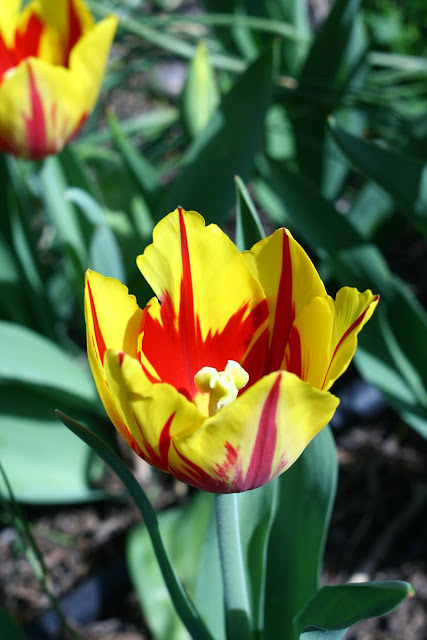
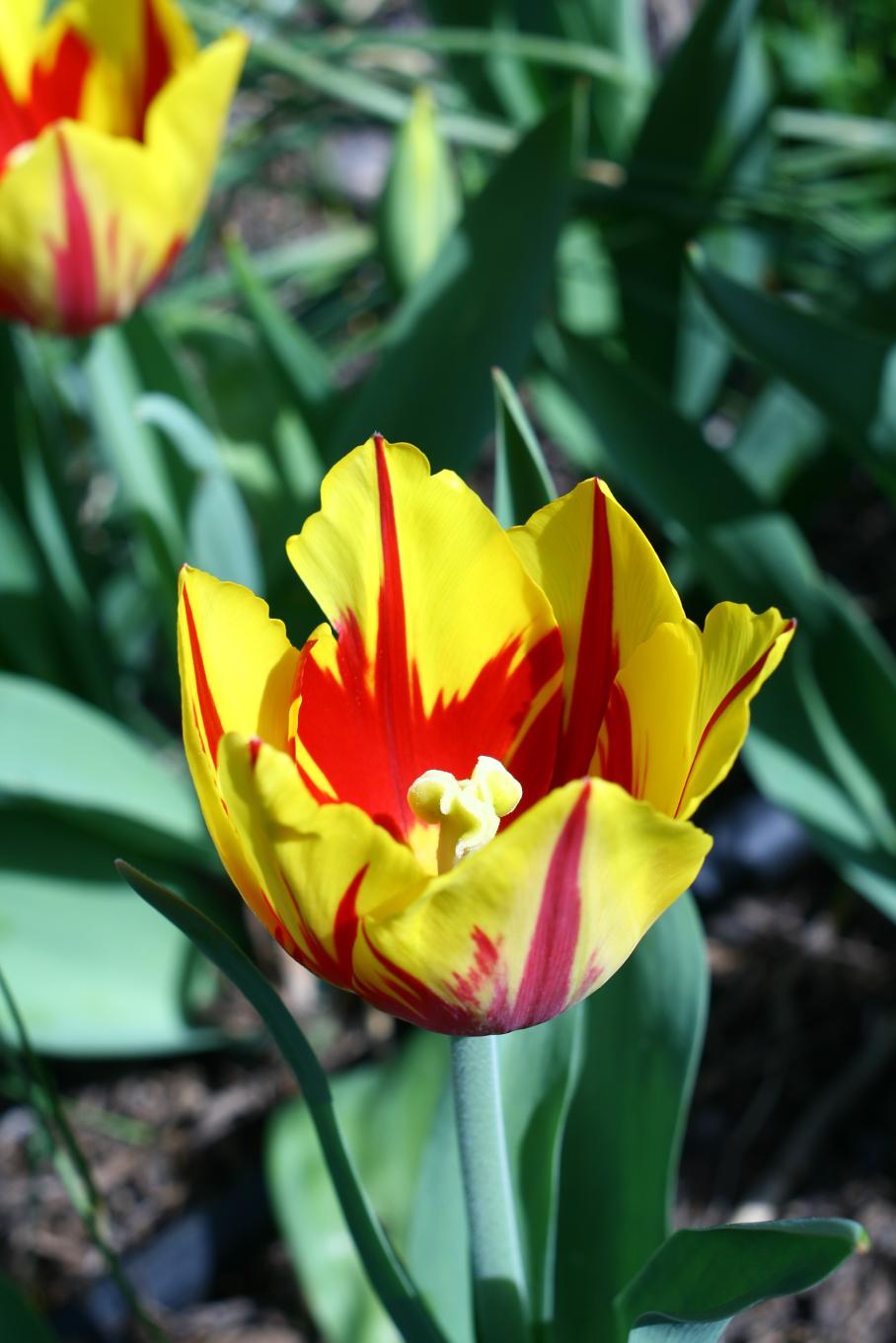
We went back to Cambridge that night, and spent Sunday morning with Ann and Alan, and walked round Clare College's garden. These pulsatilla and tulips caught my eye.



We've not seen them since around Christmas, so that was good: it was an lovely day, with a church service, buffet and ceilidh, and evening meal. I quite liked that arrangement of events. There were a wonderful array of cakes—well over a dozen—each a different variety (to account for taste!), but all white-iced with purple and silver decoration. They looked marvellous, and tasted similarly. The day went smoothly, and everyone seemed to have a good time.

We went back to Cambridge that night, and spent Sunday morning with Ann and Alan, and walked round Clare College's garden. These pulsatilla and tulips caught my eye.


Thursday, 7 April 2011
Just in Time Mowing
I took advantage of a lovely warm day, and got out into the garden by 3 yesterday to mow the lawn. Couple of hours later, the compost bin is full, the lawn is shorter, and I have itchy eyes from the clippings. A success, I suppose: I'm pleased that it only took a couple of hours, because it took about twice that for the first clip. More pleasing is the timing, as the weather over night turned for the worse, and it's grey and damp. We're busy this weekend, so I won't have time to do it then, so missing the opportunity last night would have meant leaving it quite a while...and then it wouldn't have been a two-hour job.
A little pottering was also accomplished: I repotted an ornamental and edible cherry (Prunus tormentosa) which had a cracked pot, and planted five comfrey plants which arrived in the post. They're the Bocking 14 variety, which is sterile (no seedlings) and 'less' invasive: the leaves can be rotted into water to make a pick me up, or added to compost to enrich it. Not certain where they'll go, long-term, but they can grow on in their pots for now.
I finally got round to personally testing the treacle soda bread recipe, which was very tasty, and recommended.
Lastly, you might notice the addition of an extra page, where I'm recording what's in the ground in the vegetable garden. Thus far, just potatoes, onions, and a small patch of beans and peas. The onions are showing some signs of growth, which is pleasing, but no potatoes have broken through yet.
A little pottering was also accomplished: I repotted an ornamental and edible cherry (Prunus tormentosa) which had a cracked pot, and planted five comfrey plants which arrived in the post. They're the Bocking 14 variety, which is sterile (no seedlings) and 'less' invasive: the leaves can be rotted into water to make a pick me up, or added to compost to enrich it. Not certain where they'll go, long-term, but they can grow on in their pots for now.
I finally got round to personally testing the treacle soda bread recipe, which was very tasty, and recommended.
Lastly, you might notice the addition of an extra page, where I'm recording what's in the ground in the vegetable garden. Thus far, just potatoes, onions, and a small patch of beans and peas. The onions are showing some signs of growth, which is pleasing, but no potatoes have broken through yet.
Sunday, 3 April 2011
Summer Bulbs
Another day pottering in between spring showers: a big effort to sort out the containers split between the kitchen patio and the lower patio (near the workshop) was required, as many are now out of season, or empty, and we needed to plant summer bulbs.
We isolated the empty containers (read 'dead') and put them to one side, and swapped the others around to get those in season, or coming into season, onto the patio outside the kitchen, and those that have gone over or are a way off being attractive back on the lower patio (the 'storage' patio). This meant moving the 100-odd strawberry runners that took out of sight (ready to go in the putative second strawberry bed), and bringing things like an astilbe, lilac and rose round to be seen.
The empty pots were crucially needed, though, for summer bulbs. We've planted 40 gladioli into some, with the same number again to go in in a couple of weeks; they'll either be put somewhere attractive when they bloom, or cut to bring inside. We also planted 25 single freesias, for the same purpose. I think they may be a little tricky to bring into bloom every year, but it'll be an interesting challenge.
We then dug out more plastic pots to continue the sowing extravaganza that is March/April. Fifteen new sowings, including pumpkins, courgettes, tomatoes, various salad leaves, coleus, clarkia, beetroot, beans, and chrysanthemums. We are rapidly running out of window-sill space (which annoys the cats, who like to watch the world go by)! The germinated seeds are doing quite well inside, and we'll probably start planting them out in a week or two.
We isolated the empty containers (read 'dead') and put them to one side, and swapped the others around to get those in season, or coming into season, onto the patio outside the kitchen, and those that have gone over or are a way off being attractive back on the lower patio (the 'storage' patio). This meant moving the 100-odd strawberry runners that took out of sight (ready to go in the putative second strawberry bed), and bringing things like an astilbe, lilac and rose round to be seen.
The empty pots were crucially needed, though, for summer bulbs. We've planted 40 gladioli into some, with the same number again to go in in a couple of weeks; they'll either be put somewhere attractive when they bloom, or cut to bring inside. We also planted 25 single freesias, for the same purpose. I think they may be a little tricky to bring into bloom every year, but it'll be an interesting challenge.
We then dug out more plastic pots to continue the sowing extravaganza that is March/April. Fifteen new sowings, including pumpkins, courgettes, tomatoes, various salad leaves, coleus, clarkia, beetroot, beans, and chrysanthemums. We are rapidly running out of window-sill space (which annoys the cats, who like to watch the world go by)! The germinated seeds are doing quite well inside, and we'll probably start planting them out in a week or two.
Saturday, 2 April 2011
Potatoes In
The seed potatoes we ordered at the end of January have been cheerfully chitting in the study since early March, and with the nice weather and suitable shoots on them all, it was time to plant them. We dug six-inch trenches in the big C-shaped vegetable bed, put the potatoes in, and covered them back over with an inch or so of soil. As the shoots begin to show, I'll continue covering them over, and then—when they're about six inches clear of ground level, I shall mound the soil up over them again, to keep the tubers from going green.
Potatoes are fairly frost-resistant: the shoots get a check if they're frosted, but recover. Nonetheless, I'll have to keep on top of covering them up as they grow, to protect them. The fleece cage isn't back on after the high winds last week, but once it is, that will obviously help.
We only put out six of the varieties, leaving the Orla and Vivaldi in the study to continue chitting: they're being kept for a second crop of new potatoes. The six that went in were:
We then dashed out before the shops closed, and picked up some miscellaneous hardware (nails, screws, and staples) that I'm running low on, and half a dozen new hanging baskets. The four we brought with us when we moved are slowly rotting and falling apart, and have natural fibre hanging ropes (which keep coming apart, testing my splicing skills). The new ones—while I'm sure they'll eventually decay—have a hidden metal frame, and metal chains, so I hope they'll be less laborious to maintain. They're also rather larger (14"), so will make more of an impact on this house's larger façade.
Potatoes are fairly frost-resistant: the shoots get a check if they're frosted, but recover. Nonetheless, I'll have to keep on top of covering them up as they grow, to protect them. The fleece cage isn't back on after the high winds last week, but once it is, that will obviously help.
We only put out six of the varieties, leaving the Orla and Vivaldi in the study to continue chitting: they're being kept for a second crop of new potatoes. The six that went in were:
- 'Rocket': a very early First Early, which also yields well.
- 'Lady Christl': a fast First Early, but can be left in the ground to crop as a heavier Second Early.
- 'Juliette': can be lifted as a Second Early, but may be left in the ground to bulk out further before cropping as an early Maincrop.
- 'Nicola': an early Maincrop. This replaced the Belle de Fontenay we'd ordered, as it ran out, sadly.
- 'Druid': a late, heavy-yielding Maincrop which stores well.
- 'Golden Wonder': a late, versatile Maincrop which improves on storage.
We then dashed out before the shops closed, and picked up some miscellaneous hardware (nails, screws, and staples) that I'm running low on, and half a dozen new hanging baskets. The four we brought with us when we moved are slowly rotting and falling apart, and have natural fibre hanging ropes (which keep coming apart, testing my splicing skills). The new ones—while I'm sure they'll eventually decay—have a hidden metal frame, and metal chains, so I hope they'll be less laborious to maintain. They're also rather larger (14"), so will make more of an impact on this house's larger façade.
Thursday, 31 March 2011
High Winds
There's a Met Office 'Yellow' warning of high winds for Yorkshire and the Humber, which explains this morning's observation... We've had overnight winds averaging 20mph (Beaufort 5) and gusting up to 50mph. This has, unfortunately, cause problems with the fleece cages, for which—evidently—we have not solved the fixing-the-fleece problem. I think reinforced eyelets along the edge, hooked onto nails in the beds' sides, will be the solution: so long as they don't tear out. A number of the stakes have also ripped/worn through the top, so there'll be some patching required. Never mind.
To compensate, though, I have photos!
These daffs, puschkinia scilloides var libanotica (Striped Squill) and Scilla siberica (Siberian Squill) are around the base of one of the trees on the back bank: the scilla are still coming into their full display.


And a scilla:

To compensate, though, I have photos!
These daffs, puschkinia scilloides var libanotica (Striped Squill) and Scilla siberica (Siberian Squill) are around the base of one of the trees on the back bank: the scilla are still coming into their full display.

A macro (well, semi-macro, technically) shot of one of the puschkinia, showing the striping on the back of the petals, which gives the species its common name.

And a scilla:

Monday, 28 March 2011
Spring Evenings
See, this is why I like the clocks going forward. Once we got home, it was still light enough to spend an hour in the garden before coming in to do the indoor things that always need doing.
The tulips that—in desparation, almost—went in the rectangular vegetable bed (qua nursery bed) are growing nicely, but as the space is needed for vegetables, and to allow us to move the pile of topsoil, we had to replant the tulips in pots. No, they probably won't benefit from being moved, but they were a freebie on a bigger order, and needs must. Never mind: we'll coddle them, and hopefully they'll survive, if not thrive this season.
We also moved five roses that had been unceremoniously dumped there, much longer ago: they went there in autumn 2009, in a hurriedly cut bed that we hoped would become a vegetable bed. Fortunately, it fitted in with the final plan, and the roses (excess from Liz's grandmother's garden when she moved), willow nursery log, and herbaceous perennials have been there since. The willow log was a section removed from Jenny's garden: it had collapsed sideways, and sent out a few roots, so when they took out the tree, we salvaged the log and 'planted' it. It's responded, as I hoped, by becoming analogous to a coppicing stool, and has sent out a couple of dozen withies, each now about a metre long and 5–10mm across. Who knows, I might suggest some wicker work. The roses are a mixed bag: I think they were all, originally, grafted ornamentals, but are now overcome with suckers, and we're thinking of them as dog-roses. The last two still seem likely to be ornamental, so we've moved these to the area cleared of cotoneaster. The dog-roses have gone along the bottom fence in the copse and behind the fruit-cages (where we're slowly establishing a mixed hedge).
In all that, I forgot to check how the onions were getting on. Perhaps tomorrow.
The tulips that—in desparation, almost—went in the rectangular vegetable bed (qua nursery bed) are growing nicely, but as the space is needed for vegetables, and to allow us to move the pile of topsoil, we had to replant the tulips in pots. No, they probably won't benefit from being moved, but they were a freebie on a bigger order, and needs must. Never mind: we'll coddle them, and hopefully they'll survive, if not thrive this season.
We also moved five roses that had been unceremoniously dumped there, much longer ago: they went there in autumn 2009, in a hurriedly cut bed that we hoped would become a vegetable bed. Fortunately, it fitted in with the final plan, and the roses (excess from Liz's grandmother's garden when she moved), willow nursery log, and herbaceous perennials have been there since. The willow log was a section removed from Jenny's garden: it had collapsed sideways, and sent out a few roots, so when they took out the tree, we salvaged the log and 'planted' it. It's responded, as I hoped, by becoming analogous to a coppicing stool, and has sent out a couple of dozen withies, each now about a metre long and 5–10mm across. Who knows, I might suggest some wicker work. The roses are a mixed bag: I think they were all, originally, grafted ornamentals, but are now overcome with suckers, and we're thinking of them as dog-roses. The last two still seem likely to be ornamental, so we've moved these to the area cleared of cotoneaster. The dog-roses have gone along the bottom fence in the copse and behind the fruit-cages (where we're slowly establishing a mixed hedge).
In all that, I forgot to check how the onions were getting on. Perhaps tomorrow.
Sunday, 27 March 2011
An Alphabetic Weekend
A is for Alliums
After the onion sets' arrival last week, we thought it was time to get them in the ground. The forecast's for quite a mild week, so—coupled with 'F' below—we thought it augured well. Anyway: 'assisted' by the in-laws' current respite-care foster children (see 'C'), we planted out the sets. I didn't count them as they went in, but I reckon (based on number per row averaged over the first three rows, and number of rows) there's around 480 of them. Which is quite pleasing, as I was expecting 100 per bag. A few had started to sprout (unsurprising, as the first of them arrived in February, when it was still too cold (here) to put them in), so they should get going quickly, I hope.
B is for Bunnies, Bicycle Bottom Brackets and British Summer Time
Bunnies, because the cats decided to bring a friend home for dinner. Said friend was a little traumatised, but intrinsically unhurt, so after distracting the boys, and scooping that bunny up, he was released back onto the hillside. Some nose-twitching later, he scarpered.
After coping with a clanking bike for a week or two, I decided it was about time to investigate and remediate, so I removed the bottom bracket bearing from my bike and discovered rather more movement than ideal. Now, I'm happy to subscribe to the WD-40/duct-tape principles of maintenance (If it moves, and it shouldn't: duct-tape it. If it doesn't move, and it should: WD-40 it.), but this wasn't a suitable opportunity. Thus, new bottom bracket fitted.
BST started on Saturday night: nothing to report (other than to lament the lost hour of sleep), but it is nice to have an extra hour of light in the evening for getting things done: it's still more-or-less light by the time we leave for work, which is fine.
C is for Children, Cages, and Compost*
The in-laws' current foster children (who are on a respite placement) are an energetic set aged 2, 5, and 7. Their assistance in onion planting was, shall we say, not optimized for efficiency, and basically consisted of one holding the bag of sets and passing them to me to plant, while the other (with Liz, de rigeur) brought cans of water to douse the rows. Meanwhile, the youngest would meticulously plant his own sets. In fairness, they were usually within a couple of inches of where they should be (with some prompting, but rather good), and 80% right-side-up.
I mentioned wood and fleece deliveries: the wood arrived safely on Saturday morning, and we spent the afternoon putting up the fleece supporting posts, and filling the last stretch of the C-bed (completed two weeks ago) with some of that huge pile of top-soil (the Compost). We managed to start putting up the horizontal wires, but ran out of light. Having finished constructing the cages on Sunday morning, and once we'd removed a few obnoxiously spiny berberis branches from nearby, we suspended the fleece. It now looks as though we have a slightly too short marque in the vegetable garden, which does rather spoil the aesthetic, but will help warm the beds and get everything off to a good start. The fleece will probably come down mid-May, and the cages will then be used to net those things that need it over the summer. The fleece might re-appear in the autumn, to extend the other end of the season: we'll see.
D is for Daffodils
Which are now looking marvellous. Interestingly, the bulbs we planted in 2009 are considerably behind the 2010 planting. I don't know the cause: either they're just earlier varieties (unlikely, perhaps), or their summer in Cornwall made them more energetic than those spending summer in Yorkshire, and they consequently started sooner. We'll see, next year, if the same thing happens...
We've also determined where the gaps in the spring-bulb planted bank are. The bluebells are starting to show, so a good succession is hoped for—however, I think we'll need another few hundred puschkinia, and we think 4–500 snowdrops would help bring the display forward. They, at least, should be easy to plant: if we get them 'in the green' in March next year, we'll be able to see where the daffs, puschkinia, scilla, and bluebells are, and plant between them.
E is for Electric propagator
Yes, this is a bit of a stretch. More seeds planted, including peas and beans direct in the bed, more leeks, aubergines, peppers, celeriac, tomatoes, ipomoea, gourds, and herbs. We are quite rapidly running out of window-sill space, which is, admittedly, helpfully advancing the argument for a greenhouse.
F is for Fleece
Well, see 'Constructing'. It's made a discernible difference, though: sitting inside it (as an experiment, I hasten to add, not because I was pretending to be a seedling) was warmer than outside, and still very bright.
*I've just noticed the unfortunate juxtaposition in this title. The children, I must highlight, were not caged...although they were rather curious about why we were messing around with bits of wood, wire, and fabric. I'm not entirely sure they're any the wiser, frankly.
After the onion sets' arrival last week, we thought it was time to get them in the ground. The forecast's for quite a mild week, so—coupled with 'F' below—we thought it augured well. Anyway: 'assisted' by the in-laws' current respite-care foster children (see 'C'), we planted out the sets. I didn't count them as they went in, but I reckon (based on number per row averaged over the first three rows, and number of rows) there's around 480 of them. Which is quite pleasing, as I was expecting 100 per bag. A few had started to sprout (unsurprising, as the first of them arrived in February, when it was still too cold (here) to put them in), so they should get going quickly, I hope.
B is for Bunnies, Bicycle Bottom Brackets and British Summer Time
Bunnies, because the cats decided to bring a friend home for dinner. Said friend was a little traumatised, but intrinsically unhurt, so after distracting the boys, and scooping that bunny up, he was released back onto the hillside. Some nose-twitching later, he scarpered.
After coping with a clanking bike for a week or two, I decided it was about time to investigate and remediate, so I removed the bottom bracket bearing from my bike and discovered rather more movement than ideal. Now, I'm happy to subscribe to the WD-40/duct-tape principles of maintenance (If it moves, and it shouldn't: duct-tape it. If it doesn't move, and it should: WD-40 it.), but this wasn't a suitable opportunity. Thus, new bottom bracket fitted.
BST started on Saturday night: nothing to report (other than to lament the lost hour of sleep), but it is nice to have an extra hour of light in the evening for getting things done: it's still more-or-less light by the time we leave for work, which is fine.
C is for Children, Cages, and Compost*
The in-laws' current foster children (who are on a respite placement) are an energetic set aged 2, 5, and 7. Their assistance in onion planting was, shall we say, not optimized for efficiency, and basically consisted of one holding the bag of sets and passing them to me to plant, while the other (with Liz, de rigeur) brought cans of water to douse the rows. Meanwhile, the youngest would meticulously plant his own sets. In fairness, they were usually within a couple of inches of where they should be (with some prompting, but rather good), and 80% right-side-up.
I mentioned wood and fleece deliveries: the wood arrived safely on Saturday morning, and we spent the afternoon putting up the fleece supporting posts, and filling the last stretch of the C-bed (completed two weeks ago) with some of that huge pile of top-soil (the Compost). We managed to start putting up the horizontal wires, but ran out of light. Having finished constructing the cages on Sunday morning, and once we'd removed a few obnoxiously spiny berberis branches from nearby, we suspended the fleece. It now looks as though we have a slightly too short marque in the vegetable garden, which does rather spoil the aesthetic, but will help warm the beds and get everything off to a good start. The fleece will probably come down mid-May, and the cages will then be used to net those things that need it over the summer. The fleece might re-appear in the autumn, to extend the other end of the season: we'll see.
D is for Daffodils
Which are now looking marvellous. Interestingly, the bulbs we planted in 2009 are considerably behind the 2010 planting. I don't know the cause: either they're just earlier varieties (unlikely, perhaps), or their summer in Cornwall made them more energetic than those spending summer in Yorkshire, and they consequently started sooner. We'll see, next year, if the same thing happens...
We've also determined where the gaps in the spring-bulb planted bank are. The bluebells are starting to show, so a good succession is hoped for—however, I think we'll need another few hundred puschkinia, and we think 4–500 snowdrops would help bring the display forward. They, at least, should be easy to plant: if we get them 'in the green' in March next year, we'll be able to see where the daffs, puschkinia, scilla, and bluebells are, and plant between them.
E is for Electric propagator
Yes, this is a bit of a stretch. More seeds planted, including peas and beans direct in the bed, more leeks, aubergines, peppers, celeriac, tomatoes, ipomoea, gourds, and herbs. We are quite rapidly running out of window-sill space, which is, admittedly, helpfully advancing the argument for a greenhouse.
F is for Fleece
Well, see 'Constructing'. It's made a discernible difference, though: sitting inside it (as an experiment, I hasten to add, not because I was pretending to be a seedling) was warmer than outside, and still very bright.
*I've just noticed the unfortunate juxtaposition in this title. The children, I must highlight, were not caged...although they were rather curious about why we were messing around with bits of wood, wire, and fabric. I'm not entirely sure they're any the wiser, frankly.
Thursday, 24 March 2011
Field of Moss
After starting the job at the weekend, I've now finished the lawn's first cut of the year. It's been a little mammoth, as it's been six months since its last cut, and it was a little rough. The weather has been favourable for moss, too, so there are large patches where the grass isn't doing so well, and where the moss has started to gain a foothold. Still, I don't propose doing much about it for now. A lot of the lawn will disappear over the coming years: once I know what will be left, I shall form a plan for weedkilling, feeding, and reseeding. For now, moss grows more slowly.
The clippings, though, have all but filled one bay of my composter. They'll collapse down quite quickly, no doubt, but it does highlight the fact that I need to complete at least one more bay—two won't keep me going for long. When it's this thick (and the mower's collector struggles), raking up takes as long as mowing.
We're still planning potato and onion planting at the weekend, along with moving topsoil and potentially erecting the fleece cage. The weather forecast has improved, so we might get two cool and dry days (it was suggesting rain on Sunday 'til today), which would be excellent. Speaking of weather, I've started to design a spreadsheet (or series thereof) to analyse the weather station's data. So; give me to the end of the month, and I'll have some (deeply fascinating, I'm sure) stats to share. A nerd's work is never done; nor a mower's, I fear.
The clippings, though, have all but filled one bay of my composter. They'll collapse down quite quickly, no doubt, but it does highlight the fact that I need to complete at least one more bay—two won't keep me going for long. When it's this thick (and the mower's collector struggles), raking up takes as long as mowing.
We're still planning potato and onion planting at the weekend, along with moving topsoil and potentially erecting the fleece cage. The weather forecast has improved, so we might get two cool and dry days (it was suggesting rain on Sunday 'til today), which would be excellent. Speaking of weather, I've started to design a spreadsheet (or series thereof) to analyse the weather station's data. So; give me to the end of the month, and I'll have some (deeply fascinating, I'm sure) stats to share. A nerd's work is never done; nor a mower's, I fear.
Wednesday, 23 March 2011
Pile of Soil
A day working from home, for two-fold reasons: first, it lets me get on with administrative stuff that it's best to concentrate on; second, it let me schedule a delivery of top-soil on a weekday, and oversee its delivery. Not, you understand, because I'm a control freak, and wouldn't trust anyone else to set out the tarpaulin and make sure it's dumped in the right place, oh no.
Anyway: administrative work was accomplished, and the ever-obliging Tommy Topsoil arrived with another 6m3 of topsoil. The last lot arrived at the end of April last year, though it took us until August to move it all. I'm hoping, this time, to finish topping up the vegetable beds over the weekend, and we might then plant out the potatoes and onions. The seed potatoes arrived at the start of the month, and have been happily chitting away since: they're mostly coming on well. The first onion sets arrived in February, but the heat-treated sets are only just arriving: 200 New Fen Globe arrived today, and the 100 Hyred are on their way.
Earlier this week, 240m2 of 30gsm horticultural fleece arrived, which is going to insulate the vegetable beds. I've also got an order for wood 1x1" stakes to construct a cage system to support the fleece, which should arrive on Saturday, along with timber to construct a second strawberry bed, and add horizontal framework to the raspberry cages (which will allow me to run horizontal wires along each bed to support the canes). With the fleece, I'm hoping the onions and potatoes will get off to a quick start: the soil's warming nicely, helped by a week of good weather.
The icing on the cake that is a day working from home was being able to nip out at lunch for a mooch: the puschkinia are out (and look lovely), and there's a blue tint to the bank from the squills. The daffodils are coming in to their own, with more and more out. So far, they're mostly yellows, but there are a few with orange corona and yellow perianth, and a few pale ones. Still, it's the cheerful yellow I love most, so that's fine. I'm very fond of puschkinia, too: they look white from a distance, but the blue striped racemes are elegant close-up.
The colour time-bombs are coming good.
Anyway: administrative work was accomplished, and the ever-obliging Tommy Topsoil arrived with another 6m3 of topsoil. The last lot arrived at the end of April last year, though it took us until August to move it all. I'm hoping, this time, to finish topping up the vegetable beds over the weekend, and we might then plant out the potatoes and onions. The seed potatoes arrived at the start of the month, and have been happily chitting away since: they're mostly coming on well. The first onion sets arrived in February, but the heat-treated sets are only just arriving: 200 New Fen Globe arrived today, and the 100 Hyred are on their way.
Earlier this week, 240m2 of 30gsm horticultural fleece arrived, which is going to insulate the vegetable beds. I've also got an order for wood 1x1" stakes to construct a cage system to support the fleece, which should arrive on Saturday, along with timber to construct a second strawberry bed, and add horizontal framework to the raspberry cages (which will allow me to run horizontal wires along each bed to support the canes). With the fleece, I'm hoping the onions and potatoes will get off to a quick start: the soil's warming nicely, helped by a week of good weather.
The icing on the cake that is a day working from home was being able to nip out at lunch for a mooch: the puschkinia are out (and look lovely), and there's a blue tint to the bank from the squills. The daffodils are coming in to their own, with more and more out. So far, they're mostly yellows, but there are a few with orange corona and yellow perianth, and a few pale ones. Still, it's the cheerful yellow I love most, so that's fine. I'm very fond of puschkinia, too: they look white from a distance, but the blue striped racemes are elegant close-up.
The colour time-bombs are coming good.
Sunday, 20 March 2011
Chipped
I was out on Saturday until late afternoon (a work 'away day'), leaving Liz to crack on with the huge pile of branches that needed chipping. I got home at about half-four to discover that she had put almost the entire, multi-cubic metre stack through the shredder, leaving us with a wire cage of mulch.
Impressed? I was.
While she finished off, I humbly assisted by bringing over the last branches, and cut the too-thick branches into logs or kindling ready to stack and dry. In finishing the chipping, she also uncovered three old pallets that I'd put down first, which is a bonus: building the compost bins last weekend nearly used up all my pallets in reclamation.
Today, I've started to mow the lawn for the first time this year. Not all of it; I got bored, frankly, and there were other things to do. I've done the entire middle lawn, though, which is important. The last mow of 2010 was only a half-done job, and then the weather turned and I never finished: I have a feeling it was 1st September. Anyway: the middle lawn thus hasn't been cut since August last year, and was badly in need. It's now been shorn, and looks better—though it may suffer a little in the short-term. The rest of the lawn is easier to do, and isn't as thick, so I hope to knock that off one evening this coming week.
So; these 'other things'. We've tidied the shed! By which I mean, emptied it, removed several bin-bags of rubbish, removed the things that belonged elsewhere (primarily the workshop and the garage), size-sorted the pots (more of those than I thought, and certainly not short of them), and 're-packed' the contents. With sufficient efficiency, I should say, to enable me to put the chipper, lawnmower, and garden vacuum in there—all of which were previously cluttering the workshop. This is much better, and everything's considerably better arranged.
We then pottered in the space assigned to the future greenhouse and shed. Measuring up, I think we have space for a 6' x 18' greenhouse (not a standard size, but common enough), and either a 6' x 15' shed, or an 8' x 10'. The current (rotting) shed is the latter size, but the site is a trapezium, so there are two options for filling it. I have an eye on possible sources for both, but we need to figure out the cost (especially of the foundation!), and make a plan. It may be that we get the shed this year (to remove the rotting eye-sore, which is impeding my view of the daffodils, which are starting to bloom (a few dozen are out), and preventing easy planning of the herb garden that will probably replace it), but leave the greenhouse 'til the spring sales of 2012.
Speaking of daffodils: enough are now out that Liz has been able to pick a few vases' worth. It looks as though this is a couple of weeks earlier than last year. It's also almost exactly a year since we ordered the wood for the raised beds, and I'm planning to order some more this week, to construct the fleece/netting cages for the vegetable beds and a second strawberry bed (an extended version of the rhubarb bed we planned but didn't build). Also this week, we'll receive another 6m3 of topsoil, to finish filling the vegetable beds, and hold in reserve for later things. The potatoes are chitting nicely, so things are coming together well.
Impressed? I was.
While she finished off, I humbly assisted by bringing over the last branches, and cut the too-thick branches into logs or kindling ready to stack and dry. In finishing the chipping, she also uncovered three old pallets that I'd put down first, which is a bonus: building the compost bins last weekend nearly used up all my pallets in reclamation.
Today, I've started to mow the lawn for the first time this year. Not all of it; I got bored, frankly, and there were other things to do. I've done the entire middle lawn, though, which is important. The last mow of 2010 was only a half-done job, and then the weather turned and I never finished: I have a feeling it was 1st September. Anyway: the middle lawn thus hasn't been cut since August last year, and was badly in need. It's now been shorn, and looks better—though it may suffer a little in the short-term. The rest of the lawn is easier to do, and isn't as thick, so I hope to knock that off one evening this coming week.
So; these 'other things'. We've tidied the shed! By which I mean, emptied it, removed several bin-bags of rubbish, removed the things that belonged elsewhere (primarily the workshop and the garage), size-sorted the pots (more of those than I thought, and certainly not short of them), and 're-packed' the contents. With sufficient efficiency, I should say, to enable me to put the chipper, lawnmower, and garden vacuum in there—all of which were previously cluttering the workshop. This is much better, and everything's considerably better arranged.
We then pottered in the space assigned to the future greenhouse and shed. Measuring up, I think we have space for a 6' x 18' greenhouse (not a standard size, but common enough), and either a 6' x 15' shed, or an 8' x 10'. The current (rotting) shed is the latter size, but the site is a trapezium, so there are two options for filling it. I have an eye on possible sources for both, but we need to figure out the cost (especially of the foundation!), and make a plan. It may be that we get the shed this year (to remove the rotting eye-sore, which is impeding my view of the daffodils, which are starting to bloom (a few dozen are out), and preventing easy planning of the herb garden that will probably replace it), but leave the greenhouse 'til the spring sales of 2012.
Speaking of daffodils: enough are now out that Liz has been able to pick a few vases' worth. It looks as though this is a couple of weeks earlier than last year. It's also almost exactly a year since we ordered the wood for the raised beds, and I'm planning to order some more this week, to construct the fleece/netting cages for the vegetable beds and a second strawberry bed (an extended version of the rhubarb bed we planned but didn't build). Also this week, we'll receive another 6m3 of topsoil, to finish filling the vegetable beds, and hold in reserve for later things. The potatoes are chitting nicely, so things are coming together well.
Tuesday, 15 March 2011
Synchronised
On my way home on Friday, I noticed how many of the crocuses on my route were going over. I was pleasantly surprised to see, yesterday, that although the crocuses have now all but vanished, the daffodils amongst them have started to come out over the same weekend. Not all, but enough for a splash of colour.
Perfect timing.
Perfect timing.
Sunday, 13 March 2011
Wood work
A fairly productive weekend, which is gratifying. On Saturday, I dismantled a few old pallets, and rebuilt them (with an old 6' fence panel) into most of a two-bay compost bin. Not quite finished, but back and sides, and the mechanism at the front for sliding in slats—but no slats prepared. I also finished the top wall of the C-shaped vegetable bed, which I hadn't managed last September before the weather turned. That's quite important: we've got another 6 cubic metres of soil arriving next Friday (to finish the beds, and ready for the next project), and that needs somewhere to go. While I was doing this, Liz got started on the huge pile of prunings and cotoneaster that we've accumulated over the past months.
Then, today, I've started moving the old compost bin's contents into a new bay; I haven't got far, though, as I was also helping with the chipping by disentangling branches and bringing them to the chipper (the extension cable won't quite reach the heap, annoyingly). The wire-mesh 'chippings bin' is now a bit more than twice as full, and the heap is reduced—somewhat. I also managed to (finally) put up the weather station's sensor array, which I've mounted on a six foot post that's been built into a corner of the raised beds. I modified it slightly, to allow the temperature/humidity/transmitter array to be lower than the wind/rain sensors, as I'm more interested in the temperature near the plants. I need to configure the data capturing on the base station, but it will soon start collecting analysable data.
We're starting to put some thought to a possible greenhouse (and shed): I think the available plot is going to be about 3.6m by 6.1m (or 12' by 20'), which opens up the possibility of an 8x20 greenhouse, and a long narrow shed alongside ('behind'). However, that's not going to come cheaply!
The bulbs are starting to come out: there's about three daffs out, and a handful of each of the scilla and puschkinia. I think they'll be properly out and glorious by next weekend, with a little luck.
Then, today, I've started moving the old compost bin's contents into a new bay; I haven't got far, though, as I was also helping with the chipping by disentangling branches and bringing them to the chipper (the extension cable won't quite reach the heap, annoyingly). The wire-mesh 'chippings bin' is now a bit more than twice as full, and the heap is reduced—somewhat. I also managed to (finally) put up the weather station's sensor array, which I've mounted on a six foot post that's been built into a corner of the raised beds. I modified it slightly, to allow the temperature/humidity/transmitter array to be lower than the wind/rain sensors, as I'm more interested in the temperature near the plants. I need to configure the data capturing on the base station, but it will soon start collecting analysable data.
We're starting to put some thought to a possible greenhouse (and shed): I think the available plot is going to be about 3.6m by 6.1m (or 12' by 20'), which opens up the possibility of an 8x20 greenhouse, and a long narrow shed alongside ('behind'). However, that's not going to come cheaply!
The bulbs are starting to come out: there's about three daffs out, and a handful of each of the scilla and puschkinia. I think they'll be properly out and glorious by next weekend, with a little luck.
Sunday, 6 March 2011
Potatoes and Cat-Doors
On Tuesday, a new cat-flap arrived. We've had some trouble with a local tom (we think) breaking in, terrorising the cats, and stealing food. He, or our two in response, have also been doing some marking, which is fun for no-one. We've looked at cat-flaps which use a magnetic collar to identify the cats and allow the right ones in, but—given that Domino seems to loose collars every six months or so—this didn't seem optimal. However, we have found one that uses the RFID microchips that the cats have implanted to identify them. Once 'learnt', it detects the chips when the cats approach the flap, and allows only our two in. Tail-gating could be a problem, I suppose, but it should reduce the problem. Anyway: the new flap is now installed (very straightforwardly, I should add).
A myriad of tidying and sorting tasks have also been completed, and we also made five litres of carrot soup (from a sack of horse-carrots that were going a bit...wild). Finally, we've put the seed potatoes out into egg cartons to chit, and sown some more seeds (Early Nantes carrots, scarlet kale, peas, Brussels sprouts, celeriac, and ipomoea).
Sadly, we have to go back to work tomorrow, but we managed to finish manuring the beds, by bringing up another 14-odd barrows to finish the second raspberry bed, the 'Q' vegetable bed, and the long vegetable bed. The 'C' bed is going to be roots, so no manure for it. In 2009, when we brought manure up, we had to take a long route round, but this time I removed a couple of fence-planks, so we could bring the barrow to the fence near the kitchen garden, lift it over, and carry on. It's reduced the journey to almost a third, which is vastly better. I've now re-attached the fence planks with screws, so it'll be even easier next time.
A myriad of tidying and sorting tasks have also been completed, and we also made five litres of carrot soup (from a sack of horse-carrots that were going a bit...wild). Finally, we've put the seed potatoes out into egg cartons to chit, and sown some more seeds (Early Nantes carrots, scarlet kale, peas, Brussels sprouts, celeriac, and ipomoea).
Sadly, we have to go back to work tomorrow, but we managed to finish manuring the beds, by bringing up another 14-odd barrows to finish the second raspberry bed, the 'Q' vegetable bed, and the long vegetable bed. The 'C' bed is going to be roots, so no manure for it. In 2009, when we brought manure up, we had to take a long route round, but this time I removed a couple of fence-planks, so we could bring the barrow to the fence near the kitchen garden, lift it over, and carry on. It's reduced the journey to almost a third, which is vastly better. I've now re-attached the fence planks with screws, so it'll be even easier next time.
Saturday, 5 March 2011
Manuring the Beds
We've managed a few hours in the garden, at last. Our neighbour's horse's copious 'production' is piled at the bottom of the field beneath the house, so we've trekked back and forth with the wheelbarrow, collecting manure for the fruit beds. A dozen barrows later (oh, my aching back), the gooseberry/currant/blueberry beds are done, and one raspberry bed. More of this tomorrow morning...
We picked up 80 new gladioli from the garden centre yesterday morning: the 'frost free' location we'd stored the bulbs in after lifting was not, in fact, free from frost over the bitter cold of December (about -10°C, some nights), and the bulbs are almost certainly dead. We also got some P and K fertilizer, and admired the spring hanging baskets: we need to replace our baskets, and plant them up, but their new-season baskets haven't arrived yet. Couple of weeks, hopefully.
We picked up 80 new gladioli from the garden centre yesterday morning: the 'frost free' location we'd stored the bulbs in after lifting was not, in fact, free from frost over the bitter cold of December (about -10°C, some nights), and the bulbs are almost certainly dead. We also got some P and K fertilizer, and admired the spring hanging baskets: we need to replace our baskets, and plant them up, but their new-season baskets haven't arrived yet. Couple of weeks, hopefully.
Thursday, 3 March 2011
Almost Finished
We're very nearly there...the walls are all done, the skirting board has had its second coat, and the windowsills have all been done. The floor needs cleaning, and there are a few bits and pieces, but...
Wednesday, 2 March 2011
Overcome by the Fumes
The shelves in the pantry, and on the wall, are now a lovely green (matching the cupboard doors). However, working in the confined space of the pantry with the fumes has rather taken a toll on Liz. Fresh air worked wonders, though. We're making good progress, and have turned the walls in the utility room 'Timeless', too. I've painted the spice rack, which will go back on the wall, and the plinths, green, and touched up the oak beams.
Subscribe to:
Posts (Atom)


